The emotional roller coaster of family history research

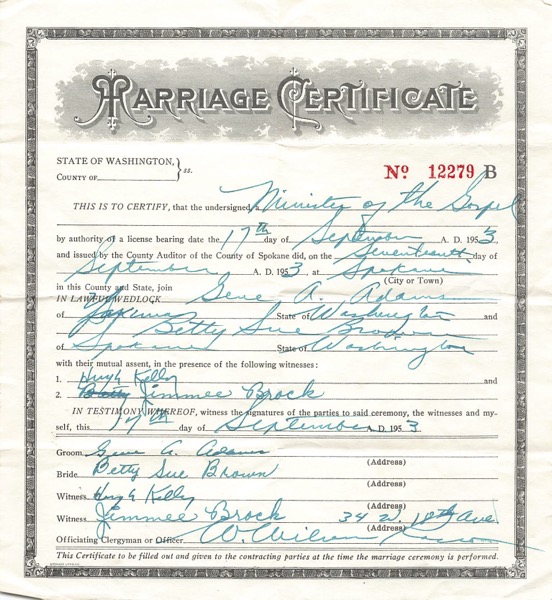
Last week I was so excited because I had (finally) followed up on a request I’d made for an ancestor’s death certificate. I anxiously awaited the arrival of the document, thinking about all the info I would glean from it.

It arrived yesterday and, indeed, there was plenty of information on it. Unfortunately, the information pointed to the fact that this George Washington Adams wasn’t my George Washington Adams, my grandfather’s grandfather. His parents’ names aren’t familiar to me so I  doubt that I’m even related to this guy.

What a disappointment. But I’ll keep looking to try to locate more information on my great great grandfather. I think the large amount of time that elapsed since I first found the index that made me think I could get my hands on his death certificate makes the disappointment event greater.

I’ll redouble my efforts (try re-searching databases I’ve searched before, perhaps) and report here if I find what I’m looking for.

Research sometimes means re-search

At Ancestry Day last month, a thought occurred to me that has really stuck. While learning about various ways to search Ancestry.com and how their databases are constantly being updated, I realized that searching again for information (i.e. re-searching) is critical. I can’t assume that since I didn’t find information when searching Ancestry (or any other database) for an ancestor I never will.

I guess this really points to the necessity and usefulness of a research log. I have to admit that since blogging about creating a research log, my use has been sporadic. I guess I should redouble my efforts.

So you might want to take a look at your brick walls and try searching again the databases that came up short before. At the rate new information is being indexed and posted, you might be in for a pleasant surprise!

Genealogy = connections

From left: Me, Penny, Sue, Mary (seated)

From left: me, Penny, Sue, Mary (seated)

Thanks to my family history research (and this blog, really), I had an extraordinary day this past Friday, meeting my mother’s cousins and aunt. My mother was born in Missouri but her family moved to Spokane, Washington, in 1936 (looking for a better climate for my grandfather, who was recovering from tuberculosis). They left behind my grandfather’s parents and siblings, a close-knit family.

As a result, I didn’t grow up knowing this branch of the family and we sort of disappeared off the family radar. But that changed when my mother’s cousin, Jerry Brown, found this blog and introduced me to the Brown cousins, a wonderfully welcoming group. So when I saw there was a genealogy conference in western Missouri, I registered and arranged to come in a day early and meet my family.

It was an incredible day. These people are hilarious and fun and we laughed and laughed and laughed. It started with lunch in Nevada, Missouri, with cousin Penny. After that, we met cousin Sue at the old-folks’ home where Penny’s mother, Mary, lives. Mary is the sole surviving sibling of my grandfather, Crawford Brown. (Crawford died in 1996, two weeks shy of his 90th birthday.) She is 99 years old and has a twinkle in her eye and is quick to laugh. That’s us in the picture up top.

Then we went to Milo, Missouri, where my great grandparents (Crawford’s parents), who are Penny and Sue’s grandparents, had lived. I saw the site of their in-town house, where they moved from the farm in 1959, when they were in their 70s. And we went to Milo cemetery, where they are buried. We also saw the site of their farm (and I heard many hilarious stories about Sue’s antics at the farm when she was little).

The graves of my great grandparents, A.J. and Rhoda Brown

The graves of my great grandparents, A.J. and Rhoda Brown

Then these lovely women took me on a quest to find the cemetery where my great grandfather Jeffries (my grandmother Sue’s father and father-in-law to Crawford) was buried, along with his parents and grandparents. Mind you, these Jeffries are no relation to Penny and Sue, but they were up for helping me find the cemetery. It wasn’t easy. We had some directions from an old book, but they didn’t turn out to be entirely accurate. To make matters more complicated, there are two cemeteries within a few miles with homophonic names (Meyer’s and Myer’s), so asking directions wasn’t terribly fruitful. But then I got my husband, Barry, on the case from home and Google maps saved the day. Once there, Sue and Penny helped me find the actual graves. Here’s the grave marker for my great grandfather’s grandparents.

The grave marker for my 3rd great grandparents, R.A. and Harriett Jeffries

The grave marker for my 3rd great grandparents, R.A. and Harriett Jeffries

Luckily the day was beautiful, sunny and in the upper 70s or low 80s. It wouldn’t have seen like such a fun adventure the next day, when it was cold and windy.

After our grave-hopping (we went to both Meyer’s and Myer’s, as well as Milo cemeteries), we went by the site of the original homestead near Rockville, Missouri, that my great grandparents established when they moved to Missouri from Nebraska in about 1914. And after that we met more cousins at a Mexican restaurant in Nevada for dinner, as well as Sue’s 90-year-old father (widower of Crawford’s sister, Nancy). A family reunion date was selected for 2014. I am eager to attend!

By the time I headed up to my hotel in Blue Springs, Missouri, I was exhausted. But so tickled to have had such a wonderful day.

When I started doing family history research, it was all about a solitary detective hunt with feelings of triumph when vital records were obtained. What I didn’t realize it would be about was connecting with family, sharing stories and memories, and uncovering life-enhancing relationships.

I am so grateful for the time spent with this new-found family. And I am so grateful for my interest in genealogy!

Making time for family history research

I love doing family history research. I really do. I’m also trying to figure out ways to integrate it into my organizing business, so technically it’s work. So why haven’t I done it in more than a week?

I can make excuses for why I haven’t made time to do any research. A week ago I returned from a week-long trip and I jumped right back in to full client load. My desk is a mess. (Embarrassing, but true.) But here’s the thing: since I’ve been home I’ve managed to catch up on most of the TV shows I recorded in my absence. I finished reading a book. I watched a couple of college basketball games.

It really does come down to priorities. (Priority management is a more accurate phrase than time management.)

As I contemplated the fact that I frequently close up shop and leave my desk for the day before I do any research, I realized a few things:

  • The messy desk really does get in the way. (Note to self: Clear it off every night like you used to!)
  • The time I thought I’d try to do it every day, 5 pm, isn’t conducive. Now that it’s winter, it’s dark at that time. I like a lot of light when I’m squinting at old handwriting.
  • If I’m running late trying to get the rest of my work done, I continue working past 5 pm and research is sacrificed.
  • I need to make it very, very easy to start doing the research. One way I might do that is to outline for myself at the end of each research session what I want to research at the start of the next one. Then it’ll be as simple as grabbing a file from the cart stored in a closet a few feet away, rather than rolling out the whole cart. And it gives me immediate focus.
  • I need to examine my priorities for my time and see where this research fits in. Is it more important than keeping up with social media or whittling my inbox down to zero? If so, I should do it before I do those daily tasks.
  • It’s important to recognize that I don’t need hours at a time to do research. As little as 30 minutes can glean some great results.

The process of writing this blog post has given me new resolve. I have a lighter day tomorrow and I’m going to make sure I do some research, earlier in the day. And I’ll make a note at the end of the session about how I want to start the next session.

I think I’ll take a few minutes to clear off my desk right now.