• BLOG
  • ABOUT
    • Privacy Policy

Organize Your Family History

Stay focused and happy while exploring your roots

Getting rid of the stubborn pile on your desk

December 20, 2024 By Janine Adams 6 Comments

Banishing the stubborn pileBack in 2015, I wrote this post about finally doing something about the genealogy-related pile on my desk. As I read it in December 2024, I thought it might be a helpful reminder that we can take action on the stacks of genealogy papers that tend to become of the landscape.

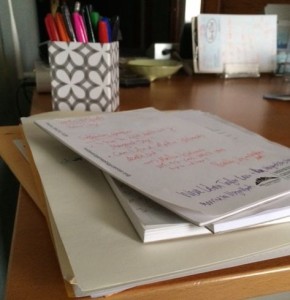
For the past few months, I’ve had this one pile on the corner of my desk that contains primarily genealogy items. When I’m hurriedly putting away the stuff cluttering my desktop, I just keep straightening that pile and leaving it there. It’s almost become a feature of the landscape of my desk. Somehow I’ve adjusted my thinking so that I have been considering my desktop clear even with that pile sitting there.

I think one of the reasons that I wasn’t dealing with it was a perception that it would take some time to really process the information in it. I was afraid that if I rushed it, I might lose valuable clues the pile might contain for my genealogy research. And I simply wasn’t taking the time to do it. (Work has been very busy lately.)

I know if I take some focused time and go through that pile, I will further my research and I won’t have an unsightly pile on my desk. But it hit me this morning that if I start but don’t finish, I’m still better off than not starting at all. So I took a photo of the pile, and wrote all the text above this line. Then I set my timer for 15 minutes and started going through the pile.

Here are some of the things I found in the pile:

  • Notes from my research trip to Kentucky and Alabama. I added tasks from those notes to my Genealogy To-Do List for the appropriate surname. Then I filed the notes in my paper files.
  • A packet of information I’d sent for from the the State of Alabama Archives pertaining to my great great grandfather, Laban Taylor Rasco. I put a sticky note saying “Analyze/process” on the packet and added that task to my Rasco To-Do List. Then I filed the packet in that couple’s file.
  • Notes from my notebook that I took on the research trip. One page had notes on Adamses on one side and notes on Rascoes on the other. I scanned the Rasco side, printed it and put in in my Rasco file for later reference. I filed the original sheet in the appropriate Adams file.
  • Notes written on several pages of two notepads I keep on my desk. I tore off the notes, logged any tasks on my To-Do list and filed or tossed the notes. Then I put the notepads where they belong.
  • A random list of how common my family surnames are. Some time ago, I found myself on a website (which I didn’t source) where you can enter a surname and see how common it is. I typed the data into Evernote so I can find it later if I ever remember it.
  • A small sticky note with a list of death certificates I’d found recently that needed to be added to my Reunion software. I checked each name to see which certificates had been entered already.  Two out of five still needed to be added and I noted that on my to-do list. I threw away the sticky note.
  • Some brainstorming notes about this blog. I filed them and made a note on my business task list to review them.

When the 15-minute timer went off I had just a few more pieces of paper to deal with. So I went ahead and finished, then did the filing.

Eliminating that pile took no more than thirty minutes. This is a pile I’d been looking at for several months. It had been mildly stressing me out, because I didn’t know its contents and it was in the way.

Now I feel in control of my research, I have clear next steps and I feel more eager to work on it. Plus I have a clear desk to enjoy. That’s the best 30 minutes I’ve spent in awhile!

What could 30 minutes of pile busting do for you?
Filed Under: Challenges, Organizing Tagged With: organizing aids, paper files

Should you hang on to paper documents after scanning them?

December 7, 2023 By Janine Adams 4 Comments

Very little paper comes into my genealogy life since do almost all my research online. But in 2022 I cleaned out my parents’ home (they have both passed away) as well as my aunt’s (she’s in a nursing home) so I have some paper to think about. I wrote about this last year and in reviewing that post, I thought it valuable enough to run again. My feelings on the matter have not changed in the intervening year and a half!

I do most of my research online, so this hasn’t come up a lot. But this week I’m going through documents that had lived in my parents’ home and my aunt’s home and some of them are original vital records. I did my first group of ten a couple of days ago and scanned and processed them. And then I had to decide what to do with the originals.

This morning I went through the little stack one by one and followed my gut about those I wanted to file into the paper files I have left over from before I processed everything digitally and those I would feel comfortable discarding.

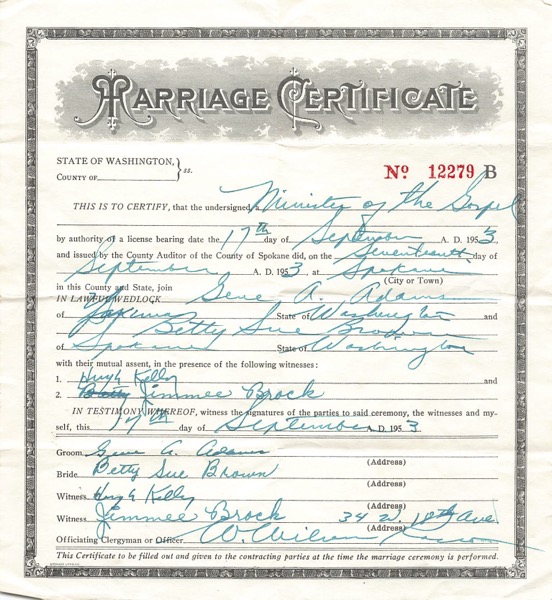
In truth, I could discard any of them, since I’ve captured the images. But my gut tells me to hang on to those documents that have original writing or signatures. An example is my parents’ marriage certificate, shown above. They were married by father’s uncle and I think he filled out the form. I don’t have a good, logical reason for this decision. It just feels right because these documents feel special. I have the space in my file cart and the files are already created, so it will be a simple matter to file them. If I have to create a new file folder label and put it on a folder to file something, I might feel like more trouble than it’s worth.

This is a matter of personal preference and I understand that my preferences might change. (And you may have a completely different preference.) If I end up with a lot more and it feels too laborious, I may revisit this criterion!

Filed Under: Challenges, Organizing, Reflections Tagged With: Adams, paper files, vital records

Striving for “organized enough”

August 1, 2023 By Janine Adams 2 Comments

Ten years ago this month, I wrote a post called Are you organized enough?. Today, I present an updated version of that post. In my  opinion, striving for organized enough is far superior to striving for perfectly organized. It’s easier and it’s more sustainable!

A lot of people (including me) strive to be organized, especially when it comes to their genealogy. There are over 43,000 members of the Facebook group, The Organized Genealogist! It’s obvious that many people are looking for ways to get their genealogy research organized.

That begs the question: What does being organized really mean?

I think the answer varies by the individual, but generally speaking, as a professional organizer, I believe that being organized means that you’re able to put your hands on what you want, when you want it (well, within a minute or two). I always discourage people from striving to be “perfectly organized” (because that’s not really possible) and instead go for “organized enough.”

So how do you become organized enough? When it comes to family history research, the path to being organized starts with picking out a system that will work for you. There’s no one right way to organize your genealogy records. Pick what you think will work for you and try to keep it simple.

The next step is to implement your system going forward.  Start immediately, with the next document you find. Don’t wait until you get through your backlog to start filing your incoming documents! The third step is to  deal with your backlog. That is, implement your system using the papers or files you already have.

The final, very important, step is to maintain your system regularly. You don’t want to wait for a backlog to build back up before filing again. Instead, file as you go along. When you acquire a new document  (be it paper or electronic) process and file it right away.

For me, the big difference in how I organize my genealogy files between now and when I first started getting interested in the hobby about two decades ago is that I no longer use paper files. All my documents are digital. I download, rather than print. And if something does come to me in printed form, I scan it. (This post, My process for downloaded documents, details my file-naming protocol and folder structure. They allow me to easily find any document on my hard drive.) I use Reunion software to keep track of my family tree and my sources. That gives me great peace of mind. (And, yes, I back everything up both on an external hard drive and in the cloud.)

The best part? My genealogy research doesn’t impinge on my physical space. The few paper files I’ve retained are in a rolling file cart that I tuck into a closet in my office. And my digital files reside tidily on my hard drive and in the cloud.

I’m not perfectly organized, not by a long shot. But I can find virtually everything I’m looking for quickly, so that makes me organized enough. And that also makes me happy.

If you’re interested in a deep dive on how I organize my own genealogy research, check out my Orderly Roots guide, How I Do It: A Professional Organizer’s Genealogy Workflow.

Filed Under: Organizing, Reflections Tagged With: electronic files, organized enough, paper files, record keeping

How do I start going digital?

November 29, 2022 By Janine Adams Leave a Comment

A year ago, I posted this article under the name Getting Started Going Digital. I think it’s an important topic, so I decided to run it again today. If you find this topic engaging, I encourage you to click on the link for the original article and look at the comments–reader Marian added interesting insights on approaching an overwhelming pile of papers.

If you’ve been pondering transitioning to digital organization of your genealogy records, you may be stymied about how to get started. It can feel overwhelming and perfectionism might be paralyzing you.

If you’ve been reading this blog for awhile, you know that I’m almost completely paperless in my genealogy research. I started out printing and filing everything but transitioned over a few years to digital. I didn’t make a decision to go paperless on a certain date. Rather, once I had a trustworthy digital folder structure and file-naming protocol in place, I didn’t feel like I needed to print anything out. I’m lucky, in a way. I came to this after just a couple of years of serious research. So I didn’t have a huge backlog to contend with.

I get a good number of questions from folks who have been researching for years and have a whole of lot paper to show for it. They want to go digital but don’t know where to start digitizing their research. If that’s something you think about, here’s a post designed to help you get started.

Here’s what I recommend as the first steps to organizing your genealogy research digitally.

  1. Create a folder structure and a file-naming protocol. This is critical so you easily find your documents. I describe my folder structure and file-naming protocol in step six of this blog post.
  2. From this point forward, stop printing and start downloading documents you find online, using your new folder structure and file-naming protocol. If you start now, you’ll familiarize yourself with your the new file system and you won’t add to your backlog of documents to be scanned and filed.
  3. Start scanning, renaming and filing your paper documents. What I did was go through my paper file folders, which were organized by couple, one by one, evaluating each piece of paper and scanning documents any that I didn’t already have in electronic form. I blogged about it in a post called Marrying my electronic and paper files. This may sound tedious, but I urge you to think about this as an opportunity to check your research. Looking at each paper, you may come across evidence that you overlooked when you first filed those papers. Here’s the good news: you don’t have to take a vacation to get it done. You can do it little by little, person by person or couple by couple (depending on how your paper documents are organized).
  4. Recycle or shred paper after you scan it. I see no reason to hang onto the paper files you have scanned, unless they have some historical value. For example, after I carefully scanned it, I kept the epic handwritten letter my grandfather wrote my grandmother before they married.
  5. If you find yourself pulling a paper document out of your files to help you in your current research, go ahead and scan and file it electronically. Then toss the paper.
  6. It should go without saying, but I’ll say it anyway. If you’re organizing your genealogy research digitally it’s imperative that you have a routine in place for backing up your hard drive. (Look no further than my recent experience of my backup saving my bacon when my computer died without warning.) It’s a good idea to have more than one back up.

This process reminds me of that age-old question: “How do you eat an elephant?” One bite at a time. Once you get your folder structure and file-naming protocol set up, you just take it paper by paper. Acknowledge that it will take awhile. Recognize the value of going through your old papers. And keep your eye on the prize: An easily accessible, readable and sharable archive of your genealogy records.

For detailed information on the digital organizing system I created for my research, check out my 2021 Orderly Roots Guide, How I Do It: A Professional Organizer’s Genealogy Workflow. The downloadable pdf is 37 pages and available for $19.99.

Photo by Tom Woodward via Flickr. Used under Creative Commons License.


Filed Under: Challenges, Genealogy tips, Organizing, Technology Tagged With: electronic files, organizing aids, paper files, record keeping, technology

  • Page 1
  • Page 2
  • Page 3
  • Interim pages omitted …
  • Page 6
  • Go to Next Page »

about me

I'm Janine Adams, a professional organizer and a genealogy enthusiast. I love doing family history research, but I find it's very easy for me to get overwhelmed and not know where to turn next. So I'm working hard to stay organized and feel in control as I grow my family tree.

In this blog, I share my discoveries and explorations, along with my organizing challenges (and solutions). I hope by sharing what I learn along the way I'll be able to help you stay focused and have fun while you do your research, too.

tags

30 x 30 Adams amy johnson crow anniversary Brown cemetery census Civil War conferences connections dna electronic files Evernote excitement Family Curator family photos genealogy tools getting started goals How They Do It Igleheart Jeffries keepsakes learning opportunities maps newspapers NGS organizing aids overwhelm paper files planning quick tips rasco record keeping research research log research trip resources RootsTech social history source documentation Stacy Julian technology time management vital records

join the facebook community!

join the facebook community!

My organizing business

Learn more about my organizing business, Peace of Mind Organizing®.

Subscribe by RSS

  • RSS - Posts
  • RSS - Comments

© 2026 Janine Adams

Loading Comments...