• BLOG
  • ABOUT
    • Privacy Policy

Organize Your Family History

Stay focused and happy while exploring your roots

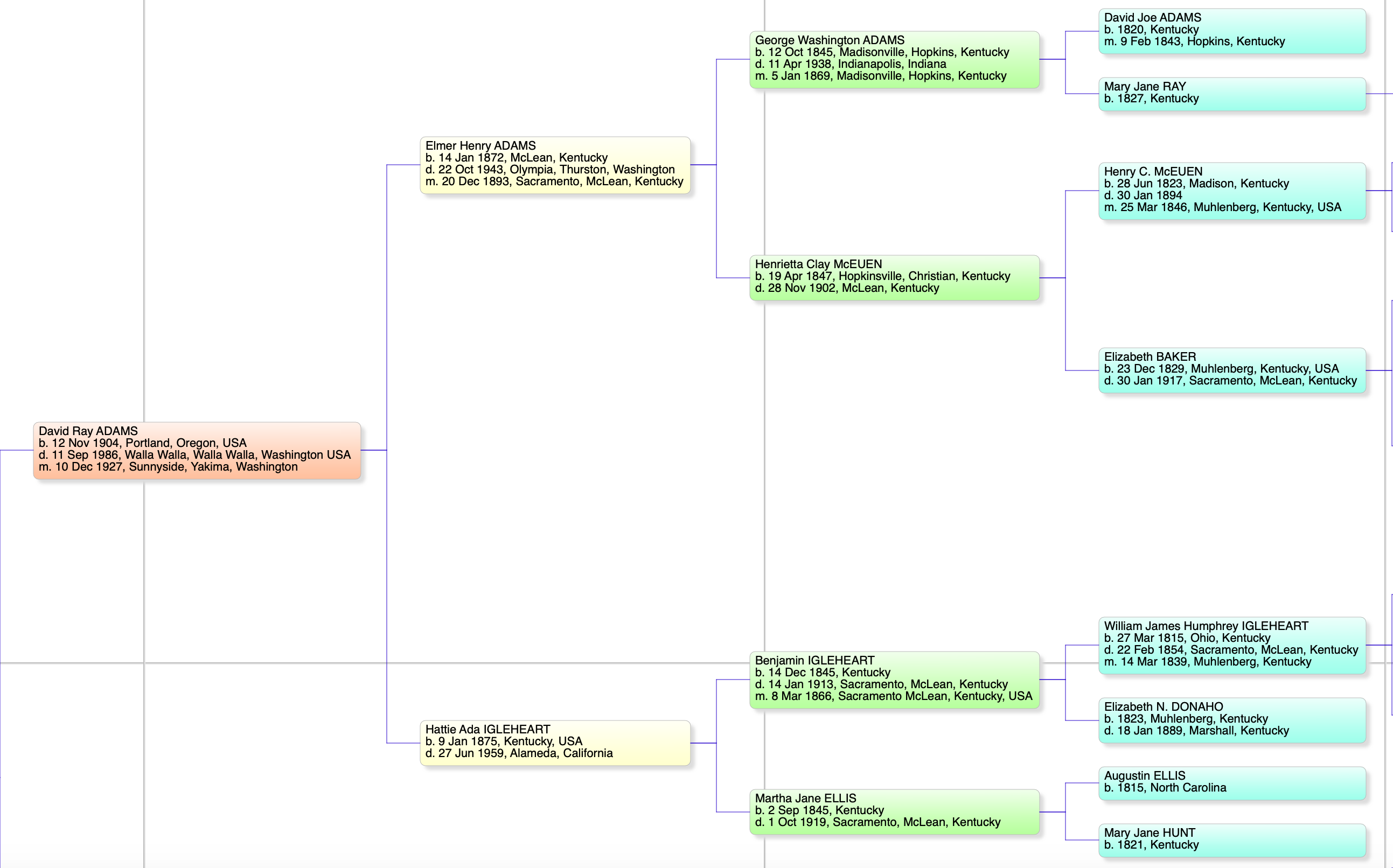
I trust my tree. Do you?

May 9, 2020 By Janine Adams 10 Comments

When I first dipped my toe into genealogy research around 20 years ago, I went online and found Family Search and Ancestry. I subscribed to Ancestry, printed out some five-generation pedigree charts and started writing down what I found, by hand. I collected names and dates and quickly went back many generations. I still remember what a thrill it was.

I made many mistakes back then. The biggest was probably that I didn’t write down a single source. The second biggest was that I didn’t apply a critical eye to anything. I didn’t check any sources, let alone create source citations. I just wrote down the information as I found it.

Of course, before long I started finding information that contradicted what I’d written in my pedigree charts. And, because I lacked sources, I couldn’t verify anything. I came to the realization that I couldn’t trust my tree. And that’s when I became overwhelmed and threw in the towel.

Fast forward to 2011 when I decided to try again. This time I realized that my handwritten pedigree charts were useful only as clues. I downloaded some genealogy software (I chose Reunion) and started with myself as the base of my tree. And I slowly started to grow my tree. I made two vows to myself:

  1. No person would be added to the tree unless I had a strong evidence they belonged there.
  2. Only facts supported by sources would be added to the tree.

As a result, my research is much slower paced than it was back in that first attempt. And it’s also much more satisfying. I love that everything on my tree is based on a source. And if I do find contradictory information I can easily compare the sources and come up with a conclusion.

For me, being able to trust my research, as it’s displayed on my tree, is everything. Do you trust your tree? Or do you have some weak branches?

If you can’t trust your tree or you don’t know if it’s trustworthy, you can do a couple of things to try to remedy that.

  • You could do a genealogy do-over. Thomas MacEntee over at Abundant Genealogy started a popular Genealogy Do Over program a few years back. He outlines his 12 steps for a Genealogy Do-Over at www.genealogydoover.com. He also offers a workbook for a do-over on that site.
  • You could go through your tree and make sure that every fact there is supported by a source. If it isn’t, you have a research question to solve! I would suggest marking the unsourced “facts” somehow so that it’s easy for you to add sources (and then remove the mark). Be sure and keep track of the facts you need to verify.
  • You could check all your sources to make sure they’re cited sufficiently and that you’ve picked all the meat off the bones. I started doing systematically going through my source documents that in 2016 (but stalled out). And then in 2018, I started going back through my source documents to make sure that I had collected all the information I could from each source. That process is ongoing.

I went from having a wildly inaccurate family tree to one that I feel confident about. That’s made all the difference in how I feel about my hobby.
Filed Under: Genealogy tips, Reflections Tagged With: research, source documentation

Free access to NGS Monthly archives for a limited time

May 5, 2020 By Janine Adams Leave a Comment

Here’s another free resource to explore during any extra time you may have during this pandemic. The National Genealogical Society is providing free access to five years of archives of the NGS Monthly, an online publication usually only available as a benefit to members. Access to the public started yesterday and will continue until July 31. The archive is housed here on the NGS website. It appears that each issue has two articles, so that means there are 120 articles now freely available. NGS encourages you to share this information with family and friends.

Issues are arranged in reverse chronological order, but there is a search bar at the top of the page that will allow you to search the archive. Individual articles are also tagged, so exploring tags of interest is another way to approach reading the archive.

NGS Monthly is currently written and edited by award-winning genealogist Aaron Goodwin and the articles are clear and easy to read. I’m a member of NGS but I have to admit that I haven’t paid close attention to the NGS Monthly. I am grateful to be reminded what a wealth of information is available there!

Filed Under: Excitement, Genealogy tips Tagged With: learning opportunities, NGS

Exploring ICD codes on death certificates

May 1, 2020 By Janine Adams 9 Comments

Death certificates can provide such great information, which is why I always try to track them down. Often my eye makes a bee-line for the names of the parents of the deceased, but of course there’s much more information to be found. One area, cause of death, is always of interest. Unfortunately, that information seems to often be the most illegible. In the past, if I could make out the words I would add them to my database. But if I couldn’t, I’d just move along.

But I’ve learned that with a little more effort you can decipher the cause of death and learn more about your ancestor. Often, in addition to the written-out words describing cause of death, there’s a ICD (International Classification of Diseases) code as well. If you can’t read the words, you can look up the ICD code to get more information. Just visit the International Classification of Diseases page at Wolfbane.com to track down the meaning of the code.

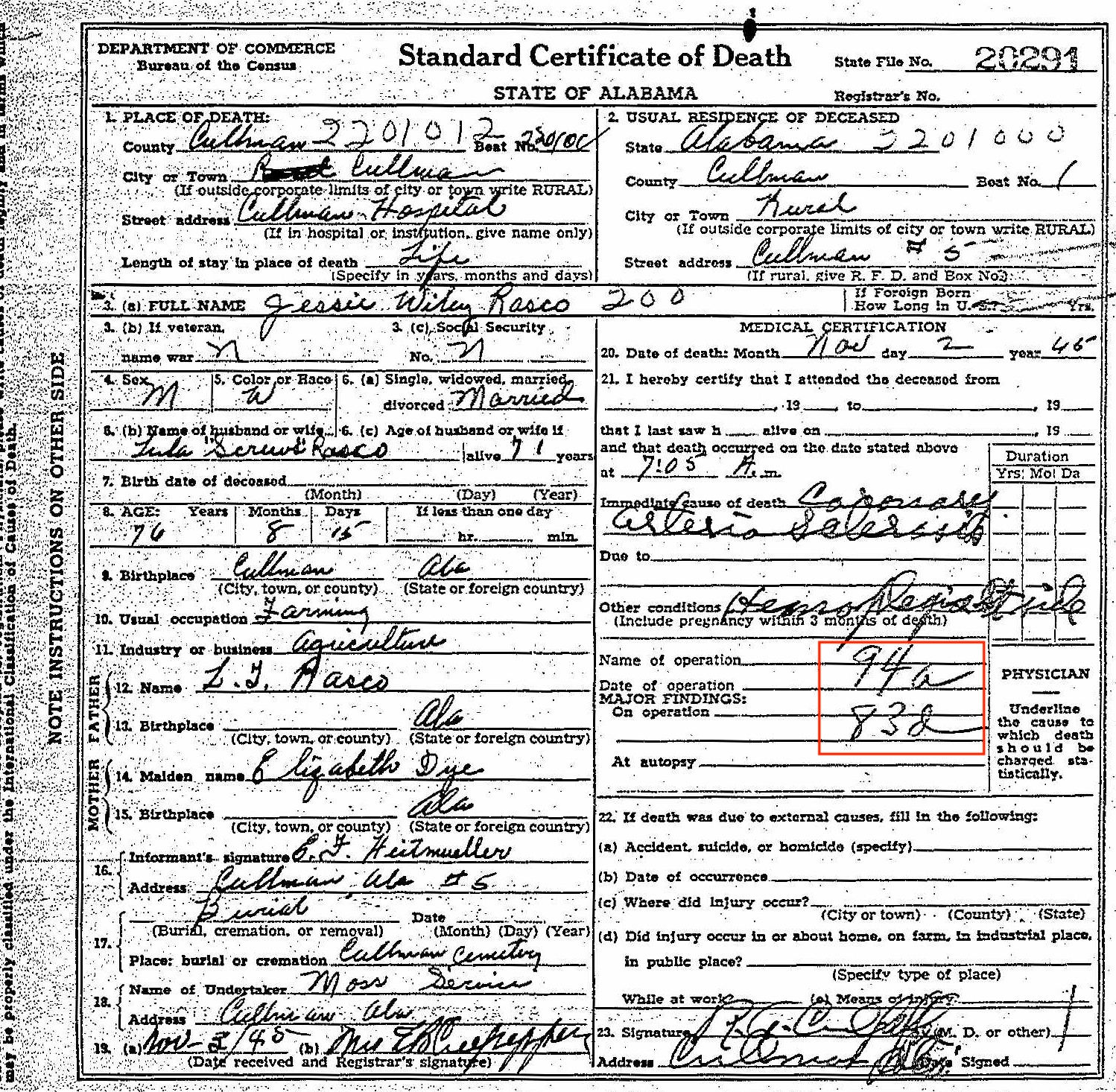
Let’s use a death certificate from my great grandfather’s brother, Jesse Wiley Rasco (1978-1957), to illustrate this.

Here’s his 1945 death certificate. I’ve put a red border around the ICD codes.

Death certificate for Jesse Wiley Rasco


As you can see, the ICD code for the primary cause of death is 94a. And the ICD code for the secondary cause of death is 83d. I could read the words for the primary cause of death. To me, it looks like Coronary Arteriosclerosis. Ordinarily, I would have stopped there. But the secondary cause of death was hard to decipher and I was curious.

I went to the International Classification of Disease page at Wolfbane.com and clicked on ILCD Revision 5 (1938), which would have been the version in use in 1945, since the next revision came out in 1948. The codes are listed in numerical order, so it was easy for me to find 94a, “diseases of the coronary arteries.” The secondary cause of death, 83d, is “hemiplegia and other paralyses of unstated origin.” Once I read that, I could see the word hemiplegia in the handwriting. It’s hard to make out the word after, but it looks to me like it could be “stroke.” I looked up the word hemiplegia and learned that it means “Paralysis on one side of the body.” [Edited to add: I received a note from reader Dennis Young suggesting that the handwriting says “Rt. side.” That makes complete sense and now seems obvious! The plot thickened a little when I received a note from reader Brad Pierce suggesting that the words say Lt. side, not Rt. side. Brad’s a physician himself so is probably good at deciphering doctor’s handwriting! I can’t tell whether it’s left or right, but I’m so glad to accept the “side” part. Thank you Dennis and Brad!]

Knowing that this 76-year-old farmer was living with paralysis on one side of his body at the time of his death gives me a bigger picture of what his life experience (or least the end of his life) was like.

As you can see, taking time to look up ICD codes when you see them might provide you with more information about your ancestor or might even solve a mystery. Just be sure you’re looking at the pertinent Revision!

Filed Under: Challenges, Genealogy tips Tagged With: genealogy tools, rasco, research, vital records

Favorite RootsTech session: Do Something with that Box!

April 28, 2020 By Janine Adams 9 Comments

Stacy Julian

I heard a lot of great sessions at RootsTech this year. But the one that really blew me away–because of the quality of its content and presentation–was Stacy Julian’s Do Something with that Box! Stacy is a blogger and podcaster and superstar in the scrapbooking world. You can learn more about her at www.stacyjulian.com.

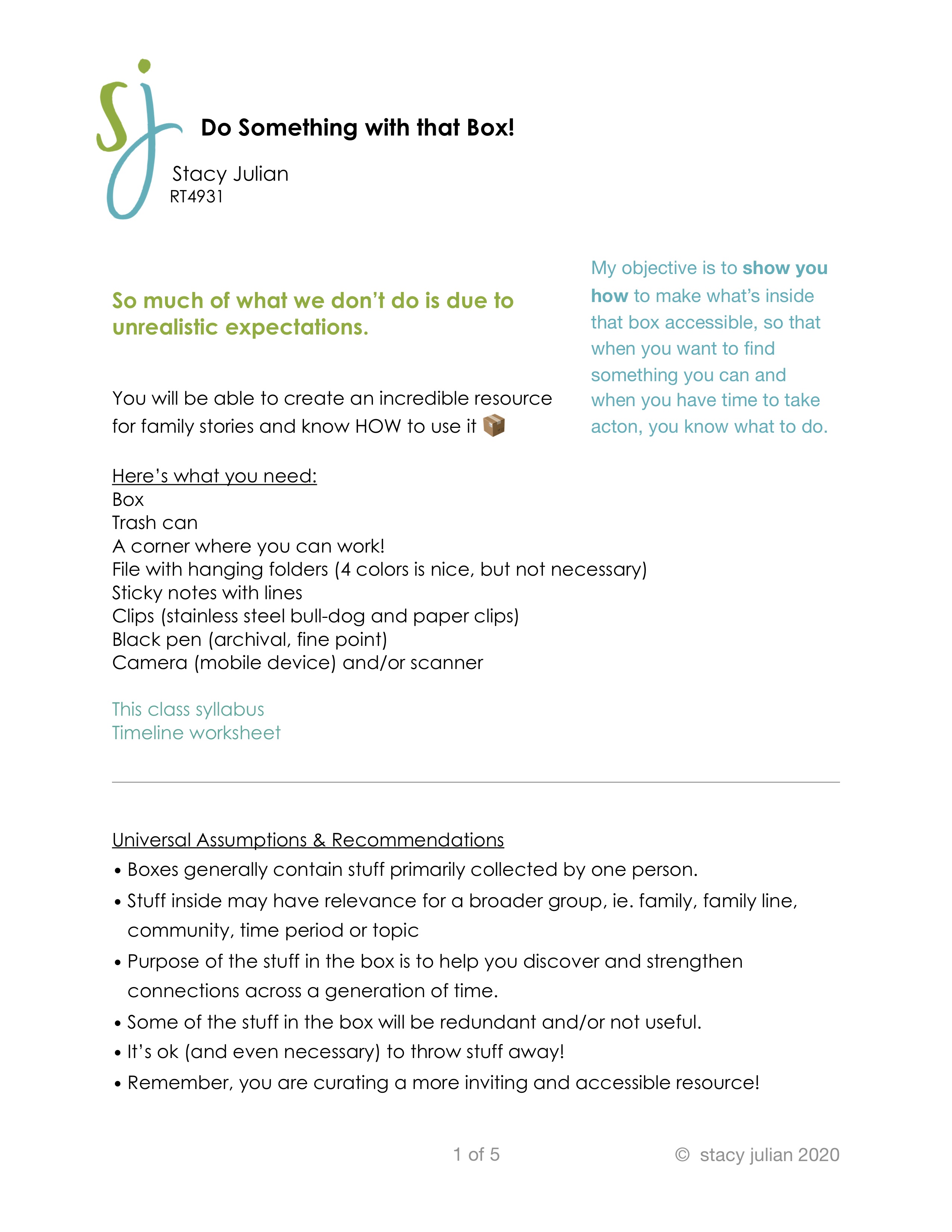
“That box” that Stacy refers to is the box of family history papers, photos, ephemera and (sometimes) junk that so many of us have been given. It’s so easy to be overwhelmed by that box, isn’t it? In her talk, Stacy took us step by step through her methodology to make the stuff inside that box accessible “so that when you want to find something you can and when you have time to take action you know what to do.” As a professional organizer, this made my heart sing.

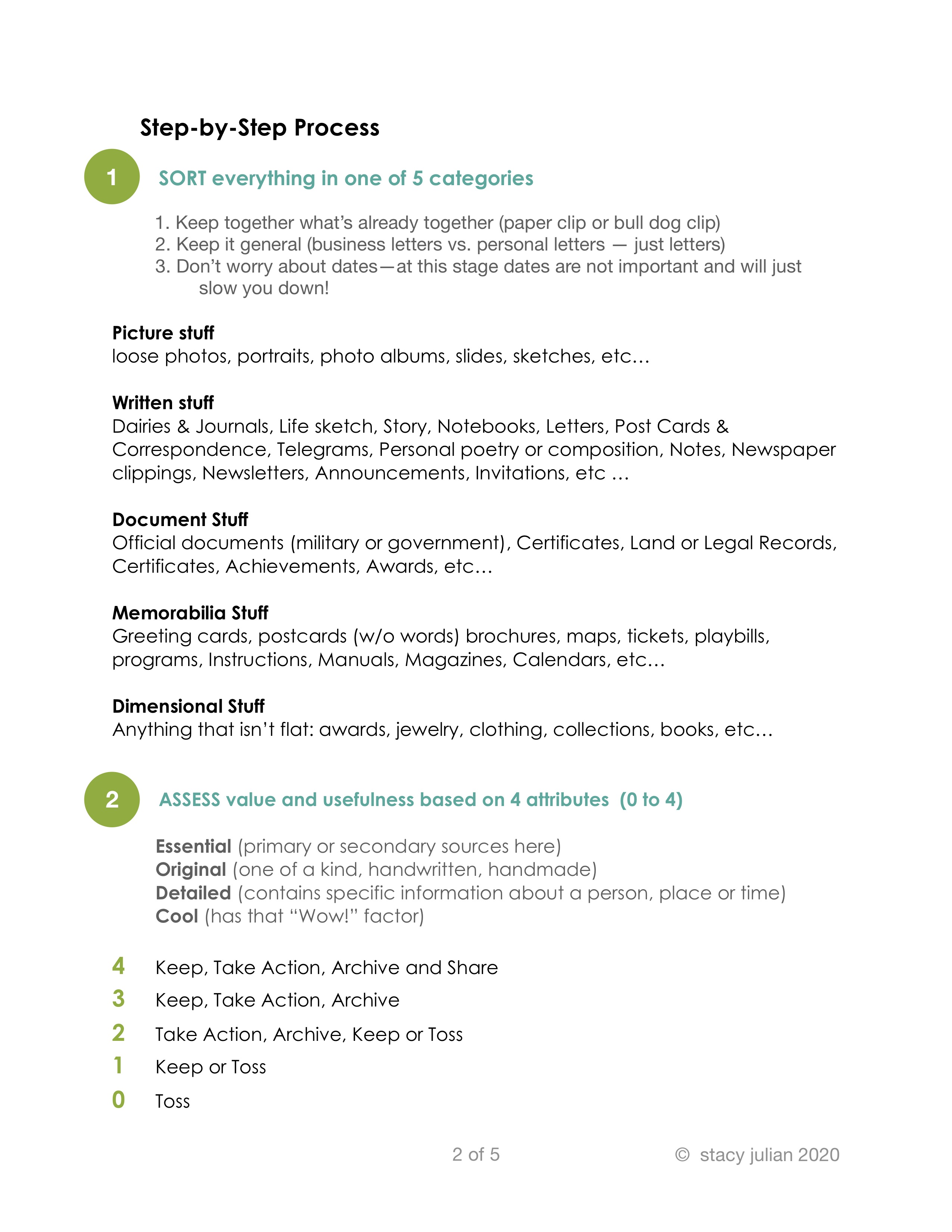
One of the things I loved about her approach is that it makes the process of dealing with a box of family-history stuff less overwhelming. Stacy has you sort everything into one of five broad categories, then go through each category and assess the value of each item. You’ll be discarding lots of stuff during this process, undoubtedly. Stacy makes the point that scarcity creates value–if you are discerning about what you keep, your family members are more likely to look at and enjoy the items.

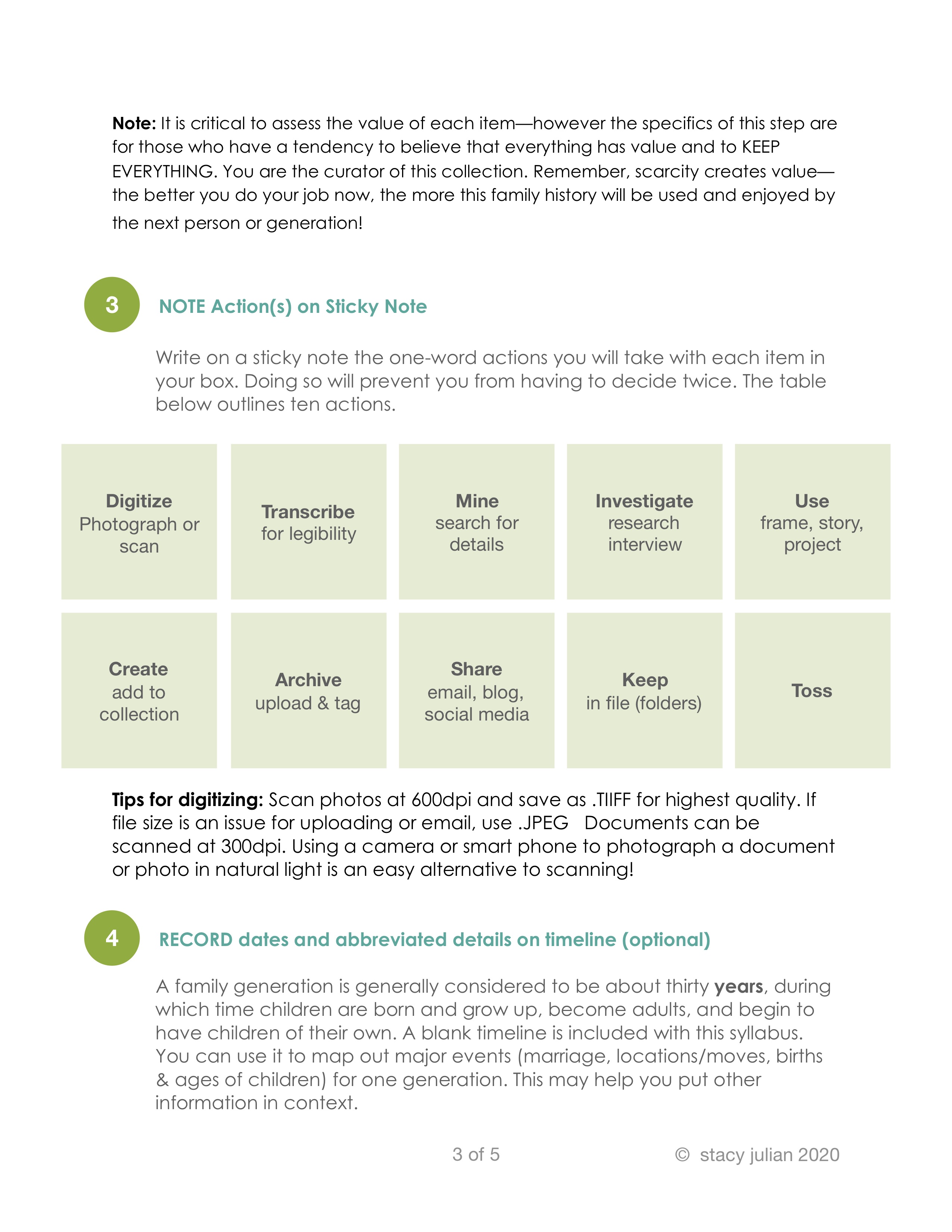
After sorting and assessing you’ll assign an action to each item that requires one (digitize, transcribe, share, etc), using a sticky note. The final step is to file the stuff into a file box using the same broad categories you started with. As you go through the documents, you’ll put those that excited you into an Action folder. Once you have ten items in the Action folder, you take action.Ā  An optional step in the process is to create a timeline, as you go, for each generation of the family represented by the box.

The system gets you to a “good enough” place where your stuff is easily accessed–by you or other family members–without expending a huge amount of effort. And when you have an itch to take action, you’ll know just what to do. Genius.

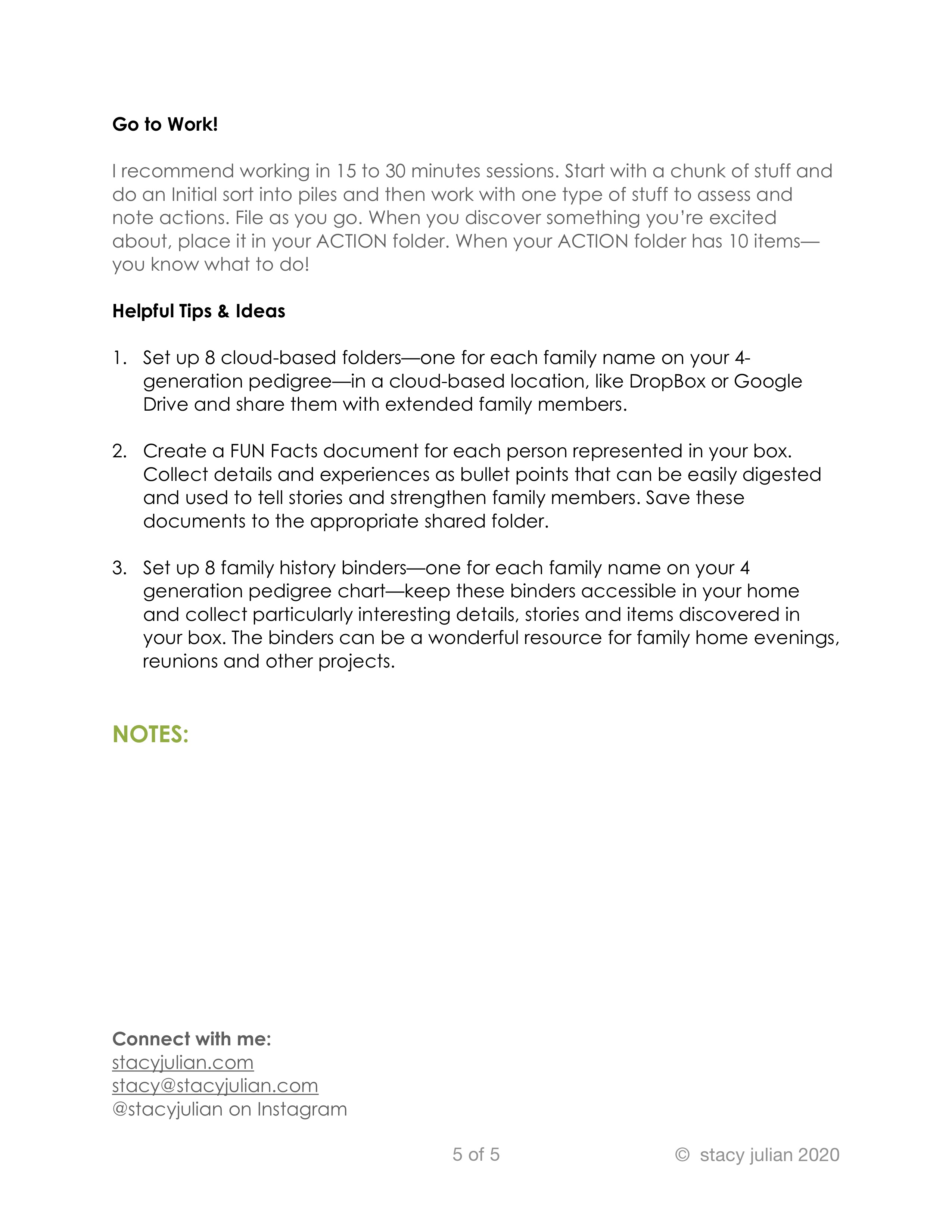
Stacy was kind enough to give me permission to make the handout that she gave to RootsTech participants available to you. At the bottom of this post are images of each of the five pages. Click on each to see a larger version.

The handout is great because it gives you the bones of her fantastic method. Hearing her speak about it was even better–there were videos included in her presentation and her energetic style was so enjoyable (and effective).

I have some great news: Stacy is developing an online course on this topic! So you’ll be able to get all the great content those of us in her RootsTech audience experienced (and probably more). I’ll be sure and post when that’s available.

In the meantime, take a look at this handout and see whether you might be able to take some steps to tackle one of your boxes while you’ve got extra time at home.

Edited to add: I was delighted to discover that Stacy has now written a robust blog post on this topic! Check out How to BEGIN with the BOX on her website.

Filed Under: Challenges, Excitement, Organizing, Preservation Tagged With: family photos, organizing aids, overwhelm, paper files, resources, Stacy Julian

  • « Go to Previous Page
  • Page 1
  • Interim pages omitted …
  • Page 72
  • Page 73
  • Page 74
  • Page 75
  • Page 76
  • Interim pages omitted …
  • Page 219
  • Go to Next Page »

about me

I'm Janine Adams, a professional organizer and a genealogy enthusiast. I love doing family history research, but I find it's very easy for me to get overwhelmed and not know where to turn next. So I'm working hard to stay organized and feel in control as I grow my family tree.

In this blog, I share my discoveries and explorations, along with my organizing challenges (and solutions). I hope by sharing what I learn along the way I'll be able to help you stay focused and have fun while you do your research, too.

tags

30 x 30 Adams amy johnson crow anniversary Brown cemetery census Civil War conferences connections dna electronic files Evernote excitement Family Curator family photos genealogy tools getting started goals How They Do It Igleheart Jeffries keepsakes learning opportunities maps newspapers NGS organizing aids overwhelm paper files planning quick tips rasco record keeping research research log research trip resources RootsTech social history source documentation Stacy Julian technology time management vital records

join the facebook community!

join the facebook community!

My organizing business

Learn more about my organizing business, Peace of Mind OrganizingĀ®.

Subscribe by RSS

  • RSS - Posts
  • RSS - Comments

© 2026 Janine Adams


Loading Comments...