• BLOG
  • ABOUT
    • Privacy Policy

Organize Your Family History

Stay focused and happy while exploring your roots

Reviewing my source documents

August 17, 2018 By Janine Adams 2 Comments

Last weekend I had the great fortune to hear genealogist and speaker Amy Johnson Crow give several talks at the Missouri State Genealogical Association‘s terrific conference. One of her talks was called “How to Milk a Source for All It’s Worth” and in it she shared tips and techniques for harvesting every bit of information you can from a source.

That got me thinking about the source documents I had found early on in my genealogy research, six or seven years ago. Back then, I was focusing on direct-line ancestors, so I’m sure I left a lot of information on the table. Rather than entering every scrap of information into my genealogy database (Reunion), I would have just glossed over it.

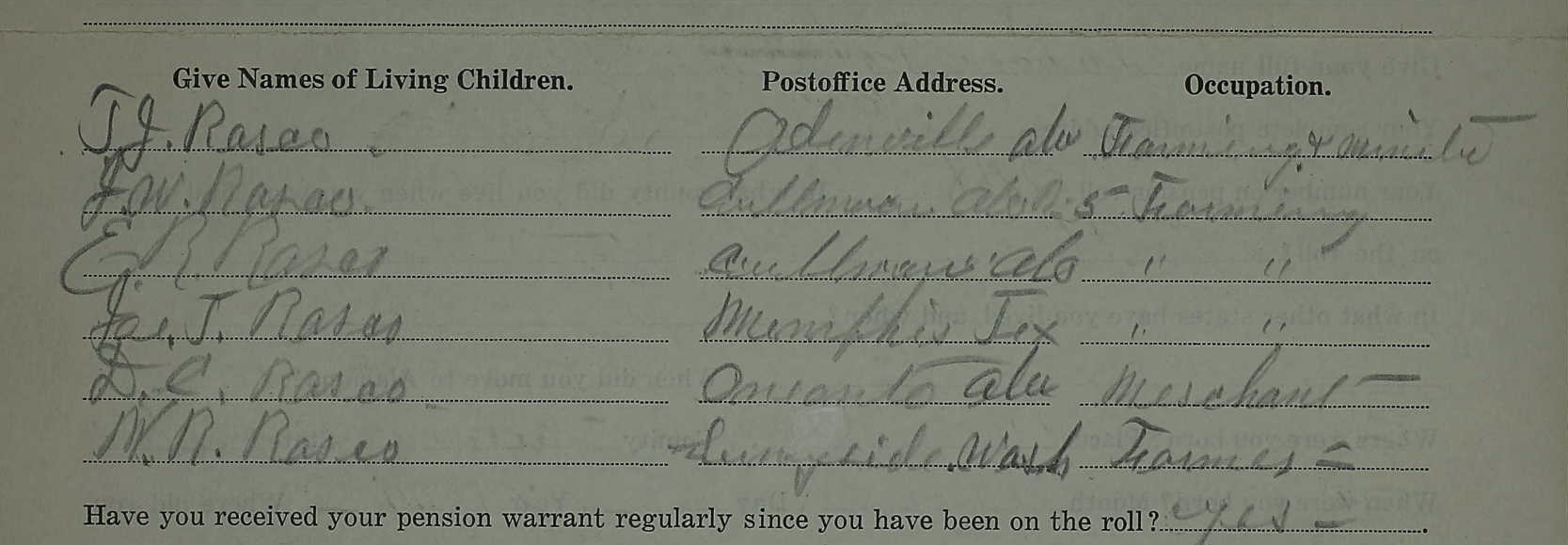
That was confirmed yesterday when I was going over an Alabama Census of Confederate Soldiers questionnaire my 2nd great grandfather, Laban Taylor Rasco (1844-1926) had filled out in 1921. I had found that source in 2012. (It’s source #127 in my database; I now have 834 sources.) I was shocked to see that I hadn’t recorded the information about his living children that was shared in that questionnaire. They were in my tree, because I’d added them at a later date, but back in 2012 I just wasn’t adding collateral lines. (I know, I was short-sighted.)

So I started adding that info and in doing so solved a little mystery. My grandmother Beatrix Rasco Adams, who was born in 1907, was living in Memphis, Texas, with her family on the 1920 census. In 1910, they were in Alabama, where she was born, and in the 1930 census they were in Washington state, where she lived the rest of her life. I never knew why they lived in Texas in 1920 (though I didn’t try very hard to find out). But I learned yesterday by focusing on that Confederate census, that her uncle, Joseph Taylor Rasco (1872-1964) was living in Memphis, Texas in 1921 and is nearby in the 1910 and 1920 censuses. Her family must have joined him. Mystery solved, or at least illuminated.

That made me realize that I have a lot of work to do with the source documentation that I have already downloaded and entered into Reunion. My genealogy research skills have improved so much that I find myself drawn to look at all those less recently found documents so I can pick all the meat off the bones.

Two summers ago, I started systematically going through my source documentation, primarily to correct the citations and to make sure that each source document was attached as a multimedia file to the source record in Reunion. At the time, I had 300 sources in my database. I got through Source #85 by the time I stalled out on that particular endeavor.

Fast forward two years and I now have an additional 500+ more sources, but I’m hopeful that the last several hundred were much better analyzed.

Last month, I shifted my focus to my father’s maternal line, the Rascos, and plan to work on them for the rest of 2018. So this is what I’ve decided to do: I’ve created a list of all the sources that pertain to the Rascos and I’m planning to systematically check each source record, making sure the citation is correct, that the source document is attached to the source record, and that all possible information is gleaned. When I see clues for further research within a document, I will either make a note of it in Evernote or, depending on time constraints and my whims, go ahead and pursue that clue.

I think this process will give me more confidence in my source citations and it will help me feel comfortable that my research is thorough–plus it will doubtless garner a lot more facts to add to my database! I also love that it will give me an easy starting point for research each day.

I’ll let you know how it goes!
Filed Under: Challenges, My family, Reflections Tagged With: rasco, record keeping, source documentation, time management

Understanding genetic genealogy (finally!)

August 7, 2018 By Janine Adams 8 Comments

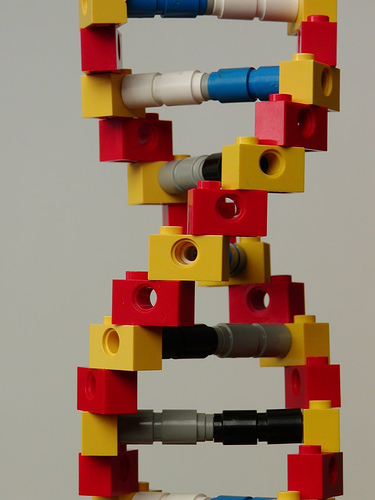
Understanding genetic genealogy (finally)I attended Diahan Southard’s series of DNA lectures on July 28 as part of the St. Louis Genealogical Society’s Summer Speaker Series. As I mentioned in a blog post last month, I’ve had a hard time using DNA in my genealogical research, mostly because I have a difficult time understanding and retaining what I try to learn about DNA.

Diahan is an expert on making this information understandable to non-scientists like me. I’ve heard her speak before but this time, a door in my brain cracked open. It may have been because at the seminar we had the privilege of listening to Diahan for four straight lectures, each of which built on the prior one. It was really a brilliant program and Diahan is an excellent speaker.

So I came home and started applying what I’ve learned and I now feel that genetic genealogy is part of my tool box. Hooray!!

Here are some of the revelations from her talks that really helped me:

  • A DNA match with a person whose tree has no familiar surnames is cause for celebration, not frustration. The DNA shows you’re related. When you figure out how you’re related, you’ll add names to your tree.
  • The Shared Centimorgan (cM) Project can help you understand how you might be related to someone, based on how much DNA you share. Here’s Diahan’s explanation of centimorgans and the Shared cM Project. It’s a great resource.
  • The solution to most DNA is quandaries is (drum roll): Do genealogy! DNA evidence can bridge gaps or open holes in brick walls. But traditional genealogy is how you build your family tree.
  • Create a list of your 32 great great great grandparents’ surnames to help you find commonalities with DNA matches. I had not compiled a list like that before and I see how it will help recognize how I might be related to those DNA matches that are fourth cousins or closer.
  • On Ancestry, even if a DNA match has not linked a tree to his/her DNA results (so you see “no family tree”), click on the “View Match” button and see if there’s a drop-down list of trees you might look at under the Pedigrees and Surnames tab. There may be a tree (or a few trees) for you to look at.

One thing I noticed when I took a look my Ancestry DNA results the day after the Diahan’s seminar is that the shared centimorgans don’t necessarily accurately reflect the relationship. For example, my mother’s first cousin, whom I know personally, shares only 183 cM with me, rather than the 439 that first cousins once removed usually share, according to the Shared cM Project. So Ancestry guessed that she was my third or fourth cousin. The Shared cM Project is a great tool, but obviously just a guideline.

Today in my research session, I explored the public tree linked to someone with whom I share 158 cM. This is a huge tree but I was able to easily focus in on a shared surname. The tree is beautifully sourced, so even though I had only a few minutes left of my 30-minute research session this morning, I was able to add a fact and supporting document to my great great grandfather’s record in my family tree software. Tomorrow I’ll go back and explore that tree more.

I finally understand how DNA can help me in my genealogy research. Better yet, I understand how to use it. This is such a revelation.

If using genetic genealogy eludes you as it did me, I heartily encourage you to check out Diahan’s website, Your DNA Guide, and to listen to Diahan speak when you have the chance. She’s speaking at the Federation of Genealogical Societies conference later this month and I know she’ll be speaking at the 2019 NGS conference in St. Charles, Missouri, next May. (I’ll plan to be in the front row!) You can also do a consultation with her where she explains your DNA results to you. She’s a terrific resource.

Unmodified photo by Michael Knowles via Flickr. Used under Creative Commons License.

Filed Under: Challenges, Excitement, Technology Tagged With: Diahan Southard, genealogy tools, genetic genealogy, research

July 30 x 30 wrap up

July 31, 2018 By Janine Adams 15 Comments

It’s the end of the month! The 30 x 30 challenge officially ended yesterday. I wanted to check in today and out how this summer’s challenge went. Were you able to do something genealogy-related every day for 30 days? Please report in the comments!

I’ll start: The challenge was tremendous for me. It was just what I needed to refocus. Having made this commitment, I made sure to do the research every morning, before I got going with other stuff during the day. I find that if I want to get something done, I need to do it first thing in the morning.

Whereas prior to this challenge, according to my research log, I hadn’t researched in two weeks, this month I blogged each and every day, save one. I did have one early-morning client appointment that prompted me to eschew research until later in the day. But after eight hours of leading a decluttering team that day, I was too brain dead to research. So I did miss one day. But overall I felt great about the challenge.

I notice that when I research a little bit every day, I stay in touch with my research and I don’t get overwhelmed. Also with daily research I always know what I’m going to work on when I get started (since it’s been just a day since my last session). That makes makes getting started much easier. It’s a huge benefit to daily research.

Even though the challenge is officially over, I’m going to try to continue with the daily research.

I’d love to hear how it went for those of you who decided to participate this month!

Filed Under: Challenges, Excitement Tagged With: 30 x 30, time management

How They Do It: Sunny Morton

July 24, 2018 By Janine Adams 1 Comment

The latest interviewee in my How They Do It series is genealogy educator Sunny Morton. I’m familiar with Sunny’s work with Lisa Louise Cooke (who was the subject of my January How They Do It Interview) and Family Tree Magazine. She leads the Genealogy Gems book club and is the author of Genealogy Giants: Comparing the 4 Major Websites. I haven’t yet met Sunny, but based on what I read in this interview, I really look forward to meeting her! Her love for her genealogy and her family shines through.

How They Do It: Sunny Morton

How long have you been doing genealogy?

I’ve participated in personal and family history for just about my entire life. I began keeping a diary at around age 8. As a young teen, I created my first travel scrapbook: a magnetic album packed with notes, receipts, ticket stubs, postcards and even pine needles from a cross-country trip with my family. I kept every letter I ever received, filed alphabetically by the person’s first name, until my early 20s. I still have a couple of binders filled with printouts of the first several hundred personal emails I sent and received, before I realized these were something you could (and should) archive electronically. As an adult, I have compiled more than 40 scrapbooks filled with memories from my own life and those of my relatives.

When I was young, my parents took me along on genealogy road trips. I remember finding gravestones in cemeteries and paging through enormous bound volumes of original newspapers. My grandmother loved to organize photos and negatives and I became her eager assistant. As a young adult, I digitized several years’ worth of family slides and tattered old photo albums. About 15 years ago, I began researching my husband’s family history, since he knew very little about it.

What’s your favorite thing about being a genealogist?

Knowing stories about what came before me. I feel more confident about who I am and why I am that way. I believe that learning about my ancestors has made me less judgmental of my own parents and grandparents and strengthened my relationships with them. I’m a more compassionate human being and a more informed citizen when it comes to having a historical perspective on topics such as civil rights and immigration.

What’s your biggest challenge when it comes to organizing your genealogy?

The transition from paper to paperless. I mentioned that I kept hundreds of letters and emails: what do I do with those? What about those archival scrapbooks, in which I’ve invested thousands of dollars and which are just barely too large to put on my scanner? I know there are ways to digitize these things for safe-keeping and so I can share them with all 3 children. But “editing” which items to scan and doing it would take hundreds of hours that I currently prefer to spend making memories with my children.

The other challenge is organizing tree data. I research across all of the major genealogy websites. I keep “working trees” on all those sites because then I can search and receive hints from each ancestor’s profile. But it’s best to have a master family tree where all the data and record image copies gets compiled. I keep a master, private tree in RootsMagic software. I also participate in the FamilySearch global tree so my research gets shared more widely. Though there can be complications when others dispute details on this open-forum tree, I love the collaborative contributions of many people’s documents, stories and pictures to our common ancestral profiles.

What is your favorite technology tool for genealogy?

My smartphone. It’s always with me, and I can use it in so many ways. I can access my tree data through apps for my software, FamilySearch and Ancestry.com. When I’m the road, I can take pictures of documents, microfilmed records (right from the reader!), other people’s old pictures, family artifacts and gravestones. I can even record oral history interviews, either in audio or video format.

If you were starting out new as a genealogist what would you do differently?

I inherited a lot of genealogy research from others, so for a long time, I ignored recent generations on my own tree. I considered this research “already done” and therefore kind of boring. If I were starting over, I’d spend a lot more time getting to know my grandparents’ generation.

Do you keep a research log? If so, what format?

I keep informal research logs in Word documents. Each ancestor has a document with running commentary about my discoveries and next steps for my research.

How do you keep track of clues or ideas for further research?

I keep them in my research logs for each individual. Toward the end of the document, in the “Next steps” section, I keep notes on intriguing questions to research or resources I’d like to explore sometime.

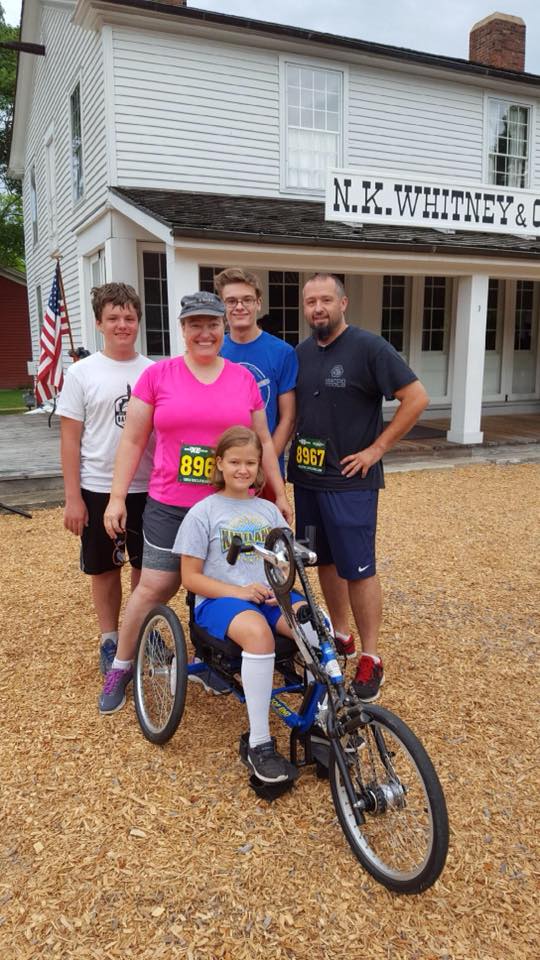
Sunny with husband Jeremy and her children Jeremy, Alex and Seneca.

How do you go about sharing your personal research with cousins or other interested parties?

Most of my sharing happens in the form of telling stories: mostly to my children, but also to my husband, parents or other relatives who may be interested. Telling a story helps me learn which parts are most interesting to which audiences. Sometimes, I take a next step by framing a photo, creating a display or sharing a quick post on Facebook. I do participate in the FamilySearch global tree, which is an easy and organized way to reach potentially thousands of fellow descendants. Although I have written longer articles for genealogy newsletters and historical journals, most of my longer writing projects will have to wait until I’ve finished raising my three children. (That’s Sunny in the photo at left, making memories by participating as a family in a 5k race in July 2018.)

What’s the most important thing you do to prepare for a research trip?

I like to do three things: review what I already know, see what else I can learn online before I go, and locate unique offline sources that may only be discovered while on that trip. This makes my research efforts on the road more productive. A few phone calls to local archives and libraries ahead of time can help me plan my time most effectively, identify must-consult sources and connect with local experts (and perhaps even descendants). I can set priorities about the most important things to accomplish while I’m there and systematically go down my list.

Occasionally, there’s not sufficient time to prepare fully for a research trip. When that happens, I’m just grateful I have my laptop and my phone—which together give me access to all my research, note-taking and organizing tools. I try to at least gather information about the people and libraries I will want to connect with in the future, and take as many pictures as I can.

Do you have a dedicated space in your home for doing genealogy research? What’s it like?

I have a home office with lots of bookshelves for organizing my how-to genealogy research library, storing whatever documents I have in print format and displaying favorite family artifacts and photos. It’s an inspiring, comfortable place, filled with memories and mementos. My favorite mementos are the special cards and crafts my children have made me over the years: they remind me to get up from my desk and make memories with them.

So many great nuggets in here, from the beautiful explanation of how being a genealogist makes one a better human being to the very practical (and, for me, freeing) suggestion of taking a smartphone photo of a document right from the microfilm reader. I tend to be phone averse, but Sunny has inspired me to actually pick up the phone and call local archives and libraries before a research trip. I so appreciate how Sunny puts the emphasis on the family in family history research and how her love for her family imbues the answers to these questions. Thank you, Sunny!

If you’d like to explore more of Sunny’s work, check out her website for her speaking calendar and links to articles. You can watch the video (and read the handout) of her RootsTech 2017 lecture on the comparing the four major “Genealogy Giants” websites on this page of the Genealogy Gems website..

Filed Under: Challenges, Excitement, Genealogy tips, Organizing Tagged With: How They Do It, organizing aids, Sunny Morton

  • « Go to Previous Page
  • Page 1
  • Interim pages omitted …
  • Page 56
  • Page 57
  • Page 58
  • Page 59
  • Page 60
  • Interim pages omitted …
  • Page 109
  • Go to Next Page »

about me

I'm Janine Adams, a professional organizer and a genealogy enthusiast. I love doing family history research, but I find it's very easy for me to get overwhelmed and not know where to turn next. So I'm working hard to stay organized and feel in control as I grow my family tree.

In this blog, I share my discoveries and explorations, along with my organizing challenges (and solutions). I hope by sharing what I learn along the way I'll be able to help you stay focused and have fun while you do your research, too.

tags

30 x 30 Adams amy johnson crow anniversary Brown cemetery census Civil War conferences connections dna electronic files Evernote excitement Family Curator family photos genealogy tools getting started goals How They Do It Igleheart Jeffries keepsakes learning opportunities maps newspapers NGS organizing aids overwhelm paper files planning quick tips rasco record keeping research research log research trip resources RootsTech social history source documentation Stacy Julian technology time management vital records

join the facebook community!

join the facebook community!

My organizing business

Learn more about my organizing business, Peace of Mind Organizing®.

Subscribe by RSS

  • RSS - Posts
  • RSS - Comments

© 2026 Janine Adams


Loading Comments...