• BLOG
  • ABOUT
    • Privacy Policy

Organize Your Family History

Stay focused and happy while exploring your roots

Quick Tip #42: Check multiple sites before giving up

July 25, 2023 By Janine Adams 2 Comments

Here’s the next in my occasional series of bite-size Quick Tips. Click on the Quick Tips tag for my other Quick Tips. Because I tend to write longer posts, I wanted to provide a quick-to-read (and quick-to-write) post every now and then on a small topic that pops into my head. This one is a good lesson on being persistent.

Check multiple sites before giving up

It can be frustrating when you can’t find a document, especially when you’re pretty darn sure it exists. Even when you pull out all the stops and search every way you can think of  at an online site,  you can come up short. But don’t give up yet! Instead, take a look at another online database. Your document may have been indexed differently by that other database and could show up in your search. (This tip applies to in-person research as well!)

Photo by Sam Dan Truong on Unsplash
Filed Under: Genealogy tips Tagged With: quick tips, research

How They Do It: J. Mark Lowe

June 14, 2023 By Janine Adams 1 Comment

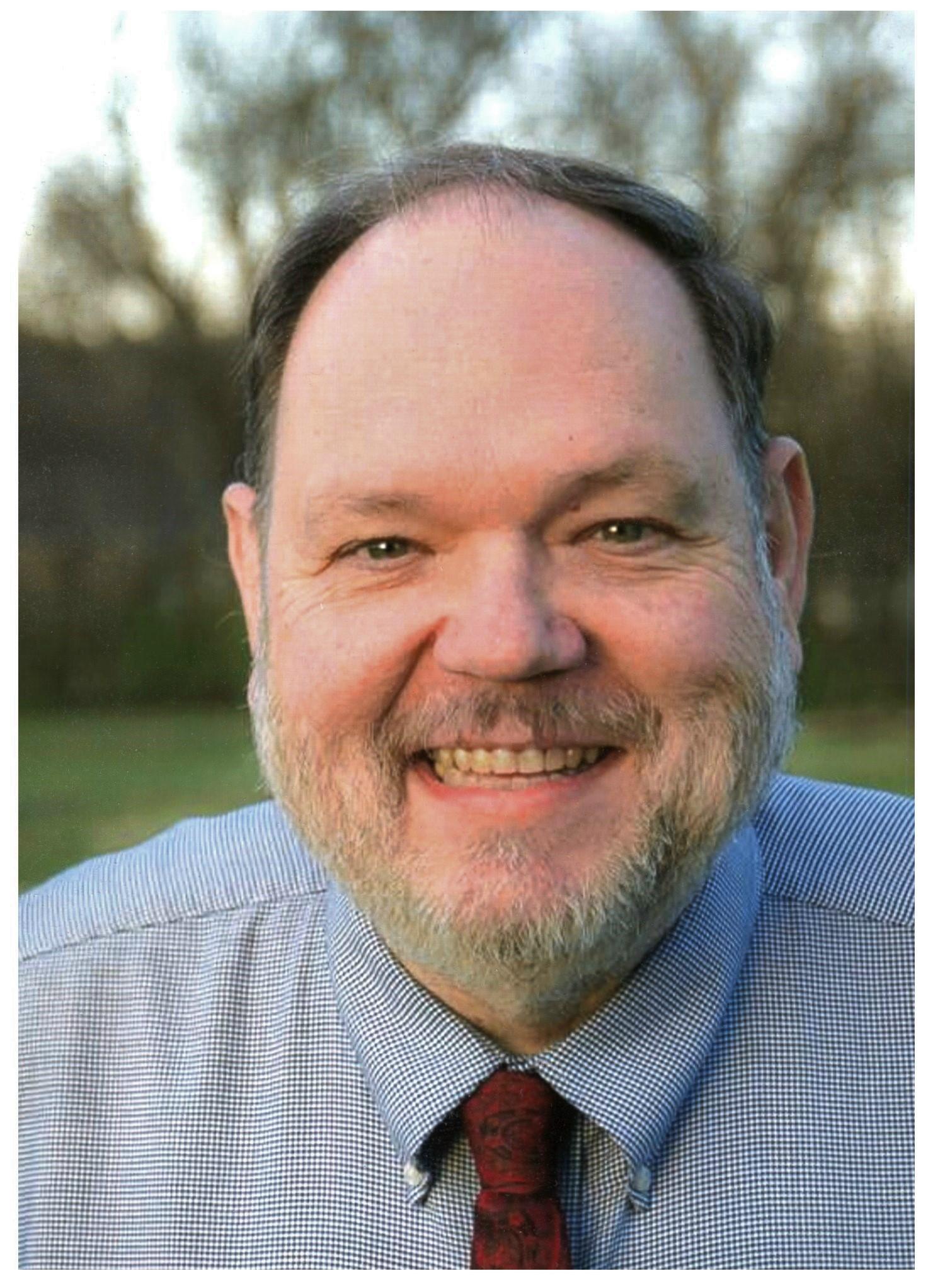
I’m so happy to publish another interview in my popular How They Do It series! This time, it’s with J. Mark Lowe, FUGA, a professional genealogist, author, and lecturer who specializes in original records and manuscripts throughout the southern U.S. A course coordinator for southern research for multiple genealogy institutes, Mark is a past president of the Association of Professional Genealogists (APG) and past president of the southern Kentucky Genealogical Society. I had the pleasure of working with him when we both presented at the Henderson County (Kentucky) Public Library seminar last year. I can tell you first hand that he is an organized individual. And he’s a delight to work with!

How They Do It: J. Mark Lowe

How long have you been doing genealogy research?

I became interested in family and connections when I was seven years old after my Grandmother passed. (Dad’s Mom) My Dad had some of the answers, but he connected me with his Aunts (my Grandmother’s Sisters) who started filling in some spots. One of those Aunts was the Secretary for the local Congressman and her office was across the street from the County Courthouse. She arranged for my Dad to bring me to visit, along with clothing. When he dropped me off, she took me to the County Court Clerk’s office in the Courthouse. Mr. Oval Motley, the Clerk, introduced me to original records, and encouraged me to create transcriptions from the originals. (Plain Paper copies were not yet available.)

That opened the door to a continuous flow of curiosity.

What’s your favorite thing about being a genealogist?

Learning the stories of my ancestors and the often untold/unheard stories of others.

What’s your biggest challenge when it comes to organizing your genealogy?

Widely diverse records with a mixture of Archival documents, copies, and digital records. Making them all accessible for different reasons.

What is your favorite technology tool for genealogy?

My cell phone, using the Ancestry app and Newspapers.com. I can answer my own question or a query on the fly about family or history.

If you were starting out new as a genealogist what would you do differently?

Focus on each person’s story more – I would not rush to collect the tree. This is especially when you have opportunity and time to learn about “near” living relatives before they or witnesses are gone.

How do you keep track of clues or ideas for further research?

I use 4×6 index cards, Google Keep & Google Tasks, and ToDos in my genealogical software.

How do you go about sharing your personal research with cousins or other interested parties?

I maintain a private tree on Ancestry that I share with folks who have an interest. I also maintain a Family website primarily for cousins.

What’s the most important thing you do to prepare for a research trip?

I take some time to mull & ponder the project, define the purpose of the trips, and determine the tasks to be completed with a timetable.

What’s your biggest piece of advice to genealogists in terms of organizing their research?

Locations are more important to research that just the single families. You are likely to have multiple family members in each location. Being able to look at the location independent of each family will save you time, money, and headaches.

Do you have a dedicated space in your home for doing genealogy research? What’s it like?

Everywhere! I have a library/office, but often do research on my front porch, in my living room chair or occasionally while lying in bed. Good wifi!

Do you have anything to add?

The best researchers are persistent. They don’s stop when the record they seek is not where they look. They back up, rethink the options, learn about the record creation, and go find the record.

So many wonderful nuggets in Mark’s concise responses! I think his advice to organize information around location as well as family is really interesting. It’s something I don’t do currently but will explore. I also love Mark’s wise words on taking the time to learn from your close relatives while they are still living and able to share family history information. Thank you so much, Mark, for sharing your wisdom and expertise! If you’d like to learn more about Mark, check out Kentucky Tennessee Research Associates. You can also find him on YouTube channel and Twitter.

Filed Under: Excitement, Genealogy tips, Organizing Tagged With: How They Do It, J. Mark Lowe

My research-friendly computer setup

June 7, 2023 By Janine Adams 18 Comments

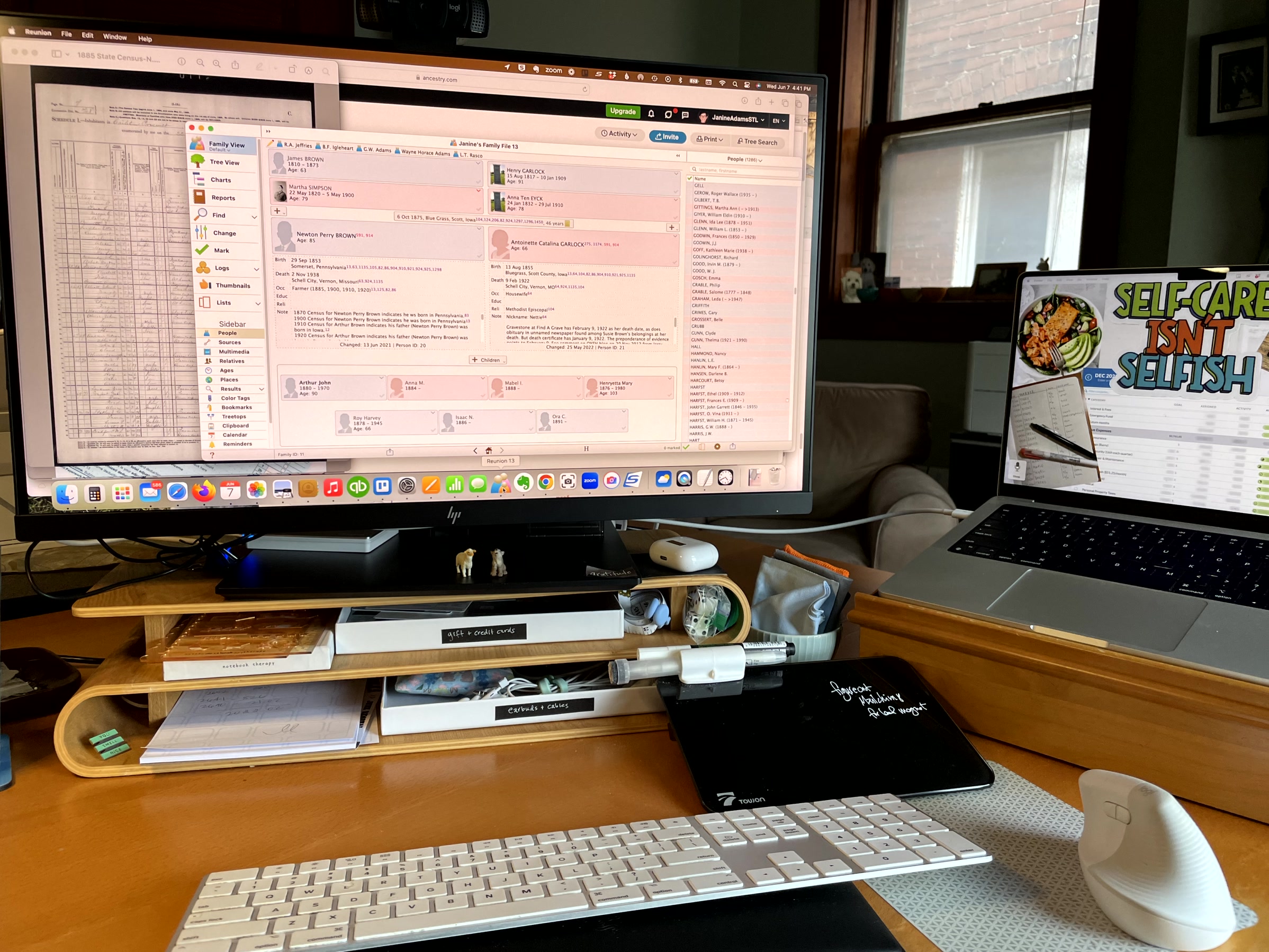
Computer monitor connected to laptop with one cord and wireless keyboard and mouseLike many people, I do most of my genealogy research online, from my desk. I have a laptop computer (a 14″ MacBook Pro). I love my laptop for its portability. I take it with me on research trips (or, really, any trip).

But I don’t love doing genealogy research on a 14″ screen and I don’t love using a trackpad instead of a mouse.

I bought my HP Business Z27 2TB68A8 27″ monitor way back in 2019 and it’s been great. (I should point out that there’s a more modern version of a similar monitor, the HP U28 4K HDR, that is less expensive and has more conveniently placed ports than mine. I’ve done no research on it, though.) What I love about this monitor is that it acts as a hub and a power source. I plug it into my computer with a USB-C cable and then I plug my external hard drive and webcam into the monitor. So I just have one cord going from my monitor to my computer. That makes it very easy to unplug and go. And it cuts down on cord clutter on my desk.

I also use a wireless keyboard and a wireless mouse. I recently developed tennis elbow from overuse of the keyboard and mouse, so I’m now using an ergonomic vertical mouse, which I think is helpful. I also prop the forward edge of my keyboard on a wrist rest so that it tilts downward, which helps my tennis elbow.

The joy of this setup is that I can have multiple documents open on my screen. I can also use my laptop screen, which I keep to the side and stash documents on. (In case you’re curious, my laptop wallpaper is the vision board I created for 2023.) If I were trying to do all my genealogy research and processing of downloaded documents on my laptop I am confident I would find it less enjoyable.

If you struggle with having as many documents visible as you’d like on your screen, you might consider a large monitor that you can use when you’re researching at home. Add a wireless keyboard and mouse and you get the best of both worlds of a desktop computer and laptop.

Filed Under: Challenges, Genealogy tips, Technology Tagged With: genealogy tools, technology

Making military research a little easier

May 26, 2023 By Janine Adams 2 Comments

Before Memorial Day in 2016, I wrote this post on figuring out which ancestors might have fought in which war. I’ve run it a couple more times and it seemed like a good time to run it again. Incidentally, MyHeritage is offering free access to its 83 million military records this weekend, May 25-30, 2023.

Whenever I read about a records collection for a certain conflict (which seems to happen around military-related holidays, like Memorial Day, Veteran’s Day or anniversaries of conflicts) I get excited about researching my ancestors in those collections, which can be such a treasure trove of information. But in the past sometimes I would have difficulty remembering which ancestor might have fought in which war and I’d become overwhelmed and abandon the effort.

So I created a document that shows me the prospective ancestors for each conflict, based on the dates they were born. At the time, I used a table from Family Tree Magazine but when I went looking for it to share in this post, I couldn’t find it. However, I did find an even-better table called Ages of Servicemen in Wars that lists 20 military conflicts, the years they were fought, the typical birth dates for soldiers and the  typical ages of soldiers. Thank you, FamilySearch!

Armed with that information, I created a simple spreadsheet (pictured, in part, above) with the following column headers:

  • Conflict
  • Likely Birth Year of Soldiers
  • Prospective Ancestor
  • Confirmed Ancestor

For each conflict, I entered the names of the ancestors who were born during the birth-year window listed in column 2. After I ascertained that one had indeed fought in that war, I entered an X in the Confirmed Ancestor column. What I should have done and will from here forward, is place a dash or an N in the Confirmed Ancestor column to indicate that I’d ruled that ancestor out.

This is a simple way to see at a glance who I might research when I’m looking at military collections at the National Archives, Fold3 or elsewhere. It’s easy to create and I think it’s well worth the time spent.


Filed Under: Genealogy tips, Organizing Tagged With: genealogy tools, military, organizing aids

  • « Go to Previous Page
  • Page 1
  • Interim pages omitted …
  • Page 6
  • Page 7
  • Page 8
  • Page 9
  • Page 10
  • Interim pages omitted …
  • Page 106
  • Go to Next Page »

about me

I'm Janine Adams, a professional organizer and a genealogy enthusiast. I love doing family history research, but I find it's very easy for me to get overwhelmed and not know where to turn next. So I'm working hard to stay organized and feel in control as I grow my family tree.

In this blog, I share my discoveries and explorations, along with my organizing challenges (and solutions). I hope by sharing what I learn along the way I'll be able to help you stay focused and have fun while you do your research, too.

tags

30 x 30 Adams amy johnson crow anniversary Brown cemetery census Civil War conferences connections dna electronic files Evernote excitement Family Curator family photos genealogy tools getting started goals How They Do It Igleheart Jeffries keepsakes learning opportunities maps newspapers NGS organizing aids overwhelm paper files planning quick tips rasco record keeping research research log research trip resources RootsTech social history source documentation Stacy Julian technology time management vital records

join the facebook community!

join the facebook community!

My organizing business

Learn more about my organizing business, Peace of Mind Organizing®.

Subscribe by RSS

  • RSS - Posts
  • RSS - Comments

© 2026 Janine Adams


Loading Comments...