• BLOG
  • ABOUT
    • Privacy Policy

Organize Your Family History

Stay focused and happy while exploring your roots

New 30 x 30 challenge starts June 1!

May 29, 2020 By Janine Adams 87 Comments

One thing I’ve learned from all the time I’ve spent at home during this pandemic is that it isn’t a lack of time that prevents me from doing regular genealogy research. Apparently it’s a lack of accountability. So I’m declaring a new 30 x 30 challenge for June.

Will join me in committing to 30 minutes of genealogy research for 30 days in a row? Of course you can modify the challenge any way you want. But I’m looking to get into a groove of daily research, which was woefully lacking this month. I’m actually going back to working with organizing clients on June 1, but I won’t be so busy that I can’t insert 30 minutes of research into my daily routine.

If you’re in, please let me know in the comments. Here’s to a great research month!
Filed Under: Challenges Tagged With: 30 x 30, time management

Help your kids know your heirlooms’ stories

May 22, 2020 By Janine Adams 7 Comments

A reader of this blog, Jacqueline Krieps Schattner, sent me a link to a post she wrote recently on her genealogy blog, Seeds to Tree, that described the decluttering she’s been doing during the pandemic (she’s used her time very well!). The blog post also presented an idea that I think is absolutely genius, so I asked her permission to write about it here (and also on the Peace of Mind Organizing blog).

Jacquie’s decluttering work during the pandemic has been very thorough. She got so much done that she turned her attention to an area that’s usually last on the list: the family treasures around her home. In her post, Pandemic De-Cluttering and a Heirloom Book, Jacquie described taking stock of some of the treasures she has collected over 40 years of marriage (and inherited from her parents and grandparents). She’s still enjoying them and has no interest in letting them go. But when she started thinking about what will happen to these heirlooms if she and her husband were to downsize or were not around to explain the significance of each piece, she came up with an important piece of wisdom:

Heirlooms without stories are just stuff.

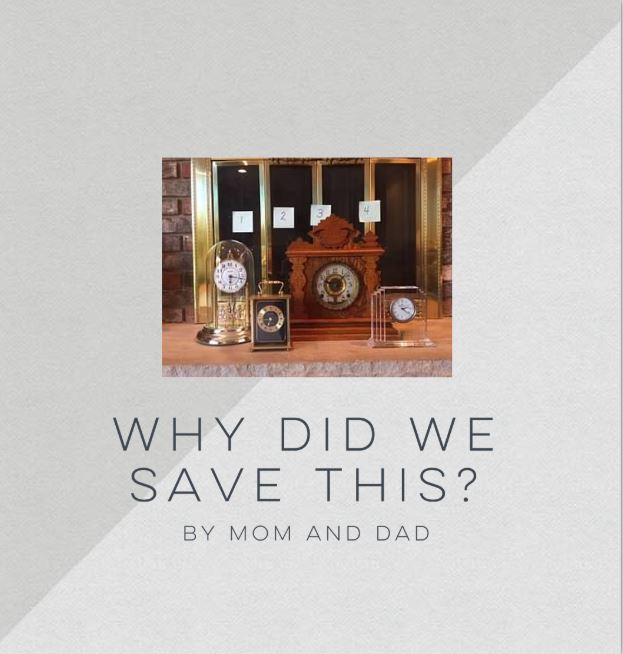
Jacquie came up with a great idea for making sure her daughters would know the stories of the individual items. She created a book with photos of each of the heirlooms, complete with captions that capture all the stories. That way, when the time comes, her daughters will be able to make informed decisions about which of these heirlooms they would like to keep. She titled the book, Why Did We Save This?

Jacquie spells out in detail how she went about creating the book (via Shutterfly), what it looks like, and what she’s done with the copies. This is such a helpful idea that I’m thrilled to share it! Thanks for allowing me to write about it, Jacquie!

Filed Under: Challenges, Genealogy tips, Preservation Tagged With: heirlooms, keepsakes

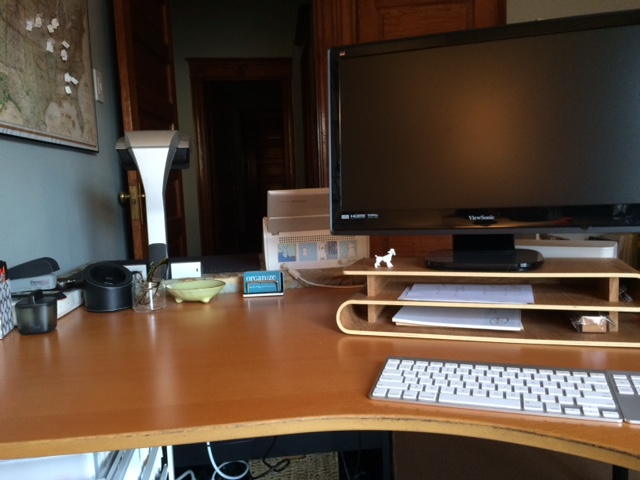
Now’s a good time to declutter your research desk!

May 13, 2020 By Janine Adams 6 Comments

I originally published this post in 2015 (and republished it at the end of 2016), and today I thought it might offer helpful information during this stay-at-home time. A lot of folks (including me) are taking the time to do some decluttering and organizing these days. Perhaps it’s because we’re surrounded by our stuff 24/7! As a professional organizer, I know a lot about tackling a messy desk (any kind of desk), so I share my expertise here, in case you’re up for some step-by-step instructions.

If you can’t remember the last time you saw your desktop in your genealogy research space, perhaps it’s time to experience the joy of a clean desk. I know that time to do genealogy research is limited for most people and the last way  you want to spend your precious genealogy time is on cleaning up your desk. But it’s worth it. When you sit down at a clear desk, your mind is more clear and you can be more focused on your research.

But there’s good news: It doesn’t have to be hard or time consuming. Here’s a step-by-step suggestion for creating some order on your desk, swiftly.

  1. Set your timer for 25 minutes.*
  2. Clear everything off your desk (and I mean everything except, perhaps, your computer). Put like things together into rough categories as you go. (For example, put papers together in a pile on the floor near your desk; put office supplies together, etc.) It might helpful to have some bankers’ boxes or plastic totes handy to hold the categories, but the floor will do too.
  3. Put away the items that already have homes. For example, put binders and books where they belong. If something belongs in another room, put it in a box or bin that you’ve marked “Relocate to another room” so you don’t wander away from the room you’re working on. At the end of the session, you can put all that stuff away.
  4. Go through the non-paper items and put back on the desk those things that deserve to take up such prime real estate. Only those things you use every research session should be placed within arms’ reach when you’re sitting at your desk (with the possible exception of items that give you great pleasure to look at). Relocate or discard the other non-paper items that were on the desk.
  5. Take all those papers and put them in a box of some sort. Mark that box “Backlog.” (I use a box similar to this one from IKEA for that purpose and I place that box on a shelf.)
  6. Every time you’re at your desk, set a timer for ten minutes and go through the papers in the backlog, discarding, scanning and/or filing as required. Do this ten minutes a day for as long as it takes to eliminate the backlog. (You might be surprised how few of these short sessions it takes.)
  7. Don’t add to the backlog box. Instead, at the end of each research session take the time (probably less than five minutes) to clear off your desk and put everything away. That way, you’ll start each session fresh.

* When your timer goes off, stop what you’re doing and take a five-minute break. Then set it for another 25 minutes and get back to work, unless you’re done.

Filed Under: Challenges, Organizing Tagged With: organizing aids

Exploring ICD codes on death certificates

May 1, 2020 By Janine Adams 9 Comments

Death certificates can provide such great information, which is why I always try to track them down. Often my eye makes a bee-line for the names of the parents of the deceased, but of course there’s much more information to be found. One area, cause of death, is always of interest. Unfortunately, that information seems to often be the most illegible. In the past, if I could make out the words I would add them to my database. But if I couldn’t, I’d just move along.

But I’ve learned that with a little more effort you can decipher the cause of death and learn more about your ancestor. Often, in addition to the written-out words describing cause of death, there’s a ICD (International Classification of Diseases) code as well. If you can’t read the words, you can look up the ICD code to get more information. Just visit the International Classification of Diseases page at Wolfbane.com to track down the meaning of the code.

Let’s use a death certificate from my great grandfather’s brother, Jesse Wiley Rasco (1978-1957), to illustrate this.

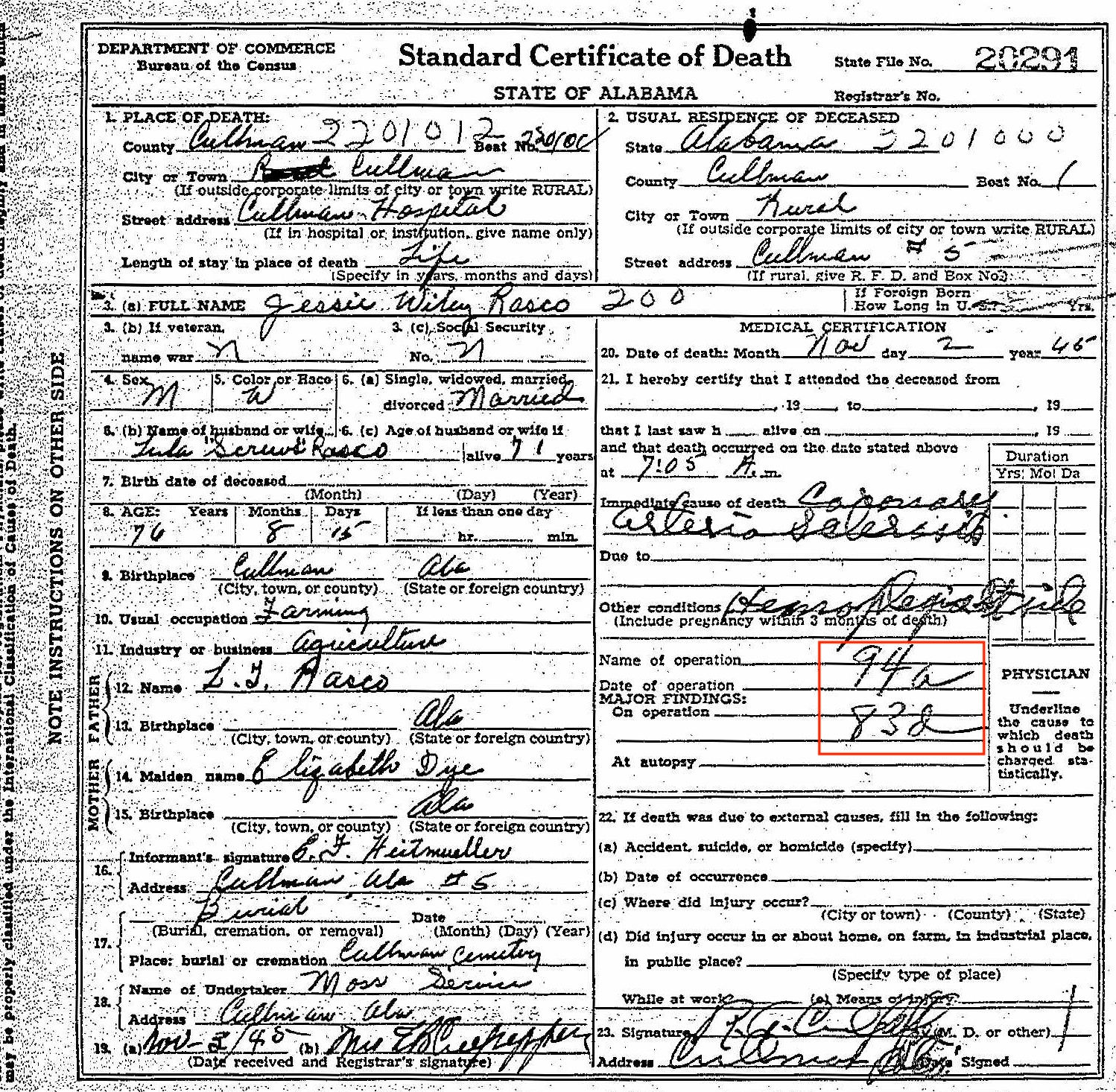
Here’s his 1945 death certificate. I’ve put a red border around the ICD codes.

Death certificate for Jesse Wiley Rasco


As you can see, the ICD code for the primary cause of death is 94a. And the ICD code for the secondary cause of death is 83d. I could read the words for the primary cause of death. To me, it looks like Coronary Arteriosclerosis. Ordinarily, I would have stopped there. But the secondary cause of death was hard to decipher and I was curious.

I went to the International Classification of Disease page at Wolfbane.com and clicked on ILCD Revision 5 (1938), which would have been the version in use in 1945, since the next revision came out in 1948. The codes are listed in numerical order, so it was easy for me to find 94a, “diseases of the coronary arteries.” The secondary cause of death, 83d, is “hemiplegia and other paralyses of unstated origin.” Once I read that, I could see the word hemiplegia in the handwriting. It’s hard to make out the word after, but it looks to me like it could be “stroke.” I looked up the word hemiplegia and learned that it means “Paralysis on one side of the body.” [Edited to add: I received a note from reader Dennis Young suggesting that the handwriting says “Rt. side.” That makes complete sense and now seems obvious! The plot thickened a little when I received a note from reader Brad Pierce suggesting that the words say Lt. side, not Rt. side. Brad’s a physician himself so is probably good at deciphering doctor’s handwriting! I can’t tell whether it’s left or right, but I’m so glad to accept the “side” part. Thank you Dennis and Brad!]

Knowing that this 76-year-old farmer was living with paralysis on one side of his body at the time of his death gives me a bigger picture of what his life experience (or least the end of his life) was like.

As you can see, taking time to look up ICD codes when you see them might provide you with more information about your ancestor or might even solve a mystery. Just be sure you’re looking at the pertinent Revision!

Filed Under: Challenges, Genealogy tips Tagged With: genealogy tools, rasco, research, vital records

  • « Go to Previous Page
  • Page 1
  • Interim pages omitted …
  • Page 36
  • Page 37
  • Page 38
  • Page 39
  • Page 40
  • Interim pages omitted …
  • Page 109
  • Go to Next Page »

about me

I'm Janine Adams, a professional organizer and a genealogy enthusiast. I love doing family history research, but I find it's very easy for me to get overwhelmed and not know where to turn next. So I'm working hard to stay organized and feel in control as I grow my family tree.

In this blog, I share my discoveries and explorations, along with my organizing challenges (and solutions). I hope by sharing what I learn along the way I'll be able to help you stay focused and have fun while you do your research, too.

tags

30 x 30 Adams amy johnson crow anniversary Brown cemetery census Civil War conferences connections dna electronic files Evernote excitement Family Curator family photos genealogy tools getting started goals How They Do It Igleheart Jeffries keepsakes learning opportunities maps newspapers NGS organizing aids overwhelm paper files planning quick tips rasco record keeping research research log research trip resources RootsTech social history source documentation Stacy Julian technology time management vital records

join the facebook community!

join the facebook community!

My organizing business

Learn more about my organizing business, Peace of Mind Organizing®.

Subscribe by RSS

  • RSS - Posts
  • RSS - Comments

© 2026 Janine Adams


Loading Comments...