• BLOG
  • ABOUT
    • Privacy Policy

Organize Your Family History

Stay focused and happy while exploring your roots

Take obituaries with a grain of salt

June 24, 2015 By Janine Adams 22 Comments

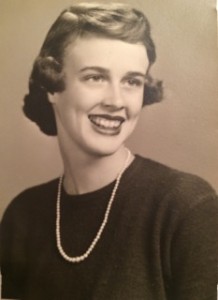
Take obituaries with a grain of saltMy mother, Betty Sue Brown Adams, died last week.  She was born on May 2, 1933 and died June 17, 2015. It felt very strange to add a death date to her entry in Reunion, my family tree software.

Since I’m a writer, my father asked me to write her obituary. Fortunately, we had had discussions about what she wanted in her obituary, so it was quite easy to write. I wrote it the day after she passed away and submitted to the local paper on June 19. It was published Sunday, June 21.

Yesterday, I was looking at the obituary and realized it contained an error, one that was completely my fault. It wasn’t a big deal–I wrote that she’d been a volunteer at the Blue Mountain Humane Society Gift Shop when in fact she’d been a volunteer at the Blue Mountain Humane Society Thrift Shop. It’s a subtle, but significant difference.

Seeing that error made me realize how easy it is for errors to be introduced into obituaries. I was writing with a clear head, with pre-planned information, into a document that I emailed to the newspaper. And yet an error showed up in print.

Just think how easily errors could be introduced into the obituaries of our ancestors: the writer may or may not have known the deceased person. The person who wrote the obituary may or may not be a good writer. The information may have been hand-entered for typesetting. There are so many ways an obituary can be made inaccurate.

So that’s today’s genealogy take away from my mother’s passing: Take obituaries with a grain of salt.

By the way, I wrote on my organizing blog yesterday about the importance of having the difficult conversation that will help make someone’s death easier for survivors. If you have loved ones near the ends of their lives, I encourage you to check it out.
Filed Under: Genealogy tips, My family, Reflections, Uncategorized Tagged With: Brown, obituary

Update on the Livescribe pen

June 19, 2015 By Janine Adams 2 Comments

In a comment on a recent blog post, reader Maria Tello mentioned that she would like to hear an update from me on how I use my Livescribe pen for genealogy.

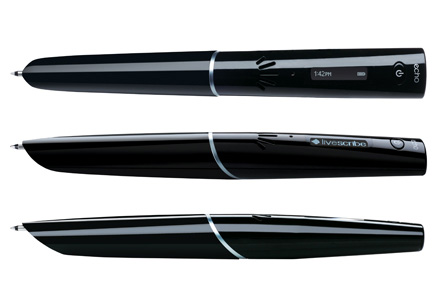
The Livescribe pen is a smart pen with a voice recorder in it that links the recording with the notes you are taking. So you can touch an area of your notes (taken in its special notebook) and hear what was being said when you took the note.

I bought my Livescribe Echo in 2013 and enthusiastically used it to take notes at conferences. In my blog post about it, I mentioned the ways I could see using it for genealogy.

True confession: The Livescribe pen is gathering dust in my desk drawer. It’s lost its luster for me. I realized that I never took the time to go back and listen to the recorded notes, which made the notes I did take less valuable (since I took fewer notes, assuming I’d listen to them).

I really do think it could be a very valuable for doing oral history interviews. I just haven’t used it that way.

It’s worth noting that since I bought my Livescribe Echo, the company has the Livescribe 3, which links with an iPhone/iPad app (as well as Android devices). It uses your device’s voice recorder, which makes the pen smaller. And the notes you take in your notebook are transmitted to the device. They can even be transcribed easily. I won’t be rushing out to buy it, since it turns out its utility for me wasn’t quite what I anticipated, but for those taking a lot of notes, I think it’s worth checking out.

Filed Under: Genealogy tips, Organizing Tagged With: excitement, genealogy tools, Livescribe smartpen, organizing aids, research, technology

Third edition of Evidence Explained is available!

June 13, 2015 By Janine Adams Leave a Comment

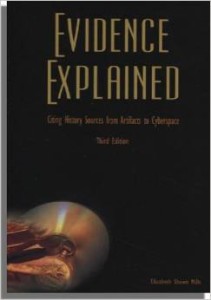
New edition of Evidence Explained is out!The newest edition of Evidence Explained: Citing History Sources from Artifacts to Cyberspace, by Elizabeth Shown Mills, has just been released. I ordered mine from Amazon last month and it arrived last week. Very exciting!

Evidence Explained is the gold standard for source citation. This new volume is a hefty 892 pages. It’s hardcover. And heavy. (And also available in an electronic edition.) But it contains within its covers the answers to knotty problems of how to cite a source. This edition includes updated information citing genetic sources as well as sources from the Internet.

Over the last few years that I’ve been doing more serious genealogy research on my family it has become very clear that citing and analyzing sources is the key to doing accurate, reliable research that holds up over time. Great source citation also helps other genealogy researchers who may want to use the data I’ve gathered because they can tell it’s reliable and find it themselves if they want. It may feel like extra work to create a proper source citation, but it’s the kind of thing that can pay dividends in the future. The hefty source I created for my ancestor’s Civil War pension records will allow me or any researcher to be able to find the source again. And its validity is apparent by the citation.

If you’re serious about your genealogy research and don’t have Evidence Explained on your bookshelf, the publication of this third edition might be just the reason to invest $54 to have it at your fingertips. If you already have the second edition, you can trade it in at Amazon for $29.74 credit and use it toward the third edition! (Thank you to Thomas MacEntee of Geneabloggers for this tip.)

I haven’t had a chance to use the third edition since it arrived last week, but as soon as I get a break from clients, I’m going to read Chapters 1 and 2 on basic principles and plan to consult the work frequently when I’m creating source citations.

Filed Under: Genealogy tips Tagged With: excitement, organizing aids, research, resources, source documentation, Thomas MacEntee

Processing Civil War pension files

June 2, 2015 By Janine Adams 23 Comments

Processing civil war pension filesAs I mentioned a couple of weeks ago, I received my 3d great grandfather’s Civil War pension files from the National Archives in record time. I’d been prepared to wait 45 to 120 days and it arrived the week after I submitted the request online.

I dug right in and started processing the information. I was so grateful that I had attended the class Anatomy of a Military Pension, presented by Certified Genealogist Julie Miller at the National Genealogical Society’s annual conference that month. She provided step-by-step instructions of what to do with a military pension.

So the day after I received that 65-page pension file, I did what Julie suggested. I put the documents in chronological order and I assigned a number to each. Then I figured out a citation for the overall file and a  citation for each of the numbered documents.

Coming up with a proper citation was a bit of a challenge and I emailed Julie, who was kind enough to share the citation she uses for these files. (She had given us that info in the talk, but I hadn’t written it down.)

Here’s the citation I’m using for the overall pension file for my ggggrandfather, Richard Anderson Jeffries:

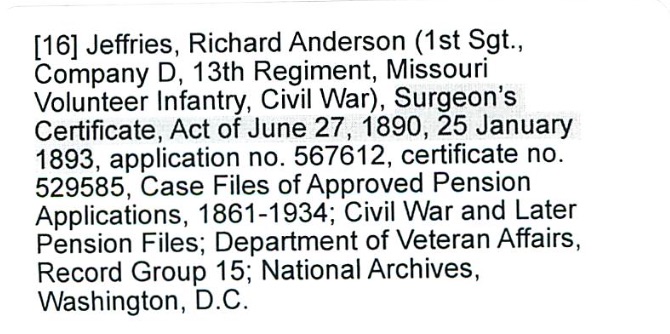
[278] Jeffries, Richard Anderson (1st Sgt., Company D, 13th Regiment, Missouri Volunteer Infantry, Civil War), application no. 567612, certificate no. 529585, Case Files of Approved Pension Applications, 1861-1934; Civil War and Later Pension Files; Department of Veteran Affairs, Record Group 15; National Archives, Washington, D.C.

278 was the next number in my source list in Reunion, my family tree software. Each of the individual documents is numbered, starting with 1, and has its own citation. My intention is that when I enter a fact into Reunion, I’ll use Source 278, but I’ll include in the detail field which of the 26 individual documents that particular fact came from.

I created citation labels for each of the documents and affixed them to the appropriate pages. (That’s the citation for document 16 above.) Then I scanned the whole document into a pdf. I elected to have one pdf, rather than 26 individual ones–time will tell whether that was a good choice. (Edited to add a year later: Yes! That was a great choice.)

The next step, according to Julie is to transcribe the documents. Yes, I’m going to type word for word exactly what is on the documents. Julie urged us not to skip that step because when we transcribe, we learn things we would not otherwise learn.

After I transcribe, I will abstract the documents, so I can tell at a glance what they are and what info is contained within each. And then I’ll enter the new-found facts into Reunion, my family-tree software.

That’s a lot of work, but I’m delighted to have learned how to be thorough with it. And I know I’ll learn so much about my ancestor.

I am so grateful to have this structure, because just a few days after receiving Richard Anderson Jeffries’s file, I received the pension file for my gggrandfather, George Washington Adams. That file is over 100 pages; I had to request and pay for the rest of the file (another 80 pages) to be copied–I’m still waiting for part two. That same week I received the third and final pension file, for another gggrandfather, Benjamin Franklin Igleheart. All three pension files, probably 250 pages, came within two weeks of my request.

If I did not have the structure Julie provided in that talk to thoroughly process the information, I know I would feel overwhelmed. I would probably skim the documents, pluck out a few easy-to-find facts, and put them away intending to get to them later. And I don’t know when later would be.

I have skimmed the most recently received pension files to get a preview what I’m going to learn. (G.W. Adams had a big dispute about the amount of his pension–an adversary in the Soldier’s Home turned him in for saying he was more disabled than he was!) But I’m not going to analyze them until I’m finished with Richard Anderson Jeffries. So that will be motivation to go through the process.

I think these pension files are going to be a great learning experience not just about my ancestors, but also about doing proper genealogical research. This feels great!

Filed Under: Challenges, Genealogy tips, Organizing Tagged With: Adams, Civil War, excitement, Igleheart, Jeffries, overwhelm, record keeping, research, source documentation

  • « Go to Previous Page
  • Page 1
  • Interim pages omitted …
  • Page 84
  • Page 85
  • Page 86
  • Page 87
  • Page 88
  • Interim pages omitted …
  • Page 106
  • Go to Next Page »

about me

I'm Janine Adams, a professional organizer and a genealogy enthusiast. I love doing family history research, but I find it's very easy for me to get overwhelmed and not know where to turn next. So I'm working hard to stay organized and feel in control as I grow my family tree.

In this blog, I share my discoveries and explorations, along with my organizing challenges (and solutions). I hope by sharing what I learn along the way I'll be able to help you stay focused and have fun while you do your research, too.

tags

30 x 30 Adams amy johnson crow anniversary Brown cemetery census Civil War conferences connections dna electronic files Evernote excitement Family Curator family photos genealogy tools getting started goals How They Do It Igleheart Jeffries keepsakes learning opportunities maps newspapers NGS organizing aids overwhelm paper files planning quick tips rasco record keeping research research log research trip resources RootsTech social history source documentation Stacy Julian technology time management vital records

join the facebook community!

join the facebook community!

My organizing business

Learn more about my organizing business, Peace of Mind Organizing®.

Subscribe by RSS

  • RSS - Posts
  • RSS - Comments

© 2026 Janine Adams


Loading Comments...