• BLOG
  • ABOUT
    • Privacy Policy

Organize Your Family History

Stay focused and happy while exploring your roots

My progress-tracking spreadsheet

August 31, 2025 By Janine Adams 16 Comments

I wrote this post, which is one of the most-read posts on this blog (more than 31,000 views!), way back in 2013. It got a great response, so I thought I’d run it again for newer readers. For me, being able to see at glance which documents I’ve found (or need to find) for my ancestors has been really helpful. I hope you find the post useful!

My memory is not what it used to be. And I’m finding the more family history research I do, the more I’m duplicating effort. In the process of researching one person, another person will pop into my mind. I’ll look for a record for that person, rejoice in finding it, then realize I’d already found it!

So in an effort to avoid that, as well help me in my never-ending quest to not feel overwhelmed about my genealogy research, this past weekend I created a series of progress-tracking spreadsheets. I was inspired by Miriam’s Census Spreadsheet, which is a Google Doc. I’m a Mac user and I used the Numbers program (similar to Excel) to create three spreadsheets (so far) that track progress, by ancestor, on finding the following records:

Sheet 1: BMD

  1. birth records
  2. marriage records
  3. death records
  4. burial records
  5. grave photos

Sheet 2: Censuses

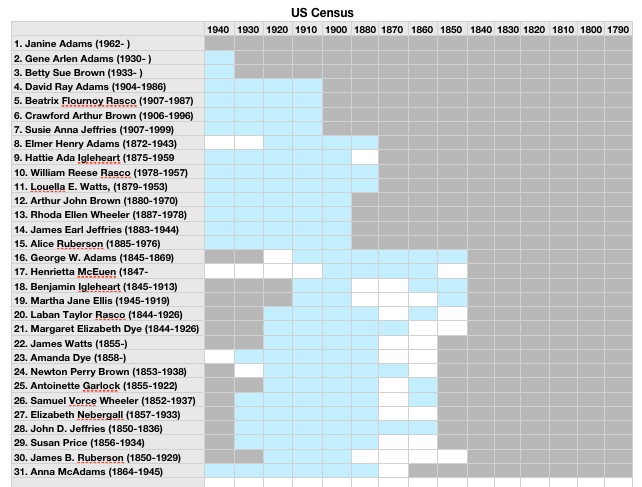
On the first table (pictured above) I have a row for each ancestor (this is a work in progress…I’ve been adding info a generation at a time and up to my great-great grandparents), and a column for each U.S. Census. I fill in the square in blue if that record was found. A grey square indicates the ancestor wasn’t alive for that census. A blank (white) square indicates I still need to find this record. I also have a table of state censuses, so I can note those.

Sheet 3: Military

Here I track what military records I’ve found for each ancestor, by war or conflict. This one’s definitely a work in progress.

Going through this process helped me realize how much census work I’d done and how much more work I had to do to find birth, marriage and death records. I think these charts will help me feel a sense of accomplishment and also help me hone in on work that needs to be done. I’ll keep adding ancestors from Reunion, until I’m caught up, and then plan to keep up with the spreadsheet as I find more records.
Filed Under: My family, Organizing Tagged With: organizing aids, overwhelm, planning, progress log, research, research log, resources

Revisit: Reading hard-to-read gravestones

June 24, 2025 By Janine Adams 4 Comments

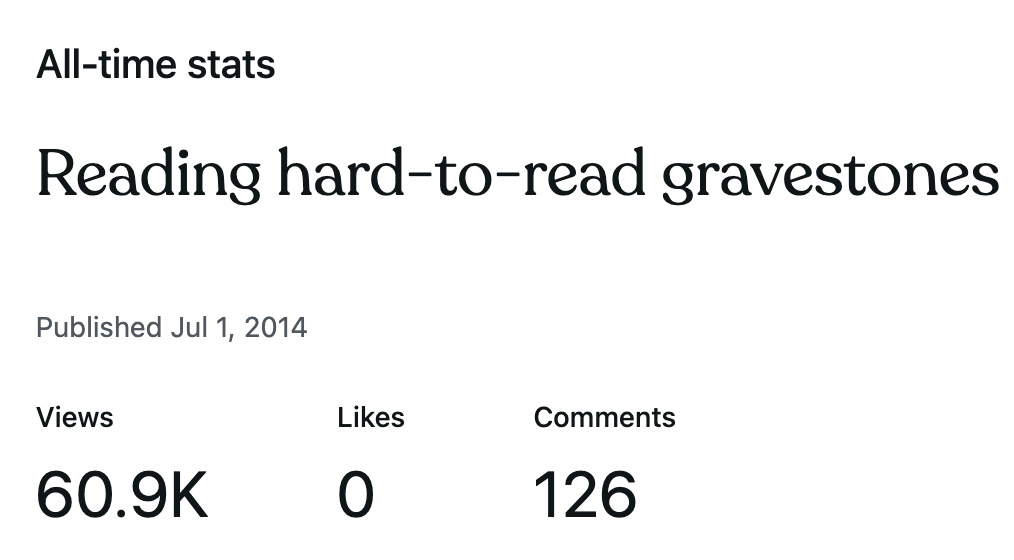
This article, which I published almost exactly 11 years ago, on July 1, 2014, is easily my most-read blog post. I looked at the stats today and saw that it has had almost 61,000 views in the past 11 years. That’s a lot of views for my little blog. I thought I’d re-run it today for readers who may not have seen it before.

My family reunion was last weekend and I had a great time. Family members were so warm and welcoming to my husband and me despite the fact that my branch of the family had not been represented at that reunion in a couple of generations. I was given family pictures (some of which I’ll probably scan and share here) and well as a painting that my grandmother had painted. It was a great weekend.

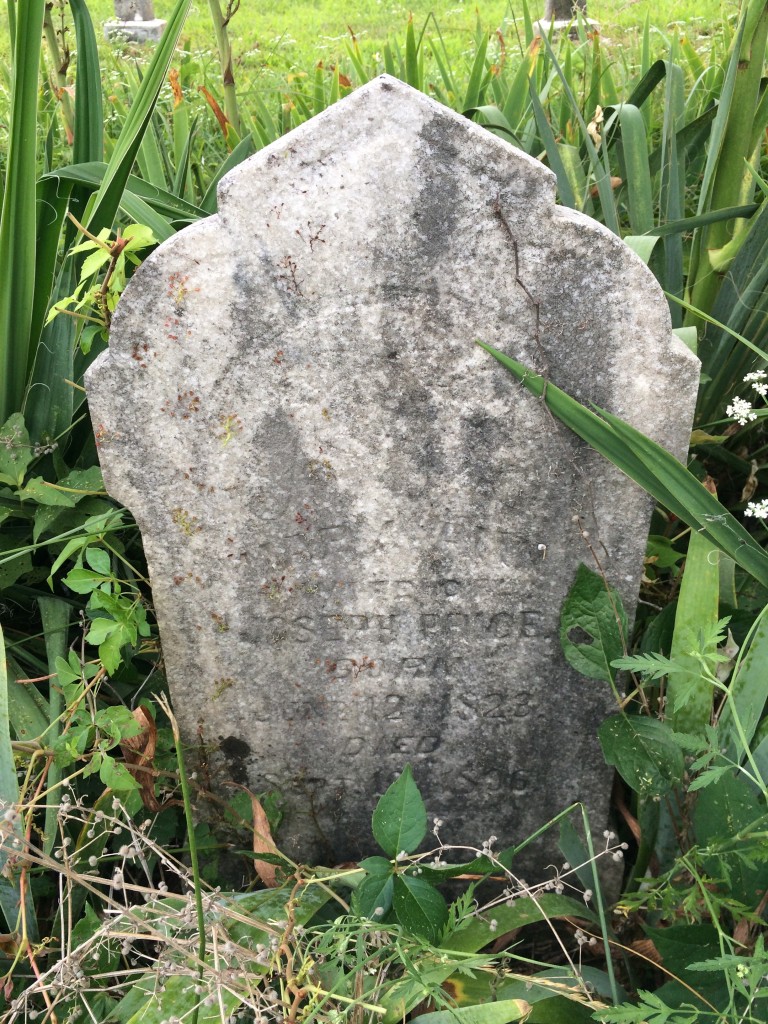
On Saturday, my husband and I paid a visit to the cemetery where my grandmother’s ancestors were buried. (This was a reunion of people from my grandfather’s side of the family, so it was an adjunct activity.) I had visited that cemetery, Meyer Cemetery, last year when I traveled to western Missouri.  Three generations of Jeffries are buried in that cemetery:  my great grandfather, James Earl Jeffries;  his parents, John D. Jeffries and Susan Price Jeffries; his in-laws, John Price and Mary Puffenbarger Price; and his grandparents, Richard Anderson Jeffries and Harriet McKinley Jeffries. I wanted to capture some more photos of the gravestones, as well as find the graves of the Prices, which I hadn’t seen on my first visit.

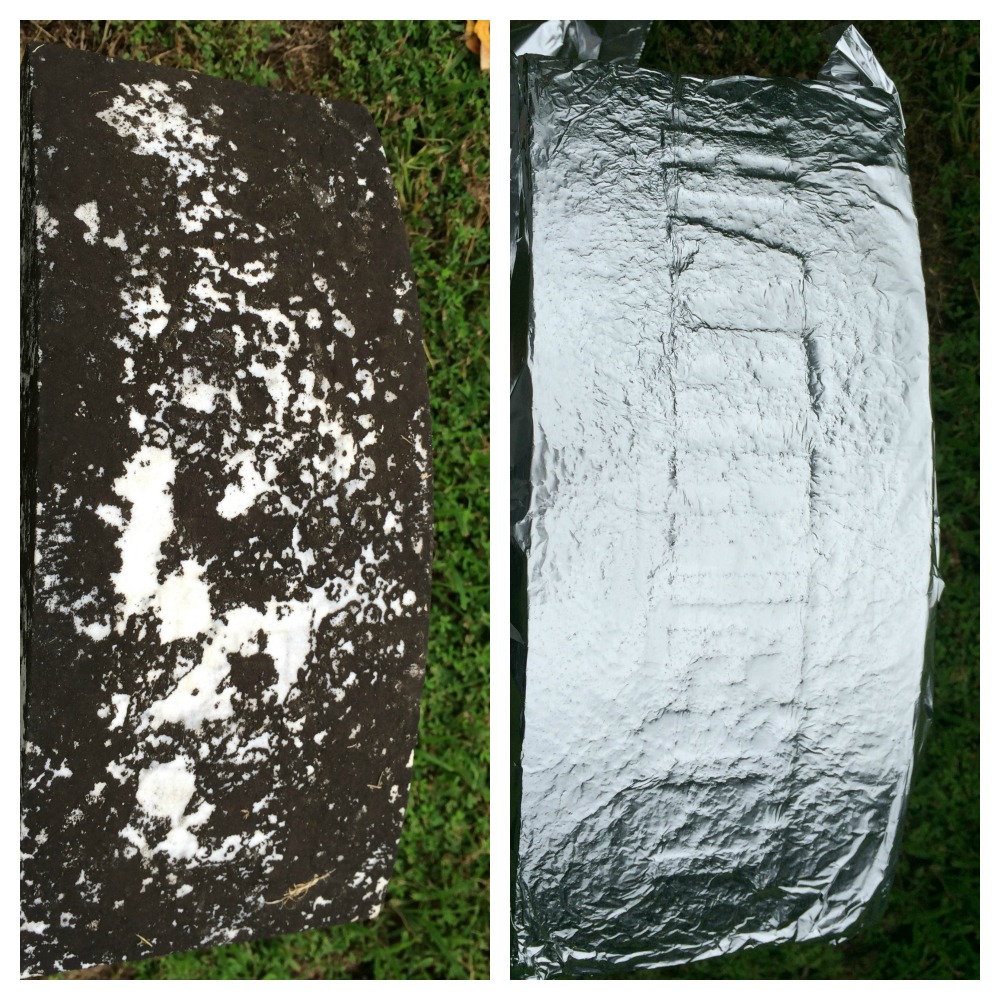
Fortunately for me, I’d learned just the prior week about using aluminum foil to make reading hard-to-read gravestones much easier. I’d seen a link to a blog post called safe solutions for hard to read tombstones on the fabulous Organized Genealogist Facebook page. That post described how you can cover a gravestone with foil and gently rub it to make the hidden words on a gravestone almost magically appear. The post linked above suggested using a clean makeup brush. I didn’t have one so I dug around a bit more on the web and found a post on Save a Grave that suggested using a damp sponge.

So I went to the dollar store and bought some cheap aluminum foil. I grabbed a sponge from under the sink and was ready to head to the cemetery the next day. The method really felt like magic.

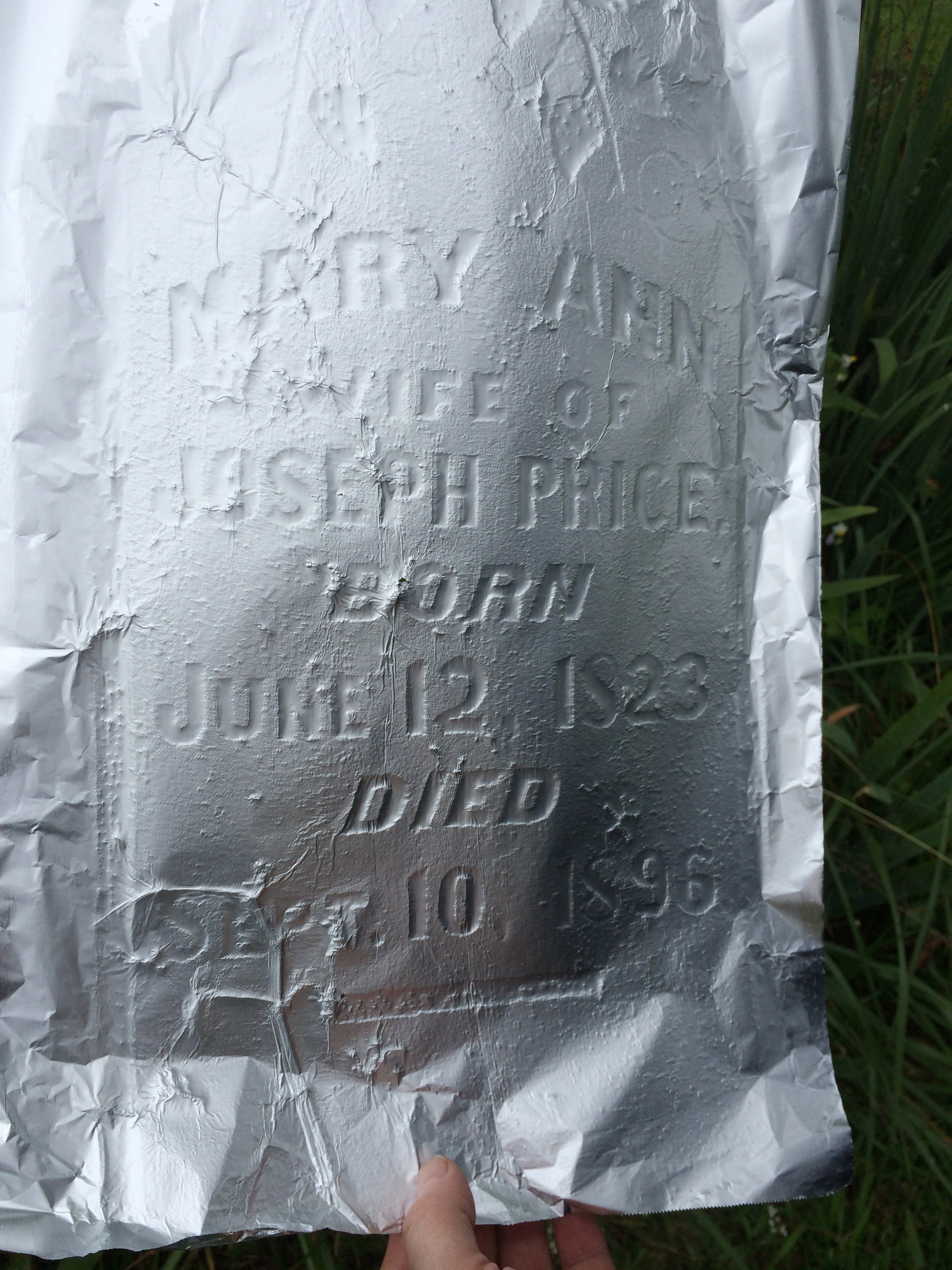
This is the stone of the Mary Ann Price, my great great great grandmother.

Foil can make hard-to-read gravestones legible

Cover it in foil and rub and voila, the writing emerges.

Foil can make hard-to-read gravestones legible

There’s a gravestone  right next to my great great grandfather’s grave. The top of that same stone was so worn and dirty you couldn’t really tell that there was a name on it. But when I covered it in foil and rubbed it with a damp sponge, the name “Harriett” appeared. Amazing!

aluminum foil can make hard-to-read gravestones legible againI love this method! The downside is that, unlike gravestone rubbings–which I learned are harmful to the gravestone–it’s not easy to keep and store foil rubbings. I consider them temporary and my digital photo of the rubbed stone to be my permanent record. I can’t quite get myself to throw away the foil (it’s driving around in the back of my SUV), but soon I expect I’ll put it in the recycling bin. [ETA in 2025: I recycled it shortly thereafter!]

Filed Under: Excitement, Genealogy tips, My family, Preservation Tagged With: Brown, cemetery, excitement, genealogy tools, Jeffries, Price, resources, revisit

Contact that courthouse: It might pay off!

April 11, 2024 By Janine Adams 2 Comments

Not all genealogy documents are available on the internetIt can be challenging for me to pick up the phone or even send an email when I can’t find what I’m looking for online. But in 2017, when I originally wrote this post, I had a beneficial experience by doing just that. I thought you might appreciate this little nudge to step away from your online searching, so I’m running this post again.
Like many people, I rely primarily on documents I find by searching the internet. When do I library or cemetery research trip, I find information not available online, but when I’m in my office, I search online and if I don’t find what I’m looking for I typically move on.

I know it’s possible to contact courthouses or state archives for documents but over the years I’ve done little of that. In the last couple of weeks, however, I hit the jackpot when I took that extra step.

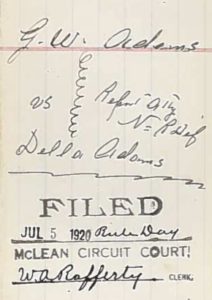
I’ve been working on transcribing the Civil War pension file of George Washington Adams, my 2nd great grandfather. In it was a divorce decree for his 1920 divorce from his second wife, Della. (I’m descended from his first wife, Henrietta.) That piqued my curiosity because it gave George custody of their “infant son” and the only son I knew about was 12 at the time of the divorce. I wondered if there was another son and also why the 75-year-old father was given custody over the 50-year-old mother. The decree referred to pleadings and depositions in the case and I wanted to get my hands on those. It was Christmas, so I couldn’t pick up the phone (and I don’t like picking up the phone), so I wrote a letter to the Circuit Court Clerk of McLean county, Kentucky.

To my delight, just a few days letter, she got back to me telling me that the documents I sought were in the State Archives and giving me a little extra information to make easier for the archivist to find them. She also gave me a phone number for the Archives. So I called and talked to a lovely young man and gave him a credit card number. That very same day he emailed me photos of the entire file. I think it cost me $8. If I’d wanted, he would have mailed a certified copy but I didn’t want to wait that long. (And get this: He added another divorce petition that I didn’t even know about! Six years into their 14-year marriage, Della filed for divorce from George, but she must have dropped it.)

The 30-page divorce file he sent had numerous depositions and probably sparked as many questions as it answered, but it’s another treasure trove. Turns out there was only one son from this marriage, Horace, who was indeed 12 at the time of the divorce. Apparently the word infant was used differently 100 years ago! But George went into the Old Soldier’s Home just two years later, so now I need to find out what happened to teenage Horace! [Note from 2024 Janine: I did find Horace on the 2020 census living with his older half brother.]

Neither the pension file nor this divorce file are available online, though I did order the pension file online. Both are outstanding sources of information about this ancestor. I’m processing the divorce file like I’m processing the pension file, by transcribing the documents and properly sourcing every fact I glean from them.

I encourage you to look beyond those documents available online, even if you’re not in a position to travel. There’s a whole world of documents that haven’t yet been digitized!

Filed Under: Challenges, Excitement, Genealogy tips, My family Tagged With: Adams, courthouse, research, vital records

My process for downloaded documents

May 5, 2023 By Janine Adams 4 Comments

Life’s a little nuts right now, so rather than creating a new post, I’m re-running this post from October 20, 2017 in which I describe my workflow for a document I downloaded from the internet. Almost six years later, the process hasn’t really changed! For more detailed information on how I process digital documents, check out How I Do It: A Professional Organizer’s Genealogy Workflow, a 37-page downloadable pdf available for $19.99.

Last March, I wrote a post called My digital workflow that detailed what I do with a document I find on the Internet. (I never print it.) My digital workflow has not changed since then and it’s working out really well for me.

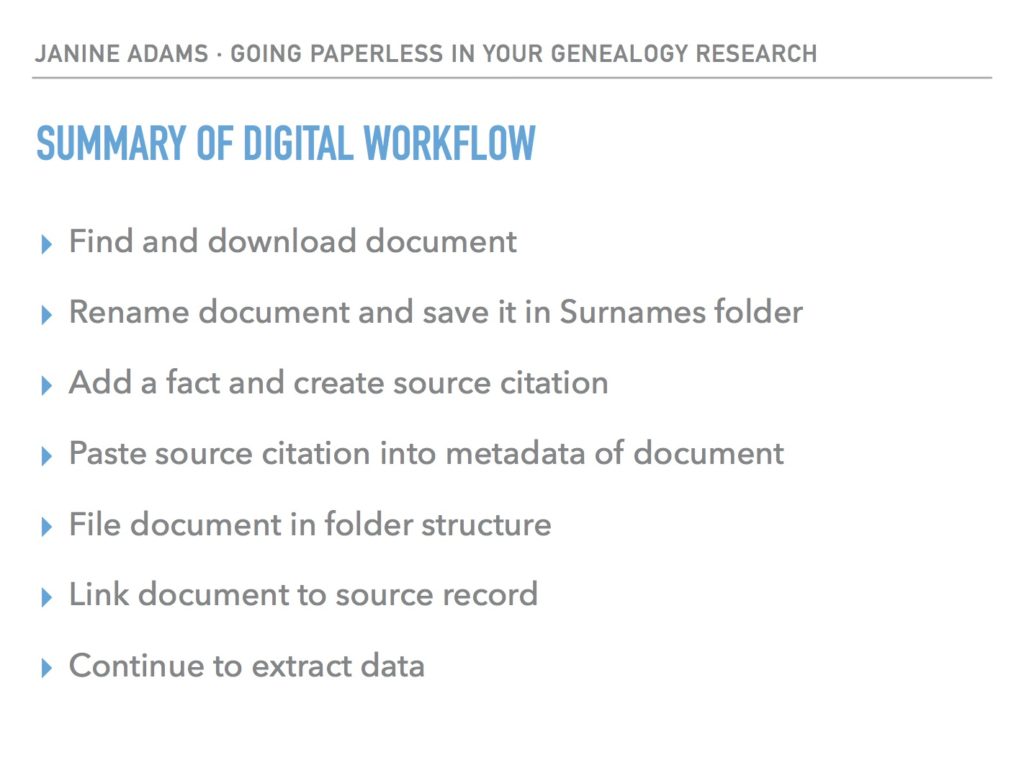
Last weekend, I did a talk at the St. Louis Genealogy Conference about going paperless and in my Powerpoint I included screenshots of the digital workflow and also a summary slide. The attendees asked for copies of the summary slide, so I decided to post it here.

The process is basically the same as my March post but I switched up the steps a little.

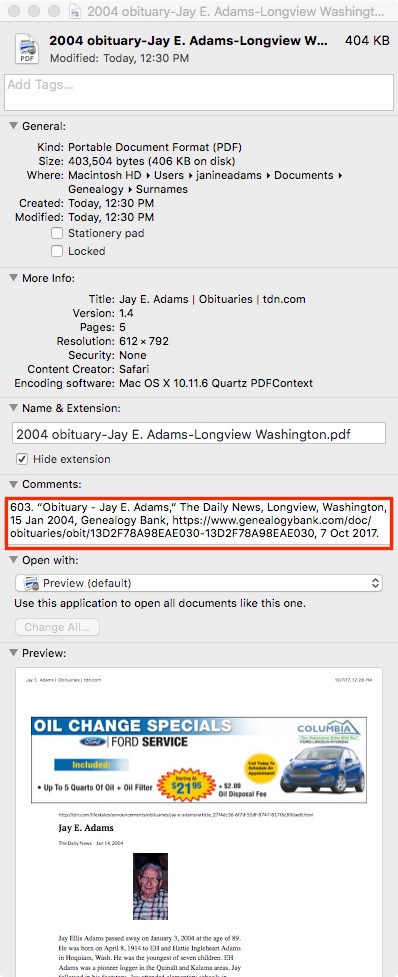
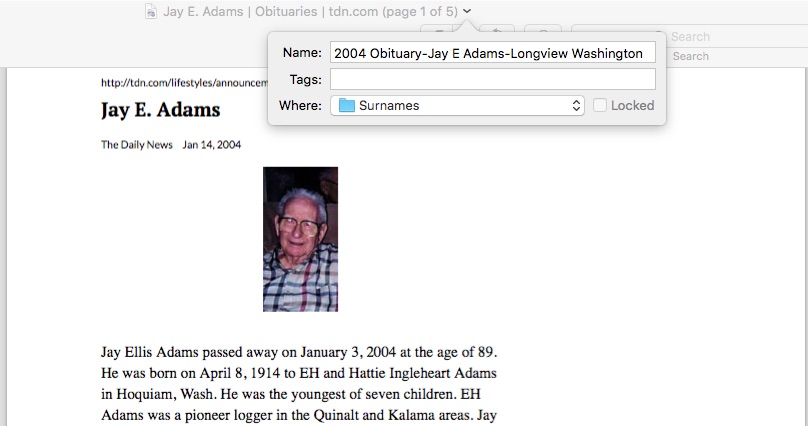
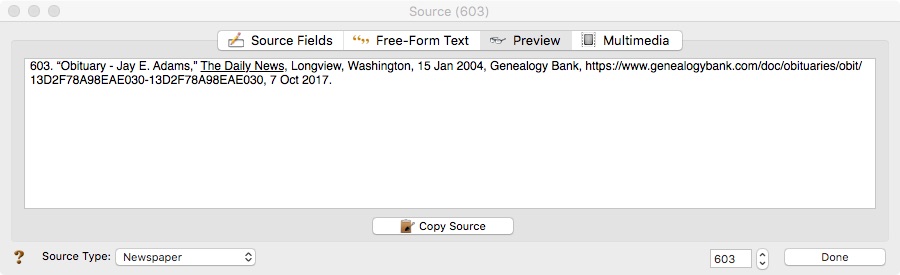
The example I used in my talk was my father’s uncle, Jay Ellis Adams (1914-2004). I had found his obituary online at the newspaper’s website. Here’s the workflow:

1. I click Print and, in the printer dialog box, Open in Preview (my Mac’s default pdf reader), which downloads the document to my computer. (If it had been a document at Ancestry, I would have clicked Save, then Save to My Computer.)

2. I immediately rename the file, using my file-naming protocol, which is Date Type of Document-Ancestor Name-Locality. I stick it into my Surnames folder, as a temporary holding place until I file it in step 6. I know that any unfiled documents in the Surnames folder require processing.


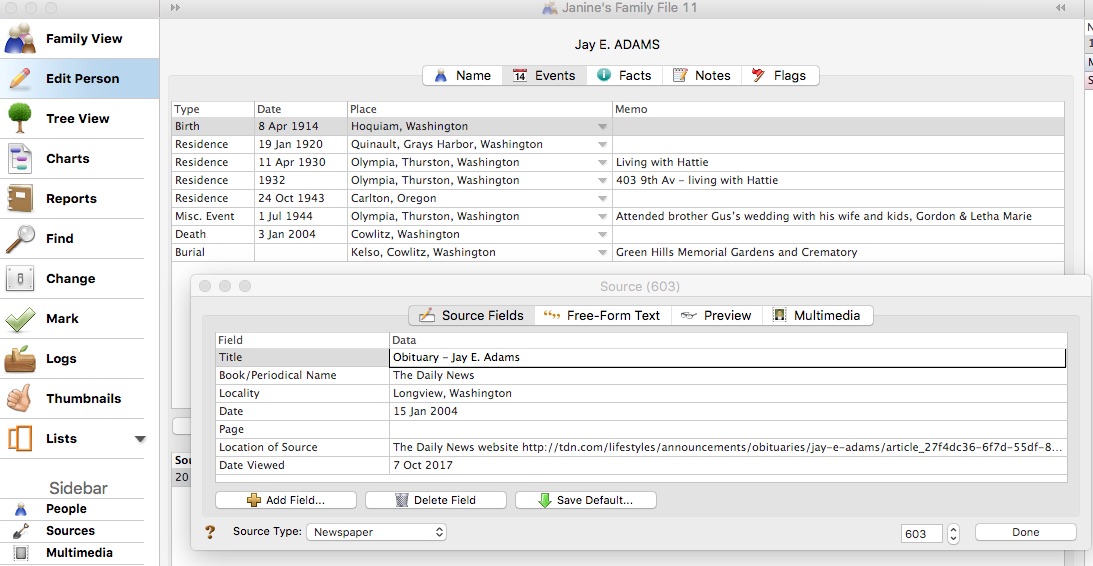
3. I select a fact from the document, add it to Reunion and create a source citation for it.


4. In Reunion, I click the Preview tab in the source record and then click Copy Source. (For the eagle-eyes among you, I originally found a transcript at Genealogy Bank and used that as the source citation. Then I decided to go to the newspaper’s website and download it from there, so I changed the source citation. But I was too lazy to take a new screenshot.)

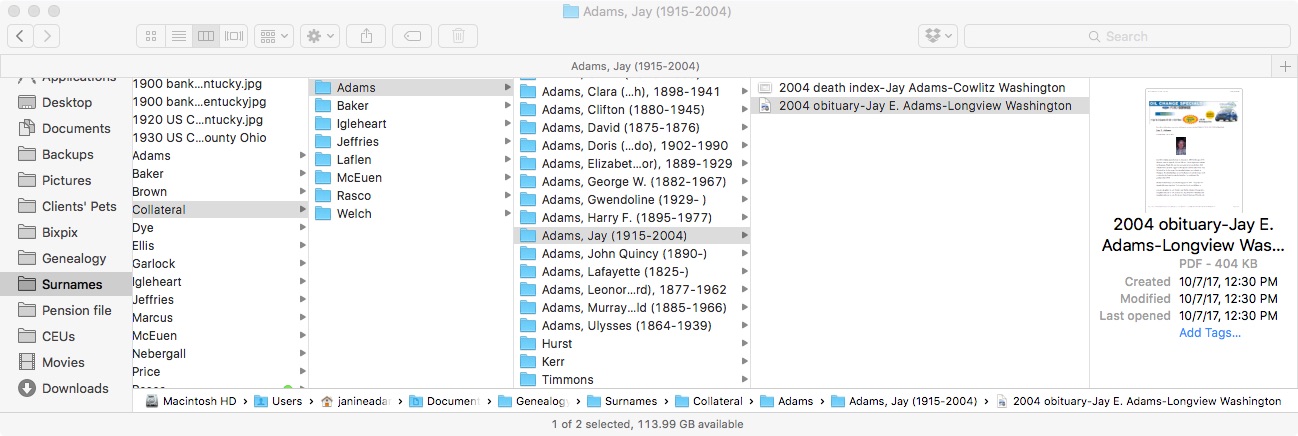
5. I paste the source citation into the metadata of the source document (the obituary) by Ctrl-clicking on the file and selecting Get Info from the menu that appears, then pasting into the Comments area.


6. Then I file the document into my folder structure. My folder structure for collateral relatives is Genealogy/Surnames/Collateral/[Surname]/[Name of Ancestor (YOB-YOD)]. If the document  applies to multiple people, I duplicate it for each person and then drag it into the appropriate folder for each person. But I don’t take the trouble to rename it.

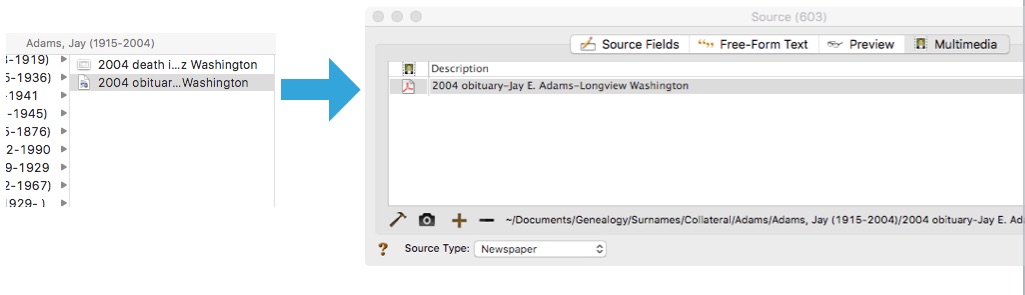
7. The final step is to drag the document into the Multimedia area of the source record in Reunion. This creates a link to the document so that I can open it up inside Reunion, which is very handy.


From there, I continue to extract information from the source document and add that it to Reunion. Every piece of information I glean from a single source document uses the same source number, no matter what person it applies to.

Here’s the summary slide:

This is the way I do and it works well for me. Of course, it’s not the only way to do it or perhaps the best way to do it. But I’m hoping you’ll find it useful to see my workflow. I’ve been processing documents this way for almost a year now and it’s working very well.

Again, for more in-depth information on how I organize my own genealogy, check out How I Do It: A Professional Organizer’s Genealogy Workflow, a 37-page downloadable pdf available for $19.99.

Filed Under: Challenges, My family, Organizing, Technology Tagged With: Adams, electronic files, organizing aids, record keeping, source documentation

  • Page 1
  • Page 2
  • Page 3
  • Interim pages omitted …
  • Page 34
  • Go to Next Page »

about me

I'm Janine Adams, a professional organizer and a genealogy enthusiast. I love doing family history research, but I find it's very easy for me to get overwhelmed and not know where to turn next. So I'm working hard to stay organized and feel in control as I grow my family tree.

In this blog, I share my discoveries and explorations, along with my organizing challenges (and solutions). I hope by sharing what I learn along the way I'll be able to help you stay focused and have fun while you do your research, too.

tags

30 x 30 Adams amy johnson crow anniversary Brown cemetery census Civil War conferences connections dna electronic files Evernote excitement Family Curator family photos genealogy tools getting started goals How They Do It Igleheart Jeffries keepsakes learning opportunities maps newspapers NGS organizing aids overwhelm paper files planning quick tips rasco record keeping research research log research trip resources RootsTech social history source documentation Stacy Julian technology time management vital records

join the facebook community!

join the facebook community!

My organizing business

Learn more about my organizing business, Peace of Mind Organizing®.

Subscribe by RSS

  • RSS - Posts
  • RSS - Comments

© 2026 Janine Adams


Loading Comments...