• BLOG
  • ABOUT
    • Privacy Policy

Organize Your Family History

Stay focused and happy while exploring your roots

How They Do It: Michael Lacopo

March 7, 2017 By Janine Adams 16 Comments

I’m excited to present the third installment of my How They Do It series, which I publish on the first Tuesday of each month.  For this series, I’ve reached out to genealogy luminaries whom I admire and asked them to talk about how they organize their own genealogy research. If you missed the first two Q&As from the series, with Thomas MacEntee and Denise May Levenick, please check them out!

Today’s Q&A is with Michael Lacopo, known to many for his Hoosier Daddy blog. Michael is a professional genealogist, a non-practicing veterinarian, and a thoroughly enjoyable (and knowledgeable) lecturer. I’ve had the pleasure of hearing him speak at several genealogy conferences.

I found myself nodding a whole lot when I read his responses to my questions. I agree with his advice (and I especially agree that you are organized if you can find what you’re looking for). I love that he, like me, uses Reunion. I hope you enjoy this interview as much as I did!
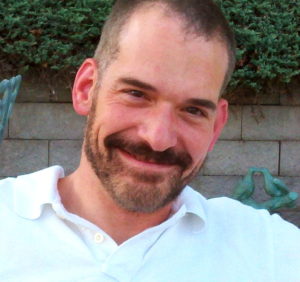
Q&A with genealogist Michael LacopoHow They Do It: Michael Lacopo

How long have you been doing genealogy?

I started doing genealogical research before I knew there was a name for it. I had a bunch of great-great-aunts, and I was always asking, “HOW are they my great-great-aunts?” So I was making basic trees as long as I remember. In 1980, I found a book at the library about genealogy and realized there was a name for what I was already doing. I was a nerd child. I still am.

What’s your favorite part of doing genealogy?

I love the problem solving; the analysis. I am drawn to the most difficult research quandaries that nobody else has solved.

Do you consider your genealogy research well organized?

I can mostly find what I am looking for, so I would say yes…. mostly.

What type of software do you use for organizing your genealogy research?

I am asked often about software for a great number of genealogical tasks, and frankly I don’t use a lot of programs. I am a Mac person from way back, so I use Reunion as my family tree software. Since the note field for each individual can hold an infinite amount of characters, I tend to keep my notes, research logs, and source citations within that program. When I want to make timelines or spread sheets, I used Microsoft Word or Excel. I keep it simple.

Do you keep a research log? If so, what format?

As stated above, my log is mostly kept in my family tree software. I also have separate surname files in Mac Mail, so any correspondence regarding a certain family is kept in easily sorted files within my mail program.

Do you have a tree on Ancestry? If so, is it public or private? Why?

I have a very basic tree on Ancestry that is public.

What’s your biggest challenge when it comes to organizing your genealogy?

Sheer volume. I am constantly downloading, searching, creating, note-taking, etc. People are appalled at the sight of my computer desktop, as any new material I am working on or have obtained goes there before I put it into computer files. I wish I could say I am an “organize as you go” kind of person. I am not. I tend to do a lot of my organizing when I am sitting on long flights or in airports on layovers.

What’s your biggest piece of advice to beginning genealogists in terms of keeping track of their research?

I try to preach the five-step mantra of the Genealogical Proof Standard, and not just for problem solving, but for genealogy in general. One of those is accurate and complete source citations. I try to tell beginners this is the drudgery of genealogy – making sure you always note your sources and what you found and what you DID NOT find. Organization is a very individualistic thing, so I don’t care how you organize it or file it or retrieve it… just make sure you DO it.

What do you think is the most important thing for people to do to stay organized when it comes to family history research?

Well, I should say “organize as you go,” but I just confessed that I don’t do that very well, so I can’t very well preach what I don’t practice. It may be a bit off the topic of the question, but I urge genealogists to be more than “information collectors.” I want them to be be “information analyzers.” Having 100 pieces of information on your ancestor John Smith means nothing unless you can interconnect those 100 pieces and make sense out them, or let them lead you to new information. No matter how you organize, make sure you keep sight of the fact that your connecting, not just adding to. Timelines are a great way of doing this.

If you were starting out new as a genealogist what would you do differently?

I’d probably do what I already preached above. I would document, document, document. There are so many times I will come across a date or a name I added to my family tree decades ago, and I will think, “How do I know that?” There is no documentation. No source citation. The same goes for negative findings. You have to keep track of what you looked at and what it did NOT tell you as well. That will keep you from looking at the same thing again long after you have forgotten you have already looked there! I think it is also important for genealogists to make notes regarding the sources they use that are more physical and descriptive in nature. This is not intuitive, and it is something I do not hear taught very often. For example, is it a typescript or is it hand-written? Is it chronological or alphabetical? Are there pages missing? Is coverage complete or spotty? Is it indexed or did you read it page-by-page? Is the handwriting different or uniform throughout? Trust me, these are things that DO make a difference in your analysis, and you WILL forget them years later unless you write it down.

Do you keep paper or electronic files (or both)?

I keep both. Many of my pre-computer era documents and notes are in paper files. I add to them periodically when I have tangible documents that need to be filed. I would love to find the time to scan all that into computer files, but I do not see that happening any time soon. Much like my email folders, I have folders on my computer dedicated to surnames. Subfolders exist within those folders that may be, for example, “Dauphin County, Pennsylvania, Deeds” or files for individuals within that surname.

Are you folder or binder person for your paper files?

Folder, definitely. I started with binders in the 1980s, but I had so many it became burdensome.

Do you use Evernote, One Note or any other electronic organizing system for your genealogy? If so, how do you use it?

Evernote appears to be a fantastic tool. I don’t use it. I probably should. Unfortunately, I am one of those perfectionists who want to understand all the aspects of something before I use it. I don’t like trial-and-error. I need five instructional courses, a couple online seminars, fifteen YouTube videos, and a manual before I feel I can tackle something. So I stick with what is working for me so far…. until it stops working.

Do you have a dedicated space in your home for doing genealogy research? What’s it like?

I have a full basement that is mostly finished. It is large enough to accommodate two computer stations, five monitors, about 7500+ books in an organized library, a sitting area, and a bar (that was there when I moved in). It is an AMAZING workspace…. but it is a basement. It gets a bit claustrophobic at times, especially when you lose track of whether it is day or night.

Do you have anything to add?

This is where I will probably be preachy, but if this interview reaches those new to the genealogy world, I want them to know that the Internet is a bittersweet trap. You will never solve your tough genealogical problems by using only online sources. There is so much more out there that will never see the light of digitization. Furthermore, with great Internet power comes great responsibility. Much like advocating for persistent and accurate source citation, you must never fall into the trap of family trees that look great but lack the citation or the thought processes behind them. The Internet has brought amazing things to the fingertips of genealogists, but it has also perpetuated garbage at a phenomenal rate. Don’t duplicate, replicate, copy-and-paste, or blog about something until your own research has proven it to be true. And call out others (nicely, of course) when they publish a connection that is obviously false. Genealogy used to be about sharing, but the Internet has unfortunately made it a bit more anonymous. Help each other, say please and thank you, ask for advice, accept well-meaning criticism. That is how we make progress.

There is so much wisdom in Michael’s delightful responses. I particularly love this bit of advice to genealogists: “Help each other, say please and thank you, ask for advice, accept well-meaning criticism.” If you haven’t yet read Hoosier Daddy, this little peek at Michael’s genealogy life will make it even more enjoyable. (Be sure to read from the blog from the bottom.) Michael has taken a hiatus from blogging but mentioned to me that his plans are to make 2017 a blogging year: “There is more to tell. Genealogists have good stories.” Let’s hope he recommences regular blogging  soon!

P.S. Michael’s Facebook page, Roots4U, lists his lecture schedule if you’re interested in hearing him in person.
 

Filed Under: Challenges, Excitement, Genealogy tips, Organizing Tagged With: How They Do It, Michael Lacopo, organizing aids

Organizing interview on Amy Johnson Crow’s blog

March 3, 2017 By Janine Adams 4 Comments

When I was at RootsTech, I had the honor of being interviewed by professional genealogist and blogger Amy Johnson Crow. Amy is a terrific blogger (and interviewer!). I really enjoyed talking with her.

Amy interviewed me in the Media Hub Booth, a fancy sound-proof booth smack in the middle of the Expo. Professional technicians recorded the video, so the quality is terrific.

I thought you might enjoy the interview.

Please check out Amy’s blog, if you’re not already reading it. She always shares great information and insights!

Filed Under: Genealogy tips, Organizing Tagged With: amy johnson crow, blogs, RootsTech

Introducing the Paperless Genealogy Guide

February 10, 2017 By Janine Adams 2 Comments

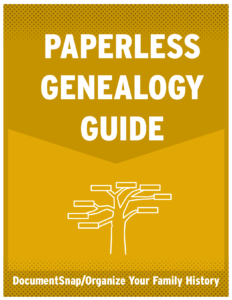
Paperless Genealogy GuideI’ve partnered with “Mr. Paperless,” Brooks Duncan of DocumentSnap, to create a guide to going paperless in your genealogy research. I think it will be really helpful for those who would like to go paperless but feel overwhelmed by the prospect.
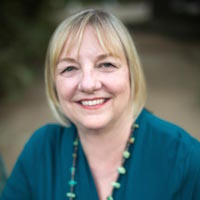
Brooks and I are presenting a session at RootsTech today (Go Paperless: Streamline and Digitize Your Genealogy) and we worked on the presentation and the guide at the same time.

You can read all the details about the Paperless Genealogy Guide over at DocumentSnap and download it for $9 there.  The guide covers how to name and find your digital documents, along with different types of scanners, and strategies for protecting your precious documents. And it ends with a checklist to walk you through the actions you need to get going.

My genealogy life is much easier now that almost all of my documents are in digital form. I can carry all my research with me, find it easily, read it easily (no more magnifying glass!) and determine very easily what I have and don’t have for a particular ancestor.

If that sounds good to you, hop on over and check out the Paperless Genealogy Guide! It can be yours instantly for $9.

Filed Under: Excitement, Genealogy tips, Organizing, Technology Tagged With: Brooks Duncan, electronic files, genealogy tools, paperless, record keeping, technology

How They Do It: Denise May Levenick

February 7, 2017 By Janine Adams 15 Comments

Here is the second installment in my How They Do It series, which I inaugurated last month with a Q&A with Thomas MacEntee. In this series, I’ve reached out to genealogy luminaries whom I admire and asked them to talk about how they organize their own genealogy research. I’ll post a new installment the first Tuesday of every month.

This month, we get to learn from Denise May Levenick, The Family Curator, author of How to Archive Family Keepsakes and How to Archive Family Photos. Denise is also a frequent contributor to Family Tree Magazine, as well as a popular teacher and lecturer.

How They Do It: Denise May Levenick

How long have you been doing genealogy?

I checked out my first census record in 1976 as part of a course in Personal and Family History at the University of Idaho, and I was hooked! That course gave me the opportunity to revisit my grandmother’s family history papers and photos, but I didn’t really pursue genealogy until my sons graduated from college and I had more time. It was a long hiatus.

What’s your favorite part of doing genealogy?

Discovering the back-story of a document or an unexplained detail about an ancestor is my favorite aspect of genealogy. I loved discovering that my grandmother was an accomplished seamstress! It gives me an extra connection when I work on quilts for my family.

Do you consider your genealogy research well organized?

Is my research well-organized? My research is one thing, my research papers and files are another. I feel pretty comfortable about both, and I can usually find what I need. But, there’s always room for improvement!

What type of software do you use for organizing your genealogy research?

I’ve used or tried almost every genealogy database program – PAF,  Family Tree Maker Legacy, RootsMagic, Reunion, MacFamily Tree, and some I can’t remember. Since moving to a Mac in 2000, I use Reunion most of the time. I keep all my work in the Notes section and export GEDCOM files as needed to use features in other programs on my PC. The best advice I ever received was to invest time and effort in the Notes section of your software rather than the individual event line data. It’s served me well when I moved around as my needs changed.

Do you keep a research log? If so, what format?

Oh… research logs. Yes, I do. I had a beautiful journal log that I left somewhere, and now I use a form log online that I can access from my desktop at home or my laptop. I still use a paper journal log, but most work is duplicated on the digital log too. I’m a “form person.” I love creating tables and forms for different projects and included dozens of worksheets and forms in both my books.

Do you have a tree on Ancestry? If so, is it public or private? Why?

I have both kinds of trees on Ancestry. Public as cousin bait, and private for my works-in-progress. I don’t want my speculative work to be copied as proven, so I feel better keeping those trees private.

What’s your biggest challenge when it comes to organizing your genealogy?

My biggest challenge is keeping paper under control. I do like paper copies to read and annotate, but the pages seem to multiply like rabbits.

What’s your biggest piece of advice to beginning genealogists in terms of keeping track of their research?

I’d say, “Don’t fight the Research Log. Just do it!” We love taking shortcuts, but in genealogy, shortcuts just cost time later.

What do you think is the most important thing for people to do to stay organized when it comes to family history research?

Organization doesn’t just “happen.” For most of us, it’s part of a process or workflow. I find that when I use a consistent research process, staying organized becomes a natural part of the entire scheme. For example, creating a digital workflow was tough to develop and implement, but it’s become a habit now that I’m using the 7-Step digital asset management process I write about in my book How to Archive Family Photos. I find that I’m naturally moving from Capture to Import and through each step, and my files are organized along the way. Developing a repeatable workflow is key.

If you were starting out new as a genealogist what would you do differently?

Oh, I wish I had been a more active genealogist years ago. I have so many ancestors yet to discover! I would encourage any new family historian to take a beginning genealogy course and develop good research and record-keeping habits. You can learn about record groups as you develop in the field, but you will always use sound basic skills.

Do you keep paper or electronic files (or both)?

I keep both paper and electronic files. Papers are filed in hanging file folders until I analyze them and enter the data in Reunion; then the papers go in a binder. I keep digital files in Surname folders with meaningful filenames. I use Spotlight or other file search software to find files faster on my computer.

Are you a folder or binder person for your paper files?

I love binders because they help me keep papers in order and in place.

Do you use Evernote, One Note or any other electronic organizing system for your genealogy? If so, how do you use it?

Evernote is my go-to app for quick reference notes of webpages and articles, but I use OneNote for notes and tasks especially when traveling. I’ve used Microsoft Word for so long that it’s like a typewriter to me, and OneNote’s notebook format makes it easy to keep track of odd bits of information. When it comes to writing, however, I turn to Scrivener. I use it for all my blog posts, magazine articles, and lecture outlines, and it was great for organizing my book projects.

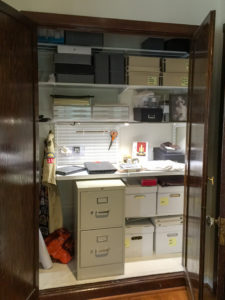
Denise’s Home Archive

Do you have a dedicated space in your home for doing genealogy research? What’s it like?

I am fortunate to have a perfect writing and research space at home. It’s a small room upstairs overlooking the front of our house, so I get a birds’ eye view of the neighborhood through a wall of glass French doors. One office wall is filled with books – English and American literature and history from my teaching days, and genealogy reference books. I have a corner cabinet that holds supplies, a vertical file cabinet, and a computer desk. We will be moving soon, and my new office will be a bit larger, so I hope I’ll have room for a table to spread out projects and items from my archive. My Home Archive is located in the closet of an extra bedroom, and I’m looking forward to having everything in one place in my new office.

Do you have anything to add?

I’ve learned that “getting organized” can become an all-consuming goal if we get stuck in the mindset of finding the “perfect” system or solution. I do better when I remind myself that progress is better than perfection; fix what isn’t working and move forward.

Such wise words! I’m particularly struck by Denise’s advice about research logs: “Don’t fight the research log. Just do it!” Amen. Thank you, Denise!

Filed Under: Challenges, Excitement, Genealogy tips, Organizing Tagged With: Denise Levenick, Family Curator, How They Do It, organizing aids

  • « Go to Previous Page
  • Page 1
  • Interim pages omitted …
  • Page 34
  • Page 35
  • Page 36
  • Page 37
  • Page 38
  • Interim pages omitted …
  • Page 69
  • Go to Next Page »

about me

I'm Janine Adams, a professional organizer and a genealogy enthusiast. I love doing family history research, but I find it's very easy for me to get overwhelmed and not know where to turn next. So I'm working hard to stay organized and feel in control as I grow my family tree.

In this blog, I share my discoveries and explorations, along with my organizing challenges (and solutions). I hope by sharing what I learn along the way I'll be able to help you stay focused and have fun while you do your research, too.

tags

30 x 30 Adams amy johnson crow anniversary Brown cemetery census Civil War conferences connections dna electronic files Evernote excitement Family Curator family photos genealogy tools getting started goals How They Do It Igleheart Jeffries keepsakes learning opportunities maps newspapers NGS organizing aids overwhelm paper files planning quick tips rasco record keeping research research log research trip resources RootsTech social history source documentation Stacy Julian technology time management vital records

join the facebook community!

join the facebook community!

My organizing business

Learn more about my organizing business, Peace of Mind Organizing®.

Subscribe by RSS

  • RSS - Posts
  • RSS - Comments

© 2026 Janine Adams


Loading Comments...