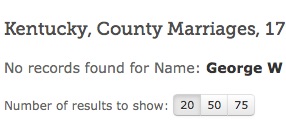
 As someone who tries to be an organized genealogist, I think one of the hardest things to remember to do is to make a note of my fruitless searches. When you do a search and get no results, the natural thing to do is to plow ahead and tweak the search and try again or to try searching another collection (or another ancestor).
But if you take the time to document that negative search, you might save yourself from duplicating that fruitless search in the near future (and therefore save yourself some time).
To me, the tricky part is figuring out how to record it. If you’re faithful about a research log (high five!), it seems fairly straightforward to include it in your log.
But if you’re one of those people (and I have to admit to being one of them) who doesn’t record everything faithfully in a log, you might have to devise a system specifically for negative research.
Here’s what I’m going to try. Using Evernote, I’ve created a Negative Research notebook in my Genealogy stack. I’ll try to remember to create a note when I spend time on fruitless research, making note of what I searched for and where, what the results were and when I did the search. By putting surnames in the note, I’ll easily be able to access the note on a simple search in Evernote, if I’m looking for information I stored there on a specific family member.
One caveat: I’m often searching sites like Ancestry.com or FamilySearch.org, so I need to bear in mind that they’re constantly adding new collections. So just because a search came up blank one day doesn’t mean that it won’t bear fruit a year (or more or less) down the road. Periodically, I’ll try to remember to check out my Negative Research notebook and see if it’s time to try that search again.
I’m hopeful this system will help me save precious research time.
How about you? Do you record your negative research? If so, how do you do it?

 If you’re planning to attend RootsTech 2017, the giant conference where genealogy meets technology, now’s the time to register. Until Friday, you can get the early-bird discount of $159 for the four-day conference registration. It’s being held February 8-11, 2017 in Salt Lake City. To me, $159 is a huge bargain (but then again, I routinely pay $600 or $700 to register for conferences for professional organizers).
 From the day I started doing genealogy research, I was overwhelmed by the possibilities. There were so many things to research, in so many places. Where do I start? How do I keep track of it all? How do I keep from going down a rabbit hole and losing track of my session goals? Sometimes I’d feel so overwhelmed that I couldn’t even start researching and I’d do something else.