• BLOG
  • ABOUT
    • Privacy Policy

Organize Your Family History

Stay focused and happy while exploring your roots

Favorite RootsTech session: Do Something with that Box!

April 28, 2020 By Janine Adams 9 Comments

Stacy Julian

I heard a lot of great sessions at RootsTech this year. But the one that really blew me away–because of the quality of its content and presentation–was Stacy Julian’s Do Something with that Box! Stacy is a blogger and podcaster and superstar in the scrapbooking world. You can learn more about her at www.stacyjulian.com.

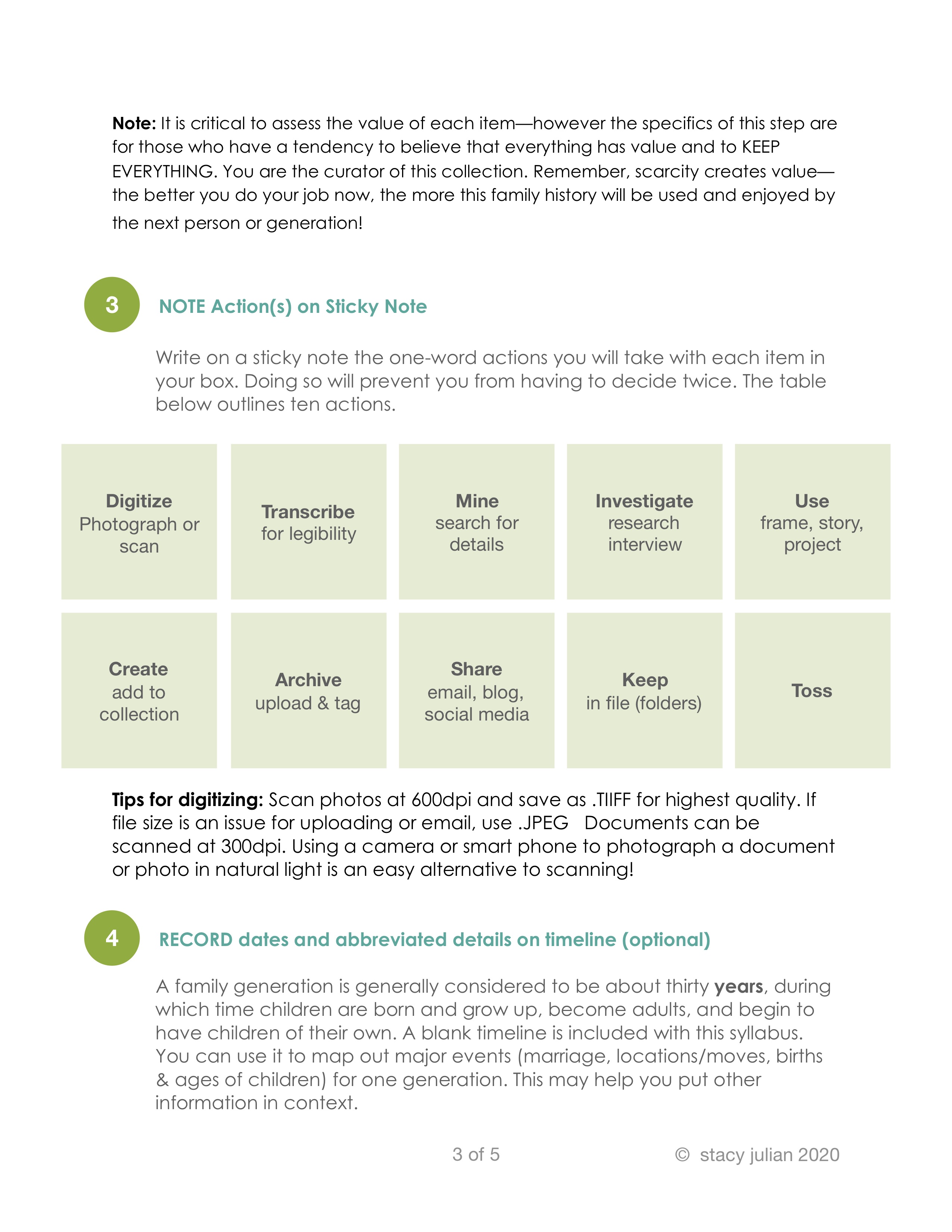
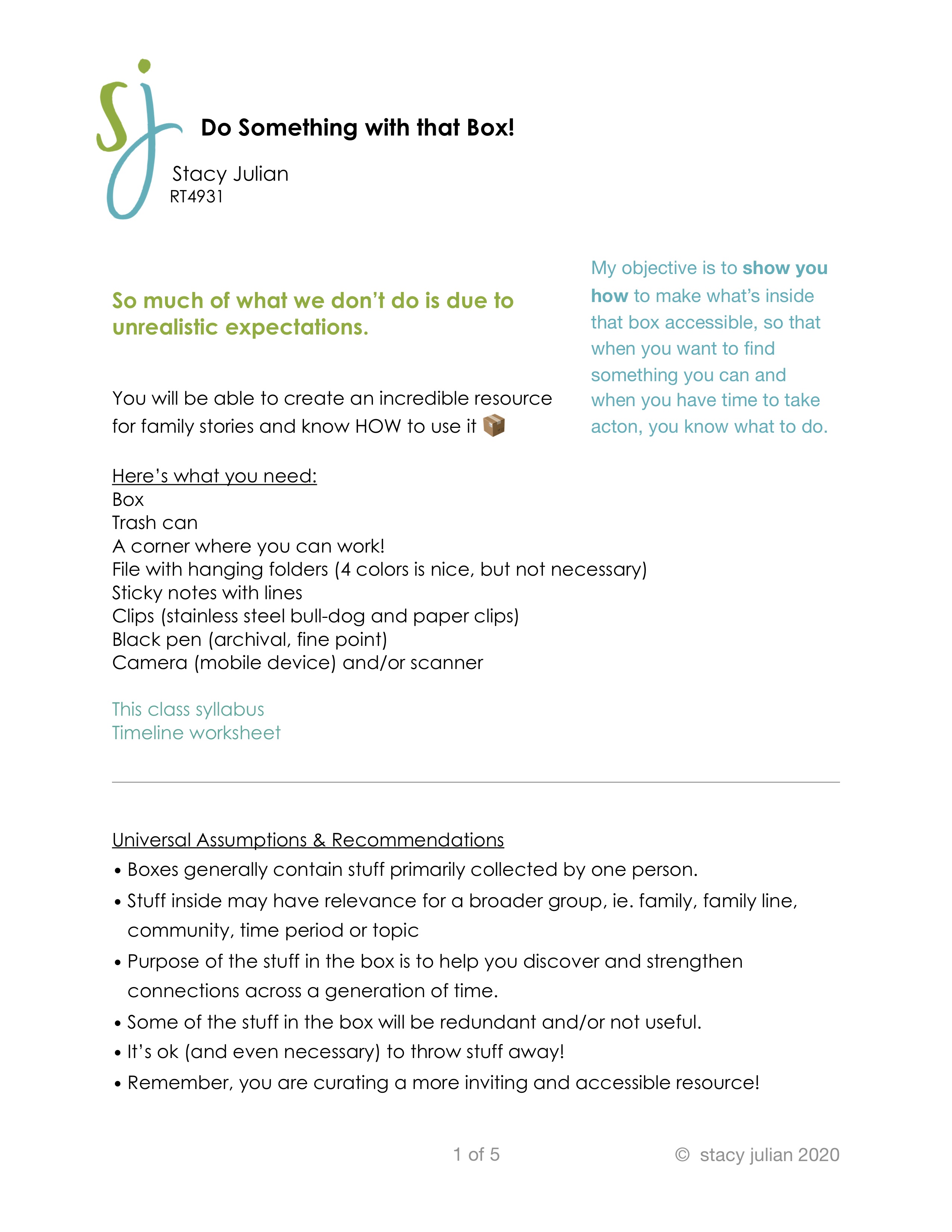
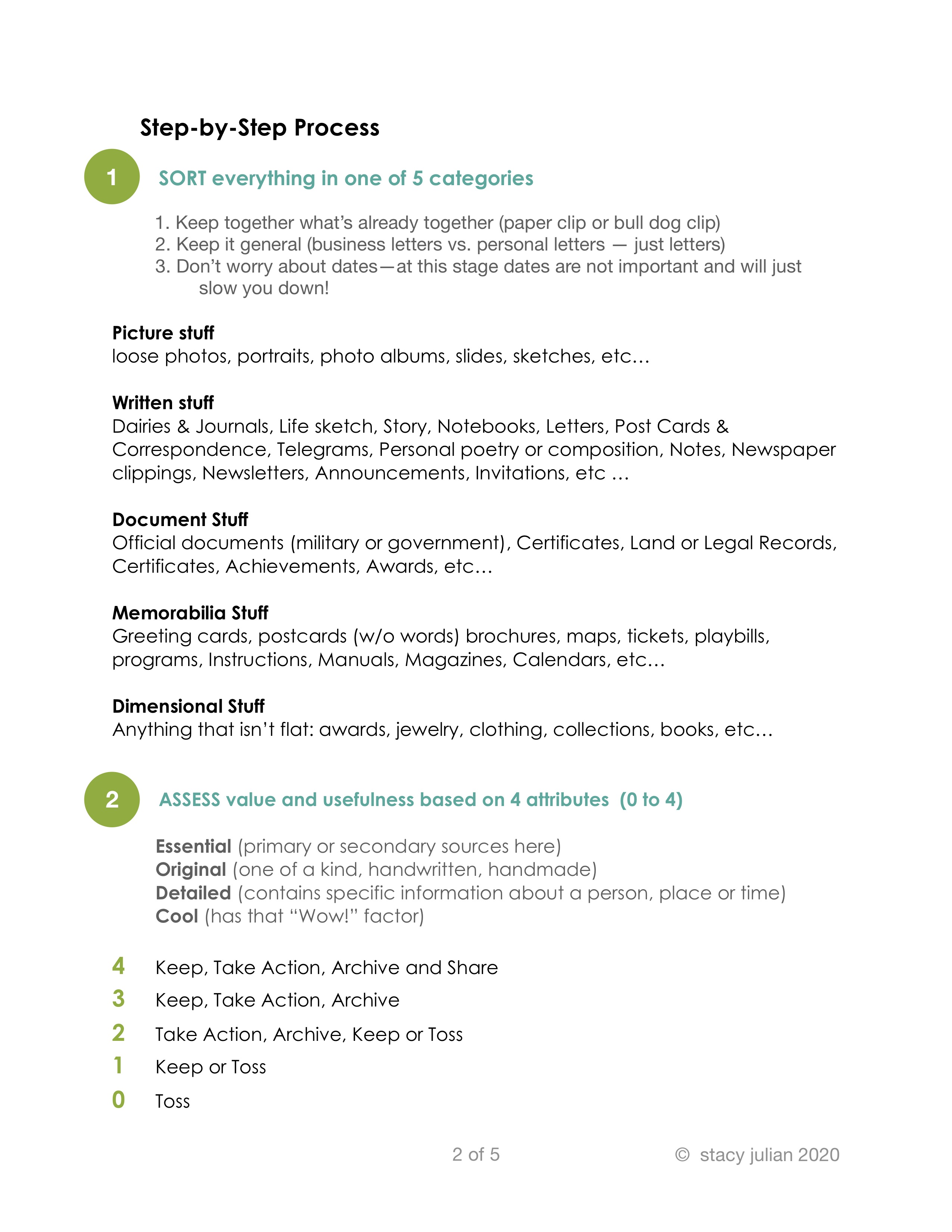
“That box” that Stacy refers to is the box of family history papers, photos, ephemera and (sometimes) junk that so many of us have been given. It’s so easy to be overwhelmed by that box, isn’t it? In her talk, Stacy took us step by step through her methodology to make the stuff inside that box accessible “so that when you want to find something you can and when you have time to take action you know what to do.” As a professional organizer, this made my heart sing.

One of the things I loved about her approach is that it makes the process of dealing with a box of family-history stuff less overwhelming. Stacy has you sort everything into one of five broad categories, then go through each category and assess the value of each item. You’ll be discarding lots of stuff during this process, undoubtedly. Stacy makes the point that scarcity creates value–if you are discerning about what you keep, your family members are more likely to look at and enjoy the items.

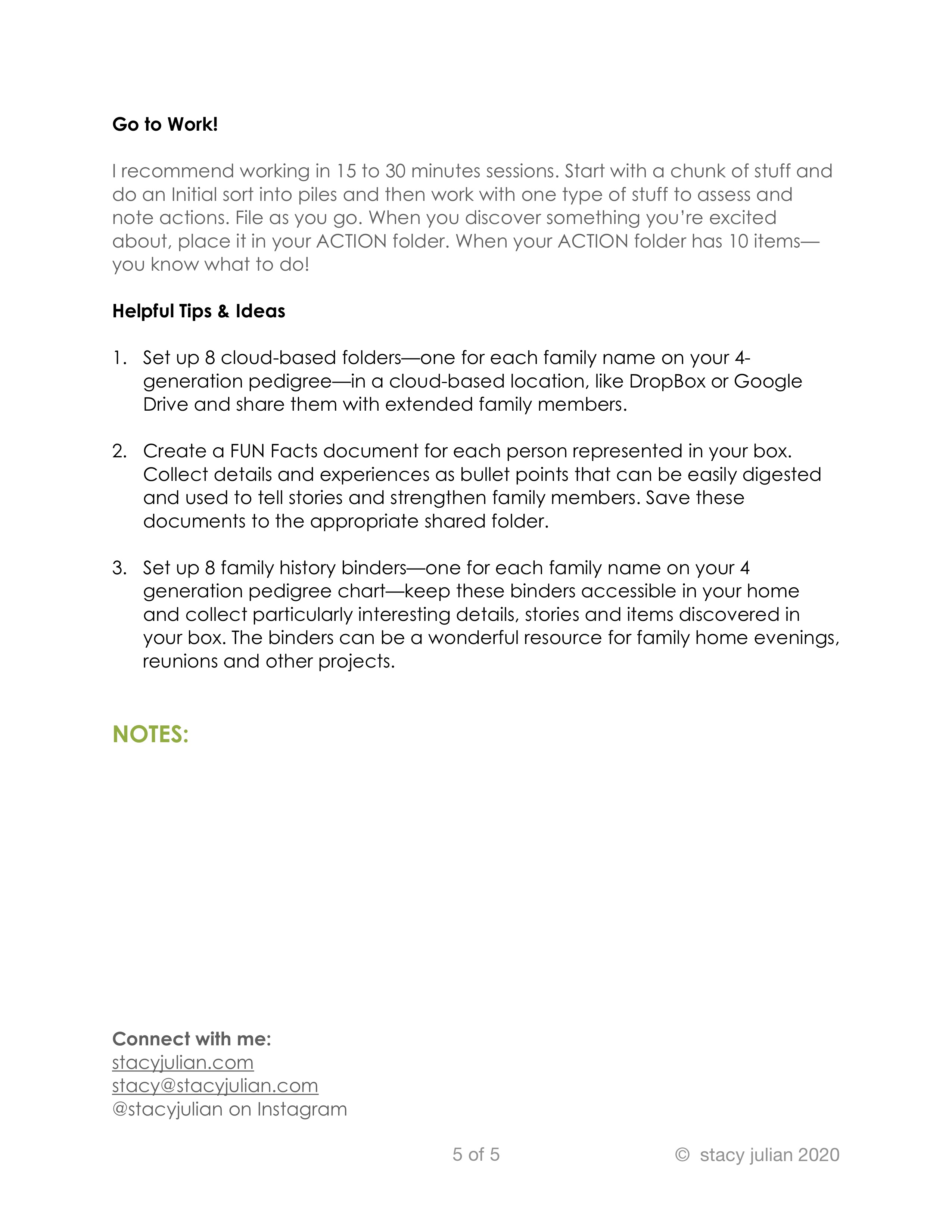
After sorting and assessing you’ll assign an action to each item that requires one (digitize, transcribe, share, etc), using a sticky note. The final step is to file the stuff into a file box using the same broad categories you started with. As you go through the documents, you’ll put those that excited you into an Action folder. Once you have ten items in the Action folder, you take action.Ā  An optional step in the process is to create a timeline, as you go, for each generation of the family represented by the box.

The system gets you to a “good enough” place where your stuff is easily accessed–by you or other family members–without expending a huge amount of effort. And when you have an itch to take action, you’ll know just what to do. Genius.

Stacy was kind enough to give me permission to make the handout that she gave to RootsTech participants available to you. At the bottom of this post are images of each of the five pages. Click on each to see a larger version.

The handout is great because it gives you the bones of her fantastic method. Hearing her speak about it was even better–there were videos included in her presentation and her energetic style was so enjoyable (and effective).

I have some great news: Stacy is developing an online course on this topic! So you’ll be able to get all the great content those of us in her RootsTech audience experienced (and probably more). I’ll be sure and post when that’s available.

In the meantime, take a look at this handout and see whether you might be able to take some steps to tackle one of your boxes while you’ve got extra time at home.
Edited to add: I was delighted to discover that Stacy has now written a robust blog post on this topic! Check out How to BEGIN with the BOX on her website.
Filed Under: Challenges, Excitement, Organizing, Preservation Tagged With: family photos, organizing aids, overwhelm, paper files, resources, Stacy Julian

MyHeritage offering free photo colorization

April 22, 2020 By Janine Adams 13 Comments

When I was at RootsTech, MyHeritage had a booth where they were colorizing old black-and-white photos for people. The booth was always swamped with people. I wasn’t one of the people who stood in line for this service because the whole idea of colorizing old photos just didn’t sit right with me. I couldn’t put my finger on my objection, exactly. But I’m curious what readers of this blog think.

Today, I thought I’d blog about it, so decided to upload a couple of photos to try it out for a spin.

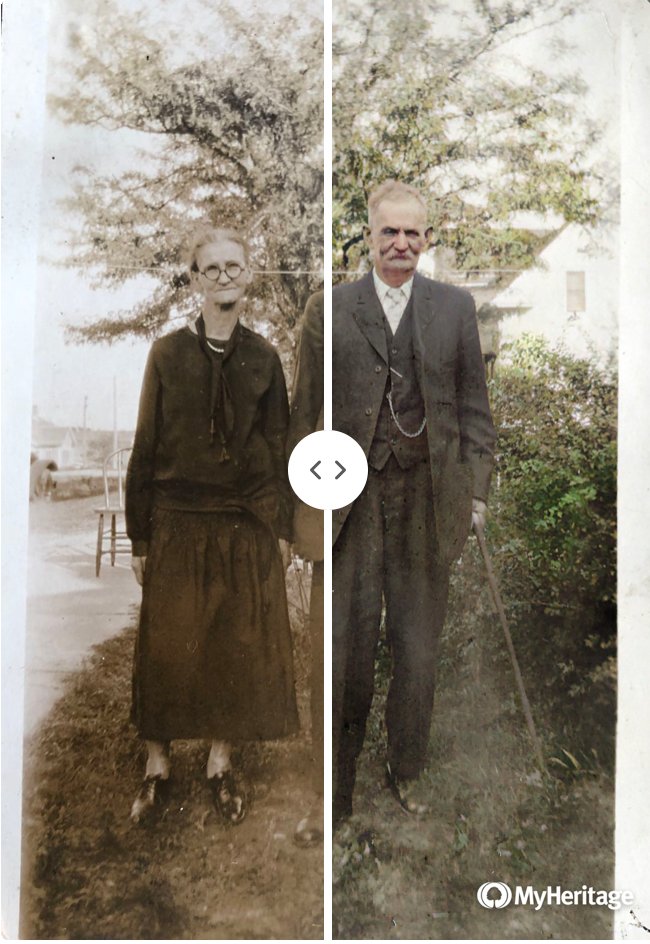
At left (at the top of this post) is a photo of my 2nd great grandparents, Samuel Vorce Wheeler (1852-1937) and Elizabeth Jane (Jennie) Nebergall Wheeler (1857-1933), taken in 1926 on the occasion of their 50th wedding anniversary. MyHeritage allows you to see your colorized and original photos side by side in one photo. You can move the dividing line back and forth and watch the photo change. That happens at the MyHeritage website–for the purposes of this post I took a screenshot. The photos you download (like those below) do not have the divider.

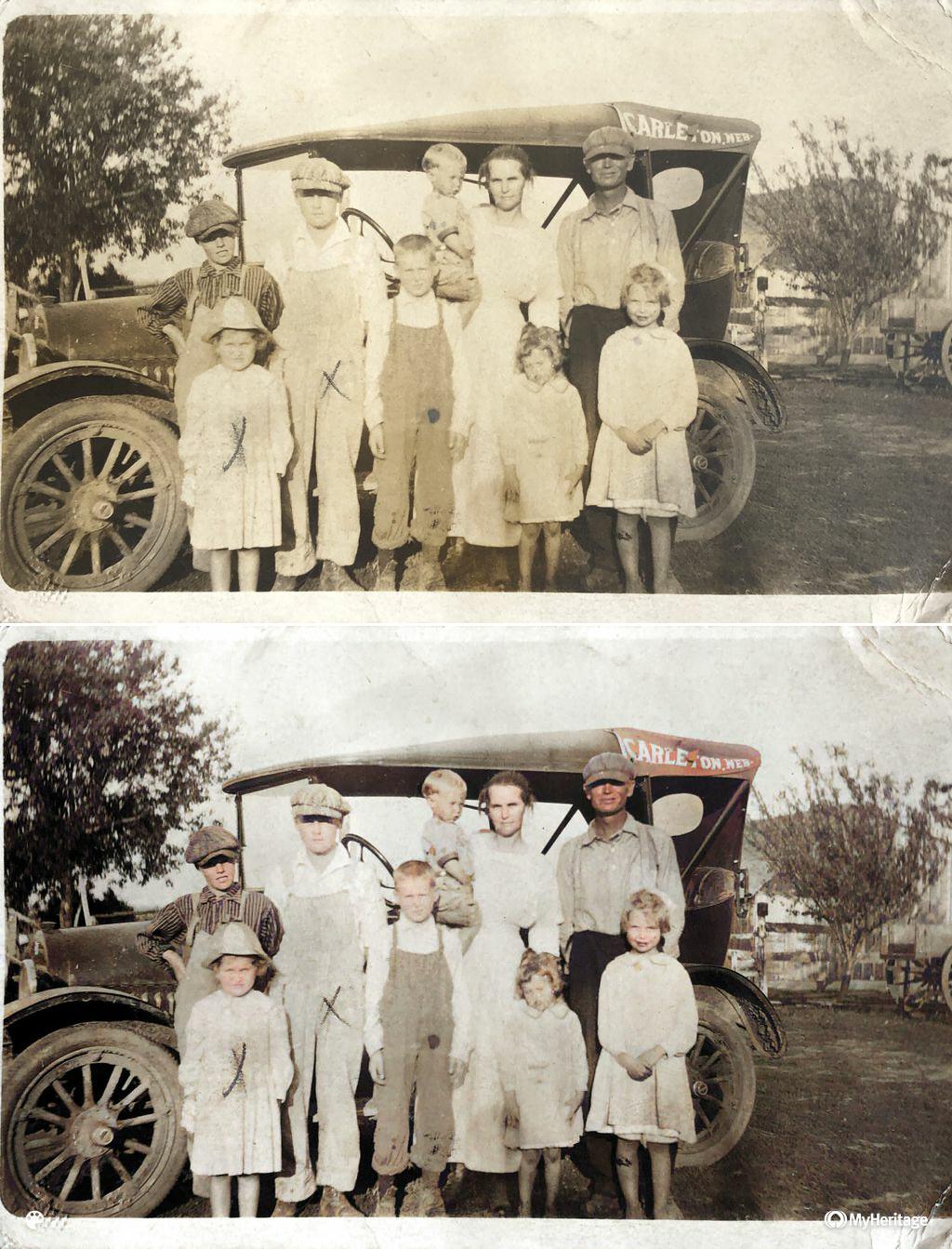
Here’s a photo of the Arthur Brown-Rhoda Wheeler family. (Rhoda is the daughter of Samuel and Jennie.) That’s my grandfather, Crawford Brown (1906-1996), on the far left with the dark striped shirt. I think the photo was taken around 1916. The top photo is the original that I uploaded. (I took a photo of the print with my phone, transferred it to my computer, and uploaded it.) Beneath is the colorized version.

I have to admit I find the colorized version more eye-catching. But it doesn’t feel like a 1916 photo, does it?

It’s incredibly simple to upload the photo to the MyHeritage site (just drag and drop). The colorizing takes seconds. There’s no charge. With a click, you can download the colorized version and/or a comparison photo that contains both images.

It’s amazing, but I’m still not sure quite what to think about it. I do know that I’m not going to include the colorized versions among my genealogy documents–they’re purely for fun.

Have you tried it? What are your thoughts?

Filed Under: Genealogy tips, Preservation, Reflections, Technology Tagged With: Brown, family photos, genealogy tools, technology

Let’s create history for our descendants this Thanksgiving

November 27, 2019 By Janine Adams 2 Comments

Once again, here’s my annual Thanksgiving post, originally written three years ago. I wish all my readers a wonderful Thanksgiving!

This Thanksgiving week, I’ve been thinking about how the ordinary lives of my ancestors are endlessly fascinating to me. As I slowly plow through my great great grandfather’s Civil War pension file, I get very excited when I come to a form he filled out 125 years ago that has a little extra information in it (like the names and birth dates of his children). Any peek into what his life was like is a special treat.
It got me thinking about how mundane aspects of our lives today might be really interesting 100 years from now to the people below us on the family tree.

Of course, we fill out fewer paper forms now. And genealogy will probably look very different in the twenty-second century. But I think photos and records will always be valuable.

This year, as we celebrate Thanksgiving (or really just go about our lives), we have the opportunity to create history for our descendants. We can be mindful of our legacy as we’re taking pictures. We can take care to label them (or add metadata to digital photos) so future generations know who the people in the photos are. We can do oral history interviews and carefully preserve them with labels for future generations.

If you have older relatives around your Thanksgiving table, I urge you to ask questions and preserve those conversations for generations to come (as well as for your own genealogy research). I sure wish I had. Wouldn’t it be great to put your hands on a recorded interview with one of your ancestors? You could be the person making that possible for your descendants.

Thanks to smartphone technology, it’s so easy for us to record conversations and take videos. Let’s do that while we can and mindfully tag and back up those recordings. (And hope that the medium will still be readable decades from now.)

As much as I urge my organizing clients to part with paper or other items that don’t serve any purpose any longer, I do sometimes encourage them to hang on to documents or photographs that might be of interest to their descendants. I encourage you to be mindful of that and store those items that so that they might be passed on to family-history-minded descendants when you pass.

Remember: Every day we have the opportunity to create history.

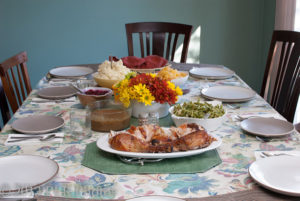
Photo by Robert and Pat Rogers via Flickr. Used under Creative Commons License.

Filed Under: Challenges, Preservation, Reflections Tagged With: family photos, keepsakes, planning, social history

Even “paperless” genealogists should keep some records

May 21, 2019 By Janine Adams 5 Comments

If you’re a regular reader, you know I’ve embraced the idea of minimizing paper in my genealogical research. I never print out the documents I find online. Instead, I download them, immediately rename the file according to my file-naming protocol and, once I’ve gleaned all the information I can from the document and created a source citation, I file it within my folder structure. My blog post called How I process a downloaded document takes you step-by-step through my digital workflow. And there’s lots more information in the Paperless Genealogy Guide, the 44-page downloadable guide that Brooks Duncan of DocumentSnap and I wrote as we prepared to speak on that topic at RootsTech in 2017.

As someone who espouses letting go of paper, I’m often asked if there are papers that those who are trying to minimize should keep. I usually reply by saying that documents that are impossible or difficult to replace–even if they’re scanned–are worth hanging on to. That means, for instance, there’s no need to hang on to census records but original birth certificates are worth keeping in a file or binder.

I recently came across a post on the Abundant Genealogy blog from Melissa Barker, The Archive Lady, on this very topic. (Melissa was the subject of my How They Do It Interview in August 2017.) Her Abundant Genealogy post, called 5 Genealogical Records You Should Never Throw Away, goes into some detail about five types of records that you should hang onto. It’s definitely worth reading. (Spoiler alert: The five types of records are original records, diaries and journals, scrapbooks, old letters and photographs. Read the blog post to find out why.)

I would have a hard time throwing away hand-written letters and, in fact, though I carefully scanned it, I still have the epic 36-page letter my grandfather my wrote my grandmother right before they got married, in which he confessed the family secrets. That will be passed along to my niece or nephew or, perhaps, a cousin. But will I keep all old photographs once I’ve scanned them? I’m not so sure.

What about you? Are there are any records you would add to the list of keepers? Any that you don’t think belong there?

Filed Under: Challenges, Genealogy tips, Organizing, Preservation Tagged With: Adams, family photos, paper files

  • « Go to Previous Page
  • Page 1
  • Interim pages omitted …
  • Page 3
  • Page 4
  • Page 5
  • Page 6
  • Page 7
  • Interim pages omitted …
  • Page 11
  • Go to Next Page »

about me

I'm Janine Adams, a professional organizer and a genealogy enthusiast. I love doing family history research, but I find it's very easy for me to get overwhelmed and not know where to turn next. So I'm working hard to stay organized and feel in control as I grow my family tree.

In this blog, I share my discoveries and explorations, along with my organizing challenges (and solutions). I hope by sharing what I learn along the way I'll be able to help you stay focused and have fun while you do your research, too.

tags

30 x 30 Adams amy johnson crow anniversary Brown cemetery census Civil War conferences connections dna electronic files Evernote excitement Family Curator family photos genealogy tools getting started goals How They Do It Igleheart Jeffries keepsakes learning opportunities maps newspapers NGS organizing aids overwhelm paper files planning quick tips rasco record keeping research research log research trip resources RootsTech social history source documentation Stacy Julian technology time management vital records

join the facebook community!

join the facebook community!

My organizing business

Learn more about my organizing business, Peace of Mind OrganizingĀ®.

Subscribe by RSS

  • RSS - Posts
  • RSS - Comments

© 2026 Janine Adams


Loading Comments...