• BLOG
  • ABOUT
    • Privacy Policy

Organize Your Family History

Stay focused and happy while exploring your roots

Identifying potential military ancestors

May 23, 2017 By Janine Adams 8 Comments

identifying military ancestorsA year ago, I wrote this post on figuring out which ancestors might have fought in which war. With Memorial Day coming up this weekend, I thought it might be useful to republish it. I think I’m going to spend some time this week updating my spreadsheet (since I’ve added to the family tree since last year), so I can easily research ancestors in military records this weekend.

Whenever I read about a records collection for a certain conflict (which seems to happen around military-related holidays, like Veteran’s Day or anniversaries of conflicts) I get excited about researching my ancestors in those collections, which can be such a treasure trove of information. But in the past sometimes I would have difficulty remembering which ancestor might have fought in which war and I’d become overwhelmed and abandon the effort.

So I created a document that shows me the prospective ancestors for each conflict, based on the dates they were born. At the time, I used a table from Family Tree Magazine but when I went looking for it to share in this post, I couldn’t find it. However, I did find an even-better table called Ages of Servicemen in Wars that lists 20 military conflicts, the years they were fought, the typical birth dates for soldiers and the  typical ages of soldiers. Thank you, FamilySearch!

Armed with that information, I created a simple spreadsheet (pictured, in part, above) with the following column headers:

  • Conflict
  • Likely Birth Year of Soldiers
  • Prospective Ancestor
  • Confirmed Ancestor

For each conflict, I entered the names of the ancestors who were born during the birth-year window listed in column 2. After I ascertained that one had indeed fought in that war, I entered an X in the Confirmed Ancestor column. What I should have done and will from here forward, is place a dash or an N in the Confirmed Ancestor column to indicate that I’d ruled that ancestor out.

This is a simple way to see at a glance who I might research when I’m looking at military collections at the National Archives, Fold3 or elsewhere. It’s easy to create and well worth the time spent.

Filed Under: Genealogy tips, Organizing Tagged With: genealogy tools, military, organizing aids

Filling in the history in your ancestors’ timelines

April 19, 2017 By Janine Adams 7 Comments

A couple of years ago, at RootsTech, I learned about HistoryLines. I was intrigued and signed up for a subscription. Then I pretty much forgot about it. (I blogged about it back then.)

HistoryLines creates a timeline for your ancestor (after you upload a GEDCOM or fill in data on an ancestor), referencing the historical events and social history of the time in which your ancestor lived.

This week I received a notification that my subscription was going to autorenew. I went to the site, intending to cancel since I never used it. But once I started exploring, I realized that this really is a tool I’d like to use.

This past quarter I focused almost exclusively on my great great grandfather, George Washington Adams (1845-1938) and his children. When I called up a HistoryLines story for him today I really enjoyed the context it placed his life in. I can see doing this for many of my ancestors, especially those I’ve studied more in depth. (So many of my ancestors seem like just names and dates to me, though I’m trying to change that.)

If you’re intrigued, here’s a promotional video from HistoryLines.

If you try it out, let me know what you think!

Filed Under: Excitement, Genealogy tips, Technology Tagged With: excitement, genealogy tools, organizing aids, resources, social history, technology

My (very informal) research log

April 4, 2017 By Janine Adams 21 Comments

A few commenters have asked me for samples of my research log. I hesitate to supply it because mine is so informal and not necessarily a good example for others to follow. But in the spirit of helping others, I offer it up.
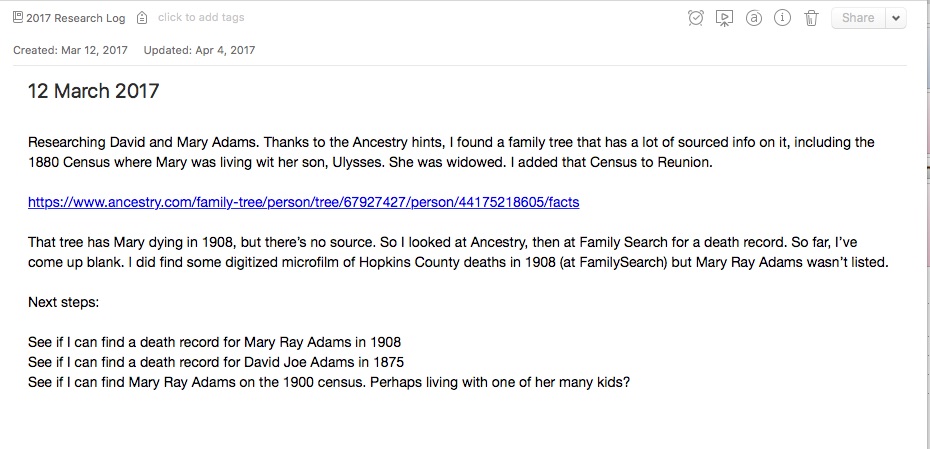

I keep my log in Evernote. I have a notebook there called “2017 Research Log” and each time I do some research I try to create a log entry. I create a new note in the aforenamed notebook and head it with the date. Then I just type notes that I think might be useful in the future. I try to include what I was looking for, what I found and what next steps would be.

Here’s why it works for me:

  • First and foremost, it is easy for me to keep up. I just jot some notes to my future self and don’t get hung up on filling out a complicated spreadsheet or making sure I have every bit of information. For me, making it easy enough so I’ll actually do it trumps making it more complete.
  • It’s searchable, so I can easily search by person or surname. I could tag it by locality, family line or other category, though so far I haven’t done that.
  • Did I mention it’s easy?

Here’s a screenshot of a recent entry that’s fairly representative.

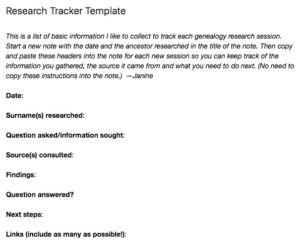
My genealogy research logI used to use a template in Evernote, one that I created when I was partnering with the dear departed Springpad. (I put that template at the top of this post; click on the image to make it bigger.) But I find I do better writing free form–I think it brings more information out of me.

Earlier this year I was experimenting with using the Log function in Reunion, also writing free-form notes, but I’ve discovered I prefer Evernote. I use Evernote on a daily basis for various aspects of my life and business, so I’m very comfortable with it.

I should mention that one downside to using Evernote as a research log is that it’s not sortable. It is searchable and taggable, but I can’t sort it like I could a spreadsheet. So far that hasn’t been an impediment to me.

I don’t think there’s any one right way to do a research log, but I’m pretty sure there are better ways than mine. But it’s working well for me at the moment.

If you are a spreadsheet person and aren’t intimidated by the opportunity to enter a lot of data, by all means check out Thomas MacEntee’s amazing research log spreadsheet.

Also, if you haven’t already feel free to join my Genealogy Research Loggers Facebook group for more conversations about research logs (as well as some samples from others).

For detailed information on how I organize my own genealogy research (including my research log), check out my Orderly Roots Guide, How I Do It: A Professional Organizer’s Genealogy Workflow, available for $19.99.

Filed Under: Challenges, Genealogy tips, Organizing, Technology Tagged With: Evernote, excitement, genealogy tools, organizing aids, research, research log, resources

AncestryDNA announces Genetic Communities

March 29, 2017 By Janine Adams 6 Comments

When I was at RootsTech, an executive from Ancestry showed a tantalizing video during an opening session about the “genetic communities” that Ancestry DNA customers would see in their profile.  It’s a big step beyond the ethnicity estimates they previously offered.

Yesterday, Ancestry announced that the genetic communities are starting to be rolled out. They also provided a help page with more information on genetic communities. Here’s the accompanying video:

You can bet that I rushed over to my Ancestry DNA results to see if I’d been placed in any genetic communities. I was delighted to see that I had one genetic community listed in my profile (so far). It is the Settlers of Southern Appalachians community and reflects my father’s mother’s side of the family (the Rascos) who were Alabama settlers.

The whole thing is a bit mysterious to me (but that’s true of DNA in general) and I’m anxious to learn about this new feature and whether I might eventually be connected with more communities. So I signed up for a free webinar from Legacy Family Tree called Exploring AncestryDNA’s New Genetic Communities, presented by renowned genetic genealogist Blaine Bettinger. It’s tomorrow, March 30, at 1 pm Central time. I’m not available at that time but I was thrilled to read that the recording will be available free of charge for seven days.

I’ve been ignoring my DNA results for at least a year now, but I sense that might be ending, since yesterday I purchased the Getting Started with DNA and Genealogy Boot Camp from Hack Genealogy. It’s $25.95 for three hours of recorded webinars and 10 pages of handouts, available for a year. I used the coupon code GETDNA to get $6 off that price. (That code expires March 31.)

I don’t want to get too distracted from the single family line I’m exploring in 2017, but I am looking forward to learning more about how DNA can help me in my research. AncestryDNA’s Genetic Communities might be really helpful!

Filed Under: Excitement, Genealogy tips, Technology Tagged With: dna, genealogy tools, learning opportunities, technology

  • « Go to Previous Page
  • Page 1
  • Interim pages omitted …
  • Page 12
  • Page 13
  • Page 14
  • Page 15
  • Page 16
  • Interim pages omitted …
  • Page 30
  • Go to Next Page »

about me

I'm Janine Adams, a professional organizer and a genealogy enthusiast. I love doing family history research, but I find it's very easy for me to get overwhelmed and not know where to turn next. So I'm working hard to stay organized and feel in control as I grow my family tree.

In this blog, I share my discoveries and explorations, along with my organizing challenges (and solutions). I hope by sharing what I learn along the way I'll be able to help you stay focused and have fun while you do your research, too.

tags

30 x 30 Adams amy johnson crow anniversary Brown cemetery census Civil War conferences connections dna electronic files Evernote excitement Family Curator family photos genealogy tools getting started goals How They Do It Igleheart Jeffries keepsakes learning opportunities maps newspapers NGS organizing aids overwhelm paper files planning quick tips rasco record keeping research research log research trip resources RootsTech social history source documentation Stacy Julian technology time management vital records

join the facebook community!

join the facebook community!

My organizing business

Learn more about my organizing business, Peace of Mind Organizing®.

Subscribe by RSS

  • RSS - Posts
  • RSS - Comments

© 2026 Janine Adams


Loading Comments...