• BLOG
  • ABOUT
    • Privacy Policy

Organize Your Family History

Stay focused and happy while exploring your roots

How They Do It: Crista Cowan

September 5, 2017 By Janine Adams 7 Comments

This month’s How They Do It interviewee is living the genealogist’s dream. As Corporate Genealogist for Ancestry.com, Crista Cowan lives and breathes genealogy for her living. I’ve heard Crista speak at a number of genealogy conferences and know her to be thoroughly knowledgeable about genealogy and so great at sharing that knowledge.  I hope you enjoy reading her thoughtful and thought-provoking answers to my questions as much as I did! I especially loved her answer to the question of public and private trees on Ancestry.com.
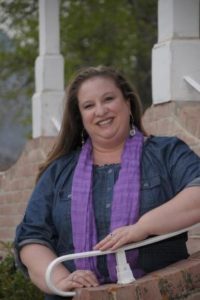
How They Do It: Crista CowanHow They Do It: Crista Cowan

How long have you been doing genealogy?

I was born into a family that has been very interested in genealogy for generations. So, I grew up going to family reunions and looking through shoeboxes of old photos with my grandma and taking trips to Utah to visit the Family History Library with my dad. When I turned 12, he setup a home computer with one of the first DOS based genealogy programs on it. I started entering all of our family’s paper-based genealogy documents into the software and I was hooked from then on.

What’s your favorite part of doing genealogy?

I think what I love the most is discovering the connections. We live in a world that is more electronically connected than ever before in history. But, I think this has created more emotional disconnection than ever before. I feel like genealogy helps restore some of what has been lost. It gives us an emotional and biological connection to history and to each other in a way that very few things can. For example, while researching the descendants of one of my 3rd great-grandfathers, I discovered that one of my college roommates was actually my 4th cousin. I hadn’t talked to her in almost seven years. This gave me an excuse to reach out to her and rekindle our friendship in a very real way (meaning outside of Facebook) and to share with her and her children the stories I had uncovered about our common ancestors.

Do you consider your genealogy research well organized?

I like to think that I am an organized genealogist. I have spent the last few years going totally paperless and that has helped. When I relied on so many paper files, things got out of hand very quickly. (I think anyone who has been doing genealogy for any length of time can relate to the piles and piles of papers that tend to accumulate.) Now I scan everything and only save digital files (as opposed to printing off my discoveries). I find that without all that paper not only am I much more organized but I am much more successful in my research as well.

What type of software do you use for organizing your genealogy research?

I use Family Tree Maker 2017 as my primary software program. I sync it with an online family tree at Ancestry. This helps me keep my family tree, my photos and documents, my DNA matches, and my research notes all easily accessible and organized.

Do you keep a research log? If so, what format?

I keep research notes on every person in my family tree. I use the NOTES space in the software to transcribe records that I discover, record failed searches, keep a to do list for future research, and write out my genealogical proofs. For me, it is most useful to have this information attached directly to the person and/or families in the software I’m already using instead of trying to incorporate another software program (or more paperwork) into my workflow.

Do you have a tree on Ancestry? If so, is it public or private? Why?

I do have my entire family tree on Ancestry and it is public. It was private for several years. I kept it private because there are mistakes in my tree – the mistakes of a teenage girl who was overly excited about her new hobby, the mistakes of generations of family historians who latched onto a source and ended up climbing the wrong family tree, simple mistakes of data entry errors. I was afraid that if my tree was public, those mistakes would be copied. I was even more afraid that people would discover those mistakes and think less of me as a professional genealogist. I figured I would make my tree public “some day.” Some day when I had gone through my tree with a fine tooth comb and discovered all my mistakes and corrected them.

But then, five years ago, I took an AncestryDNA test. And, I realized that without collaboration, my DNA matches and I were never going to figure out how exactly we were related. We were never going to be able to use our DNA results to break through our brick walls if we weren’t willing to share more openly. I made my tree public. The very next week I received a nasty email from someone who found an error in my tree. My initial reaction was to make my tree private again. But, I discovered that she was right (even if her tone was wrong). I corrected the error, thanked her, and had a major epiphany in the process. So long as my tree is public, people will find my errors. Then I don’t have to. When we freely and openly share, family history becomes this truly collaborative environment that helps us make discoveries quicker and helps us be more accurate. I’ve never looked back.

What’s your biggest challenge when it comes to organizing your genealogy?

My biggest challenge with organizing my genealogy revolves around old photographs. I have inherited five generations of family photo albums, slides, home movies, and pictures. My mom helped me get them all scanned and digitally organized into folders. Going back through those digital files to identify each photo and upload it to our tree, however, has taken a back seat to other research projects. I worry about the thousands of images sitting in digital files (well backed up mind you) that I still need to sort through.

What’s your biggest piece of advice to beginning genealogists in terms of keeping track of their research?

My biggest advice to new researchers is to keep track of the origin of every piece of information you enter into your family tree. If grandma told you what her parents’ names were and when and where they were born, make a note in your tree that you got that information from grandma. If you found an old book that listed seven generations of your ancestors, make a note of it. Nothing is more frustrating to me 30 years later than to go back to a branch of my family tree and look at information I entered and have no idea if it is accurate or not because I have no idea where that information came from.

What do you think is the most important thing for people to do to stay organized when it comes to family history research?

I have found that I can stay most organized if I research one family group at a time. Jumping around the family tree tends to cause the most confusion and the most disorganization, both in my files and in my brain. So, for example, when working with Ancestry Leaf Hints, I never use the All Hints list. It’s just a random list of hints for people in my tree. Instead, I use my family tree, find a family I want to work on and then methodically review hints for each person. Sometimes I have to look at groups of hints together to determine if they are for the right family or not. Sometimes I have to go up or down a generation on that branch to find the clues I need. Once I have worked the hints, then I can create a research list about what other records I need to discover and what research questions I need to answer for this specific family. This work habit has kept me organized and on track in a way that little else does.

If you were starting out new as a genealogist what would you do differently?

When I first started doing family history, I figured that if someone had printed it in a book, it must be true. I received two (very large) family histories and entered everything in them into my family tree. Over time, I have proved most of the information in these volumes to be true. However, I have also discovered some real errors. Some of the errors have been minor details about dates or places. Some of them have been major problems that have led to incorrectly identifying someone’s parents and climbing someone else’s family tree. If I was just starting out again, I would be sure to check the published information against other sources.

Do you keep paper or electronic files (or both)?

For decades I kept both paper and electronic files. However, for the past several years, I have been slowly going through all of my old paper files and purging them. I had lots of copies of census records and other documents that are now readily available online. After verifying that I have attached them to my tree, I have thrown away the paper copies. Other things, like certificates that I ordered from vital records offices, I have digitized and attached to my tree and then thrown away the paper copy. There are still a few treasures, like my great-grandmother’s baptismal certificate, that I have held onto because of the “heirloom” value but I try to find ways to display those instead of keeping them locked away in a filing cabinet. All of that said, I do, occasionally, print out a chart or a bound book reflecting the research I have done on a specific branch of my family tree so I can share it with family or display in my home.

Are you folder or binder person for your paper files?

When I had paper files, I used both folders and binders. When the folders and binders needed a room of their own in my house, I knew it was time for a change.

Do you use Evernote, One Note or any other electronic organizing system for your genealogy? If so, how do you use it?

I use OneNote when I am working out a genealogical problem but don’t yet have a person to put into my tree to whom I can attach that information. For example, if I am trying to discover the parents of a particular ancestor and doing so requires identifying all of the individuals of a certain surname in a specific county. I copy URLs for documents that I want to review later in more detail. I make notes and table to correlate and analyze data in a table format or some other comparative manner. If I end up with too much data, like with DNA matches, I might switch over to using a spreadsheet. I also use PowerPoint, specifically the org chart template, to figure out relationships with DNA matches when there are unknown variables. I have a digital folder with dozens of those kinds of charts and spreadsheets.

I used to use tons of little pieces of scratch paper but that got out of hand. So, I went to a craft store and bought a little hard bound sketch notebook. I use that now when I need to sketch out information or jot down quick notes to keep me on track while I am in the process of research.

Do you have a dedicated space in your home for doing genealogy research? What’s it like?
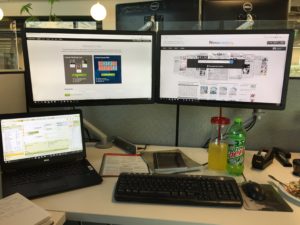
As the Corporate Genealogist for Ancestry, I’m lucky to get to do what I love every day as part of my job. So my work desk is my genealogy desk. I use a laptop as my primary computer and for years have had a large monitor attached to it so that I have double the screen space. Recently, however, I added a 2nd monitor so now I have three screens. I don’t know how I ever did without it. I can have Family Tree Maker open on one screen, Ancestry on another, and Newspapers.com on a third. It makes comparison and analysis of records so much easier. And, it ensures that my data entry is more accurate than if I had to flip back and forth between screens. I know this isn’t possible for everyone but even if you can just get a USB plug-in, portable monitor, it is totally worth it. That’s what I do at home – my laptop with a portable, plug-in monitor.

Also in my workspace, both at home and at the office I have a few books and quick sheets that I reference often. These include: The Source, The Redbook, Genealogy Standards, Evidence Explained and accompanying Quick Sheets, and the Shared cM Project Cluster and Relationships Charts.

Do you have anything to add?

Every Sunday night my dad and I get on the phone with one another, he from Oregon and me in Utah, and we work on our family history research together. Every day at work, I sit with some of the greatest genealogists in the world, and we collaborate on research projects for various television shows and marketing and PR campaigns. Several times a year, I go to a family reunion, or sit with my grandma or my cousins and share the discoveries I have made in our family tree since we were last together. For me, family history is about making fascinating discoveries in the lives of those who have gone before and feeling the connection to them and to the past. But, family history is also about the living. That realization has helped me to be more organized in my approach to research than any other thing – that knowledge that I have to be able to discuss and share and explain at any moment. And in that sharing, we rediscover and reaffirm our connections to each other as well the past.

Thank you, Crista, for your thorough answers! I feel like we’re kindred spirits. I loved reading about Crista’s transition from paper to digital files, her focus on one family group at a time and the connections she’s made through her genealogy research. Most of all, I think, I love the image of her working over the phone every week with her father on family history research. Genealogy really is about connection. If you’d like to hear more from Crista, you can access Crista’s weekly YouTube show, The Barefoot Genealogist, here.
Filed Under: Challenges, Excitement, Genealogy tips, Organizing Tagged With: Crista Cowan, How They Do It, organizing aids

Processing newspaper articles (screencast)

August 27, 2017 By Janine Adams 6 Comments

Last week I blogged about how I’ve been finding newspaper articles about my father’s family in Olympia, Washington, in the first part of the 20th century. Despite being the state capital, Olympia’s newspaper has a decidedly small-town feel. I was able to find a couple of dozen (if not more) articles about my family, each of which gives me a little nugget of information and a little more of a sense of how they lived.

This morning, I created a twelve-minute screencast of how I process these articles. If you haven’t set up a process yourself, you might find it helpful.

As I said in the screencast, this is one of probably many ways to do it and it’s not necessarily the best way, but it works for me.

To summarize the steps, here’s what I do:

  • Click on the article in Genealogy Bank
  • Click the PDF button to get a pdf of the full page
  • Open the page in Preview
  • Zoom in on the article itself
  • Use Grab to take a screenshot of just the article, in an easily readable size
  • Name the full-page pdf, using my file-naming protocol, and file it in the Surnames folder
  • Copy the name and paste into the filename of the zoomed-in snip, adding the word “snip” to the first part of the file name
  • Add one fact from the article in Reunion, creating a source record for the article
  • Paste the source information from the Reunion source record into the Comments section of the two image files in Finder
  • Move the full-page and the snip file from the Surnames folder to the appropriate subfolder for the person mentioned in the article
  • Drag the image files into the Multimedia area of the source record in Reunion
  • Glean the rest of the information, attaching the newly created source to each fact

Watching the screencast will probably make that more understandable.

I hope you find it helpful. Please let me know if you have any questions!

Filed Under: Challenges, Genealogy tips, My family, Organizing, Technology Tagged With: Adams, electronic files, newspapers, organizing aids, research, source documentation, technology

How They Do It: Melissa Barker

August 4, 2017 By Janine Adams 2 Comments

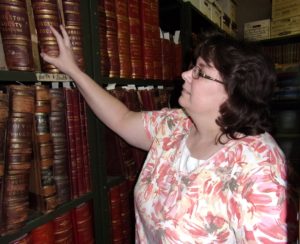
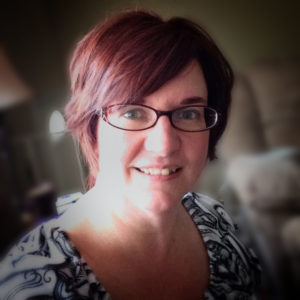
New month, new entry in my How They Do It series. Today’s interview is with Melissa Barker, an archivist, genealogist and writer. Melissa, a Certified Archives Manager, is currently working as the Houston County, Tennessee, Archivist. She is also a professional genealogist and lectures, teaches and writes about the genealogy research process, researching in archives and records preservation.

Melissa writes a bi-weekly advice column entitled The Archive Lady that can be viewed at Abundant Genealogy. She writes a monthly column entitled The Archive Lady’s Corner in the In-Depth Genealogist Magazine. She also writes a bi-weekly column for her local newspaper The Stewart-Houston Times called From the Archives. You may have heard her as The Archive Lady on Lisa Louise Cooke’s Genealogy Gems Podcast. Frankly, I’m  impressed that she has any time left to research her ancestors!

How They Do It: Melissa Barker, The Archive Lady
How long have you been doing genealogy?

I have been doing mine and my husband’s genealogy research for 27 years. I was bitten by the genealogy bug in 1990 while attending a funeral of one of my husband’s family members. There was a family member at the visitation night that was going around and talking to everyone and writing in a spiral bound notebook. I asked her what she was doing and she said she was collecting genealogy information. She let me look at her notebook and also allowed me to take it home and copy it. I was hooked! I have been doing genealogy ever since that day!

What’s your favorite part of doing genealogy?

My favorite part of doing genealogy is getting know the ancestors that I research. I believe every person who walked this earth has a story to tell. That story may be a sad story, a happy story or a mixture of both. I want to document all of it! Our ancestors have a lot to tell us today and there is so much we could learn from them. Collecting names and dates is not enough for me; I want to know everything about them and their lives, even what they had for breakfast! I want my ancestors to be remembered and the only way to do that is to tell their story.

Do you consider your genealogy research well organized?

I actually do think my genealogy is well organized. Before I became an archivist, my genealogy was a mess! Once I went back to school and received my certification in archives management and learned how archivists organize their collections, I used what I learned to organize my own genealogy research. When I learned the processes that archivists use to organize the records in their archives, I knew that it would work with my own records.

What type of software do you use for organizing your genealogy research?

I use the free version of Legacy Family Tree. I have been using this software for many years. I really like how the information that I put in the software is listed in a timeline format. That really helps me to see the gaps in my research. I find this software to be very user friendly. I have tried other genealogy software to only come back to Legacy Family Tree.

Do you keep a research log? If so, what format?

Yes, I do keep a research log. My research log is in paper format. I actually came up with the format myself after looking at other logs and finding that they didn’t work for me. I put a blank research log in front of every ancestor’s file so that it is there when I open the file. As I do research online, contact an archive or anything I can record that information right on the log in the file as I am doing it. I find that it is very convenient and works well for me.

Do you have a tree on Ancestry? If so, is it public or private? Why?

I do have trees on Ancestry. I have chosen to have multiple trees, one for each of the major surnames that I am researching. My trees are all public and open to anyone and everyone to view and use the information that I put on the tree. I only put on my trees that information that I can confirm and source. I also upload documents and photographs and love it when people put them on their own trees. The reason I have public trees is because I want to share my ancestors with everyone but especially those that are researching the same ancestors. I don’t own my ancestors; they belong to whoever is related to them. I love sharing and if I can share a document or photograph that helps someone else with their research, that makes me feel good!

What’s your biggest challenge when it comes to organizing your genealogy?

Time. I work as a full time county archivist and I am also The Archive Lady, speaking, teaching, lecturing and writing about researching in archives and records preservation. I try to carve out time during the week to do a little bit of my own genealogy research and I try to be very diligent to organize as I go so that it doesn’t pile up. That doesn’t always work out perfectly but I do know that staying organized helps us to be more successful with our research efforts.

What’s your biggest piece of advice to beginning genealogists in terms of keeping track of their research?

My biggest piece of advice for beginning genealogists is to keep a research log and organize as you go. Keeping a research log will keep you from doing duplicate research and wasting valuable research time. Before I started using a research log I found that I was looking at the same websites over and over. I also requested some of the same records from archives that I already had or had already requested and found they didn’t have them. Taking the time to record each and every research step in your research log is so very important.

What do you think is the most important thing for people to do to stay organized when it comes to family history research?

Organize as you go! Organizing your research as you go will help you to know your records and the information that you already have so that you can plan research for the information that you don’t have and would like to obtain. It takes time to stop researching and organize but it really is part of doing good genealogy research.

If you were starting out new as a genealogist what would you do differently?

If I were a new genealogist just starting out, I would use archives much more. Archives have tons of records that are not online and are not even microfilmed. Archives are full of shelves of records just waiting for the genealogist to discover them. Archives have unique records that can help tell our ancestor’s story more completely.
Do you keep paper or electronic files (or both)?

I keep both paper and electronic files. I actually prefer paper files but maybe that’s because I love working with original records as an archivist. I do have computer files so that I can share with other genealogists and so that I can access my records when I am not at home. Plus, it’s kind of hard to carry around my filing cabinets! For me, holding paper records, even if they are just copies of the originals, makes me feel closer to my ancestors.

Are you folder or binder person for your paper files?

I was a binder person for many years and now I am a folder person. I have a file folder for each and every ancestor that I research and keep those file folders in filing cabinets. I found that when I was doing research on an ancestor I didn’t want to search through a binder to locate that ancestor’s individual records. Using file folders for each ancestor I can put that particular person’s record in one file folder. So, when I open the file folder I am seeing only that ancestor’s records. I keep the records in each file folder in chronological order.

Do you use Evernote, One Note or any other electronic organizing system for your genealogy? If so, how do you use it?

I actually don’t use an electronic organizing system. I have tried to use Evernote and found that it just didn’t work very well with how I work. I use paper and pencil, the old fashioned way! I feel like I organize better writing things down in my own hand. I believe something happens between your brain and your hand as you are writing that the information you are recording sticks in your brain better. At least it works for me!

Do you have a dedicated space in your home for doing genealogy research? What’s it like?

Yes, I have a home office. I have always had a corner in the home where I had a desk and computer where I worked on my genealogy. But five years ago, after my daughter got married, I took over her bedroom as my office. Now, I have a lot of room for genealogy records and a very nice space to work on my genealogy. I also enjoy writing my blog, articles, doing webinars and preparing lectures as The Archive Lady in my home office.

Do you have anything to add?

I love talking to genealogists and helping them with their research. Working as an archivist, I am so very fortunate to have genealogists walk through my archives door every day. I see them with their family group sheets, binders of records and many times they are not prepared when they show up at my archives. Before visiting an archive, library, courthouse or any repository, sit down and make a to-do list. Plan your visit and have goals you want to achieve when you get there. Organization is so important in this process. If you show up at an archive prepared and organized, the archivist will be able to help you much more find information on your ancestors.

Somehow it doesn’t surprise me that The Archive Lady loves paper! I wholeheartedly agree with Melissa’s advice to organize as you go. If you can keep from creating a backlog of documents that need to be organized your research life becomes less overwhelming and more productive. Thank you so much, Melissa, for participating! FYI, Melissa’s professional genealogy expertise is in Tennessee records and she takes research clients. If you’d like her help, you can reach her at melissabarker20@hotmail.com.

Filed Under: Challenges, Excitement, Genealogy tips, Organizing Tagged With: How They Do It, Melissa Barker, organizing aids

How They Do It: Amy Johnson Crow

July 4, 2017 By Janine Adams 8 Comments

Today’s entry in my How They Do It series is an interview with Amy Johnson Crow, professional genealogist and blogger at AmyJohnsonCrow.com. I really enjoy Amy’s blog, where she offers really great and practical advice, and I was privileged to do a video interview with her for her blog when we were both at RootsTech earlier this year. I hope you enjoy reading this interview as much as I did. I wholeheartedly agree with her assertion that Simple is good!

How They Do It: Amy Johnson CrowHow They Do It: Amy Johnson Crow

How long have you been doing genealogy?

I’ve been interested ever since I was little. My grandma was the unofficial family historian in the family and she told me a lot of stories. I did my first “real” research in 1990 and became certified in 1995.

What’s your favorite part of doing genealogy?

The hunt. I love taking a research problem, figuring out how to approach it, finding resources, and putting it all together.

Do you consider your genealogy research well organized?

Fairly. I try to always go into it with some sort of objective. “Who are Matilda’s parents?” “Where was John in 1850?” “Why is there a gap in the ages of these children?” It helps me not go down the research rabbit hole as often (but it still happens!)

What type of software do you use for organizing your genealogy research?

I’m kind of between genealogy software programs right now. For organizing my research and my notes, I use Excel for timelines (I would be lost without timelines) and Word for my notes.

Do you keep a research log? If so, what format?

My notes are all in Word. I don’t keep a separate log, but I integrate it into my notes. I’ll add the title, etc. of whatever I’m looking at, why I’m looking at it, and what I found (and what I didn’t find).

Do you have a tree on Ancestry? If so, is it public or private? Why?

I have several trees on Ancestry. One is public, the rest are private. The public tree is for cousin bait and DNA. The private trees are for my “works in progress” and trees where I’m helping someone.

What’s your biggest challenge when it comes to organizing your genealogy?

Digital files, especially photos. I’ve been known to take dozens or even hundreds of photos when I’m researching or at a cemetery. I organize them by general category, but it’s the specific tagging that trips me up. There are times when I *know* I have a photo of a particular type of tombstone, but I can’t find it.

What’s your biggest piece of advice to beginning genealogists in terms of keeping track of their research?

Get in the habit of copying or scanning the title page of whatever book you’re using. Also note when you *don’t* find something.

What do you think is the most important thing for people to do to stay organized when it comes to family history research?

Find a method that works for them. Some people have to organize by family, while others go by location or record type. (I’m more of a location-based organizer myself, but I know that doesn’t work for everyone.)

If you were starting out new as a genealogist what would you do differently?

I would have started out with better citations. Back when I first started, my genealogy software allowed all of 8 characters to record a source. So many of my earliest citations were “stone” or some code that I later had no idea what it meant. It wasn’t a whole lot of fun trying to figure out where some of those facts came from!

Do you keep paper or electronic files (or both)?

Both. As techie as I am, I still love some paper.

Are you folder or binder person for your paper files?

Folders. I find them more flexible for how I organize.

Do you use Evernote, One Note or any other electronic organizing system for your genealogy? If so, how do you use it?

I’ve dabbled in Evernote, but I don’t use it regularly.

Do you have a dedicated space in your home for doing genealogy research? What’s it like?

I have my own home office. (I joke that the best piece of office equipment that I have is my door!) I’m actually scaling it back and getting rid of an entire bookcase of books (donating them to a couple of different libraries.) I love books — I am a librarian, after all — but I find that having a workspace that’s more “minimal” helps with my work.

Do you have anything to add?

There’s a lot to be said for organizing how it makes sense and is comfortable for you. However, I would encourage people not to make their systems too complicated. If another researcher or a family member ever has to go through your papers later and it isn’t clear how things are organized, that’s when research ends up getting tossed. Simple is good.

Amen, sister! A great example both of a simple organizing strategy and the kind of practical advice that Amy shares on her blog is one of her favorite posts (and mine), The Easy, Low-Tech Way to Label Scanned Photos. Organizing systems don’t have to be complicated–in fact we think it’s better if they aren’t!


Filed Under: Challenges, Excitement, Genealogy tips, Organizing Tagged With: amy johnson crow, How They Do It, organizing aids

  • « Go to Previous Page
  • Page 1
  • Interim pages omitted …
  • Page 20
  • Page 21
  • Page 22
  • Page 23
  • Page 24
  • Interim pages omitted …
  • Page 43
  • Go to Next Page »

about me

I'm Janine Adams, a professional organizer and a genealogy enthusiast. I love doing family history research, but I find it's very easy for me to get overwhelmed and not know where to turn next. So I'm working hard to stay organized and feel in control as I grow my family tree.

In this blog, I share my discoveries and explorations, along with my organizing challenges (and solutions). I hope by sharing what I learn along the way I'll be able to help you stay focused and have fun while you do your research, too.

tags

30 x 30 Adams amy johnson crow anniversary Brown cemetery census Civil War conferences connections dna electronic files Evernote excitement Family Curator family photos genealogy tools getting started goals How They Do It Igleheart Jeffries keepsakes learning opportunities maps newspapers NGS organizing aids overwhelm paper files planning quick tips rasco record keeping research research log research trip resources RootsTech social history source documentation Stacy Julian technology time management vital records

join the facebook community!

join the facebook community!

My organizing business

Learn more about my organizing business, Peace of Mind Organizing®.

Subscribe by RSS

  • RSS - Posts
  • RSS - Comments

© 2026 Janine Adams


Loading Comments...
