Sorting out all the learning opportunities

Ancestry.com learning centerI absolutely love that there are so many different ways to learn about genealogy. I swear I could easily spend 40 hours a week learning about family history research (and researching my family). Unfortunately, I don’t have that kind of time to devote to it.

Over the past year, since I’ve become more serious about genealogy, I’ve signed up for courses, purchased books (even read some), subscribed to online services like Ancestry.com, Fold 43 and Genealogy Bank, visited online forums, gone to a conference and I’m starting to feel a little overwhelmed by all the ways there are to learn.

Family Tree University (FTU) has many, many interesting courses. They have ones you take online at your own pace in a given period of time. They have live webinars. They have recorded webinars. They have virtual conferences. They have video classes. It makes my head spin a little.

What I’m come to discover is that it’s much easier for me to make the time for a learning opportunity if it happens at a scheduled time. It may be the former writer in me, but I’m very deadline driven. I signed up for a FTU virtual conference last winter, knowing that I wouldn’t be able to participate live but being satisfied that I could download the videos of the classes. Have I watched all of them yet? No.

As I ponder this, I realize what I need to do is to create a list of the resources I’ve downloaded and schedule time to watch/read them. And I need to make a commitment to not purchase any more until I’ve watched what I have.

While I’m at it, I’d be smart to create a list of free online learning opportunities–or those I’ve already paid for by virtue of a subscription, like Ancestry.com’s Learning Center,and try to make a point of perusing those. I’ll also be sure and post that list here once I’ve compiled it.

Family history research can be really overwhelming, in my experience. This is one aspect that’s teetering on the edge of making me feel overwhelmed and I’m bound and determined to get a handle on it!

Embracing Evernote

A couple of days ago I wrote that I was ready to give Evernote a try in organizing my genealogy notes. The truth of the matter is that it’s been a crazy busy week in my business and I haven’t had a chance to do any family history research and give Evernote a test drive.

On Wednesday, I did a web search to try to get my head around how Evernote could help me with my family history research. I quickly was overwhelmed when I didn’t find exactly what I needed. So I stopped looking.

But then, while I was at the gym, I listened to Lisa Louise Cooke’s Genealogy Gems Premium Podcast comparing Evernote to Microsoft’s OneNote. That led me to her Premium Video all about Evernote. And that was all I needed to really feel comfortable with giving Evernote a trial run.

I am so excited by the notion that, using Evernote, I can quickly keep and organize my notes, documents, newspaper articles as I come to them during the course of my research. I have a feeling that my consumption of printer paper and toner is about to go down.

I’ve known about Evernote for years and had friends show me how they use it. But I never felt like I had the problem it was solving.  But now I can see how it really might simplify my genealogy life. And I look forward to telling you that I’m right. (I promise to tell you if I’m wrong, too!)

Exploring Evernote for genealogy

Evernote logoI blogged awhile back that I wanted to start using research logs for my genealogy research. I have to admit, it’s been a bit of a failure. I found the Excel spreadsheet format I used constricting and then I didn’t remember to log my research. But I’m convinced it’s important and I want to refocus my efforts. This morning, I did a little Google searching to try to find suggestions for formats for research logs that might be more useful for me.

As part of that searching, I stumbled upon an article entitled Evernote: The Total Recall Research Log in the Winter 2011 issue of Forum, the Magazine of Federated Genealogical Societies. It’s all about on using Evernote, the cloud-based note management technology, to create and  maintain research logs.

I’m intrigued. I’ve used Evernote sporadically for a few years but have been wanting to learn more about it. As I’ve heard genealogy buffs extol its virtues for help with family history research, I’ve been meaning to explore it more. Today, I think I’ve finally activated that aspiration.

I downloaded the latest version of Evernote for the Mac. I updated the app on my iPhone. I entered my first note. I’ve read articles on the web. And if I feel I need a little extra help, I’ll download the Family Tree University on-demand video class, Using Evernote.

I think my interest in using research logs will dovetail nicely with my interest in using Evernote more for genealogy research. When I look at the Total Recall Research Log of Genealogical Research, which shows detailed research log entries in Evernote, I’m really drawn in.

Do you use Evernote to help you in your family history research? If so, how?

Making time for family history research

I love doing family history research. I really do. I’m also trying to figure out ways to integrate it into my organizing business, so technically it’s work. So why haven’t I done it in more than a week?

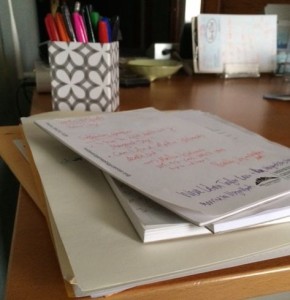
I can make excuses for why I haven’t made time to do any research. A week ago I returned from a week-long trip and I jumped right back in to full client load. My desk is a mess. (Embarrassing, but true.) But here’s the thing: since I’ve been home I’ve managed to catch up on most of the TV shows I recorded in my absence. I finished reading a book. I watched a couple of college basketball games.

It really does come down to priorities. (Priority management is a more accurate phrase than time management.)

As I contemplated the fact that I frequently close up shop and leave my desk for the day before I do any research, I realized a few things:

  • The messy desk really does get in the way. (Note to self: Clear it off every night like you used to!)
  • The time I thought I’d try to do it every day, 5 pm, isn’t conducive. Now that it’s winter, it’s dark at that time. I like a lot of light when I’m squinting at old handwriting.
  • If I’m running late trying to get the rest of my work done, I continue working past 5 pm and research is sacrificed.
  • I need to make it very, very easy to start doing the research. One way I might do that is to outline for myself at the end of each research session what I want to research at the start of the next one. Then it’ll be as simple as grabbing a file from the cart stored in a closet a few feet away, rather than rolling out the whole cart. And it gives me immediate focus.
  • I need to examine my priorities for my time and see where this research fits in. Is it more important than keeping up with social media or whittling my inbox down to zero? If so, I should do it before I do those daily tasks.
  • It’s important to recognize that I don’t need hours at a time to do research. As little as 30 minutes can glean some great results.

The process of writing this blog post has given me new resolve. I have a lighter day tomorrow and I’m going to make sure I do some research, earlier in the day. And I’ll make a note at the end of the session about how I want to start the next session.

I think I’ll take a few minutes to clear off my desk right now.