• BLOG
  • ABOUT
    • Privacy Policy

Organize Your Family History

Stay focused and happy while exploring your roots

Researching the history of my old house

August 21, 2018 By Janine Adams 8 Comments

I’ve lived in my house here in St. Louis since 1992. (Four of those years we rented out the house and lived in Brooklyn, New York.) When we moved in, I did a little research about my house, which was built in 1908, at city hall, where I the building permit. And when the 1940 census was released, I did some census research on the house, which I talked about in this 2013 post.

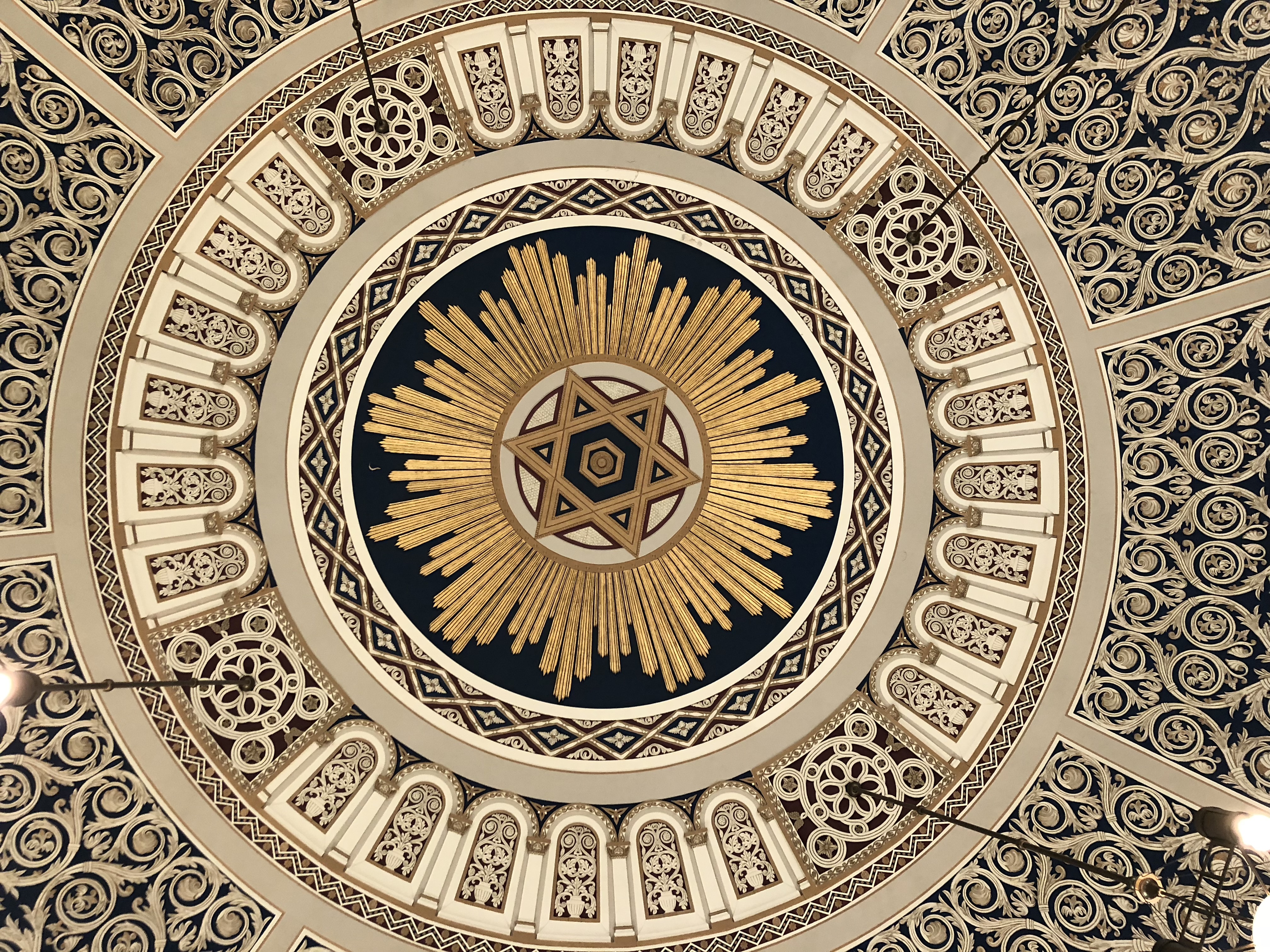
On Saturday, I attended a workshop at the Missouri Historical Society’s library on doing house history research. It was a great experience. The library itself–which I had never visited–is absolutely beautiful. The building was once a synagogue and it has lovely interior with an incredible domed ceiling. (That’s a picture of the interior of the dome at the top of this post.)

The Missouri Historical Society has put a lot of work into its house history resources page, with many resources spelled out. Some are available in the library, some are available online, and some are at other facilities, like St. Louis City Hall.

Associate Archivist Dennis Northcott took us through all these resources at the workshop. He even went to the trouble to find samples for each resource using the addresses the workshop attendees were researching.

After the workshop I came home and started to work on researching my house. I started by looking at the census research I’d already done. (It was so long ago that I hadn’t saved the images digitally.) I thought about how I wanted to organize the information, particularly since a traditional family tree wouldn’t be applicable.

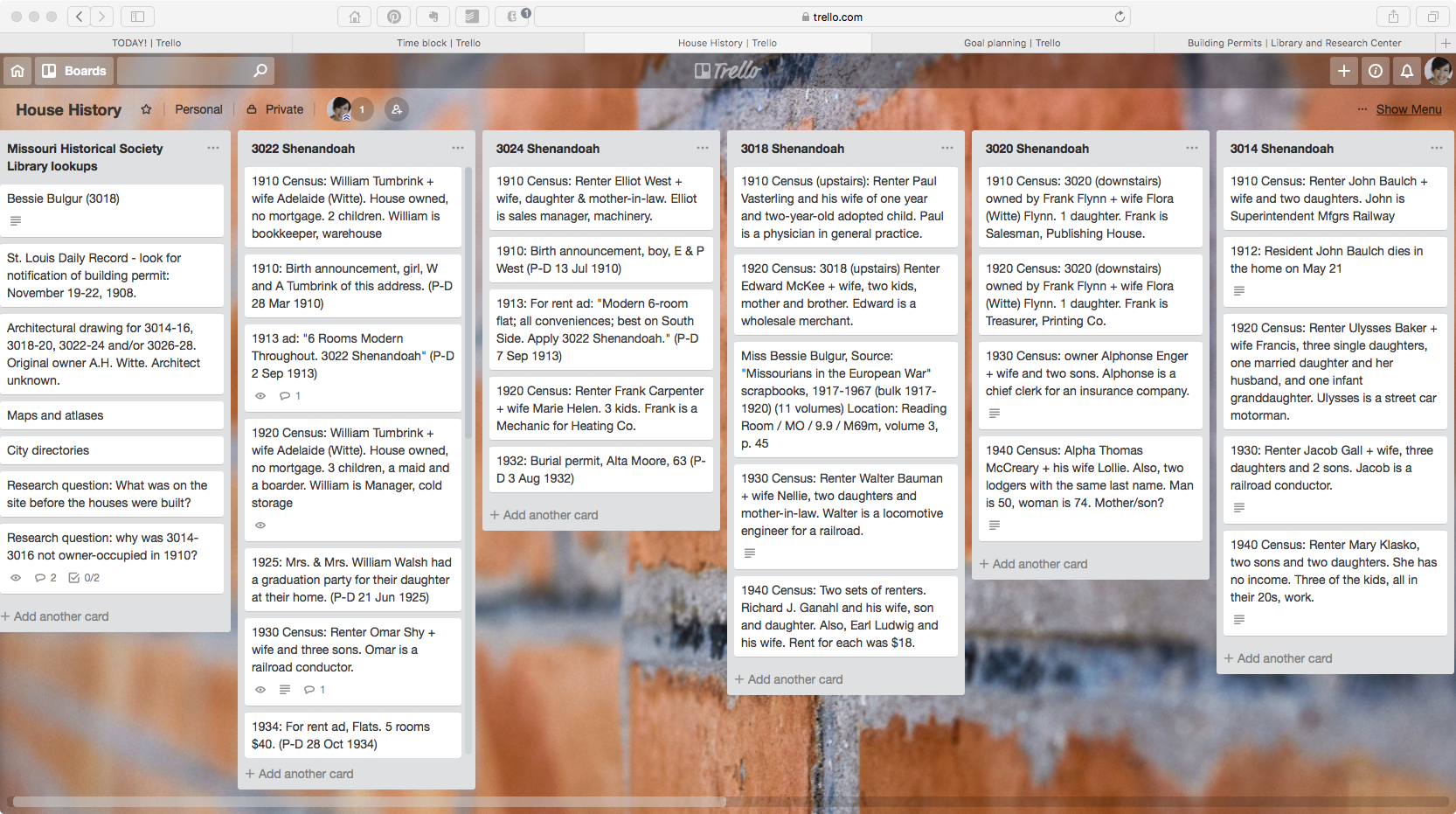
I decided to use my latest favorite app, Trello, to keep track of the research. I made a House History board, with a list for library lookups and a list for each of the addresses I’m researching. As I spelled out in my previous post about researching my house, mine is one of four two-family houses in a row built by a man for his four daughters. So I’m interested in all four houses plus I’m interested in the houses the daughters lived in prior to and after living in mine. I’m also interested in the other owners and tenants of my home and, to a lesser extent, the occupants of the other three homes of the quartet.

Here’s a picture of my Trello House History board as it stands today:
The other thing I did at the outset was to create an Evernote checklist of the resources spelled out on the Missouri Historical Society website.

So far, in addition to census research, I’ve done newspaper research. Next up will probably be city directories as well. Tomorrow, I’m going to go to the Missouri Historical Society Library to do some research with a friend who has an interest in the history of his beautiful old home. I don’t want my house history research to distract me too much from my genealogy research, but it sure is fun!
 

Filed Under: Genealogy tips, Organizing Tagged With: house research, missouri historical society, St. Louis

Reviewing my source documents

August 17, 2018 By Janine Adams 2 Comments

Last weekend I had the great fortune to hear genealogist and speaker Amy Johnson Crow give several talks at the Missouri State Genealogical Association‘s terrific conference. One of her talks was called “How to Milk a Source for All It’s Worth” and in it she shared tips and techniques for harvesting every bit of information you can from a source.

That got me thinking about the source documents I had found early on in my genealogy research, six or seven years ago. Back then, I was focusing on direct-line ancestors, so I’m sure I left a lot of information on the table. Rather than entering every scrap of information into my genealogy database (Reunion), I would have just glossed over it.

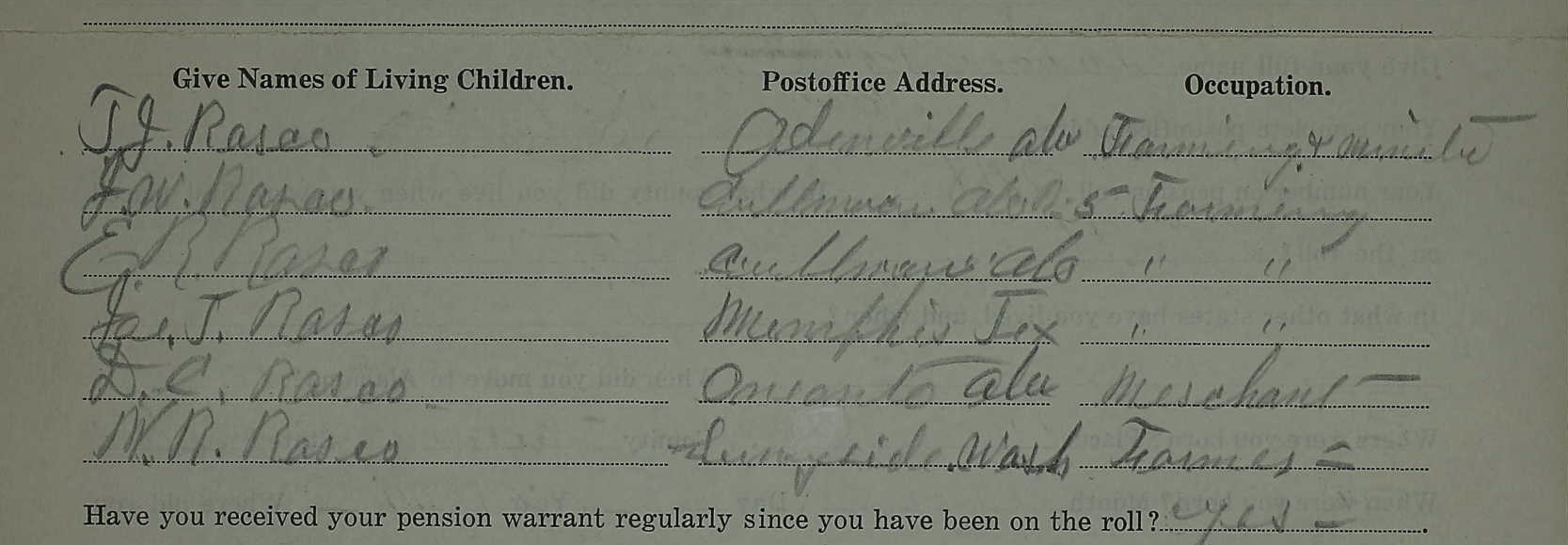
That was confirmed yesterday when I was going over an Alabama Census of Confederate Soldiers questionnaire my 2nd great grandfather, Laban Taylor Rasco (1844-1926) had filled out in 1921. I had found that source in 2012. (It’s source #127 in my database; I now have 834 sources.) I was shocked to see that I hadn’t recorded the information about his living children that was shared in that questionnaire. They were in my tree, because I’d added them at a later date, but back in 2012 I just wasn’t adding collateral lines. (I know, I was short-sighted.)

So I started adding that info and in doing so solved a little mystery. My grandmother Beatrix Rasco Adams, who was born in 1907, was living in Memphis, Texas, with her family on the 1920 census. In 1910, they were in Alabama, where she was born, and in the 1930 census they were in Washington state, where she lived the rest of her life. I never knew why they lived in Texas in 1920 (though I didn’t try very hard to find out). But I learned yesterday by focusing on that Confederate census, that her uncle, Joseph Taylor Rasco (1872-1964) was living in Memphis, Texas in 1921 and is nearby in the 1910 and 1920 censuses. Her family must have joined him. Mystery solved, or at least illuminated.

That made me realize that I have a lot of work to do with the source documentation that I have already downloaded and entered into Reunion. My genealogy research skills have improved so much that I find myself drawn to look at all those less recently found documents so I can pick all the meat off the bones.

Two summers ago, I started systematically going through my source documentation, primarily to correct the citations and to make sure that each source document was attached as a multimedia file to the source record in Reunion. At the time, I had 300 sources in my database. I got through Source #85 by the time I stalled out on that particular endeavor.

Fast forward two years and I now have an additional 500+ more sources, but I’m hopeful that the last several hundred were much better analyzed.

Last month, I shifted my focus to my father’s maternal line, the Rascos, and plan to work on them for the rest of 2018. So this is what I’ve decided to do: I’ve created a list of all the sources that pertain to the Rascos and I’m planning to systematically check each source record, making sure the citation is correct, that the source document is attached to the source record, and that all possible information is gleaned. When I see clues for further research within a document, I will either make a note of it in Evernote or, depending on time constraints and my whims, go ahead and pursue that clue.

I think this process will give me more confidence in my source citations and it will help me feel comfortable that my research is thorough–plus it will doubtless garner a lot more facts to add to my database! I also love that it will give me an easy starting point for research each day.

I’ll let you know how it goes!

Filed Under: Challenges, My family, Reflections Tagged With: rasco, record keeping, source documentation, time management

Sign up for What the Pros Know: Genealogy Organizing Tips workshop

August 14, 2018 By Janine Adams Leave a Comment

Family Tree University is once again offering the online workshop I hosted, called What the Pros Know: Genealogy Organization Tips. The workshop is on sale now and will start August 27. In this one-hour workshop,Ā  I interview four prominent genealogy experts. Each interview will focus on a particular aspect of genealogy organization. It’s designed to provide some great practical tips that will help you make your genealogy more organized and streamlined.

The interviews were recorded in January, and I created a Powerpoint presentation, with the salient points spelled out, that runs on your screen while the audio is played.

The experts are:

  • Drew Smith, on organizing the research process
  • Thomas MacEntee on using research logs
  • Joshua Taylor, on time management and staying focused and
  • Denise Levenick, on organizing family archives

Also included in the workshop is the opportunity to ask questions and have discussions in the workshop’s online forum the week of August 27. I will be on hand the evening of August 30 to answer any questions directed my way.

In the months since I conducted those interviews, many of the things I learned have popped to mind as I research and organize my research. These experts are so knowledgeable and I feel privileged to have had the chance to interview them.

Click here to learn more and sign up!

Filed Under: Excitement, Genealogy tips, Organizing Tagged With: Denise Levenick, Drew Smith, Family Curator, family tree university, Joshua Taylor, learning opportunities, organizing aids, Thomas MacEntee

Understanding genetic genealogy (finally!)

August 7, 2018 By Janine Adams 8 Comments

Understanding genetic genealogy (finally)I attended Diahan Southard’s series of DNA lectures on July 28 as part of the St. Louis Genealogical Society’s Summer Speaker Series. As I mentioned in a blog post last month, I’ve had a hard time using DNA in my genealogical research, mostly because I have a difficult time understanding and retaining what I try to learn about DNA.

Diahan is an expert on making this information understandable to non-scientists like me. I’ve heard her speak before but this time, a door in my brain cracked open. It may have been because at the seminar we had the privilege of listening to Diahan for four straight lectures, each of which built on the prior one. It was really a brilliant program and Diahan is an excellent speaker.

So I came home and started applying what I’ve learned and I now feel that genetic genealogy is part of my tool box. Hooray!!

Here are some of the revelations from her talks that really helped me:

  • A DNA match with a person whose tree has no familiar surnames is cause for celebration, not frustration. The DNA shows you’re related. When you figure out how you’re related, you’ll add names to your tree.
  • The Shared Centimorgan (cM) Project can help you understand how you might be related to someone, based on how much DNA you share. Here’s Diahan’s explanation of centimorgans and the Shared cM Project. It’s a great resource.
  • The solution to most DNA is quandaries is (drum roll): Do genealogy! DNA evidence can bridge gaps or open holes in brick walls. But traditional genealogy is how you build your family tree.
  • Create a list of your 32 great great great grandparents’ surnames to help you find commonalities with DNA matches. I had not compiled a list like that before and I see how it will help recognize how I might be related to those DNA matches that are fourth cousins or closer.
  • On Ancestry, even if a DNA match has not linked a tree to his/her DNA results (so you see “no family tree”), click on the “View Match” button and see if there’s a drop-down list of trees you might look at under the Pedigrees and Surnames tab. There may be a tree (or a few trees) for you to look at.

One thing I noticed when I took a look my Ancestry DNA results the day after the Diahan’s seminar is that the shared centimorgans don’t necessarily accurately reflect the relationship. For example, my mother’s first cousin, whom I know personally, shares only 183 cM with me, rather than the 439 that first cousins once removed usually share, according to the Shared cM Project. So Ancestry guessed that she was my third or fourth cousin. The Shared cM Project is a great tool, but obviously just a guideline.

Today in my research session, I explored the public tree linked to someone with whom I share 158 cM. This is a huge tree but I was able to easily focus in on a shared surname. The tree is beautifully sourced, so even though I had only a few minutes left of my 30-minute research session this morning, I was able to add a fact and supporting document to my great great grandfather’s record in my family tree software. Tomorrow I’ll go back and explore that tree more.

I finally understand how DNA can help me in my genealogy research. Better yet, I understand how to use it. This is such a revelation.

If using genetic genealogy eludes you as it did me, I heartily encourage you to check out Diahan’s website, Your DNA Guide, and to listen to Diahan speak when you have the chance. She’s speaking at the Federation of Genealogical Societies conference later this month and I know she’ll be speaking at the 2019 NGS conference in St. Charles, Missouri, next May. (I’ll plan to be in the front row!) You can also do a consultation with her where she explains your DNA results to you. She’s a terrific resource.

Unmodified photo by Michael Knowles via Flickr. Used under Creative Commons License.

Filed Under: Challenges, Excitement, Technology Tagged With: Diahan Southard, genealogy tools, genetic genealogy, research

  • « Go to Previous Page
  • Page 1
  • Interim pages omitted …
  • Page 104
  • Page 105
  • Page 106
  • Page 107
  • Page 108
  • Interim pages omitted …
  • Page 219
  • Go to Next Page »

about me

I'm Janine Adams, a professional organizer and a genealogy enthusiast. I love doing family history research, but I find it's very easy for me to get overwhelmed and not know where to turn next. So I'm working hard to stay organized and feel in control as I grow my family tree.

In this blog, I share my discoveries and explorations, along with my organizing challenges (and solutions). I hope by sharing what I learn along the way I'll be able to help you stay focused and have fun while you do your research, too.

tags

30 x 30 Adams amy johnson crow anniversary Brown cemetery census Civil War conferences connections dna electronic files Evernote excitement Family Curator family photos genealogy tools getting started goals How They Do It Igleheart Jeffries keepsakes learning opportunities maps newspapers NGS organizing aids overwhelm paper files planning quick tips rasco record keeping research research log research trip resources RootsTech social history source documentation Stacy Julian technology time management vital records

join the facebook community!

join the facebook community!

My organizing business

Learn more about my organizing business, Peace of Mind OrganizingĀ®.

Subscribe by RSS

  • RSS - Posts
  • RSS - Comments

© 2026 Janine Adams


Loading Comments...