• BLOG
  • ABOUT
    • Privacy Policy

Organize Your Family History

Stay focused and happy while exploring your roots

How do I start going digital?

November 29, 2022 By Janine Adams Leave a Comment

A year ago, I posted this article under the name Getting Started Going Digital. I think it’s an important topic, so I decided to run it again today. If you find this topic engaging, I encourage you to click on the link for the original article and look at the comments–reader Marian added interesting insights on approaching an overwhelming pile of papers.

If you’ve been pondering transitioning to digital organization of your genealogy records, you may be stymied about how to get started. It can feel overwhelming and perfectionism might be paralyzing you.

If you’ve been reading this blog for awhile, you know that I’m almost completely paperless in my genealogy research. I started out printing and filing everything but transitioned over a few years to digital. I didn’t make a decision to go paperless on a certain date. Rather, once I had a trustworthy digital folder structure and file-naming protocol in place, I didn’t feel like I needed to print anything out. I’m lucky, in a way. I came to this after just a couple of years of serious research. So I didn’t have a huge backlog to contend with.

I get a good number of questions from folks who have been researching for years and have a whole of lot paper to show for it. They want to go digital but don’t know where to start digitizing their research. If that’s something you think about, here’s a post designed to help you get started.

Here’s what I recommend as the first steps to organizing your genealogy research digitally.

  1. Create a folder structure and a file-naming protocol. This is critical so you easily find your documents. I describe my folder structure and file-naming protocol in step six of this blog post.
  2. From this point forward, stop printing and start downloading documents you find online, using your new folder structure and file-naming protocol. If you start now, you’ll familiarize yourself with your the new file system and you won’t add to your backlog of documents to be scanned and filed.
  3. Start scanning, renaming and filing your paper documents. What I did was go through my paper file folders, which were organized by couple, one by one, evaluating each piece of paper and scanning documents any that I didn’t already have in electronic form. I blogged about it in a post called Marrying my electronic and paper files. This may sound tedious, but I urge you to think about this as an opportunity to check your research. Looking at each paper, you may come across evidence that you overlooked when you first filed those papers. Here’s the good news: you don’t have to take a vacation to get it done. You can do it little by little, person by person or couple by couple (depending on how your paper documents are organized).
  4. Recycle or shred paper after you scan it. I see no reason to hang onto the paper files you have scanned, unless they have some historical value. For example, after I carefully scanned it, I kept the epic handwritten letter my grandfather wrote my grandmother before they married.
  5. If you find yourself pulling a paper document out of your files to help you in your current research, go ahead and scan and file it electronically. Then toss the paper.
  6. It should go without saying, but I’ll say it anyway. If you’re organizing your genealogy research digitally it’s imperative that you have a routine in place for backing up your hard drive. (Look no further than my recent experience of my backup saving my bacon when my computer died without warning.) It’s a good idea to have more than one back up.

This process reminds me of that age-old question: “How do you eat an elephant?” One bite at a time. Once you get your folder structure and file-naming protocol set up, you just take it paper by paper. Acknowledge that it will take awhile. Recognize the value of going through your old papers. And keep your eye on the prize: An easily accessible, readable and sharable archive of your genealogy records.

For detailed information on the digital organizing system I created for my research, check out my 2021 Orderly Roots Guide, How I Do It: A Professional Organizer’s Genealogy Workflow. The downloadable pdf is 37 pages and available for $19.99.

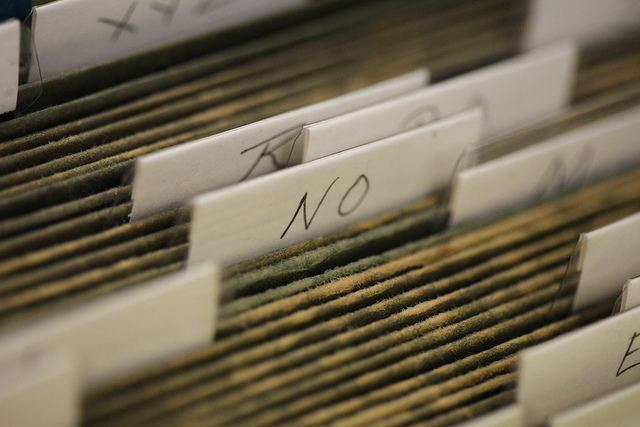
Photo by Tom Woodward via Flickr. Used under Creative Commons License.
 

Filed Under: Challenges, Genealogy tips, Organizing, Technology Tagged With: electronic files, organizing aids, paper files, record keeping, technology

What is a perfectionist?

November 25, 2022 By Janine Adams Leave a Comment

I co-host a weekly podcast called Getting to Good Enough, all about letting go of perfectionism so you can do more of what you love. Each week, my co-host, Shannon Wilkinson, and I discuss getting past perfectionism in some aspect of life.

I’ve internalized a definition of perfectionism that I first learned from time-management guru Harold L. Taylor more than a dozen years ago. This definition rings true for me and informs a lot of what I do. I thought I’d share it with you because I think it applies to genealogy and, really, to everything we do.

A perfectionist is someone who spends more time on a task than it merits.

Next time you’re spending a lot of time trying to get something just right, ask yourself whether the task really merits that effort. It can be a great way to let good enough be good enough. And that can save you time, effort and angst.

Filed Under: Genealogy tips Tagged With: perfectionism, podcast, Shannon Wilkinson

Let’s create history for our descendants this Thanksgiving

November 22, 2022 By Janine Adams Leave a Comment

I originally wrote this post in 2016, and I like repeating it on Thanksgiving where we might once again be getting together for a meal with our loved ones. Happy Thanksgiving to all my readers!

This Thanksgiving week, I’ve been thinking about how the ordinary lives of my ancestors are endlessly fascinating to me. As I slowly plow through my great great grandfather’s Civil War pension file, I get very excited when I come to a form he filled out 125 years ago that has a little extra information in it (like the names and birth dates of his children). Any peek into what his life was like is a special treat.

It got me thinking about how mundane aspects of our lives today might be really interesting 100 years from now to the people below us on the family tree.

Of course, we fill out fewer paper forms now. And genealogy will probably look very different in the twenty-second century. But I think photos and records will always be valuable.

This year, as we celebrate Thanksgiving (or really just go about our lives), we have the opportunity to create history for our descendants. We can be mindful of our legacy as we’re taking pictures. We can take care to label them (or add metadata to digital photos) so future generations know who the people in the photos are. We can do oral history interviews and carefully preserve them with labels for future generations.

If you have older relatives around your Thanksgiving table, I urge you to ask questions and preserve those conversations for generations to come (as well as for your own genealogy research). I sure wish I had. Wouldn’t it be great to put your hands on a recorded interview with one of your ancestors? You could be the person making that possible for your descendants.

Thanks to smartphone technology, it’s so easy for us to record conversations and take videos. Let’s do that while we can and mindfully tag and back up those recordings. (And hope that the medium will still be readable decades from now.) Or we can do what Stacy Julian does and ask our relatives to fill out a simple form.

As much as I urge my organizing clients to part with paper or other items that don’t serve any purpose any longer, I do sometimes encourage them to hang on to documents or photographs that might be of interest to their descendants. I encourage you to be mindful of that and store those items that so that they might be passed on to family-history-minded descendants when you pass.

Remember: Every day we have the opportunity to create history.

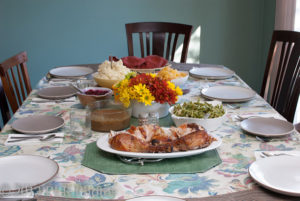
Photo by Robert and Pat Rogers via Flickr. Used under Creative Commons License.
Filed Under: Challenges, Preservation, Reflections Tagged With: family photos, keepsakes, planning, social history, Stacy Julian

Quick Tip #38: Ask yourself open questions

November 4, 2022 By Janine Adams Leave a Comment

Here’s the next in my occasional series of bite-size Quick Tips. Click on the Quick Tips tag for my other Quick Tips. Because I tend to write longer posts, I wanted to provide a quick-to-read (and quick-to-write) post every now and then on a small topic that pops into my head. This one can save you time and effort. 

Ask yourself open questions

It’s always a good idea to start a research session with a question that you want answered. And it can pay to be careful how you phrase those questions.

Rather than asking yourself a confirming question like “Was my great grandmother Alice Ruberson born in Kansas?” it’s better to ask an open question, like “Where was my great grandmother Alice born?”

The reason for this is confirmation bias, the tendency to interpret new evidence as confirmation of one’s existing beliefs or theories (according to the Oxford English Dictionary). As Amy Johnson Crow explained in this morning’s Wikitree Symposium, when you think you know the answer, you’re likely to stop researching once you find evidence that confirms it. But when you ask an open question, you tend to search more extensively.

Next time you come up with a research question, consider how you’re phrasing it.

Photo by Sam Dan Truong on Unsplash

Filed Under: Genealogy tips Tagged With: quick tips

  • « Go to Previous Page
  • Page 1
  • Interim pages omitted …
  • Page 24
  • Page 25
  • Page 26
  • Page 27
  • Page 28
  • Interim pages omitted …
  • Page 219
  • Go to Next Page »

about me

I'm Janine Adams, a professional organizer and a genealogy enthusiast. I love doing family history research, but I find it's very easy for me to get overwhelmed and not know where to turn next. So I'm working hard to stay organized and feel in control as I grow my family tree.

In this blog, I share my discoveries and explorations, along with my organizing challenges (and solutions). I hope by sharing what I learn along the way I'll be able to help you stay focused and have fun while you do your research, too.

tags

30 x 30 Adams amy johnson crow anniversary Brown cemetery census Civil War conferences connections dna electronic files Evernote excitement Family Curator family photos genealogy tools getting started goals How They Do It Igleheart Jeffries keepsakes learning opportunities maps newspapers NGS organizing aids overwhelm paper files planning quick tips rasco record keeping research research log research trip resources RootsTech social history source documentation Stacy Julian technology time management vital records

join the facebook community!

join the facebook community!

My organizing business

Learn more about my organizing business, Peace of Mind Organizing®.

Subscribe by RSS

  • RSS - Posts
  • RSS - Comments

© 2026 Janine Adams


Loading Comments...