Here is the second installment in my How They Do It series, which I inaugurated last month with a Q&A with Thomas MacEntee. In this series, I’ve reached out to genealogy luminaries whom I admire and asked them to talk about how they organize their own genealogy research. I’ll post a new installment the first Tuesday of every month.
This month, we get to learn from Denise May Levenick, The Family Curator, author of How to Archive Family Keepsakes and How to Archive Family Photos. Denise is also a frequent contributor to Family Tree Magazine, as well as a popular teacher and lecturer.
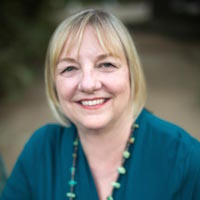 How They Do It: Denise May Levenick
How long have you been doing genealogy?
I checked out my first census record in 1976 as part of a course in Personal and Family History at the University of Idaho, and I was hooked! That course gave me the opportunity to revisit my grandmother’s family history papers and photos, but I didn’t really pursue genealogy until my sons graduated from college and I had more time. It was a long hiatus.
What’s your favorite part of doing genealogy?
Discovering the back-story of a document or an unexplained detail about an ancestor is my favorite aspect of genealogy. I loved discovering that my grandmother was an accomplished seamstress! It gives me an extra connection when I work on quilts for my family.
Do you consider your genealogy research well organized?
Is my research well-organized? My research is one thing, my research papers and files are another. I feel pretty comfortable about both, and I can usually find what I need. But, there’s always room for improvement!
What type of software do you use for organizing your genealogy research?
I’ve used or tried almost every genealogy database program – PAF, Family Tree Maker Legacy, RootsMagic, Reunion, MacFamily Tree, and some I can’t remember. Since moving to a Mac in 2000, I use Reunion most of the time. I keep all my work in the Notes section and export GEDCOM files as needed to use features in other programs on my PC. The best advice I ever received was to invest time and effort in the Notes section of your software rather than the individual event line data. It’s served me well when I moved around as my needs changed.
Do you keep a research log? If so, what format?
Oh… research logs. Yes, I do. I had a beautiful journal log that I left somewhere, and now I use a form log online that I can access from my desktop at home or my laptop. I still use a paper journal log, but most work is duplicated on the digital log too. I’m a “form person.” I love creating tables and forms for different projects and included dozens of worksheets and forms in both my books.
Do you have a tree on Ancestry? If so, is it public or private? Why?
I have both kinds of trees on Ancestry. Public as cousin bait, and private for my works-in-progress. I don’t want my speculative work to be copied as proven, so I feel better keeping those trees private.
What’s your biggest challenge when it comes to organizing your genealogy?
My biggest challenge is keeping paper under control. I do like paper copies to read and annotate, but the pages seem to multiply like rabbits.
What’s your biggest piece of advice to beginning genealogists in terms of keeping track of their research?
I’d say, “Don’t fight the Research Log. Just do it!” We love taking shortcuts, but in genealogy, shortcuts just cost time later.
What do you think is the most important thing for people to do to stay organized when it comes to family history research?
Organization doesn’t just “happen.” For most of us, it’s part of a process or workflow. I find that when I use a consistent research process, staying organized becomes a natural part of the entire scheme. For example, creating a digital workflow was tough to develop and implement, but it’s become a habit now that I’m using the 7-Step digital asset management process I write about in my book How to Archive Family Photos. I find that I’m naturally moving from Capture to Import and through each step, and my files are organized along the way. Developing a repeatable workflow is key.
If you were starting out new as a genealogist what would you do differently?
Oh, I wish I had been a more active genealogist years ago. I have so many ancestors yet to discover! I would encourage any new family historian to take a beginning genealogy course and develop good research and record-keeping habits. You can learn about record groups as you develop in the field, but you will always use sound basic skills.
Do you keep paper or electronic files (or both)?
I keep both paper and electronic files. Papers are filed in hanging file folders until I analyze them and enter the data in Reunion; then the papers go in a binder. I keep digital files in Surname folders with meaningful filenames. I use Spotlight or other file search software to find files faster on my computer.
Are you a folder or binder person for your paper files?
I love binders because they help me keep papers in order and in place.
Do you use Evernote, One Note or any other electronic organizing system for your genealogy? If so, how do you use it?
Evernote is my go-to app for quick reference notes of webpages and articles, but I use OneNote for notes and tasks especially when traveling. I’ve used Microsoft Word for so long that it’s like a typewriter to me, and OneNote’s notebook format makes it easy to keep track of odd bits of information. When it comes to writing, however, I turn to Scrivener. I use it for all my blog posts, magazine articles, and lecture outlines, and it was great for organizing my book projects.
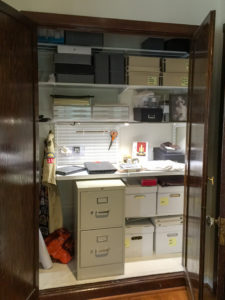
Denise’s Home Archive
Do you have a dedicated space in your home for doing genealogy research? What’s it like?
I am fortunate to have a perfect writing and research space at home. It’s a small room upstairs overlooking the front of our house, so I get a birds’ eye view of the neighborhood through a wall of glass French doors. One office wall is filled with books – English and American literature and history from my teaching days, and genealogy reference books. I have a corner cabinet that holds supplies, a vertical file cabinet, and a computer desk. We will be moving soon, and my new office will be a bit larger, so I hope I’ll have room for a table to spread out projects and items from my archive. My Home Archive is located in the closet of an extra bedroom, and I’m looking forward to having everything in one place in my new office.
Do you have anything to add?
I’ve learned that “getting organized” can become an all-consuming goal if we get stuck in the mindset of finding the “perfect” system or solution. I do better when I remind myself that progress is better than perfection; fix what isn’t working and move forward.
Such wise words! I’m particularly struck by Denise’s advice about research logs: “Don’t fight the research log. Just do it!” Amen. Thank you, Denise!
 RootsTech has announced its schedule of sessions being streamed from next week’s conference. If you can’t make it to Salt Lake City, you can at least watch some of the keynotes and breakout sessions. (Alas, my session on Friday morning, Go Paperless: Digitize & Streamline Your Research, isn’t one of them.)
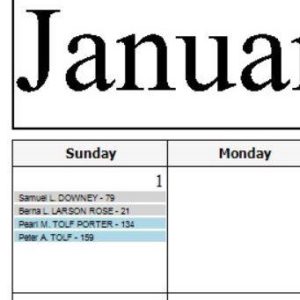 Over on the Genealogy Research Loggers Facebook group, member Laura Aanenson posted her 2017 research plan and the brilliant method she uses to select the ancestor to research each session. I thought it was a such a great idea I asked her permission to write about it here.