• BLOG
  • ABOUT
    • Privacy Policy

Organize Your Family History

Stay focused and happy while exploring your roots

Five things I wish my early-researcher self had known

April 26, 2019 By Janine Adams 12 Comments

Earlier this year, I found a pile of papers from early days of my genealogy research and went through them to see what was of value. As I reported back, I let go of a lot of it and scanned some, and it was a worthwhile, if somewhat tedious, endeavor.

In a separate project, I’ve been evaluating the source documentation in my Reunion database. The way I cited and processed early sources was not always great, to say the least. As part of this project, I’ve been reexamining each source, which has helped me make the citation better and glean more information.

As I looked at my early research efforts, five things emerged that I wish I’d known back then.

  1. Always write down a source or copy a title page when photocopying something. In some cases, while examining the paper pile, I had no idea where the document had come from. In a couple of cases, a little searching online revealed the source. But what a waste of time.
  2. Assume you’ll remember nothing. I now keep notes in my research log because the work involved in trying to figure out why I copied or downloaded something  is another waste of time.
  3. Siblings matter. Early on, I researched only direct-line ancestors. I think it was because keeping track of collateral relatives felt overwhelming. I know better now. Keeping track of siblings (and cousins!) helps you evaluate information and provides critical clues.
  4. Indexes are clues, not sources. Some of the early sources in my Reunion database are indexes. Now, I don’t include an index as a source unless I’ve absolutely exhausted the possibilities for finding the actual document that was indexed. There is so much more information available in the actual document than the index itself. And, of course, indexes, which were created after the fact, are almost by definition less reliable than original sources.
  5. Be really critical. Early on, finding anything that seemed to support an idea I already had felt like a big win and I didn’t necessary examine it critically. But I’ve learned to critically evaluate every bit of evidence. I don’t automatically accept documents that support my hypotheses, nor do I reject evidence that does not. I like to think of it as sources earning their way into my database.

Genealogy is a process of constant learning. We all make mistakes at the beginning and with any luck we learn from them. (I’m still making mistakes and still learning.) Perhaps this short list will help someone avoid a couple of mistakes.

How about you? What do you wish your early-genealogist self had known?
Filed Under: Challenges, Genealogy tips, Reflections Tagged With: record keeping, research, source documentation, time management

NGS livestream schedule released

April 24, 2019 By Janine Adams Leave a Comment

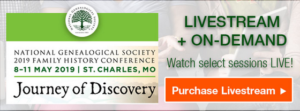
I’m excited to be attending the 2019 National Genealogical Society conference, which is being held 8 to 11 May 2019 in St. Charles, Missouri, where I’ll get to choose from more than 135 different classes being offered. If you’re not able to make it, you have the option of watching ten of the classes via live stream (and, later, on demand).

The sessions being streamed are offered on Thursday, May 9 and Friday, May 10. Three of Thursday’s five sessions will focus on DNA’s role in supplementing genealogical research. The other two lectures streamed on Friday are on ethnic research. The five selections on Friday feature lectures by the Board for Certification of Genealogists (BCG) that emphasize research, analysis, and problem-solving skills. For a complete list of the sessions being live streamed, go to the live stream page for the conference.

You can buy a one-day pass for either day for $95 or a two-day pass for $149. If you want to watch the sessions live, you must register by May 8. From May 9 to 11, you can purchase on-demand viewing of the ten sessions for that price. (After that, you can purchase a video pass for all ten but the price goes up to $249.) The sessions remain available to you to view, as many times as you’d like, for a year, until May 11, 2020.

Live stream registrants receive a copy of the electronic syllabus for the whole conference. For those registrants who miss the live broadcast, the session will be available on demand about 48 hours after the broadcast.

Audio recordings of all the sessions will also be available for purchase. See the video and audio recordings page for details and pricing. The price for audio recordings goes up by $100 after May 11. If you purchase the audio package, you can download the MP3s with no expiration. Both video and audio purchasers receive access to the electronic syllabus.

If you are attending the conference, the syllabus is now available for download. (Check your email for login details.) And if you’re going to the conference and would like to meet up and haven’t already told me, please comment below!

Filed Under: Genealogy tips Tagged With: conferences, learning opportunities, NGS

How They Do It: Megan Smolenyak

April 10, 2019 By Janine Adams 1 Comment

This month I’m thrilled to present the insights of genealogical adventurer and storyteller (don’t you love that description?) Megan Smolenyak Smolenyak. Megan is well known as a writer, speaker and TV guest and is the author of six books, most recently Hey, America, Your Roots Are Showing and Who Do You Think You Are?: The Essential Guide to Tracing Your Family History, the companion guide to the TV series. Her personality shines through in this interview. Enjoy!

How They Do It: Megan Smolenyak

How long have you been doing genealogy?

I’ve been doing genealogy since a 6th grade homework assignment got me started, so decades now!

What’s your favorite thing about being a genealogist?

I get to wake up every day and play detective to help other people. That’s pretty great, isn’t it? I love the thrill of the hunt, and playing at the fringes. That’s why I was one of the first to play with DNA, use genealogy for forensic purposes (e.g., military identifications, FBI civil rights cold cases, coroners’ offices, etc.), produce roots-oriented videos, and so forth. I like experimenting to find different ways to apply genealogical research and hopefully wind up doing some good.

What’s your biggest challenge when it comes to organizing your genealogy?

My biggest challenge organization-wise is my personal research. I’m quite organized when it comes to others’ family history, but not so much with my own. I don’t get much time to play with it, but suffice it to say, I have decades of research in a variety of formats.

What is your favorite technology tool for genealogy?

I wouldn’t say they’re my favorite, but more the toys I’m playing with lately. I’ve been pondering recently how to ensure that my personal research survives me, and since there are no keen genealogists among my close family members, I’ve been looking for ways to share what I’ve learned in ways that relatives might find half-way interesting. So I’ve been experimenting with what you might call distribution tools.

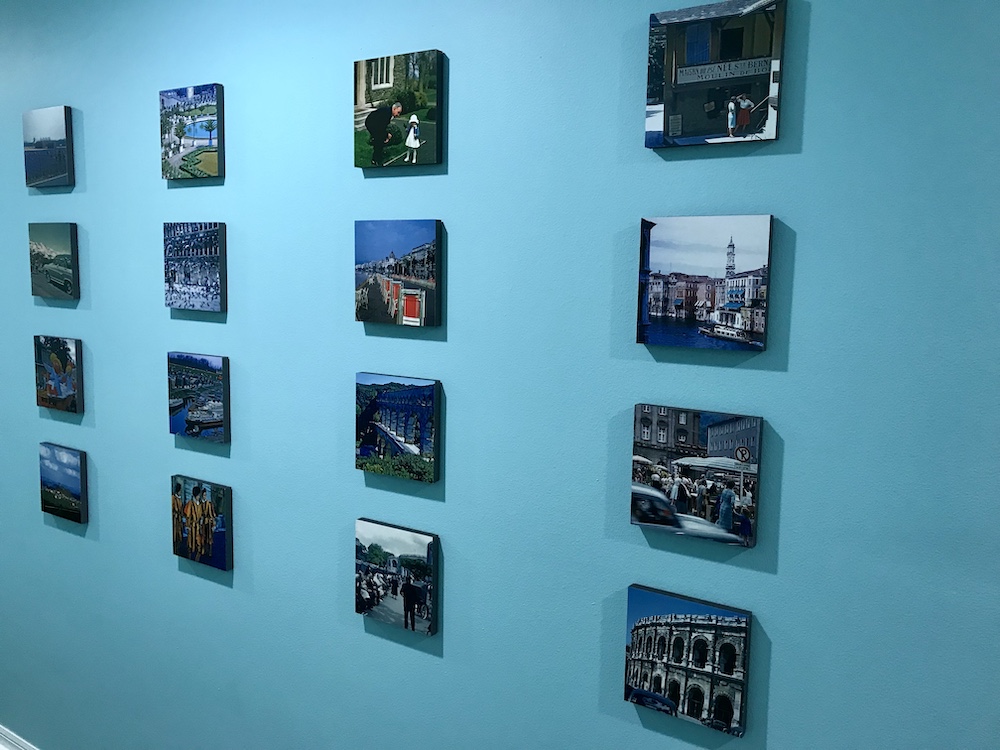
Megan’s wall of Mixtiles

For instance, I have lots of my father’s slides from our time living in Europe, so I selected and edited some and now have a display along a long hallway. To do that, I used the Mixtiles app, and what’s great about it is that each “tile” can be applied and removed multiple times, so I can rotate the content over time. Then I took it a step further and made a slender book of these same slides using Blurb and sent copies to my dad and siblings.

If you were starting out new as a genealogist what would you do differently?

When I first shifted careers to genealogy, I said ‘yes’ to every opportunity that came my way, and I would still do that again today. That said, I should have started turning down some invitations earlier than I did. While I’m beyond grateful for all the opportunities that have come my way, I got myself over-obligated and it took years to dig out.

Do you keep a research log? If so, what format?

It depends on the project and scale, but for the most part, conventional research logs in good, old-fashioned Word. And I’m a big fan of white boards when juggling multiple sub-projects (e.g., orchestrating research for a TV season). I once worked in a place that had an entire wall made of white board and I’d love to have that again!

How do you keep track of clues or ideas for further research?

Again, fairly old school. For instance, a dedicated notebook for a particular project. Or a generic notebook for multiple projects where I scribble ideas and then create an on-going table of contents (from the back of the notebook in) so I can easily find what I’m looking for (color-coding often comes into play). Sometimes I’ll append pages for this purpose to a research log. Also, for those times when I trip across cool new sites I want to explore, but know I’ll get distracted by, I’ll add them into a slot in my calendar app and then give myself time – usually a random Friday afternoon – to play with several at once.

What’s the most important thing you do to prepare for a research trip?

Homework, homework, homework. I explore the websites of all the repositories I plan to go to and dig into their catalogs, online collections, and the like so I know exactly what’s necessary and exactly what’s possible. I’ll often wind up back-and-forthing with an archivist or librarian in advance – sometimes to have materials waiting, perhaps to clarify details about a particular collection, or maybe to pick their brains for further ideas. I recently did this for a research trip to the Archives of Macau, and it saved so much time – not to mention, gave me some gems I probably wouldn’t have found on my own.

What’s your biggest piece of advice to genealogists in terms of organizing their research?

This is probably a blinding flash of the obvious, but get yourself organized when you’re first starting out. Form those habits early. If nothing else, you will save yourself so much re-work by not constantly re-inventing your research trail.

Do you have a dedicated space in your home for doing genealogy research? What’s it like?

Yes, since I’ve been a professional genealogist for two decades now, I’ve always had a dedicated room for my office wherever we lived (Virginia, New Jersey and Florida so far), and they’ve all had their own vibe. My current one is lighter and airier than in the past – partly due to digitization reducing the need for filing cabinets and other storage. I have a large sit/stand desk (very reasonable at IKEA), a filing credenza, a bookcase, and a utility cart (IKEA again) and library cart (Demco caters to libraries, but sells to individuals) – the last two for current projects. I also have a sleeper ottoman (that’s hardly ever been opened into a bed) where visitors can plop themselves down and get comfortable. The walls are light teal, the furniture is mostly white, and there’s lots of colorful art. So all that, terrific views and Mixtiles. More Mixtiles.

I love Megan’s light-hearted, but wise, responses and this peek into the organizational life of such an experienced genealogist. I had never of Mixtiles and excited to explore more! Thank you so much, Megan, for sharing!

Filed Under: Excitement, Genealogy tips Tagged With: How They Do It, Megan Smolenyak, organizing aids

Succeeding at the 30 x 30 challenge

April 4, 2019 By Janine Adams 7 Comments

We’re at the start of a new 30 x 30 challenge (30 minutes of genealogy research for a 30 days in a row). For me, throwing down the gauntlet of the challenge is enough to get me sticking to it–it’s my challenge after all. But I wanted to share some strategies to help you feel successful about the 30 x 30 challenge when the month is over.

This is something that my co-host, Shannon Wilkinson, and I discuss on our weekly podcast Getting to Good Enough, which is about letting go of perfectionism so you can do more of what you love. Perfectionism can truly get in the way of sticking with a challenge like this. But it doesn’t have to.

I think the key is building in flexibility to allow yourself to stick with the challenge, even if you miss a day or don’t put in the full 30 minutes. As I said in the post that started this month’s challenge, I’m traveling for a week this month and I know it will be hard to carve out 30 minutes of research some days. So I’ve adapted the challenge a bit. I will feel successful if I research each day (even if it’s just for a few minutes, as it was for me in the airport yesterday), with an average of 30 minutes a day accomplished. And I’m not going to be too upset if I miss a day.

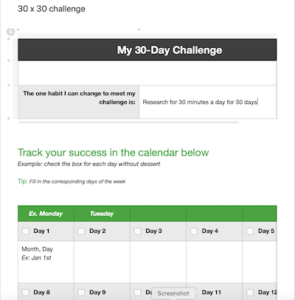
Reader Kim adapted the challenge to be 900 minutes total for the month, regardless of how many days she is able to research. Beautiful! To keep track of those minutes, she found an Evernote habit tracker template and was kind enough to follow up with a comment on last week’s post and tell us how to access it. (Start a new note, click Template in the first line of the new note, select Personal Well-Being from the sidebar, then scroll down to Habit Tracker.) This is a tool that many of us can use to keep track of the challenge. I know it will help me ensure that I average 30 minutes a day. Thank you, Kim, for taking the time to share that information!

Sometimes planning for going off track can help you find success. Things come up that might prevent you from researching some days. Accept that as inevitability and think about how you’ll handle it if it happens. There’s no need to beat yourself up. Just keep going if that happens.

I don’t want you to drop the challenge entirely if you miss a day.  You can still get so much done if you research the other days. (And if you take a moment to plan the next day’s research at the end of a session, you can jump right in at the beginning of the next session, which makes everything easier.)

This week’s episode of Getting to Good Enough is called Getting Back on Track and it’s all about gently re-starting habits that inevitably fall by the wayside. If you have a half hour, give it a listen and you’ll hear some strategies for hopping back on the wagon if you fall off.

To your success!

Filed Under: Challenges, Genealogy tips, Reflections Tagged With: 30 x 30, time management

  • « Go to Previous Page
  • Page 1
  • Interim pages omitted …
  • Page 44
  • Page 45
  • Page 46
  • Page 47
  • Page 48
  • Interim pages omitted …
  • Page 106
  • Go to Next Page »

about me

I'm Janine Adams, a professional organizer and a genealogy enthusiast. I love doing family history research, but I find it's very easy for me to get overwhelmed and not know where to turn next. So I'm working hard to stay organized and feel in control as I grow my family tree.

In this blog, I share my discoveries and explorations, along with my organizing challenges (and solutions). I hope by sharing what I learn along the way I'll be able to help you stay focused and have fun while you do your research, too.

tags

30 x 30 Adams amy johnson crow anniversary Brown cemetery census Civil War conferences connections dna electronic files Evernote excitement Family Curator family photos genealogy tools getting started goals How They Do It Igleheart Jeffries keepsakes learning opportunities maps newspapers NGS organizing aids overwhelm paper files planning quick tips rasco record keeping research research log research trip resources RootsTech social history source documentation Stacy Julian technology time management vital records

join the facebook community!

join the facebook community!

My organizing business

Learn more about my organizing business, Peace of Mind Organizing®.

Subscribe by RSS

  • RSS - Posts
  • RSS - Comments

© 2026 Janine Adams


Loading Comments...