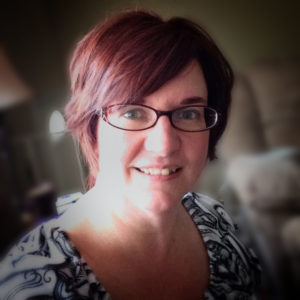
New month, new entry in my How They Do It series. Today’s interview is with Melissa Barker, an archivist, genealogist and writer. Melissa, a Certified Archives Manager, is currently working as the Houston County, Tennessee, Archivist. She is also a professional genealogist and lectures, teaches and writes about the genealogy research process, researching in archives and records preservation.
Melissa writes a bi-weekly advice column entitled The Archive Lady that can be viewed at Abundant Genealogy. She writes a monthly column entitled The Archive Lady’s Corner in the In-Depth Genealogist Magazine. She also writes a bi-weekly column for her local newspaper The Stewart-Houston Times called From the Archives. You may have heard her as The Archive Lady on Lisa Louise Cooke’s Genealogy Gems Podcast. Frankly, I’m impressed that she has any time left to research her ancestors!
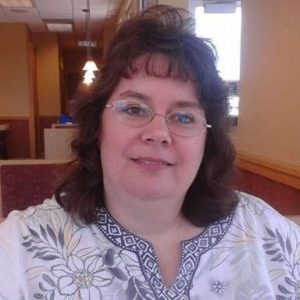 How They Do It: Melissa Barker, The Archive Lady
How long have you been doing genealogy?
I have been doing mine and my husband’s genealogy research for 27 years. I was bitten by the genealogy bug in 1990 while attending a funeral of one of my husband’s family members. There was a family member at the visitation night that was going around and talking to everyone and writing in a spiral bound notebook. I asked her what she was doing and she said she was collecting genealogy information. She let me look at her notebook and also allowed me to take it home and copy it. I was hooked! I have been doing genealogy ever since that day!
What’s your favorite part of doing genealogy?
My favorite part of doing genealogy is getting know the ancestors that I research. I believe every person who walked this earth has a story to tell. That story may be a sad story, a happy story or a mixture of both. I want to document all of it! Our ancestors have a lot to tell us today and there is so much we could learn from them. Collecting names and dates is not enough for me; I want to know everything about them and their lives, even what they had for breakfast! I want my ancestors to be remembered and the only way to do that is to tell their story.
Do you consider your genealogy research well organized?
I actually do think my genealogy is well organized. Before I became an archivist, my genealogy was a mess! Once I went back to school and received my certification in archives management and learned how archivists organize their collections, I used what I learned to organize my own genealogy research. When I learned the processes that archivists use to organize the records in their archives, I knew that it would work with my own records.
What type of software do you use for organizing your genealogy research?
I use the free version of Legacy Family Tree. I have been using this software for many years. I really like how the information that I put in the software is listed in a timeline format. That really helps me to see the gaps in my research. I find this software to be very user friendly. I have tried other genealogy software to only come back to Legacy Family Tree.
Do you keep a research log? If so, what format?
Yes, I do keep a research log. My research log is in paper format. I actually came up with the format myself after looking at other logs and finding that they didn’t work for me. I put a blank research log in front of every ancestor’s file so that it is there when I open the file. As I do research online, contact an archive or anything I can record that information right on the log in the file as I am doing it. I find that it is very convenient and works well for me.
Do you have a tree on Ancestry? If so, is it public or private? Why?
I do have trees on Ancestry. I have chosen to have multiple trees, one for each of the major surnames that I am researching. My trees are all public and open to anyone and everyone to view and use the information that I put on the tree. I only put on my trees that information that I can confirm and source. I also upload documents and photographs and love it when people put them on their own trees. The reason I have public trees is because I want to share my ancestors with everyone but especially those that are researching the same ancestors. I don’t own my ancestors; they belong to whoever is related to them. I love sharing and if I can share a document or photograph that helps someone else with their research, that makes me feel good!
What’s your biggest challenge when it comes to organizing your genealogy?
Time. I work as a full time county archivist and I am also The Archive Lady, speaking, teaching, lecturing and writing about researching in archives and records preservation. I try to carve out time during the week to do a little bit of my own genealogy research and I try to be very diligent to organize as I go so that it doesn’t pile up. That doesn’t always work out perfectly but I do know that staying organized helps us to be more successful with our research efforts.
What’s your biggest piece of advice to beginning genealogists in terms of keeping track of their research?
My biggest piece of advice for beginning genealogists is to keep a research log and organize as you go. Keeping a research log will keep you from doing duplicate research and wasting valuable research time. Before I started using a research log I found that I was looking at the same websites over and over. I also requested some of the same records from archives that I already had or had already requested and found they didn’t have them. Taking the time to record each and every research step in your research log is so very important.
What do you think is the most important thing for people to do to stay organized when it comes to family history research?
Organize as you go! Organizing your research as you go will help you to know your records and the information that you already have so that you can plan research for the information that you don’t have and would like to obtain. It takes time to stop researching and organize but it really is part of doing good genealogy research.
If you were starting out new as a genealogist what would you do differently?
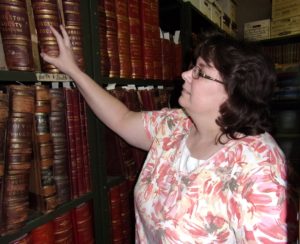 If I were a new genealogist just starting out, I would use archives much more. Archives have tons of records that are not online and are not even microfilmed. Archives are full of shelves of records just waiting for the genealogist to discover them. Archives have unique records that can help tell our ancestor’s story more completely.
Do you keep paper or electronic files (or both)?
I keep both paper and electronic files. I actually prefer paper files but maybe that’s because I love working with original records as an archivist. I do have computer files so that I can share with other genealogists and so that I can access my records when I am not at home. Plus, it’s kind of hard to carry around my filing cabinets! For me, holding paper records, even if they are just copies of the originals, makes me feel closer to my ancestors.
Are you folder or binder person for your paper files?
I was a binder person for many years and now I am a folder person. I have a file folder for each and every ancestor that I research and keep those file folders in filing cabinets. I found that when I was doing research on an ancestor I didn’t want to search through a binder to locate that ancestor’s individual records. Using file folders for each ancestor I can put that particular person’s record in one file folder. So, when I open the file folder I am seeing only that ancestor’s records. I keep the records in each file folder in chronological order.
Do you use Evernote, One Note or any other electronic organizing system for your genealogy? If so, how do you use it?
I actually don’t use an electronic organizing system. I have tried to use Evernote and found that it just didn’t work very well with how I work. I use paper and pencil, the old fashioned way! I feel like I organize better writing things down in my own hand. I believe something happens between your brain and your hand as you are writing that the information you are recording sticks in your brain better. At least it works for me!
Do you have a dedicated space in your home for doing genealogy research? What’s it like?
Yes, I have a home office. I have always had a corner in the home where I had a desk and computer where I worked on my genealogy. But five years ago, after my daughter got married, I took over her bedroom as my office. Now, I have a lot of room for genealogy records and a very nice space to work on my genealogy. I also enjoy writing my blog, articles, doing webinars and preparing lectures as The Archive Lady in my home office.
Do you have anything to add?
I love talking to genealogists and helping them with their research. Working as an archivist, I am so very fortunate to have genealogists walk through my archives door every day. I see them with their family group sheets, binders of records and many times they are not prepared when they show up at my archives. Before visiting an archive, library, courthouse or any repository, sit down and make a to-do list. Plan your visit and have goals you want to achieve when you get there. Organization is so important in this process. If you show up at an archive prepared and organized, the archivist will be able to help you much more find information on your ancestors.
Somehow it doesn’t surprise me that The Archive Lady loves paper! I wholeheartedly agree with Melissa’s advice to organize as you go. If you can keep from creating a backlog of documents that need to be organized your research life becomes less overwhelming and more productive. Thank you so much, Melissa, for participating! FYI, Melissa’s professional genealogy expertise is in Tennessee records and she takes research clients. If you’d like her help, you can reach her at melissabarker20@hotmail.com.
 I’m excited about attending the
 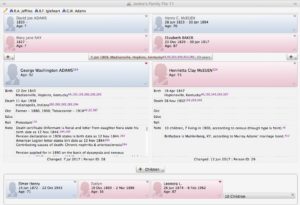 One of the things I love about handling digital, rather than paper, documents is I never have to deal with a big pile of papers waiting to be filed. Over the long Independence Day weekend, I did a whole lot of genealogy research. I was researching the ten (!) children of my great great grandfather, George Washington Adams, and hitting lots of pay dirt. They were born in the late 19th century and died in the mid- to late 20th century so there were lots easily accessible documents available to me.
 How They Do It: Amy Johnson Crow