• BLOG
  • ABOUT
    • Privacy Policy

Organize Your Family History

Stay focused and happy while exploring your roots

At long last, a new Orderly Roots guide!

June 2, 2017 By Janine Adams 2 Comments

When I announced that I would be publishing Orderly Roots guides (concise, downloadable pdfs) back in October 2015, I promptly published two. I fully expected to write more quickly, but then other priorities got in the way.

But I’m thrilled to announce that I just published the third Orderly Roots Guide, Organizing Your Genealogy Right From the Start! This 13-page guide will hope new and more experienced genealogists create a simple, complete organizing system. It allows me to go a little more in-depth than I can on the blog.

I just published Organizing Your Genealogy Right From the Start this morning. It’s available for immediate download, for $8.99.

Now that I’m back on it, I hope to publish more soon. Other topics in the works are:

  • Creating Great Genealogy Habits
  • Making the Most of Your Online Research Time
  • How I Organize My Genealogy Research
  • Getting Started in Genealogy
  • Essential Technology for Genealogists
  • Planning a Genealogy Research Trip
  • Planning a Cemetery Research Trip

Of course, that list might change. And I’m definitely interested in hearing from you if there’s another topic you’d like to see me cover in depth!

Filed Under: Excitement, Genealogy tips, Organizing Tagged With: excitement, learning opportunities, resources

Identifying potential military ancestors

May 23, 2017 By Janine Adams 8 Comments

identifying military ancestorsA year ago, I wrote this post on figuring out which ancestors might have fought in which war. With Memorial Day coming up this weekend, I thought it might be useful to republish it. I think I’m going to spend some time this week updating my spreadsheet (since I’ve added to the family tree since last year), so I can easily research ancestors in military records this weekend.

Whenever I read about a records collection for a certain conflict (which seems to happen around military-related holidays, like Veteran’s Day or anniversaries of conflicts) I get excited about researching my ancestors in those collections, which can be such a treasure trove of information. But in the past sometimes I would have difficulty remembering which ancestor might have fought in which war and I’d become overwhelmed and abandon the effort.

So I created a document that shows me the prospective ancestors for each conflict, based on the dates they were born. At the time, I used a table from Family Tree Magazine but when I went looking for it to share in this post, I couldn’t find it. However, I did find an even-better table called Ages of Servicemen in Wars that lists 20 military conflicts, the years they were fought, the typical birth dates for soldiers and the  typical ages of soldiers. Thank you, FamilySearch!

Armed with that information, I created a simple spreadsheet (pictured, in part, above) with the following column headers:

  • Conflict
  • Likely Birth Year of Soldiers
  • Prospective Ancestor
  • Confirmed Ancestor

For each conflict, I entered the names of the ancestors who were born during the birth-year window listed in column 2. After I ascertained that one had indeed fought in that war, I entered an X in the Confirmed Ancestor column. What I should have done and will from here forward, is place a dash or an N in the Confirmed Ancestor column to indicate that I’d ruled that ancestor out.

This is a simple way to see at a glance who I might research when I’m looking at military collections at the National Archives, Fold3 or elsewhere. It’s easy to create and well worth the time spent.

Filed Under: Genealogy tips, Organizing Tagged With: genealogy tools, military, organizing aids

How They Do It: Pat Richley-Erickson (DearMYRTLE)

May 2, 2017 By Janine Adams 10 Comments

Grab a cup of coffee or tea and settle in for a great read. Today’s installment of How They Do It features Pat Richley-Erickson, known to genealogy enthusiasts as DearMYRTLE. Pat is a prolific writer and educator. She has the DearMYRTLE Genealogy blog, the DearMYRTLE YouTube channel, her own Google+ genealogy community and hosts frequent hangouts. She is one of the administrators of the wildly popular The Organized Genealogist Facebook group. So she knows more than a little about organizing genealogy. She generously shares her insights and workflow (!) in today’s interview.

How They Do It: Dear Myrtle

How They Do It: Pat Richley-Erickson

How long have you been doing genealogy?

My first foray into genealogy was in early middle school where I learned calligraphy and created an illuminated manuscript of my five generation pedigree.

What’s your favorite part of doing genealogy?

Uncovering stories of the life and times of an ancestor. Historical context is everything when it comes to understanding why someone moved, joined the army, took up a profession, etc. Mr. Myrt once hired a professional guide as we toured Gettysburg. The guide was a specialist who knew the precise troop movements for my ancestor in the 19th Indiana, part of the Iron Brigade. I had assumed the Union retreat through the town of Gettysburg was a frantic mess, but the guide explained not so for the units in the Iron Brigade. They took up the rear, laying a suppressing fire to defend the troops from Confederate attack at the rear. The guide also took us to Culp’s Hill and explained how my Union soldier’s regiment did not engage in battle against Cousin Russ’ Confederate Marylander. The hill is more of a ridge, where the battle with Russ’ ancestor took place on the south and southeast, while my ancestor’s unit was bivouacked on the north side of the ridge and did not engage.

Do you consider your genealogy research well organized?

Seriously? This must be a trick question. 🙂

What type of software do you use for organizing your genealogy research?

I organize my research findings in my genealogy management program and have networked my computers, tablets and printers. If I get the urge to look something up on any device, it can be printed and saved to a network drive. I use alternate trees, online and in my RootsMagic for “possibly related”  individuals and family units. Sometimes it takes research on several generations before I can distinguish the difference between two men with the same name living in the same locality. It is only then that I drag and drop the appropriate individuals to my main database. Unlike a GEDCOM file, the drag and drop feature in RootsMagic can bring one, all or some ancestors along with the digital files I’ve attached. (The current data transfer protocol known as GEDCOM has no containers for transferring the actual images.)

Do you keep a research log? If so, what format?

Research logs are essential for planning what to do next, and postulating where to look for applicable record sets. I’ve progressed from Word/Excel (in Dropbox) to Google Docs/Sheets simply because regardless of the device I choose to access the cloud-based research logs, that device doesn’t require Word or Excel to view it. See comments below under One Note where I’ve described a new change in my field research process rolling out these past few months.

Do you have a tree on Ancestry? If so, is it public or private? Why?

Yes, I have several private Ancestry member trees, in addition to those at FamilySearch, FindMyPast, MyHeritage, and WikiTree. I do this because I want to get the low-lying fruit of shaky leaf hints whenever possible. I have a big problem with “one big tree” sites where other researchers can indiscriminately modify my data. Three times someone has added a deceased Uncle Jack to my paternal grandparents on FamilySearch, though my true Uncle Jack is alive and well. I don’t have time to go around repairing the mistakes of others. The Ancestry trees were changed to “private” status when I noticed living individuals were clearly in full view to a cousin on her computer as she looked at my public tree.

What’s your biggest challenge when it comes to organizing your genealogy?

Does a backlog of digitizing paper files ring a bell with any of your readers? That’s my biggest challenge. Though my daughter and I spent a week of 8-hour days digitizing records, I think we’re only 20% finished.

What’s your biggest piece of advice to beginning genealogists in terms of keeping track of their research?

Develop a work flow consistent with the Genealogical Proof Standard, learning more about the GPS by attending as many genealogical institute courses as possible. There’s a difference between classes you pick and choose to fit your conference schedule, and dedicating a solid week of in-person or virtual institute classes designed by a coordinator who knows what you need to learn. We don’t know what we don’t know.

My work flow is this this:

  • Decide on a question to answer, i.e. what’s the bride’s maiden name, or who are the parents?
  • Read up on the locality – its history, culture, laws and various church and government jurisdictions for the time period my known ancestors lived there.
  • List possible record groups to research.
  • Review those records – most are offline at this point.
  • Analyze info from each document, correlating with info from other documents.
  • Work through conflicting evidence logically. Dr. Thomas W. Jones, CG has taught the most likely scenario is usually correct.
  • Summarize conclusions, or as Cousin Russ likes to call it “current thinking.”
  • Enter the conclusion narrative in notes for an individual or family unit in my genealogy management program.
  • Attach all documents, properly cited to the individuals in question.
  • Recognize that the narrative may change if new info comes to light. At least, the narrative will get me up to speed with my thinking when I return to the research later.
  • Proceed to the next research question.

What do you think is the most important thing for people to do to stay organized when it comes to family history research?

Digitize what you find immediately so it is easier to cite and then review all collected about a family or individual. Our dining room tables are only so big. Digital copies are also easier to share with distant cousins at a moment’s notice.

If you were starting out new as a genealogist what would you do differently?

I’d make notations about a record set even when I didn’t find anything applicable to my ancestors, and I’d learn to craft citations immediately, so I can find that record set again. Citations would include these elements: author, title, publication info, who it’s about and date of event, volume and page number and a little information about the repository. If the document is online include the URL and the date accessed. Elizabeth Shown Mills, noted author of Evidence Explained: Citing history sources from artifacts to cyberspace said in a forum post at EvidenceExplained.com: “Bottom line: As researchers, we may add anything to our citations that we feel will help us as we proceed with the project—recognizing that the citations may be trimmed at publication time.” So, don’t be afraid to annotate. I have rogue documents from research 30 years ago, usually pages from books, where I didn’t take the time to also copy the title and copyright page(s). At home I make a copy of the title page and write “no Fromans, no Goerings, no Phillips,” filing a copy with each surname folder on my hard drive.

Are you folder or binder person for your paper files?

When I moved from folders to binders, Ol’ Myrt here ended up with 122 four-inch 3-ring binders! Now I safely store in Hollinger metal edge boxes only precious, one of a kind documents, like original marriage records and family bibles.

Do you use Evernote, One Note or any other electronic organizing system for your genealogy? If so, how do you use it?

Last fall I learned from a friend’s husband how he does on-site research as a fire inspector. He uses a Microsoft Surface Pro – a highly portable computer that acts like a tablet. He takes pic with the device, adds them to One Note, where he uses a stylus to scribble field notes, and can tap to type as desired. I could see the immediate use in my genealogical research.

I’ve installed a full-version of RootsMagic, using my databases in a Dropbox folder shared on my home network. At an archive, I take a photo of the file folder label, and then the contents, The “paper” in One Note isn’t confined to any paper size, so you can draw mini pedigree charts when trying to figure out the relationship of people in the will. I am also careful to “bookend” all images from a file with the folder or box label. That way if I consult multiple files that day, I know which photos below to which folder.

This would also work well in a cemetery. I’d take a picture of the cemetery entrance sign, then the tombstones in question. I could add those images to One Note and then transcribe the text with my stylus. I could move around until I could decipher every letter, before moving on to the next image. When leaving the cemetery, I’d take another picture of the cemetery entrance sign. That would set apart those images from the next cemetery visited that day.

Do you have a dedicated space in your home for doing genealogy research? What’s it like?
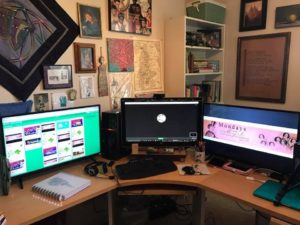
My genealogy office has four full-height shelves, a four-drawer lateral file, and a closet with built-in shelves. Our big library is shared with Mr. Myrt, also a genealogist. My computer desk has three monitors. This works well since I provide most all-day seminars virtually to a distant society or library group. When researching, I keep RootsMagic open on my right screen, website research in the middle screen, and research log in Google Doc or Google Sheet on the left screen. I can zoom in on the document in question as I transcribe it word for word. I recently added an external hard drive strictly for artwork and my embroidery machine graphics. Everything is backed up to BackBlaze. All documents, images, handouts and PowerPoint slides are in Dropbox.

I’ve had to add a bookshelf outside my office in the hallway, so I guess you could say the books have gotten out of hand. At least they are basically organized by topic – Rev War, Civil War, WWI, WWII, African American, Quakers, general reference, British research, etc. Above that hangs what Mr. Myrt like to call a lesson in provenance. Not only do I have my father’s bear-skin rug, but I have the image of him hunting it at the Olympic Peninsula and the framed taxidermy receipt.

Yup! We eat, sleep and breathe family history.

I’m so grateful to Pat for sharing her insights, particularly her workflow and her recent use of One Note. I am inspired by the interview to give serious consideration to signing up for a genealogical institute course! Thank you so much, Pat!

Filed Under: Challenges, Excitement, Genealogy tips, Organizing Tagged With: DearMYRTLE, How They Do It, organizing aids, Pat Richley-Erickson

How They Do It: Diahan Southard

April 7, 2017 By Janine Adams Leave a Comment

I’m so happy to present the fourth installment in my How They Do It series, in which I ask well-known genealogists how they organize their own research. The series runs the first Tuesday of each month, though this week I forgot! (Yes, even professional organizers mess up their schedules sometimes.)

This month I interview Diahan Southard, Your DNA Guide. Diahan is an expert in genetic genealogy and is a regular speaker at genealogy conferences. She manages to make the confusing topic of using DNA in genealogy understandable, no small feat, in my opinion. I’ve  had the pleasure of doing a consultation with her about my own autosomal DNA results, which was a very valuable experience! For this interview, we focused on Diahan’s genetic genealogy research.

How They Do It: Diahan Southard

How long have you been doing genealogy?

I have been involved in genetic genealogy since the beginning, so about 17 years.

What’s your favorite part of doing genetic genealogy?

My favorite part about genetic genealogy is the unexpected tangible connection that I feel with my DNA cousins that I have never met.

Do you consider your genealogy research well organized?

I honestly spend more time helping others than I do on my own research at this point, so while I feel like I have some good organization in the DNA realm, I know my traditional research could use some help.

What type of software do you use for organizing your genetic genealogy research?

Each testing company does offer some limited means for keeping track of your matches in the form of notes. When I look at a match, I just make a quick note in that person’s profile about what I did and what I found, especially if I was able to find the common ancestor. This makes it easy for me to remember when I go back weeks later.

Do you have a tree on Ancestry? If so, is it public or private? Why?

I do have a public tree on Ancestry as it gives me access to all of the best genetic genealogy tools at AncestryDNA. With a public tree I get access to the DNA circles and New Ancestor discoveries features, as well as the shaky leaf hints. Having my tree public also allows me to take advantage of other people’s research time, meaning that my tree is out there for them to peruse so that my DNA matches might be able to identify our connection even if I haven’t had a chance to look yet.

What’s your biggest challenge when it comes to organizing your genetic genealogy?

The biggest challenge in genetic genealogy is figuring out what to do with all of those fourth cousins! Most of us have so many. The best thing to do is to pull your Best Matches out of the longer list and focus on those. Your best matches have shared surnames, shared locations, or are your best genetic matches.

What’s your biggest piece of advice to beginners in genetic genealogy in terms of keeping track of their research?

If you are just getting started in genetic genealogy, please don’t get overwhelmed by the more experienced people telling you that you HAVE to have this fancy tool or you HAVE to transfer your data to another database. Spend at least a year getting to know the database you were tested in and don’t worry about anything else for now.

What do you think is the most important thing for people to do to stay organized when it comes to family history research?

Stay focused on one goal. Don’t get distracted by other shiny objects.

If you were starting out new in genetic genealogy what would you do differently?

I would test more of my ancestors before they passed away. If you have parents or grandparents, or aunts or uncles still around, go order them a DNA test!!

Do you keep paper or electronic files (or both)?

All my genetic genealogy is electronic.

Do you use Evernote, One Note or any other electronic organizing system for your genealogy? If so, how do you use it?

I do use Evernote to clip particularly helpful articles or charts to help me make sense of my genetic genealogy results. I also use it to save screenshots of DNA circles and New Ancestor discoveries, or important matches.

Do you have anything to add?

While the ins and outs and ups and downs of genetic genealogy can take you down many paths with many twists and turns, keep in mind that it really comes down to a simple concept: if you share DNA, you are family.

Diahan obviously has a lot to teach those of us struggling with knowing what to do with our DNA results! I really love her advice to stayed focused and to spend a year getting to know the database you’ve tested with before branching out to other databases or trying new tools. And, of course, her advice to test your older relatives now, while they’re still with you, is so important.

Filed Under: Challenges, Excitement, Genealogy tips, Organizing Tagged With: Diahan Southard, dna, How They Do It, organizing aids

  • « Go to Previous Page
  • Page 1
  • Interim pages omitted …
  • Page 32
  • Page 33
  • Page 34
  • Page 35
  • Page 36
  • Interim pages omitted …
  • Page 69
  • Go to Next Page »

about me

I'm Janine Adams, a professional organizer and a genealogy enthusiast. I love doing family history research, but I find it's very easy for me to get overwhelmed and not know where to turn next. So I'm working hard to stay organized and feel in control as I grow my family tree.

In this blog, I share my discoveries and explorations, along with my organizing challenges (and solutions). I hope by sharing what I learn along the way I'll be able to help you stay focused and have fun while you do your research, too.

tags

30 x 30 Adams amy johnson crow anniversary Brown cemetery census Civil War conferences connections dna electronic files Evernote excitement Family Curator family photos genealogy tools getting started goals How They Do It Igleheart Jeffries keepsakes learning opportunities maps newspapers NGS organizing aids overwhelm paper files planning quick tips rasco record keeping research research log research trip resources RootsTech social history source documentation Stacy Julian technology time management vital records

join the facebook community!

join the facebook community!

My organizing business

Learn more about my organizing business, Peace of Mind Organizing®.

Subscribe by RSS

  • RSS - Posts
  • RSS - Comments

© 2026 Janine Adams


Loading Comments...