• BLOG
  • ABOUT
    • Privacy Policy
  • CONTACT

Organize Your Family History

Stay focused and happy while exploring your roots

The scanner that comes with your iPhone

September 24, 2019 By Janine Adams Leave a Comment

I recently learned on one of the many terrific Facebook genealogy groups I belong to (I apologize that I don’t remember which one), about a little gem hiding in the iPhone and iPad. I’ve been using an iPhone since I bought a 4S back in 2012 (the same year I started this blog!), but I had never heard about this feature. It’s the scanner feature on the native Notes app.

I don’t use the Notes app much, since I tend to use Evernote to actually keep notes, but I’ve used it off and on over the year. Since I learned about the scanner feature, I’ve using it every time I have a piece of paper I want to capture. I’ve found it easier than using a dedicated scanning app. And it’s handy sometimes that creates a pdf, rather than a jpg.

Here’s how it works:

Let’s say you’re in a library or repository and find a document you want to save.

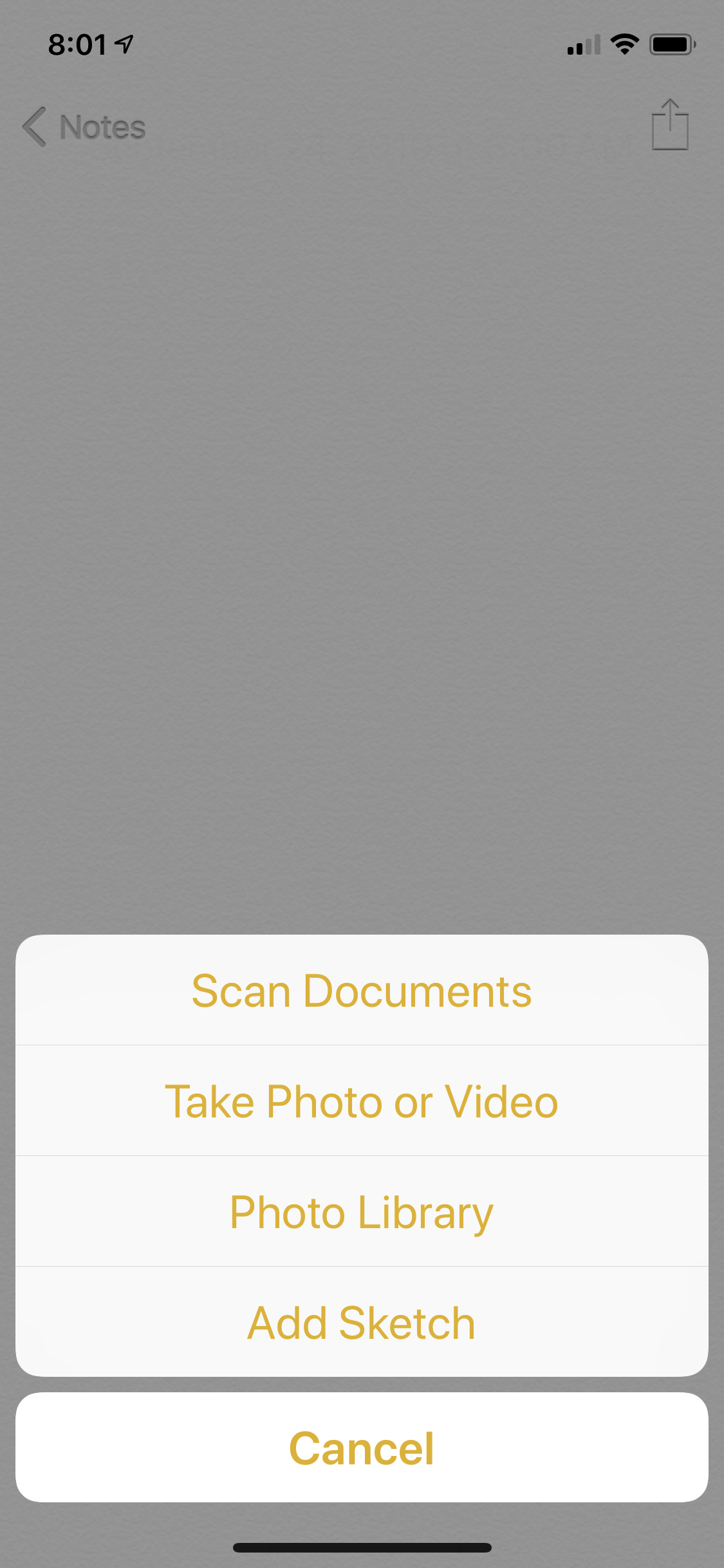
  1. Open the Notes app on your iPhone or iPad.
  2. Press the icon to create a new note.
  3. Touch the icon that looks like a + sign inside a circle.
  4. Touch Scan Documents
  5. Position your phone above the document.

The app will try to locate the edges of the document and take the picture automatically. (It’s like my bank’s app when I’m doing a mobile deposit of a check.) If it can’t find the corners quickly, you can press the round shutter-release icon (like on the camera app) and take the picture and then adjust the corners as necessary. For books that aren’t lying flat, that’s more likely to happen.

For pieces of paper, the photo tends to get taken automatically. It’s really fast and easy–it feels like magic.

Once you have the scan, you can press Save, or you can press the little icon of the picture and then retake it. Once you press Save, you can keep it in your Notes app for processing later or use the Share icon to either email it to yourself or save it in Evernote, Dropbox, Google Drive or other apps that might work for you.

On my next research trip, I will give it a try. I think it will save time over just using my phone’s camera, as I did on my Kentucky trip.

One caveat: I understand that in the latest iOS iteration from Apple, the iPad has its own operating system, rather than sharing the iPhone’s. I have not downloaded iOS 13 yet (I like to wait until the kinks are worked out before downloading) and I don’t use an iPad. I’m assuming this feature will exist in the new iOS for the iPhone and the iPad, but I haven’t tried it.
 

Filed Under: Genealogy tips, Technology Tagged With: electronic files, genealogy tools, organizing aids, technology

Registration for RootsTech 2020 is open!

September 20, 2019 By Janine Adams 2 Comments

Registration has opened for RootsTech 2020, to be held in Salt Lake City February 26 to 29! As I mentioned, I will be speaking at this conference. Right now, my talk, The Imperfect Genealogist, is scheduled for Friday afternoon, February 28, but that’s subject to change. (You can see the current schedule here.) In a communication to speakers, we learned that 600 people signed up within the first few hours of registration opening on Wednesday. That bodes well for a well-attended conference as usual!

You can purchase a RootsTech pass for all four days ($169), or a one-day pass for a particular day ($99). And, if you’re feeling flush, you can also purchase an Ultimate Experience Pass (for $799) that gives you reserved seating, and behind-the-scenes opportunities, including a main stage rehearsal opportunity. You can check out this comparison chart of the various pass options.

RootsTech also offers Family Discovery Day on Saturday, February 29, for members of the LDS church. It’s free, but registration is required.

If you know you’ll attend, I urge you to register now (the early bird pricing above ends until October 11) and book a hotel room at the same time. The RootsTech block of rooms at the conference hotels are already selling out. You might consider booking a hotel room even if you’re still on the fence, since you can cancel it later if you decide not to attend. But be sure and make a note of it. Last year, I didn’t attend RootsTech, but I did book a hotel room months before–and promptly forgot. Imagine how shocked I was when I received an email suggesting I could check in for my Salt Lake City room online just a couple of days before the conference. Thankfully, I was able to cancel without penalty.

In addition to the the over 300 breakout sessions and daily general sessions with keynote speakers, RootsTech also features a giant Expo Hall where you can see the latest and greatest products and services for genealogists and talk with representatives from those companies. The conference is sponsored by Family Search, which typically has a huge booth staffed by their personnel to help you learn to take full of advantage of Family Search. Exhibitors also offer talks in the Expo Hall.

If you need more convincing, check out 10 Reasons to Attend RootsTech. And here’s an 11th reason. If you go, you can meet me! If you decide to attend, please let me know in the comments, if you haven’t already in a previous post, and we’ll arrange to meet up.

Filed Under: Challenges, Excitement, Organizing, Technology Tagged With: conferences, learning opportunities, RootsTech

I’m speaking at RootsTech 2020!

August 22, 2019 By Janine Adams 18 Comments

I was so excited to learn last Thursday that one of my speaking proposals for RootsTech 2020 was accepted! My talk is called “The Imperfect Genealogist” and it’s about not letting perfectionism get in the way of your genealogy research. I’ll talk about the areas of genealogy where good enough really is good enough and discuss some techniques for getting past perfectionistic tendencies.
The topic, of course, ties in with the podcast I co-host, Getting to Good Enough and I’m thrilled that I’ll have a few months to work on it. RootsTech 2020 will be held February 26-29, 2020 in Salt Lake City. Please let me know if you’re planning to attend!

I spoke at RootsTech 2017, on going paperless in your genealogy. But that time I had a fabulous co-presenter, Brooks Duncan of DocumentSnap. (Together, we created the Paperless Genealogy Guide.) Doing this solo is a thousand times more terrifying. But I think I’m up for the challenge.

I hope to see some readers there! Registration will open September 18 and I’ll be sure to remind you when it’s open!

Filed Under: Challenges, Excitement, Organizing, Technology Tagged With: conferences, learning opportunities, RootsTech

How accurate is Ancestry?

August 9, 2019 By Janine Adams 46 Comments

When I was at the Kentucky Historical Society research room in June, I overheard a conversation between a librarian and a patron. The patron, who displayed a certain amount of naivetĂ© about genealogy research when he asked the librarian whether there was an index to everything in the library, proudly told the librarian that he’d been researching on Ancestry.com for years. The librarian’s response made me raise my eyebrows. He said, with a disapproving tone of voice, “A lot of stuff is wrong there; you can’t really trust those online sites.” I was so surprised by that statement that I wrote it down.

This felt all kinds of wrong to me for a couple of reasons. One is that, in one sentence, he invalidated this man’s genealogy experience. The other is that it’s just not true. I probably should have spoken up and argued the point, but I was in a library…it didn’t feel the place for a debate.

But it got me thinking about the notion that online sites like Ancestry or Family Search are inaccurate. I think that the librarian was referring to the family trees that can be found on the sites. Sure, trees are only as good as the practices of the genealogist who created them (or, in the case of Family Search, added to them). Many are not accurate. That’s why I ignore them.

Ancestry is typically the first place I go for source documents when I’m doing online research. It has millions of documents that provide evidence to prove facts in my genealogy research. I usually find them via search, either on a person or in the card catalog. I almost never even look at hints. And I carefully evaluate the suggested records that come up when I’ve clicked on a document in a search. (Usually, they are for the person I’m researching and are hugely helpful.)

Ancestry, along with Family Search, are fundamental to growing my research when I’m researching online (and I’m usually researching online). I was shocked to hear this authority figure completely dismiss online sites.

I was recently talking with a genealogy friend about her quest to solve a mystery. It became apparent that she was using online trees (in combination with DNA matches) as a main avenue for trying to solve the mystery. The conflicts among the trees were frustrating her. I suggested she back away from the trees and look for documents that could prove her suppositions. For me, the documents in Ancestry, not the trees, are where the value lies.

Of course, we must evaluate the documents and the evidence found in them. Good genealogists question everything. Is there inaccurate information on Ancestry? Of course–the family trees are full of them. Do the hints or suggested records sometimes apply to the wrong person? Yes!

But to describe Ancestry as inaccurate is, well, inaccurate. Everything you find in any repository (online or otherwise) must be evaluated. If you use Ancestry as tool to find documents that you then analyze, you’re on the path to success, in my opinion. However, if your starting point at Ancestry is looking at family trees, you may find yourself in the weeds.

My annual subscription to Ancestry is up for renewal this month. I always give it some thought and I always renew. I’m fortunate to be able to afford it; if I were looking to economize, though, Ancestry would probably be the last subscription I’d drop.

What about you? Do you think that the online sites get a bad rap? How do you make sure you’re getting good information from them?


Filed Under: Genealogy tips, Reflections, Technology Tagged With: Ancestry, genealogy tools, online research, research, technology

  • « Go to Previous Page
  • Page 1
  • Interim pages omitted …
  • Page 7
  • Page 8
  • Page 9
  • Page 10
  • Page 11
  • Interim pages omitted …
  • Page 27
  • Go to Next Page »

about me

I'm Janine Adams, a professional organizer and a genealogy enthusiast. I love doing family history research, but I find it's very easy for me to get overwhelmed and not know where to turn next. So I'm working hard to stay organized and feel in control as I grow my family tree.

In this blog, I share my discoveries and explorations, along with my organizing challenges (and solutions). I hope by sharing what I learn along the way I'll be able to help you stay focused and have fun while you do your research, too.

tags

30 x 30 Adams amy johnson crow anniversary Brown cemetery census Civil War conferences connections dna electronic files Evernote excitement Family Curator family photos genealogy tools getting started goals How They Do It Igleheart Jeffries keepsakes learning opportunities maps newspapers NGS organizing aids overwhelm paper files planning quick tips rasco record keeping research research log research trip resources RootsTech social history source documentation Stacy Julian technology time management vital records

join the facebook community!

join the facebook community!

My organizing business

Learn more about my organizing business, Peace of Mind Organizing®.

Subscribe by RSS

  • RSS - Posts
  • RSS - Comments

© 2026 Janine Adams


Loading Comments...
