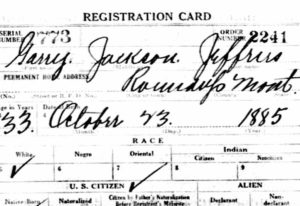
 When you’re doing genealogy research, it’s easy to stumble on facts you’re not looking for. Let’s say you’re researching your great grandfather. Ancestry gives you all sorts of information about his brother. Do you take the time to carefully document the information on the brother?
This isn’t exactly hypothetical. This happened to me this morning. Five years ago, I would have skipped that information and kept my focus on my great grandfather. Now I know better.
After about ten years of genealogy research, there’s one thing I’m pretty sure about.
Every documented fact is relevant. Or might be some day.
Why should I bother to document the marriage certificate and draft registrations for Garry Jeffries (brother of my great grandfather James E. Jeffries)? Here are a few reasons that pop to mind:
- I get a clearer picture of my family.
- I might be able to help one of his descendants, a cousin of mine, one day by including this information in my family tree.
- Down the road I may learn something about the relationship between my great grandfather and his brothers and this information might help connect the dots.
- As commenter Marcia Philbrick said, “Those brothers, sisters and their descendants may be the clue to break through brick walls.” (Thank you, Marcia!)
I’m sure that’s just the beginning. Basically, I’ve come to the conclusion that since I can’t see what puzzle pieces I’m going to need in the future, it benefits me to take the time to record and download all the documents I come across, even if they’re not for my direct line ancestors. (Here’s how I process that information.) It can feel tedious and also feel like it’s taking me away from my “real” research. But I think it’s worth it.
After all, genealogy research is a marathon, not a sprint.

Totally agree! Those brothers, sisters and their descendants may be the clue to break thru brick walls.
Yes! That’s the perfect way to put it! I’m going to add your words to the post. Thank you!
As usual, very well said and excellent points!
Thanks so much, Lori!
Completely agree with you! I had a client who was seeking the birthplace of a great grandfather, I found it on the birth certificate of one of the children, not in his direct line. It was a huge roadblock for the family.
Yes! That’s a very direct and probably not rare way to solve a mystery, isn’t it? Thanks for commenting, Maria!
The amount of information about an individual that resides buried in a tree is sometimes the most important detail – that isn’t readily available just when looking at that person. I’ve been documenting generations in families in order to get the right details about one person. Of course those family trees are enormous but the overall picture of migration, occupations and such like is also pertinent data.
Thanks for commenting, Delia. These details gleaned from non-direct family members really can flesh out an ancestor’s story, can’t it?
If I’m searching and accidentally come across another family member, I save the information. I think of it as an added bonus to my search. While I may not have a place for it right now, it may come in handy when I least expect it!
Robyn, where do you save the information? The tricky thing seems to me remembering you have such a tidbit if you can’t yet put it in your family tree software. (I’m thinking if I found info on someone I think is a relative but the link hasn’t been confirmed.) I guess I would use Evernote for that.
I appreciate your comment!
I have a paper file system for family members. If I find info I’m unsure of, I write it on a sticky note and place it on the possible family members file.
Thanks for sharing! That sounds like a good system for people who paper-based files.
Speaking to Robyn’s idea, a lot depends on who it is. If I have this ‘feeling’ the person is part of my tree, I usually just add him as an ‘unlinked person’ right into Reunion, and of course include my sources. I also have a flag for ‘relationship unknown’. That way the information is all entered if I ever do find a relationship and it is easy to link him up.
If it is someone who is probably relatively distantly related, I will sometimes start a new ‘bare bones’ Reunion file, trying to figure out the relationship.
Kim, that’s really helpful, thank you. I haven’t used “unlinked person” in Reunion or the “relationship unknown” flag. So glad to know about it!
I agree with everything you say. I pretty much add everyone related, no matter how distantly. Though if it gets REALLY distant….the children of the niece of my great-grandmother’s sister’s husband…I may just make a note in the husband that he is ‘survived by’ and list their names along with source. That way the information is there is I ever have reason to investigate further.
(And I sometimes add them all in anyway, depending on how much time I have)
Thanks, Kim. So glad to know from these comments that I’m on the right track by taking the time to document these collateral relatives!
I love researching othef family members as often extra tidbits of information come to light with that research. Any extra info may come in useful later on. I keep them in a miscellaneous file under the surname most relevant and check through it when restarting research on that family
Thanks for weighing in, Nan! I think I need an attitude adjustment and start loving the collateral-line research, instead of resisting it, as I have in the past. I’ll take a page from your book!
Sometimes it’s just fun and educational to track a non-direct line relative. I have a 1st cousin, 2X removed who in 1898 enlisted in the US Army as a volunteer in the Spanish-American War. Due to military records on Ancestry, I was able to track his career in the Army, and documented he was a Buffalo Soldier (9th & 10th Calvary) serving in the Philippines, Kansas Territory, Arizona Territory, and California. Somewhere along the line his surname changed from Senar to Senor in the handwritten army records, but I was still able to follow him until his 1943 death in California. Ferreting out documents about him was a lot more interesting than banging my head against the brick wall of our direct line ancestors who were born, lived and died in the Mobile Alabama area.
Danni, that’s an excellent point! And that cousin does sound like loads of fun to research!
I operate on the basis also that you never know when a piece of info will become relevant. Its helped sometimes to track info via a census when I couldnt find my direct line because of spelling errors. if I look up the person identified on a marriage certificate for example as witness they may be living near to my relative so its useful to find them on the census
I love how thorough you are! I have never researched a non-family-member witness on a marriage certificate (or other document). That is a great idea. I love that you keep no stone unturned! Thanks for commenting.
I have also checked people who were witnesses to a marriage on my husbands Maternal Grandfather, and found they were his half siblings which we never knew about. This then lead me to find him in the British 1871 census under his step Fathers name. This was a bonus.
What a story, Nan! That’s inspirational. Thanks for sharing.