• BLOG
  • ABOUT
    • Privacy Policy

Organize Your Family History

Stay focused and happy while exploring your roots

Search Results for: 30 x 30 challenge

Using newspapers to fill in the blanks

August 22, 2017 By Janine Adams 8 Comments

I’ve been limiting my research to the Adams line of my family this year. I love the focus that gives me and there has been no shortage of information to ferret out!

Recently, I’ve been looking at newspaper articles in Olympia, Washington, where this family lived in the first four decades of the 20th century. The Daily Olympian (which I access via Genealogy Bank) was full of articles about things we wouldn’t consider of much interest today (like family members who live in the same town visiting one another). These articles help paint a picture of my ancestors’ lives and occasionally help connect dots.

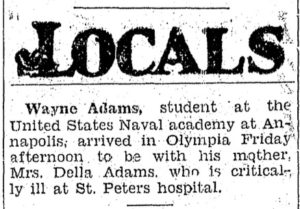
For example, I read that my great great grandfather’s second wife, Della Adams, was critically ill in 1930 and that her son, Wayne Horace Adams, traveled to be at her side at the hospital all the way from Maryland, where he was attending the U.S. Naval Academy. I don’t know how he traveled cross country or how long it took, but it reveals a devotion that is an interesting detail as I try to piece together this family’s puzzling early life. In 1919, according to divorce documents, Della abandoned Horace (as he was known then) to the care of his 74-year-old father (my great great grandfather, George Washington Adams), when he was 12. As a 23-year-old he crossed the country to be with her when she was critically ill. By then, his father was living in the National Soldier’s Home in Danville, Illinois. (Della recovered from her illness and  lived another 13 years.)

These newspaper articles also have allowed me to see how active my great grandmother, Hattie, was in various societies, like the Daughter of Union Veterans and the Daughters of America. I’m also learning the various cities where my grandfather’s sister lived. And I came across a delightful article on a badminton tournament that my own grandparents played in together.

I have the good fortune that my grandfather, Dave Adams, was a reporter for the Daily Olympian when he was in his twenties. So I was able to find some first-person articles that gave me some insight into his life (as well as a picture of him at work). I think my favorite was when he wrote about participating in a spelling bee. He was an excellent writer.

I spent a few hours on Sunday with the newspaper and was faced with the challenge of whether to be selective about which articles I downloaded or to take everything I found. Downloading and processing the articles can get quite tedious, so I wanted to be selective. But I know that even the smallest detail might shed light on a future quandary. (Of course, I have to bear in mind that newspaper articles are not always accurate, but they can provide some great clues.)

So I downloaded with abandon and decided that a few of the articles would reside in the appropriate person’s folder on my hard drive without necessarily getting entered as a source in my genealogy software. But the vast majority are being used as sources because a nugget–even if it’s just a data point about residence–can be gleaned.

In the near future, I plan to outline here how exactly I process these newspaper articles, in hopes that it will be helpful. (I plan to do a screencast.)

How about you? Do you use newspapers in your research? What’s your favorite source for relevant newspaper articles? And what’s the most helpful thing you’ve found in your newspaper research?
Filed Under: Genealogy tips, My family Tagged With: Adams, newspapers, resources

Those Eureka! moments

August 15, 2017 By Janine Adams Leave a Comment

I just had one of those moments where I raised both arms in the air and whooped. I think I startled my standard poodle, Bix.
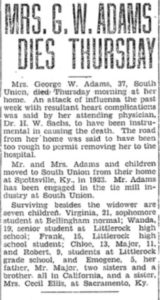
I’ve been trying for the five research sessions to ascertain whether a couple I had found was my couple. I had downloaded seven documents for a George Washington Adams born in 1882 (this is the son of the George Washington Adams whose Civil War pension file I transcribed this year). He had a wife, Elizabeth Major Adams, who passed away from influenza in 1929, leaving behind seven children. Before processing these documents, I wanted to be certain that this G.W. Adams was my G.W. Adams.

A year ago, I would have accepted that he was the right person, perhaps overlooking the fact I didn’t have any definitive proof. The Genealogical Proof Standard requires reasonably exhaustive research and kept bearing that in mind as I kept researching until I found a definitive connection.

I’m keeping a research log in Evernote, so I can see everything I’ve done on this search and at the end of each session, I’ve jotted down next steps. I’ve had to keep my sessions short, so these next steps have been really helpful–and there have always been plenty of them.

One of the challenges is that on his World War I draft registration card, George, who at the time was married to Elizabeth (Betha), listed his birth date as September 19, 1883, rather than 1882 as his father had listed in a pension document. The World War II draft registration I found for George, married to Estle, listed his birth Sepember 19, 1881. Both documents show him with brown eyes and brown hair. (Brown eyes are uncommon in my family, I’ve noticed.)

I hadn’t focused on Estle until today. My Eureka moment came when I found George and Estle on the 1940 census, living with children the same names and ages as those listed as survivors in the news article about Elizabeth’s death. That’s when I whooped and hollered. I also found Estle in the burial plot next to George and two spots away from Elizabeth.

I am so glad I pursued this until I felt I’d made a real connection. If I’d gone ahead with the assumption that George and Elizabeth were the right couple I might have had lingering doubts. And I know that would have driven me crazy. Also, there’s nothing like the thrill of those Eureka moments!

Filed Under: Challenges, Excitement, Export, Genealogy tips, My family Tagged With: Adams, excitement, research, research log

How They Do It: Melissa Barker

August 4, 2017 By Janine Adams 2 Comments

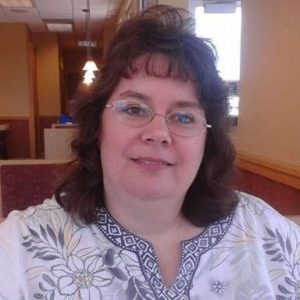
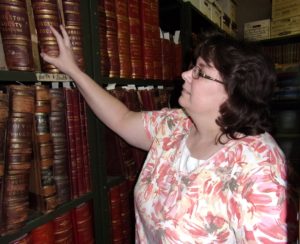
New month, new entry in my How They Do It series. Today’s interview is with Melissa Barker, an archivist, genealogist and writer. Melissa, a Certified Archives Manager, is currently working as the Houston County, Tennessee, Archivist. She is also a professional genealogist and lectures, teaches and writes about the genealogy research process, researching in archives and records preservation.

Melissa writes a bi-weekly advice column entitled The Archive Lady that can be viewed at Abundant Genealogy. She writes a monthly column entitled The Archive Lady’s Corner in the In-Depth Genealogist Magazine. She also writes a bi-weekly column for her local newspaper The Stewart-Houston Times called From the Archives. You may have heard her as The Archive Lady on Lisa Louise Cooke’s Genealogy Gems Podcast. Frankly, I’m  impressed that she has any time left to research her ancestors!

How They Do It: Melissa Barker, The Archive Lady
How long have you been doing genealogy?

I have been doing mine and my husband’s genealogy research for 27 years. I was bitten by the genealogy bug in 1990 while attending a funeral of one of my husband’s family members. There was a family member at the visitation night that was going around and talking to everyone and writing in a spiral bound notebook. I asked her what she was doing and she said she was collecting genealogy information. She let me look at her notebook and also allowed me to take it home and copy it. I was hooked! I have been doing genealogy ever since that day!

What’s your favorite part of doing genealogy?

My favorite part of doing genealogy is getting know the ancestors that I research. I believe every person who walked this earth has a story to tell. That story may be a sad story, a happy story or a mixture of both. I want to document all of it! Our ancestors have a lot to tell us today and there is so much we could learn from them. Collecting names and dates is not enough for me; I want to know everything about them and their lives, even what they had for breakfast! I want my ancestors to be remembered and the only way to do that is to tell their story.

Do you consider your genealogy research well organized?

I actually do think my genealogy is well organized. Before I became an archivist, my genealogy was a mess! Once I went back to school and received my certification in archives management and learned how archivists organize their collections, I used what I learned to organize my own genealogy research. When I learned the processes that archivists use to organize the records in their archives, I knew that it would work with my own records.

What type of software do you use for organizing your genealogy research?

I use the free version of Legacy Family Tree. I have been using this software for many years. I really like how the information that I put in the software is listed in a timeline format. That really helps me to see the gaps in my research. I find this software to be very user friendly. I have tried other genealogy software to only come back to Legacy Family Tree.

Do you keep a research log? If so, what format?

Yes, I do keep a research log. My research log is in paper format. I actually came up with the format myself after looking at other logs and finding that they didn’t work for me. I put a blank research log in front of every ancestor’s file so that it is there when I open the file. As I do research online, contact an archive or anything I can record that information right on the log in the file as I am doing it. I find that it is very convenient and works well for me.

Do you have a tree on Ancestry? If so, is it public or private? Why?

I do have trees on Ancestry. I have chosen to have multiple trees, one for each of the major surnames that I am researching. My trees are all public and open to anyone and everyone to view and use the information that I put on the tree. I only put on my trees that information that I can confirm and source. I also upload documents and photographs and love it when people put them on their own trees. The reason I have public trees is because I want to share my ancestors with everyone but especially those that are researching the same ancestors. I don’t own my ancestors; they belong to whoever is related to them. I love sharing and if I can share a document or photograph that helps someone else with their research, that makes me feel good!

What’s your biggest challenge when it comes to organizing your genealogy?

Time. I work as a full time county archivist and I am also The Archive Lady, speaking, teaching, lecturing and writing about researching in archives and records preservation. I try to carve out time during the week to do a little bit of my own genealogy research and I try to be very diligent to organize as I go so that it doesn’t pile up. That doesn’t always work out perfectly but I do know that staying organized helps us to be more successful with our research efforts.

What’s your biggest piece of advice to beginning genealogists in terms of keeping track of their research?

My biggest piece of advice for beginning genealogists is to keep a research log and organize as you go. Keeping a research log will keep you from doing duplicate research and wasting valuable research time. Before I started using a research log I found that I was looking at the same websites over and over. I also requested some of the same records from archives that I already had or had already requested and found they didn’t have them. Taking the time to record each and every research step in your research log is so very important.

What do you think is the most important thing for people to do to stay organized when it comes to family history research?

Organize as you go! Organizing your research as you go will help you to know your records and the information that you already have so that you can plan research for the information that you don’t have and would like to obtain. It takes time to stop researching and organize but it really is part of doing good genealogy research.

If you were starting out new as a genealogist what would you do differently?

If I were a new genealogist just starting out, I would use archives much more. Archives have tons of records that are not online and are not even microfilmed. Archives are full of shelves of records just waiting for the genealogist to discover them. Archives have unique records that can help tell our ancestor’s story more completely.
Do you keep paper or electronic files (or both)?

I keep both paper and electronic files. I actually prefer paper files but maybe that’s because I love working with original records as an archivist. I do have computer files so that I can share with other genealogists and so that I can access my records when I am not at home. Plus, it’s kind of hard to carry around my filing cabinets! For me, holding paper records, even if they are just copies of the originals, makes me feel closer to my ancestors.

Are you folder or binder person for your paper files?

I was a binder person for many years and now I am a folder person. I have a file folder for each and every ancestor that I research and keep those file folders in filing cabinets. I found that when I was doing research on an ancestor I didn’t want to search through a binder to locate that ancestor’s individual records. Using file folders for each ancestor I can put that particular person’s record in one file folder. So, when I open the file folder I am seeing only that ancestor’s records. I keep the records in each file folder in chronological order.

Do you use Evernote, One Note or any other electronic organizing system for your genealogy? If so, how do you use it?

I actually don’t use an electronic organizing system. I have tried to use Evernote and found that it just didn’t work very well with how I work. I use paper and pencil, the old fashioned way! I feel like I organize better writing things down in my own hand. I believe something happens between your brain and your hand as you are writing that the information you are recording sticks in your brain better. At least it works for me!

Do you have a dedicated space in your home for doing genealogy research? What’s it like?

Yes, I have a home office. I have always had a corner in the home where I had a desk and computer where I worked on my genealogy. But five years ago, after my daughter got married, I took over her bedroom as my office. Now, I have a lot of room for genealogy records and a very nice space to work on my genealogy. I also enjoy writing my blog, articles, doing webinars and preparing lectures as The Archive Lady in my home office.

Do you have anything to add?

I love talking to genealogists and helping them with their research. Working as an archivist, I am so very fortunate to have genealogists walk through my archives door every day. I see them with their family group sheets, binders of records and many times they are not prepared when they show up at my archives. Before visiting an archive, library, courthouse or any repository, sit down and make a to-do list. Plan your visit and have goals you want to achieve when you get there. Organization is so important in this process. If you show up at an archive prepared and organized, the archivist will be able to help you much more find information on your ancestors.

Somehow it doesn’t surprise me that The Archive Lady loves paper! I wholeheartedly agree with Melissa’s advice to organize as you go. If you can keep from creating a backlog of documents that need to be organized your research life becomes less overwhelming and more productive. Thank you so much, Melissa, for participating! FYI, Melissa’s professional genealogy expertise is in Tennessee records and she takes research clients. If you’d like her help, you can reach her at melissabarker20@hotmail.com.

Filed Under: Challenges, Excitement, Genealogy tips, Organizing Tagged With: How They Do It, Melissa Barker, organizing aids

Trying not to let a backlog build up

July 7, 2017 By Janine Adams 2 Comments

One of the things I love about handling digital, rather than paper, documents is I never have to deal with a big pile of papers waiting to be filed. Over the long Independence Day weekend, I did a whole lot of genealogy research. I was researching the ten (!) children of my great great grandfather, George Washington Adams, and hitting lots of pay dirt. They were born in the late 19th century and died in the mid- to late 20th century so there were lots easily accessible documents available to me.

The problem with lots of easily accessible documents is that it can seem tedious to process them. Suddenly a census document with five kids feels like a drag rather than a treasure. That’s probably the time to take a break from the research session. Instead of taking a break and coming back fresh, what I did this weekend was save these documents to the top of my Surnames folder (as a parking lot) so I could process them later. Then I would move on to the next discovery.

On July 3 I realized my backlog was getting ridiculous and on July 4, when I found 25 documents about one particular family (who kept doing newsworthy things like filing and re-filing for divorces and marriages license), I actually processed each one before moving on to the next. (If you’re wondering what I mean by process, here’s where I describe my digital workflow.) That family lived in Indiana where death certificates are readily available and easily findable.

By weekend’s end, I had a backlog of 25 to 30 documents that I needed to deal with. I’m still researching 30 minutes a day, so I determined that those 30 minutes would be spend chipping away at the backlog, processing each document as I came to it (gleaning every bit of information and adding it to Reunion), until the backlog is gone. Today was my third day of working on the backlog and I made it through four documents before my timer went off.

I have only nine documents to go, thankfully. I want to try hard to avoid creating a backlog again. The problem, of course, is that if I’m keeping my focus on an individual and Ancestry puts one his relatives in front of me, it’s hard to ignore the relative. But that’s where my research log comes in. I can write down the new person I’ve come to, complete with a link to the document I found, and then include that person in the next steps I jot down at the end of each session. Or, if I have plenty of time, I can go ahead and process the document(s) for the new person, but make a note to come back to the original person when I’m finished. My goal is to not have unprocessed documents on my hard drive, if I can avoid it.

One of the challenges of genealogy research is balancing the thrill of discovery with the mundane tasks of processing the discoveries. As a professional organizer, I rather enjoy processing documents, but doing nothing but processing them gets tedious. By processing every document as I come to it rather than putting it off, I avoid whole sessions where all I do is process. For me, that’s a great way to have a balanced genealogy session.

Edited to add: I wrote this post on Friday morning, and on Friday afternoon I took a four-hour non-stop flight to Portland, Oregon. I spent the bulk of the time processing my backlog (which was a very enjoyable way to pass the time) and by the time we landed, it was gone, with the exception of two documents I needed to go online to suss out a little more. By Saturday morning, the backlog had vanished. Hooray!

Filed Under: Challenges, Genealogy tips, Organizing Tagged With: Adams, electronic files

  • « Go to Previous Page
  • Page 1
  • Interim pages omitted …
  • Page 51
  • Page 52
  • Page 53
  • Page 54
  • Page 55
  • Interim pages omitted …
  • Page 59
  • Go to Next Page »

about me

I'm Janine Adams, a professional organizer and a genealogy enthusiast. I love doing family history research, but I find it's very easy for me to get overwhelmed and not know where to turn next. So I'm working hard to stay organized and feel in control as I grow my family tree.

In this blog, I share my discoveries and explorations, along with my organizing challenges (and solutions). I hope by sharing what I learn along the way I'll be able to help you stay focused and have fun while you do your research, too.

tags

30 x 30 Adams amy johnson crow anniversary Brown cemetery census Civil War conferences connections dna electronic files Evernote excitement Family Curator family photos genealogy tools getting started goals How They Do It Igleheart Jeffries keepsakes learning opportunities maps newspapers NGS organizing aids overwhelm paper files planning quick tips rasco record keeping research research log research trip resources RootsTech social history source documentation Stacy Julian technology time management vital records

join the facebook community!

join the facebook community!

My organizing business

Learn more about my organizing business, Peace of Mind Organizing®.

Subscribe by RSS

  • RSS - Posts
  • RSS - Comments

© 2026 Janine Adams


Loading Comments...