• BLOG
  • ABOUT
    • Privacy Policy

Organize Your Family History

Stay focused and happy while exploring your roots

How I process a downloaded document

October 20, 2017 By Janine Adams 14 Comments

Last March, I wrote a post called My digital workflow that detailed what I do with a document I find on the Internet. (I never print it.) My digital workflow has not changed since then and it’s working out really well for me.

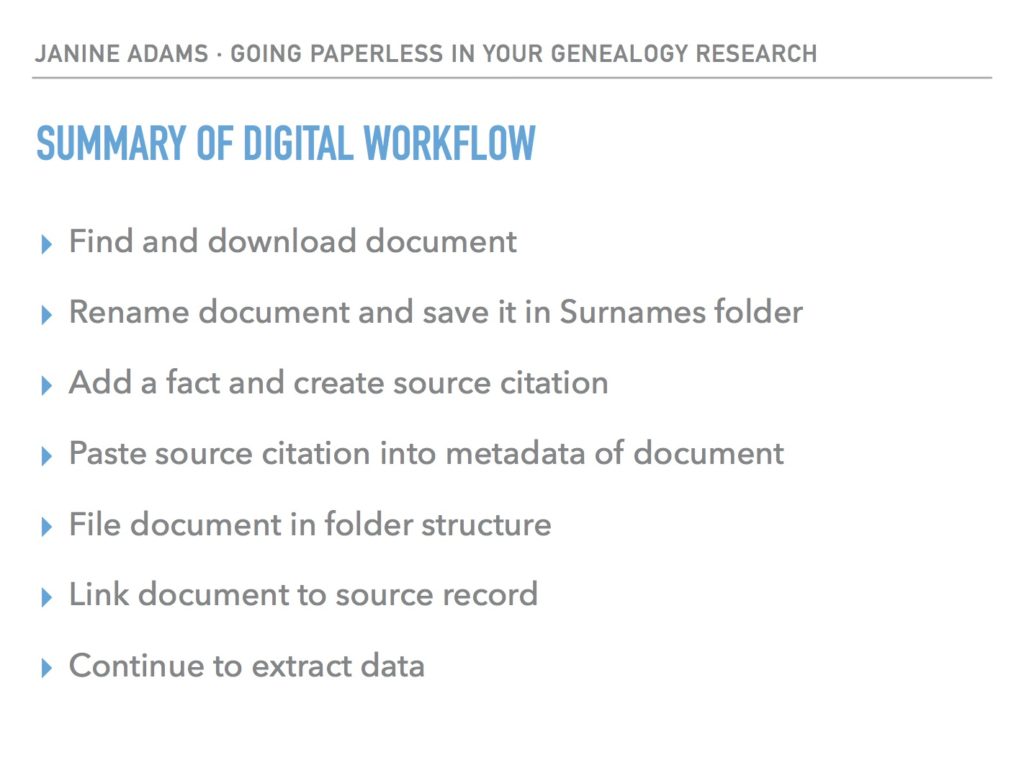
Last weekend, I did a talk at the St. Louis Genealogy Conference about going paperless and in my Powerpoint I included screenshots of the digital workflow and also a summary slide. The attendees asked for copies of the summary slide, so I decided to post it here.

The process is basically the same as my March post but I switched up the steps a little.

The example I used in my talk was my father’s uncle, Jay Ellis Adams (1914-2004). I had found his obituary online at the newspaper’s website. Here’s the workflow:

1. I click Print and, in the printer dialog box, Open in Preview (my Mac’s default pdf reader), which downloads the document to my computer. (If it had been a document at Ancestry, I would have clicked Save, then Save to My Computer.)

2. I immediately rename the file, using my file-naming protocol, which is Date Type of Document-Ancestor Name-Locality. I stick it into my Surnames folder, as a temporary holding place until I file it in step 6. I know that any unfiled documents in the Surnames folder require processing.
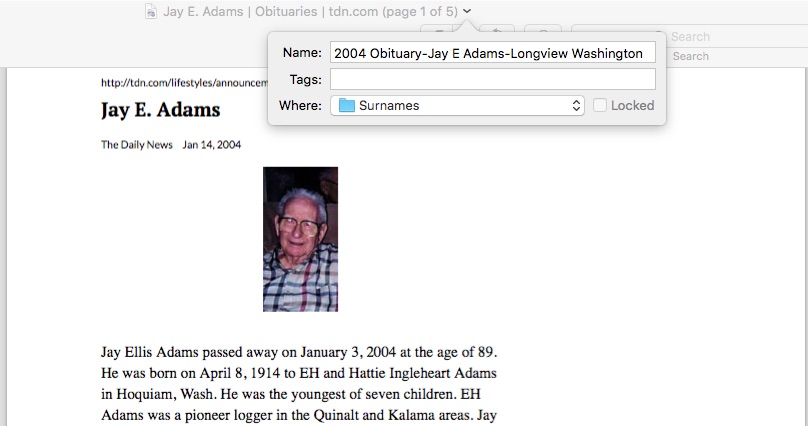
 

3. I select a fact from the document, add it to Reunion and create a source citation for it.
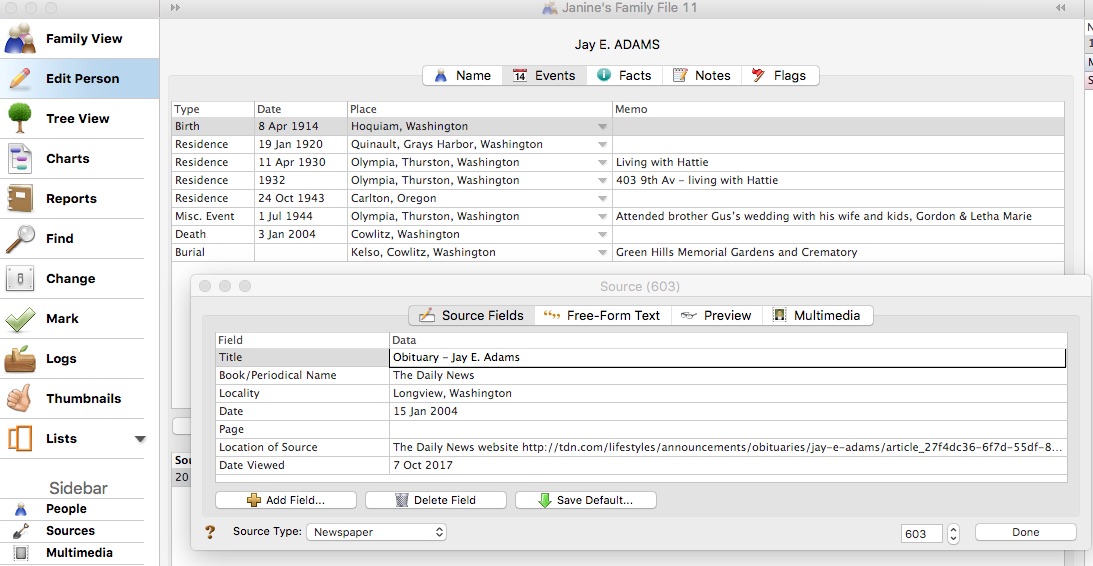
 

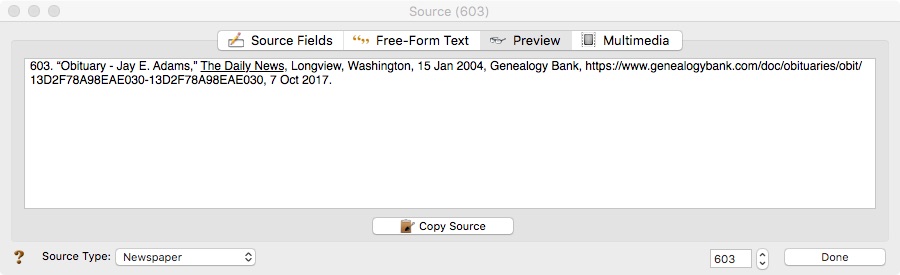
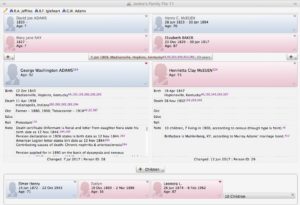
4. In Reunion, I click the Preview tab in the source record and then click Copy Source. (For the eagle-eyes among you, I originally found a transcript at Genealogy Bank and used that as the source citation. Then I decided to go to the newspaper’s website and download it from there, so I changed the source citation. But I was too lazy to take a new screenshot.)
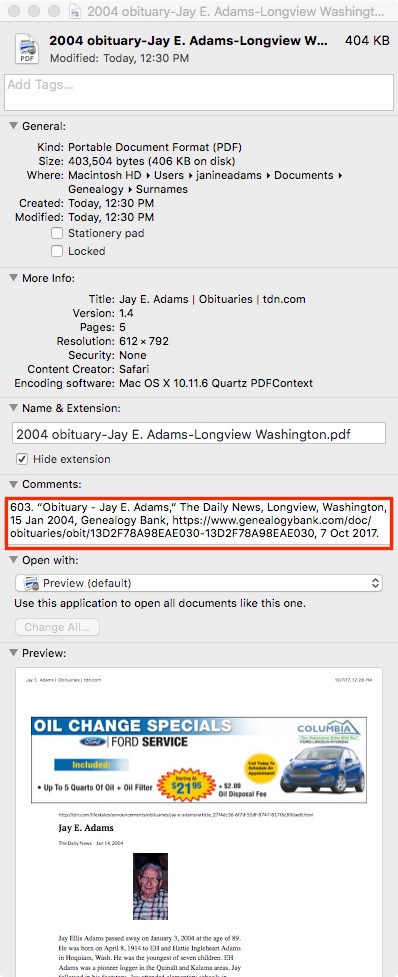
5. I paste the source citation into the metadata of the source document (the obituary) by Ctrl-clicking on the file and selecting Get Info from the menu that appears, then pasting into the Comments area.
 

6. Then I file the document into my folder structure. My folder structure for collateral relatives is Genealogy/Surnames/Collateral/[Surname]/[Name of Ancestor (YOB-YOD)]. If the document  applies to multiple people, I duplicate it for each person and then drag it into the appropriate folder for each person. But I don’t take the trouble to rename it.
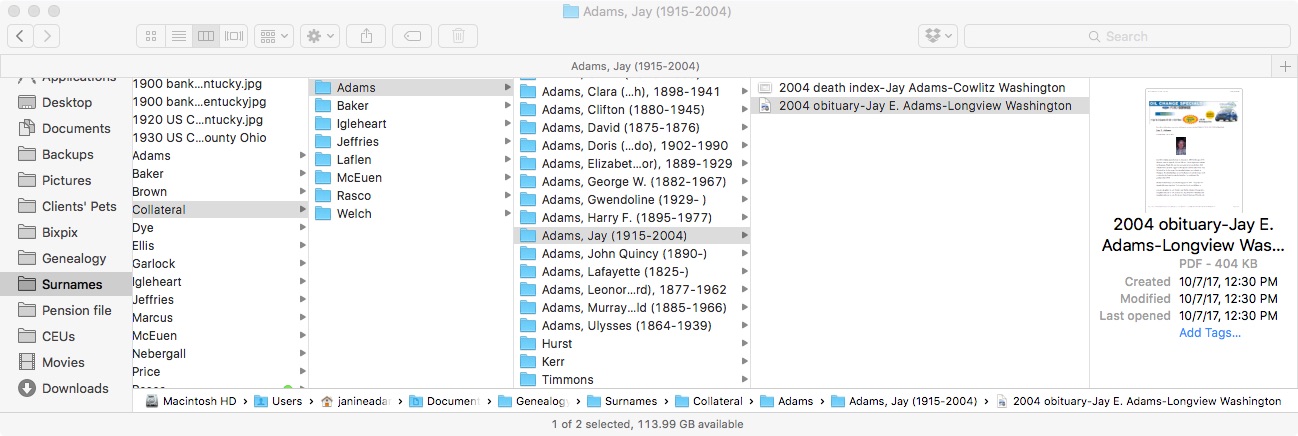
7. The final step is to drag the document into the Multimedia area of the source record in Reunion. This creates a link to the document so that I can open it up inside Reunion, which is very handy.
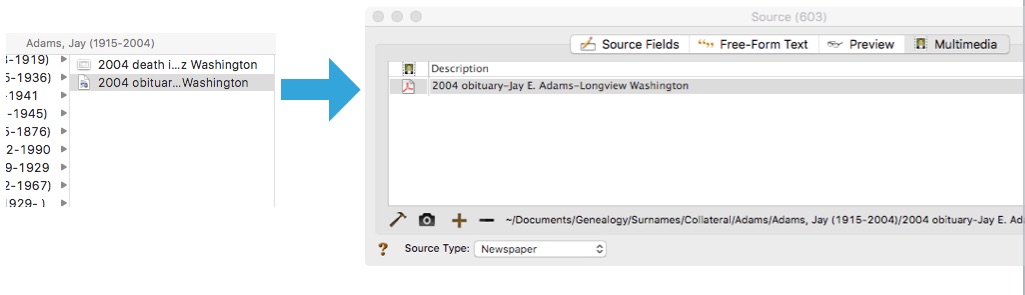
 

From there, I continue to extract information from the source document and add that it to Reunion. Every piece of information I glean from a single source document uses the same source number, no matter what person it applies to.

Here’s the summary slide:
This is the way I do and it works well for me. Of course, it’s not the only way to do it or perhaps the best way to do it. But I’m hoping you’ll find it useful to see my workflow. I’ve been processing documents this way for almost a year now and it’s working very well.

For more in-depth information on how I organize my own genealogy, check out How I Do It: A Professional Organizer’s Genealogy Workflow, a 37-page downloadable pdf available for $19.99.
Filed Under: Challenges, My family, Organizing, Technology Tagged With: Adams, electronic files, organizing aids, record keeping, source documentation

Processing newspaper articles (screencast)

August 27, 2017 By Janine Adams 6 Comments

Last week I blogged about how I’ve been finding newspaper articles about my father’s family in Olympia, Washington, in the first part of the 20th century. Despite being the state capital, Olympia’s newspaper has a decidedly small-town feel. I was able to find a couple of dozen (if not more) articles about my family, each of which gives me a little nugget of information and a little more of a sense of how they lived.

This morning, I created a twelve-minute screencast of how I process these articles. If you haven’t set up a process yourself, you might find it helpful.

As I said in the screencast, this is one of probably many ways to do it and it’s not necessarily the best way, but it works for me.

To summarize the steps, here’s what I do:

  • Click on the article in Genealogy Bank
  • Click the PDF button to get a pdf of the full page
  • Open the page in Preview
  • Zoom in on the article itself
  • Use Grab to take a screenshot of just the article, in an easily readable size
  • Name the full-page pdf, using my file-naming protocol, and file it in the Surnames folder
  • Copy the name and paste into the filename of the zoomed-in snip, adding the word “snip” to the first part of the file name
  • Add one fact from the article in Reunion, creating a source record for the article
  • Paste the source information from the Reunion source record into the Comments section of the two image files in Finder
  • Move the full-page and the snip file from the Surnames folder to the appropriate subfolder for the person mentioned in the article
  • Drag the image files into the Multimedia area of the source record in Reunion
  • Glean the rest of the information, attaching the newly created source to each fact

Watching the screencast will probably make that more understandable.

I hope you find it helpful. Please let me know if you have any questions!

Filed Under: Challenges, Genealogy tips, My family, Organizing, Technology Tagged With: Adams, electronic files, newspapers, organizing aids, research, source documentation, technology

Trying not to let a backlog build up

July 7, 2017 By Janine Adams 2 Comments

One of the things I love about handling digital, rather than paper, documents is I never have to deal with a big pile of papers waiting to be filed. Over the long Independence Day weekend, I did a whole lot of genealogy research. I was researching the ten (!) children of my great great grandfather, George Washington Adams, and hitting lots of pay dirt. They were born in the late 19th century and died in the mid- to late 20th century so there were lots easily accessible documents available to me.
The problem with lots of easily accessible documents is that it can seem tedious to process them. Suddenly a census document with five kids feels like a drag rather than a treasure. That’s probably the time to take a break from the research session. Instead of taking a break and coming back fresh, what I did this weekend was save these documents to the top of my Surnames folder (as a parking lot) so I could process them later. Then I would move on to the next discovery.

On July 3 I realized my backlog was getting ridiculous and on July 4, when I found 25 documents about one particular family (who kept doing newsworthy things like filing and re-filing for divorces and marriages license), I actually processed each one before moving on to the next. (If you’re wondering what I mean by process, here’s where I describe my digital workflow.) That family lived in Indiana where death certificates are readily available and easily findable.

By weekend’s end, I had a backlog of 25 to 30 documents that I needed to deal with. I’m still researching 30 minutes a day, so I determined that those 30 minutes would be spend chipping away at the backlog, processing each document as I came to it (gleaning every bit of information and adding it to Reunion), until the backlog is gone. Today was my third day of working on the backlog and I made it through four documents before my timer went off.

I have only nine documents to go, thankfully. I want to try hard to avoid creating a backlog again. The problem, of course, is that if I’m keeping my focus on an individual and Ancestry puts one his relatives in front of me, it’s hard to ignore the relative. But that’s where my research log comes in. I can write down the new person I’ve come to, complete with a link to the document I found, and then include that person in the next steps I jot down at the end of each session. Or, if I have plenty of time, I can go ahead and process the document(s) for the new person, but make a note to come back to the original person when I’m finished. My goal is to not have unprocessed documents on my hard drive, if I can avoid it.

One of the challenges of genealogy research is balancing the thrill of discovery with the mundane tasks of processing the discoveries. As a professional organizer, I rather enjoy processing documents, but doing nothing but processing them gets tedious. By processing every document as I come to it rather than putting it off, I avoid whole sessions where all I do is process. For me, that’s a great way to have a balanced genealogy session.

Edited to add: I wrote this post on Friday morning, and on Friday afternoon I took a four-hour non-stop flight to Portland, Oregon. I spent the bulk of the time processing my backlog (which was a very enjoyable way to pass the time) and by the time we landed, it was gone, with the exception of two documents I needed to go online to suss out a little more. By Saturday morning, the backlog had vanished. Hooray!

Filed Under: Challenges, Genealogy tips, Organizing Tagged With: Adams, electronic files

Help for going paperless

June 27, 2017 By Janine Adams Leave a Comment

Paperless Genealogy GuideI’ve been researching every day as part of the current 30 x 30 challenge and was just thinking about how grateful I am that all my documents are organized digitally. Five years ago, when I kept and organized paper versions of everything (and let my digital files fall where they may on my hard drive), researching took more effort. I stored my files in a rolling file cart, which I would roll out from my office closet to my desk. I would have to pull out folders, I would print, I would file. I’d roll the cart back. Just handling the paper took precious time away from my research.

Now that everything is digital, I sit at my desk and just get going. I’m downloading and renaming, not printing. I’m still filing, but electronic filing takes moments because I have a solid file structure. I know where everything is and it’s not taking up any physical space. As a professional organizer, I find great peace in this.

If that sounds good to you but you’re not there yet, I’d like to offer you some help for going paperless with your own research. Earlier this year I wrote, with scanning expert Brooks Duncan of DocumentSnap, the Paperless Genealogy Guide, a 44-page downloadable pdf. We published it in February in conjunction with the talk we gave at RootsTech (Go Paperless: Streamline and Digitize Your Genealogy). It’s detailed and quite complete and available instantly for only $9. You can read more about it (and buy it!) at the Paperless Genealogy Guide page at Brooks’ website.

Filed Under: Genealogy tips, Organizing, Technology Tagged With: Brooks Duncan, electronic files, genealogy tools, paperless, record keeping, technology

  • « Go to Previous Page
  • Page 1
  • Interim pages omitted …
  • Page 9
  • Page 10
  • Page 11
  • Page 12
  • Page 13
  • Interim pages omitted …
  • Page 15
  • Go to Next Page »

about me

I'm Janine Adams, a professional organizer and a genealogy enthusiast. I love doing family history research, but I find it's very easy for me to get overwhelmed and not know where to turn next. So I'm working hard to stay organized and feel in control as I grow my family tree.

In this blog, I share my discoveries and explorations, along with my organizing challenges (and solutions). I hope by sharing what I learn along the way I'll be able to help you stay focused and have fun while you do your research, too.

tags

30 x 30 Adams amy johnson crow anniversary Brown cemetery census Civil War conferences connections dna electronic files Evernote excitement Family Curator family photos genealogy tools getting started goals How They Do It Igleheart Jeffries keepsakes learning opportunities maps newspapers NGS organizing aids overwhelm paper files planning quick tips rasco record keeping research research log research trip resources RootsTech social history source documentation Stacy Julian technology time management vital records

join the facebook community!

join the facebook community!

My organizing business

Learn more about my organizing business, Peace of Mind Organizing®.

Subscribe by RSS

  • RSS - Posts
  • RSS - Comments

© 2026 Janine Adams


Loading Comments...