• BLOG
  • ABOUT
    • Privacy Policy

Organize Your Family History

Stay focused and happy while exploring your roots

Just say no to “should”

November 6, 2018 By Janine Adams 5 Comments

It’s natural to ask about questions about organizing (your genealogy or anything else) that start with the word “should.” Should I organize my documents this way or that way? Should I store things here or there? Should I focus on this or that?

When I try to answer a question that starts with should, the answer is almost always, “It depends.” Because it’s all about what will work for you.

I encourage my clients (and anyone else who will listen to me) to let go of the word should. And to also let go of asking questions that start with, “What’s the right way to…” or What’s the best way to….”

Because here’s the thing: I can’t tell you what you should do. Only you know what’s right for you. It can be much more beneficial to think in terms of what you’d like to do, or what you think will work best for you, rather than what you should do. Especially when it comes to organizing your genealogy research, the thing you should do (in my opinion) is the thing that works well for you and that you can keep up.

For example:

  • Maybe you’ve always heard that you should store your paper documents in binders, but you have trouble keeping up with that. Let go of that should and consider using file folders or scanning your documents.
  • Maybe you think you should print every document for the sake of posterity but you’re overrun with unfiled paper. You can let go of that should, particularly if your electronic documents are already organized.
  • Conversely, maybe you’ve heard you should scan every bit of paper and store files electronically, but you’re overwhelmed by the prospect. Bye bye, should. You can let your paper files be sufficient. Or just start storing new files electronically and leaving your papers unscanned.
  • Maybe you’re told you should keep a research log, but you just can’t get yourself to do it. A research log can be hugely beneficial. But don’t beat yourself up if you don’t have one just because you think you should.

In other words, set yourself up for success and do what works for you. Decide what your priorities are (accessibility for you, accessibility for others, ease of use, etc.) and focus your organizing systems on those priorities. Don’t do something just because someone told you you should if it doesn’t seem like it will work for you.

All that said, there are some genealogy shoulds that I think you should pay attention to:

  • You should cite your sources so you can find them again and know where your facts came from (but you don’t have to cite them perfectly if that’s getting in the way of citing them at all).
  • You should back up your electronic data in case of a crash. (I use an external hard drive and automated cloud storage.)

Genealogy is supposed to be fun. Don’t let the shoulds drag you down. Make your own choices and own them. And keep yourself open to new ways of doing things. (See what I did there? I told you all sorts of things I think you should do, without using that word. Take what works for you and let go of the rest.)

[I initially published this post on May 17, 2016 with a different title. I came across it on my blog recently and liked the message so much I wanted to share it again for newer readers.]
Filed Under: Genealogy tips, Organizing, Reflections Tagged With: goals, organizing aids, overwhelm, research log, source documentation

My evolution from paper to digital

August 31, 2018 By Janine Adams Leave a Comment

I just re-read a blog post I wrote on August 12, 2012, just a couple of months after I started this blog, called How I organize my family history research. It outlines how I organized my research back in the day, when I kept everything on paper. If you have all your genealogy documents on paper, you might find it helpful.

What struck me in reading this six years later is that, with the exception of using Reunion software, I no longer do anything I outlined in that article. Wow!

Specifically, I don’t print documents. Therefore I don’t file documents. And I almost never access the documents I printed and filed six years ago. If I wanted to see them and didn’t already have them filed on my hard drive, I would just go online and download them. The exceptions are the few documents I have that were mailed to me. And I scan those whenever I come across them.

Am I better at organizing my genealogy research now than I was in 2012? Not necessarily. I’m a professional organizer and I did a great job of organizing my papers back then. But is my current system better than my 2012 system? For me, the answer is unequivocally yes.

My digital filing system is easier, more convenient and less labor-intensive than my paper filing system was.

If you’re curious about my evolution of paper to digital, check out these posts:

  • 2012: How I organize my family history research
  • 2013: To print or not to print?
  • 2014: Going paperless
  • 2015: 8 reasons not to print
  • 2016: Resisting the urge to print
  • 2016: How I store my genealogy information
  • 2017: Introducing the Paperless Genealogy Guide (which I co-wrote with Brooks Duncan)
  • 2017: My digital workflow
  • 2018: A time-saving addition to my digital workflow

It’s so fun having a blog so that I can look back and see how things have changed over the years. This transition from paper to digital has undoubtedly been a positive change for me!

My electronic file system continued to evolve and in 2021 I published an Orderly Roots Guide called How I Do It: A Professional Organizer’s Genealogy Workflow that provides detailed information on how I organize my own genealogy research, which is now 100 percent digital. The downloadable pdf is 37 pages and available for $19.99.

Photo by Tom Woodward via Flickr. Used under Creative Commons License.

Filed Under: Challenges, Genealogy tips, Organizing, Reflections Tagged With: electronic files, organizing aids, paper files, record keeping, technology

Sign up for What the Pros Know: Genealogy Organizing Tips workshop

August 14, 2018 By Janine Adams Leave a Comment

Family Tree University is once again offering the online workshop I hosted, called What the Pros Know: Genealogy Organization Tips. The workshop is on sale now and will start August 27. In this one-hour workshop,  I interview four prominent genealogy experts. Each interview will focus on a particular aspect of genealogy organization. It’s designed to provide some great practical tips that will help you make your genealogy more organized and streamlined.

The interviews were recorded in January, and I created a Powerpoint presentation, with the salient points spelled out, that runs on your screen while the audio is played.

The experts are:

  • Drew Smith, on organizing the research process
  • Thomas MacEntee on using research logs
  • Joshua Taylor, on time management and staying focused and
  • Denise Levenick, on organizing family archives

Also included in the workshop is the opportunity to ask questions and have discussions in the workshop’s online forum the week of August 27. I will be on hand the evening of August 30 to answer any questions directed my way.

In the months since I conducted those interviews, many of the things I learned have popped to mind as I research and organize my research. These experts are so knowledgeable and I feel privileged to have had the chance to interview them.

Click here to learn more and sign up!

Filed Under: Excitement, Genealogy tips, Organizing Tagged With: Denise Levenick, Drew Smith, Family Curator, family tree university, Joshua Taylor, learning opportunities, organizing aids, Thomas MacEntee

How They Do It: Sunny Morton

July 24, 2018 By Janine Adams 1 Comment

The latest interviewee in my How They Do It series is genealogy educator Sunny Morton. I’m familiar with Sunny’s work with Lisa Louise Cooke (who was the subject of my January How They Do It Interview) and Family Tree Magazine. She leads the Genealogy Gems book club and is the author of Genealogy Giants: Comparing the 4 Major Websites. I haven’t yet met Sunny, but based on what I read in this interview, I really look forward to meeting her! Her love for her genealogy and her family shines through.

How They Do It: Sunny Morton

How long have you been doing genealogy?

I’ve participated in personal and family history for just about my entire life. I began keeping a diary at around age 8. As a young teen, I created my first travel scrapbook: a magnetic album packed with notes, receipts, ticket stubs, postcards and even pine needles from a cross-country trip with my family. I kept every letter I ever received, filed alphabetically by the person’s first name, until my early 20s. I still have a couple of binders filled with printouts of the first several hundred personal emails I sent and received, before I realized these were something you could (and should) archive electronically. As an adult, I have compiled more than 40 scrapbooks filled with memories from my own life and those of my relatives.

When I was young, my parents took me along on genealogy road trips. I remember finding gravestones in cemeteries and paging through enormous bound volumes of original newspapers. My grandmother loved to organize photos and negatives and I became her eager assistant. As a young adult, I digitized several years’ worth of family slides and tattered old photo albums. About 15 years ago, I began researching my husband’s family history, since he knew very little about it.

What’s your favorite thing about being a genealogist?

Knowing stories about what came before me. I feel more confident about who I am and why I am that way. I believe that learning about my ancestors has made me less judgmental of my own parents and grandparents and strengthened my relationships with them. I’m a more compassionate human being and a more informed citizen when it comes to having a historical perspective on topics such as civil rights and immigration.

What’s your biggest challenge when it comes to organizing your genealogy?

The transition from paper to paperless. I mentioned that I kept hundreds of letters and emails: what do I do with those? What about those archival scrapbooks, in which I’ve invested thousands of dollars and which are just barely too large to put on my scanner? I know there are ways to digitize these things for safe-keeping and so I can share them with all 3 children. But “editing” which items to scan and doing it would take hundreds of hours that I currently prefer to spend making memories with my children.

The other challenge is organizing tree data. I research across all of the major genealogy websites. I keep “working trees” on all those sites because then I can search and receive hints from each ancestor’s profile. But it’s best to have a master family tree where all the data and record image copies gets compiled. I keep a master, private tree in RootsMagic software. I also participate in the FamilySearch global tree so my research gets shared more widely. Though there can be complications when others dispute details on this open-forum tree, I love the collaborative contributions of many people’s documents, stories and pictures to our common ancestral profiles.

What is your favorite technology tool for genealogy?

My smartphone. It’s always with me, and I can use it in so many ways. I can access my tree data through apps for my software, FamilySearch and Ancestry.com. When I’m the road, I can take pictures of documents, microfilmed records (right from the reader!), other people’s old pictures, family artifacts and gravestones. I can even record oral history interviews, either in audio or video format.

If you were starting out new as a genealogist what would you do differently?

I inherited a lot of genealogy research from others, so for a long time, I ignored recent generations on my own tree. I considered this research “already done” and therefore kind of boring. If I were starting over, I’d spend a lot more time getting to know my grandparents’ generation.

Do you keep a research log? If so, what format?

I keep informal research logs in Word documents. Each ancestor has a document with running commentary about my discoveries and next steps for my research.

How do you keep track of clues or ideas for further research?

I keep them in my research logs for each individual. Toward the end of the document, in the “Next steps” section, I keep notes on intriguing questions to research or resources I’d like to explore sometime.

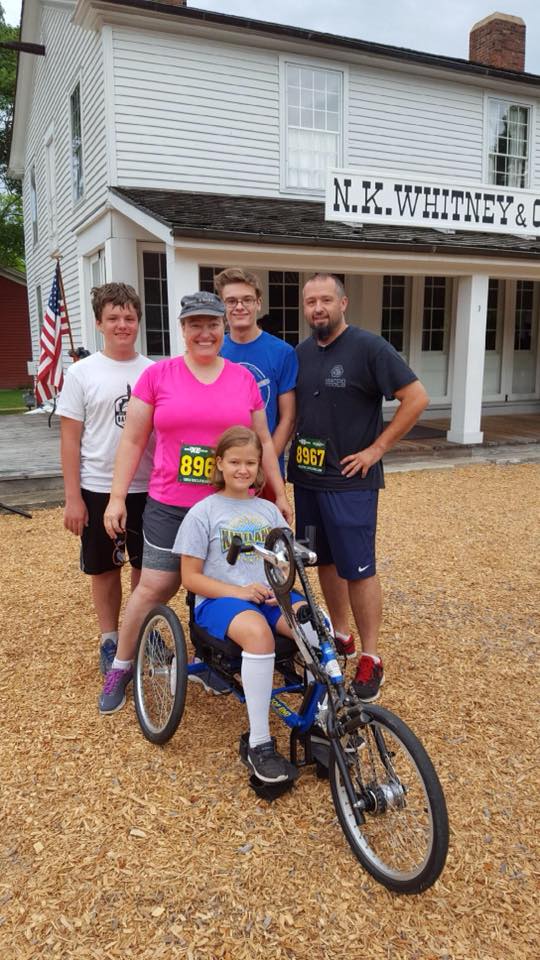
Sunny with husband Jeremy and her children Jeremy, Alex and Seneca.

How do you go about sharing your personal research with cousins or other interested parties?

Most of my sharing happens in the form of telling stories: mostly to my children, but also to my husband, parents or other relatives who may be interested. Telling a story helps me learn which parts are most interesting to which audiences. Sometimes, I take a next step by framing a photo, creating a display or sharing a quick post on Facebook. I do participate in the FamilySearch global tree, which is an easy and organized way to reach potentially thousands of fellow descendants. Although I have written longer articles for genealogy newsletters and historical journals, most of my longer writing projects will have to wait until I’ve finished raising my three children. (That’s Sunny in the photo at left, making memories by participating as a family in a 5k race in July 2018.)

What’s the most important thing you do to prepare for a research trip?

I like to do three things: review what I already know, see what else I can learn online before I go, and locate unique offline sources that may only be discovered while on that trip. This makes my research efforts on the road more productive. A few phone calls to local archives and libraries ahead of time can help me plan my time most effectively, identify must-consult sources and connect with local experts (and perhaps even descendants). I can set priorities about the most important things to accomplish while I’m there and systematically go down my list.

Occasionally, there’s not sufficient time to prepare fully for a research trip. When that happens, I’m just grateful I have my laptop and my phone—which together give me access to all my research, note-taking and organizing tools. I try to at least gather information about the people and libraries I will want to connect with in the future, and take as many pictures as I can.

Do you have a dedicated space in your home for doing genealogy research? What’s it like?

I have a home office with lots of bookshelves for organizing my how-to genealogy research library, storing whatever documents I have in print format and displaying favorite family artifacts and photos. It’s an inspiring, comfortable place, filled with memories and mementos. My favorite mementos are the special cards and crafts my children have made me over the years: they remind me to get up from my desk and make memories with them.

So many great nuggets in here, from the beautiful explanation of how being a genealogist makes one a better human being to the very practical (and, for me, freeing) suggestion of taking a smartphone photo of a document right from the microfilm reader. I tend to be phone averse, but Sunny has inspired me to actually pick up the phone and call local archives and libraries before a research trip. I so appreciate how Sunny puts the emphasis on the family in family history research and how her love for her family imbues the answers to these questions. Thank you, Sunny!

If you’d like to explore more of Sunny’s work, check out her website for her speaking calendar and links to articles. You can watch the video (and read the handout) of her RootsTech 2017 lecture on the comparing the four major “Genealogy Giants” websites on this page of the Genealogy Gems website..

Filed Under: Challenges, Excitement, Genealogy tips, Organizing Tagged With: How They Do It, organizing aids, Sunny Morton

  • « Go to Previous Page
  • Page 1
  • Interim pages omitted …
  • Page 15
  • Page 16
  • Page 17
  • Page 18
  • Page 19
  • Interim pages omitted …
  • Page 43
  • Go to Next Page »

about me

I'm Janine Adams, a professional organizer and a genealogy enthusiast. I love doing family history research, but I find it's very easy for me to get overwhelmed and not know where to turn next. So I'm working hard to stay organized and feel in control as I grow my family tree.

In this blog, I share my discoveries and explorations, along with my organizing challenges (and solutions). I hope by sharing what I learn along the way I'll be able to help you stay focused and have fun while you do your research, too.

tags

30 x 30 Adams amy johnson crow anniversary Brown cemetery census Civil War conferences connections dna electronic files Evernote excitement Family Curator family photos genealogy tools getting started goals How They Do It Igleheart Jeffries keepsakes learning opportunities maps newspapers NGS organizing aids overwhelm paper files planning quick tips rasco record keeping research research log research trip resources RootsTech social history source documentation Stacy Julian technology time management vital records

join the facebook community!

join the facebook community!

My organizing business

Learn more about my organizing business, Peace of Mind Organizing®.

Subscribe by RSS

  • RSS - Posts
  • RSS - Comments

© 2026 Janine Adams


Loading Comments...