• BLOG
  • ABOUT
    • Privacy Policy

Organize Your Family History

Stay focused and happy while exploring your roots

My pause on searching: Easier said than done

September 4, 2018 By Janine Adams 6 Comments

Just over a week ago, in my post called Searcher vs. researcher, I vowed to get through the backlog of documents I had downloaded but never processed and to do no online searching until the backlog was gone. I’ll confess to you that my resolve not to search dissolved the very first day.

My curiosity about certain things that came up while I was processing my backlogged documents could not be satisfied by merely jotting down a note on my follow-up task list. So I quickly amended the vow I’d made to myself. Now, I try not to do any searching and downloading but when I do, I process the new document during the session in which I download it.

This is working out well. I have managed to resist the temptation to search but every now and then I go for it. (For example, when I’m processing a Washington state marriage certificate and I know that Washington marriage license applications, which have more interesting information, are also easily found.)

Today, in processing an 1880 census, a grandchild appeared living with his widowed grandmother and I need to verify whose parent that grandchild is before I can add the grandchild to my genealogy software and consider the census document processed. That’s going to require a little searching online tomorrow and I’m okay with that.

So far, this backlog-busting project is going well. I’ve reduced my backlog by 25 documents in the last ten days and have 78 documents in my backlog remaining. It’s feeling good!
Filed Under: Challenges, Genealogy tips, Reflections Tagged With: electronic files, research, time management

No need to settle for bad scans

August 28, 2018 By Janine Adams 8 Comments

I do a lot of my research online and I’m so grateful for the amazing digitization that has been done of genealogy documents. I’m frequently astounded by the high quality of the scans. It’s a little hard to imagine a genealogy life before this digitizing. (Hats off to those of you who did genealogy research prior to the internet!)

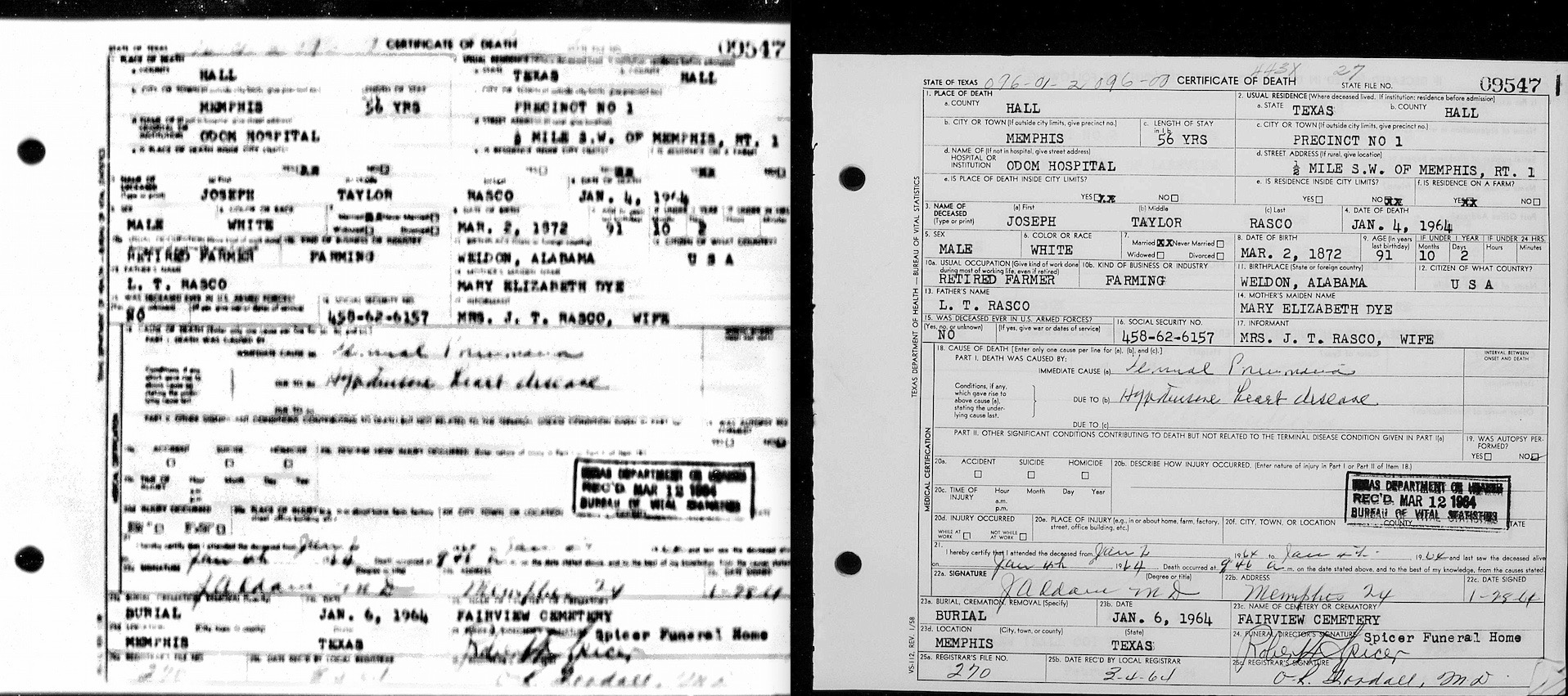
But every now and then I come across a document that was poorly scanned. It happened recently when I downloaded from Ancestry a death certificate for my great grandfather’s brother, Joseph Taylor Rasco (1872-1964). It’s a typewritten death certificate, which is always nice. But the scan was blurry. It was clear enough that I knew it was him, but too blurry to glean information without difficulty.

So I decided to look to see whether Family Search had a different scan of the same document. A few clicks later, I pulled up a crystal clear version of the same document.

Here they are side by side (click the photo to see them larger):

It was a good reminder to me to look a little harder if I come across a scan of a document whose quality makes it hard to read. I may not find a better one, but it’s worth a try!


Photo by Stefan Cosma on Unsplash

Filed Under: Challenges, Genealogy tips Tagged With: electronic files, research

Searcher vs. researcher

August 25, 2018 By Janine Adams 6 Comments

Genealogy searcher vs researcherI’ve been thinking a lot lately about the difference between being a genealogy searcher and being a genealogy researcher. It’s so much fun to go online and track down documents and attach them to a tree or download them. (I know some people like to print them, but not me.) Because so many searchers attach documents to Ancestry trees without evaluating them we end up with an alarming number of inaccurate trees there.

That’s being a searcher. In my opinion, we’re not really researchers unless we analyze the documents we find so that we know they pertain to the person we’re researching, then go through them with a fine-toothed comb, extracting information and storing that data somewhere–with a source citation.

As I’ve written in my post on how I process a downloaded document, I have a digital workflow for the documents I find online, after I determine they belong to my ancestor. In short, I create a source citation and analyze and extract all information from the document and enter that information into my genealogy software. (I use Reunion). I then file the document. On a good day, I process each document as soon as I find it. That’s always my goal.

But the reality is that, especially since I tend to research in short spurts (like 30 minutes a day), I sometimes end up with documents on my hard drive that I’ve downloaded but not yet processed. That’s been happening a lot recently. I’m a little embarrassed to admit it, but I have over 100 documents that I have downloaded that are hanging out on my hard drive, waiting for me process. (At least I changed the file name when I downloaded the documents, so I know at a glance what they are.)

The thing is, these documents won’t do me any good until I process them. I need to read and analyze them and add all facts (with source citation) to my genealogy software in order to benefit from them. But it’s so hard to resist searching, especially when search possibilities pop to mind as I read the downloaded documents.

I want to be a researcher, not a mere searcher. So here’s my vow:

Until the backlog is gone, I will not download any more genealogy documents to my hard drive. I also won’t go to any libraries and bring home paper documents. When searches pop to mind, I will store them in the appropriate follow up notebook inĀ  Evernote to look at when the backlog is gone.

I’m hoping to take a research trip to Kentucky in October. This adds extra urgency to my resolve to get rid of my backlog. You can bet I’ll post here when the backlog is gone!

Do any of you have this particular challenge? Let me know if you’d like to join me in resolving to do no more searching until your backlog of documents you’ve already found is gone. I’d love the company!

Filed Under: Challenges, Genealogy tips, Reflections Tagged With: electronic files, research, time management

Understanding genetic genealogy (finally!)

August 7, 2018 By Janine Adams 8 Comments

Understanding genetic genealogy (finally)I attended Diahan Southard’s series of DNA lectures on July 28 as part of the St. Louis Genealogical Society’s Summer Speaker Series. As I mentioned in a blog post last month, I’ve had a hard time using DNA in my genealogical research, mostly because I have a difficult time understanding and retaining what I try to learn about DNA.

Diahan is an expert on making this information understandable to non-scientists like me. I’ve heard her speak before but this time, a door in my brain cracked open. It may have been because at the seminar we had the privilege of listening to Diahan for four straight lectures, each of which built on the prior one. It was really a brilliant program and Diahan is an excellent speaker.

So I came home and started applying what I’ve learned and I now feel that genetic genealogy is part of my tool box. Hooray!!

Here are some of the revelations from her talks that really helped me:

  • A DNA match with a person whose tree has no familiar surnames is cause for celebration, not frustration. The DNA shows you’re related. When you figure out how you’re related, you’ll add names to your tree.
  • The Shared Centimorgan (cM) Project can help you understand how you might be related to someone, based on how much DNA you share. Here’s Diahan’s explanation of centimorgans and the Shared cM Project. It’s a great resource.
  • The solution to most DNA is quandaries is (drum roll): Do genealogy! DNA evidence can bridge gaps or open holes in brick walls. But traditional genealogy is how you build your family tree.
  • Create a list of your 32 great great great grandparents’ surnames to help you find commonalities with DNA matches. I had not compiled a list like that before and I see how it will help recognize how I might be related to those DNA matches that are fourth cousins or closer.
  • On Ancestry, even if a DNA match has not linked a tree to his/her DNA results (so you see “no family tree”), click on the “View Match” button and see if there’s a drop-down list of trees you might look at under the Pedigrees and Surnames tab. There may be a tree (or a few trees) for you to look at.

One thing I noticed when I took a look my Ancestry DNA results the day after the Diahan’s seminar is that the shared centimorgans don’t necessarily accurately reflect the relationship. For example, my mother’s first cousin, whom I know personally, shares only 183 cM with me, rather than the 439 that first cousins once removed usually share, according to the Shared cM Project. So Ancestry guessed that she was my third or fourth cousin. The Shared cM Project is a great tool, but obviously just a guideline.

Today in my research session, I explored the public tree linked to someone with whom I share 158 cM. This is a huge tree but I was able to easily focus in on a shared surname. The tree is beautifully sourced, so even though I had only a few minutes left of my 30-minute research session this morning, I was able to add a fact and supporting document to my great great grandfather’s record in my family tree software. Tomorrow I’ll go back and explore that tree more.

I finally understand how DNA can help me in my genealogy research. Better yet, I understand how to use it. This is such a revelation.

If using genetic genealogy eludes you as it did me, I heartily encourage you to check out Diahan’s website, Your DNA Guide, and to listen to Diahan speak when you have the chance. She’s speaking at the Federation of Genealogical Societies conference later this month and I know she’ll be speaking at the 2019 NGS conference in St. Charles, Missouri, next May. (I’ll plan to be in the front row!) You can also do a consultation with her where she explains your DNA results to you. She’s a terrific resource.

Unmodified photo by Michael Knowles via Flickr. Used under Creative Commons License.

Filed Under: Challenges, Excitement, Technology Tagged With: Diahan Southard, genealogy tools, genetic genealogy, research

  • « Go to Previous Page
  • Page 1
  • Interim pages omitted …
  • Page 17
  • Page 18
  • Page 19
  • Page 20
  • Page 21
  • Interim pages omitted …
  • Page 43
  • Go to Next Page »

about me

I'm Janine Adams, a professional organizer and a genealogy enthusiast. I love doing family history research, but I find it's very easy for me to get overwhelmed and not know where to turn next. So I'm working hard to stay organized and feel in control as I grow my family tree.

In this blog, I share my discoveries and explorations, along with my organizing challenges (and solutions). I hope by sharing what I learn along the way I'll be able to help you stay focused and have fun while you do your research, too.

tags

30 x 30 Adams amy johnson crow anniversary Brown cemetery census Civil War conferences connections dna electronic files Evernote excitement Family Curator family photos genealogy tools getting started goals How They Do It Igleheart Jeffries keepsakes learning opportunities maps newspapers NGS organizing aids overwhelm paper files planning quick tips rasco record keeping research research log research trip resources RootsTech social history source documentation Stacy Julian technology time management vital records

join the facebook community!

join the facebook community!

My organizing business

Learn more about my organizing business, Peace of Mind OrganizingĀ®.

Subscribe by RSS

  • RSS - Posts
  • RSS - Comments

© 2026 Janine Adams


Loading Comments...