• BLOG
  • ABOUT
    • Privacy Policy

Organize Your Family History

Stay focused and happy while exploring your roots

Reconnecting with my research

May 12, 2017 By Janine Adams 4 Comments

Reconnecting with my genealogy researchI was out of town for ten days and I managed to sneak in a little genealogy research. I returned on May 7 to a full client schedule for my organizing business. I’m certainly not complaining about that, but I have not had the energy and time to do any genealogy research for over a week.

I was regretting that state of affairs when I realized I didn’t have to have a large swath of time available to me in order to get some research done. Sometimes just spending a little time on it to reconnect me with my ancestors and get the ball rolling again can be really beneficial.

In the past, a big barrier to my starting a research session was figuring out what to work on. But now I have a few small, systematic projects I can always fall back on. This morning, I decided to set a timer and work on my research for just 15 minutes. I had three choices of easy things to dive into:

  • Checking my source documentation
  • Adding multimedia files to sources in Reunion where missing (step six of my digital workflow, which I didn’t add until later in my research life)
  • Transcribing the Civil War pension file of George Washington Adams (1845-1938), my 2nd great grandfather

For any of these projects, I could make some progress in just 15 minutes. I chose to work on option #1, checking my source documentation. I have a checklist in Evernote in which I check off each source after I’ve made sure that the source citation is good, the multimedia file is attached to the source and the pertinent data from the source was included in Reunion. When I finish a source I check it off so I can always see where I stand.

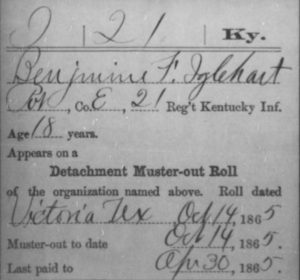
This morning, the next source on the list was the Compiled Service Record for a different 2nd great grandfather, Benjamin Franklin Igleheart (1845-1913). I hit the jackpot, because I hadn’t done a great job of extracting data to include in his record on Reunion. The 15 minutes flew by as I noted his eye, hair and complexion color, for example. (His eyes were listed as black!)

I didn’t actually finish going through the 16-page record, but I employed a trick I learned years ago: When my timer went off, I stopped, even though I was in the middle of a document. I know that since our brains crave completion, I’ll be anxious to get right back to the document and finished extracting data from it. Then I’ll check it off my source documentation checklist (another satisfying thing to do). I made a note in my research log to remind me where I left off. I’d be willing to bet I’ll be so anxious to finish it that I work on it this evening.

I find that if I spend too much time away from my research I feel disconnected from it. Taking a little snippet of time to work on it this morning will help me get back to it this weekend, when I have more time.
Filed Under: Challenges, Genealogy tips, My family Tagged With: Adams, Igleheart, source documentation, time management

My digital workflow

March 24, 2017 By Janine Adams 26 Comments

Digital workflow for genealogyWhen Brooks Duncan and I spoke at RootsTech last month about going digital with genealogy research, it became apparent to me from the questions that digital workflow is an individual thing. I’ve developed a work flow that works well for me, so I thought I’d share it here. I’m not suggesting I do things The Right Way (I don’t know if there is a right way, especially for hobbyists), but I wanted to show you what works for me. I know that I love seeing examples of how people handle their own workflow, so in the spirit of sharing, here’s mine.

When I find a digital document online–let’s say it’s a census document that I found at Ancestry–I take the following steps after ascertaining that it’s pertinent to my research:

  1. I click Save to download the document to my computer’s desktop.
  2. I rename the file immediately so that it reflects my simple file-naming protocol (year document type-ancestor name-location).
  3. I immediately file the document in my file structure (Genealogy/Surnames/[Ancestor’s surname]/[Ancestor’s name]
  4. I analyze the document and enter the first fact into my Reunion software.
  5. I create a source for that fact, using Reunion’s templates.
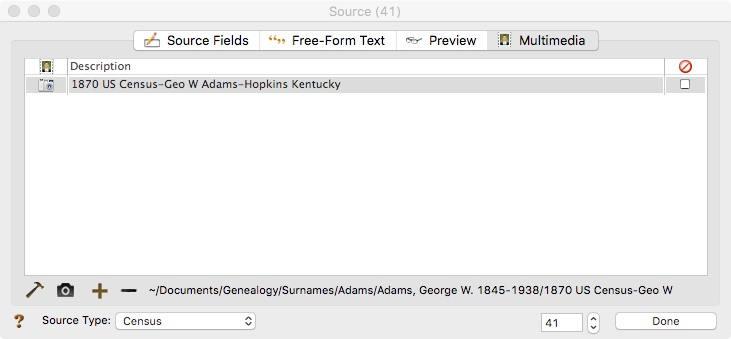
  6. I drag the image of the file into the Multimedia section of the Reunion source screen for that source. (That’s an example of the Reunion source screen at the top of this post.)
  7. I enter all other facts I find in the document into Reunion, using the same source number for each fact I find in that document.
  8. I click Preview in the Reunion source screen for that source and copy the citation and paste it into the metadata of the image file on my hard drive.

I added that last step after RootsTech, adapting a suggestion made by an audience member at our talk. I hadn’t thought about noting on the image what the source number and citation is. I think it’s a great idea and now I intend to go to back and do that for all my sources.

This eight-step work flow takes me from discovery through processing the document. It means that I don’t have stray documents on my hard drive with nonsensical file means. It also means I can easily a find a document when I want to. And it helps me see what documents are missing. Having the confidence that I can find a document I’ve saved allows me to feel good about not printing it, which cuts down on my paper clutter. (And, yes, I backup my hard drive daily, both to the cloud and to an external hard drive.) This workflow was about five years in the making, but I’m very satisfied with it!

For more in-depth information on how I organize my own genealogy, including a detailed look at my digital workflow, check out How I Do It: A Professional Organizer’s Genealogy Workflow, a 37-page downloadable available for $19.99.

Filed Under: Challenges, Organizing, Technology Tagged With: electronic files, organizing aids, record keeping, source documentation

How important are formal citations?

January 13, 2017 By Janine Adams 30 Comments

I may be opening up a can of worms here, but a conversation in the comments of my post about accountability for research logs has me pondering the question again.
How important is it for the hobbyist genealogist to use properly formatted citations?

(Please understand that my question is about the format of source citations, not about whether we should cite sources. I absolutely believe every fact should be backed up by at least one source.)

I think many folks would agree that Elizabeth Shown Mills’ book Evidence Explained is the gold standard source citations. I own Evidence Explained and I do consult it occasionally. But generally I relax the rules for myself. I make sure that my citations would allow me to find the source again and I typically use the citation templates found in my Reunion software.

Basically, I want to make sure that it’s easy to cite sources so that I always cite them. If I’m hung on doing it right, I may put off citing the source, which does not do me any good.  So, for example, I used templates in Reunion to create this census citation, associated with a fact in the record of my 3d great grandparents, Joseph and Mary Price:

“1870 U.S. Census,” Pleasant Gap, Bates, Missouri, 25 Jun 1870, Ancestry.com, 4 April 2014.

The 1870 date is the date the census was taken, and the 2014 date is the date I first viewed it. If I needed to find it again, I think I could.

So I’m curious: what do you do? Do you use formal citations are are you more casual? If you don’t use Evidence Explained, do you have another source you swear by?

If you think I’m making a mistake by not being more formal, feel free to tell me!

Filed Under: Challenges, Genealogy tips, General Tagged With: source documentation

Checking my sources

June 29, 2016 By Janine Adams 30 Comments

Verifying my sourcesThis year I’ve been having the hardest time figuring out what I want to focus on in my genealogy research sessions. I think part of the problem is that I’ve also had trouble finding time to research, so it’s been more sporadic. And when I do have time, then I don’t know what to work on.

A couple of years ago, I tried focusing on a different line each quarter. That was successful, but this year I’m not researching frequently enough to make that work. Last year, I was really focused on processing and transcribing my ancestors’ Civil War pension files. That was great too, but I’m wanting to mix it up a bit more these days.

I know I need to figure out what I want to focus on during my week at the Allen County Library in August, which means that I feel the need to revisit my ancestors and remind myself of my mysteries.

So I lit on a strategy that, for the moment anyway, is working well for me. (And I also came up with a strategy that’s allowing me to research more frequently–more on that in the next post.) Here’s what I’m doing:

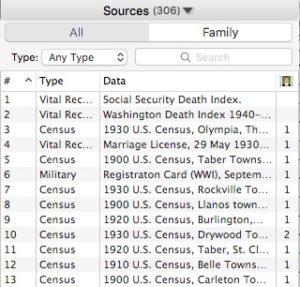
I’m going through all my sources in the Reunion family-tree software, checking the format, and attaching an image of the source to the source entry.

I exported the list of my 300 sources as an rtf file then opened the file in Evernote. I made the type big enough to read easily, then turned it one long bullet list with checkboxes for bullets. One by one, I’m going down the list and looking at each source and at the document that goes with the source. I’m checking the usage of the source. I attach the document as a multimedia file (leaving it on my hard drive in its folder, organized by surname and individual).  I’m getting reacquainted with my ancestors. And it’s been really fun.

I’m seeing several benefits to this process:

  • I know exactly where to start when I sit down to do research.
  • I’m cleaning up some formatting issues, since I became better at source documentation over time (so I’ve been able to make entries more consistent).
  • I’m making a list of things to investigate further, which will be helpful in planning my research trip.
  • I’m finding things I missed in the source documents the first time around.
  • I’m making new discoveries as I go along.
  • I get to work on a variety of ancestors every day, which suits me these days.
  • I see tangible progress every session.
  • I can make progress in just a few minutes, which is great when I don’t have a lot of time to research.
  • I’ve found that some electronic files had not been filed correctly and I’ve been able to refile them.
  • I end up with a wonderfully organized source list.
  • It’s systematic and enjoyable. I love checking off the box when I’m finished with that source!

If I wanted to focus on the sources of a single family, Reunion makes that easy for me. (I just click on “Family” rather than “All” in the sources list.) But for me, right now, mixing up the families by checking the sources in the order in which I entered them is working out nicely.

So far, I’ve checked off 20 of my now-306 sources. (I’ve made a few discoveries in the process, so I’ve added a few sources.) I’ve been doing a little a day for the last five days or so. Clearly it’s not fast work (though it may get faster as my sourcing gets better). But it’s beneficial and enjoyable. Hooray!

Filed Under: Challenges, Excitement, Organizing Tagged With: record keeping, research, source documentation, time management

  • « Go to Previous Page
  • Page 1
  • Interim pages omitted …
  • Page 4
  • Page 5
  • Page 6
  • Page 7
  • Page 8
  • Page 9
  • Go to Next Page »

about me

I'm Janine Adams, a professional organizer and a genealogy enthusiast. I love doing family history research, but I find it's very easy for me to get overwhelmed and not know where to turn next. So I'm working hard to stay organized and feel in control as I grow my family tree.

In this blog, I share my discoveries and explorations, along with my organizing challenges (and solutions). I hope by sharing what I learn along the way I'll be able to help you stay focused and have fun while you do your research, too.

tags

30 x 30 Adams amy johnson crow anniversary Brown cemetery census Civil War conferences connections dna electronic files Evernote excitement Family Curator family photos genealogy tools getting started goals How They Do It Igleheart Jeffries keepsakes learning opportunities maps newspapers NGS organizing aids overwhelm paper files planning quick tips rasco record keeping research research log research trip resources RootsTech social history source documentation Stacy Julian technology time management vital records

join the facebook community!

join the facebook community!

My organizing business

Learn more about my organizing business, Peace of Mind Organizing®.

Subscribe by RSS

  • RSS - Posts
  • RSS - Comments

© 2026 Janine Adams


Loading Comments...