• BLOG
  • ABOUT
    • Privacy Policy

Organize Your Family History

Stay focused and happy while exploring your roots

Some RootsTech sessions available to watch on demand

February 21, 2017 By Janine Adams 2 Comments

If you weren’t able to attend RootsTech or watch the Live Stream of certain RootsTech sessions, you now have the chance to watch most of those sessions on demand (and a few more). I was disappointed to see that LeVar Burton’s Friday keynote isn’t available. It was a terrific speech that was very moving.

RootsTech has made it easy to click and watch the videos. Here’s the list. (Click on the day name to get access to the videos for that day.) There are a few I wasn’t able to attend that I plan to watch!

Wednesday, February 8

Innovator Summit General Session (Full session or individual speeches)
Speakers: Steve Rockwood, Liz Wiseman

Industry Trends and Outlook panel
Speakers: Ben Bennett; Craig Bott, Grow Utah; Heather Holmes, TapGenes; Nick Jones, JRNL, Inc.; Robert Kehrer, FamilySearch

Innovation—Best Practices and Applications
Speaker: Cydni Tetro

Innovator Showdown Semi-Final
Speakers: Innovator Showdown Semi-Finalists

Metadata—Writing on the Back of Digital Photos
Speaker: Alison Taylor, Pictures and Stories

Thursday, February 9

RootsTech General Session (full session and individual keynotes)
Speakers: Steve Rockwood, Jonathan and Drew Scott, Steve Rockwood & MyHeritage

Getting Started in Genealogy
Speaker: Kelli Bergheimer

DNA: The Glue That Holds Families Together
Speaker: Diahan Southard, Your DNA Guide

DNA Matching on MyHeritage
Speaker: Dana Drutman

Jewish Genealogy: Where to Look and What’s Available
Speaker: Lara Diamond

My Ancestors are in My DNA!
Speaker: Angie Bush

Family History Is Anything but Boring
Speakers: Crystal Farish and Rhonna Farrer

Friday, February 10

RootsTech General Session: African Heritage presentations
Speakers: Kenyatta Berry, Sherri Camp, Melvin Collier

Innovator Showdown Finals
Speakers: Jason Hewlett & Innovator Showdown Finalists

Mothers, Daughters, Wives: Tracing Female Lines
Speaker: Judy G. Russell

Censational Census Strategies
Speaker: Mary Kircher Roddy

Next Steps in British Research
Speaker: Amy Harris

Big 4: Comparing Ancestry, findmypast, FamilySearch, and MyHeritage
Speaker: Sunny Morton

You Found It Where? Unusual Records
Speakers: Rorey Cathcart, D. Joshua Taylor, Rich Venezia

Cross the Atlantic with Religious Records
Speaker: Jen Baldwin

How to Preserve Your Family Heirlooms
Speakers: Anna Graff, Jennifer Hadley, Katie Smith, Andrew Thomas, Tyler Thorsted

Saturday, February 11

RootsTech General Session (full session and individual keynotes)
Speakers: Cece Moore, Buddy Valastro

Journaling Principles That Work
Speaker: Steve Reed, JRNL, Inc.

Don’t Just Be a Searcher, Be a Researcher
Speaker: Crista Cowan, Ancestry

Creating Google Alerts for Your Genealogy
Speaker: Katherine R. Willson
Filed Under: Excitement, Genealogy tips, General Tagged With: conferences, excitement, learning opportunities, RootsTech, technology

The joys of newspaper research

February 14, 2017 By Janine Adams 6 Comments

This past month or so, I’ve been focusing my genealogy research on a small family unit: My great great grandfather, George Washington Adams, his second wife, Della, and their children. Even though I’m not directly descended from Della, their story (which I picked up on thanks to George’s Civil War pension file) has fascinated me and I’ve been trying to learn more.

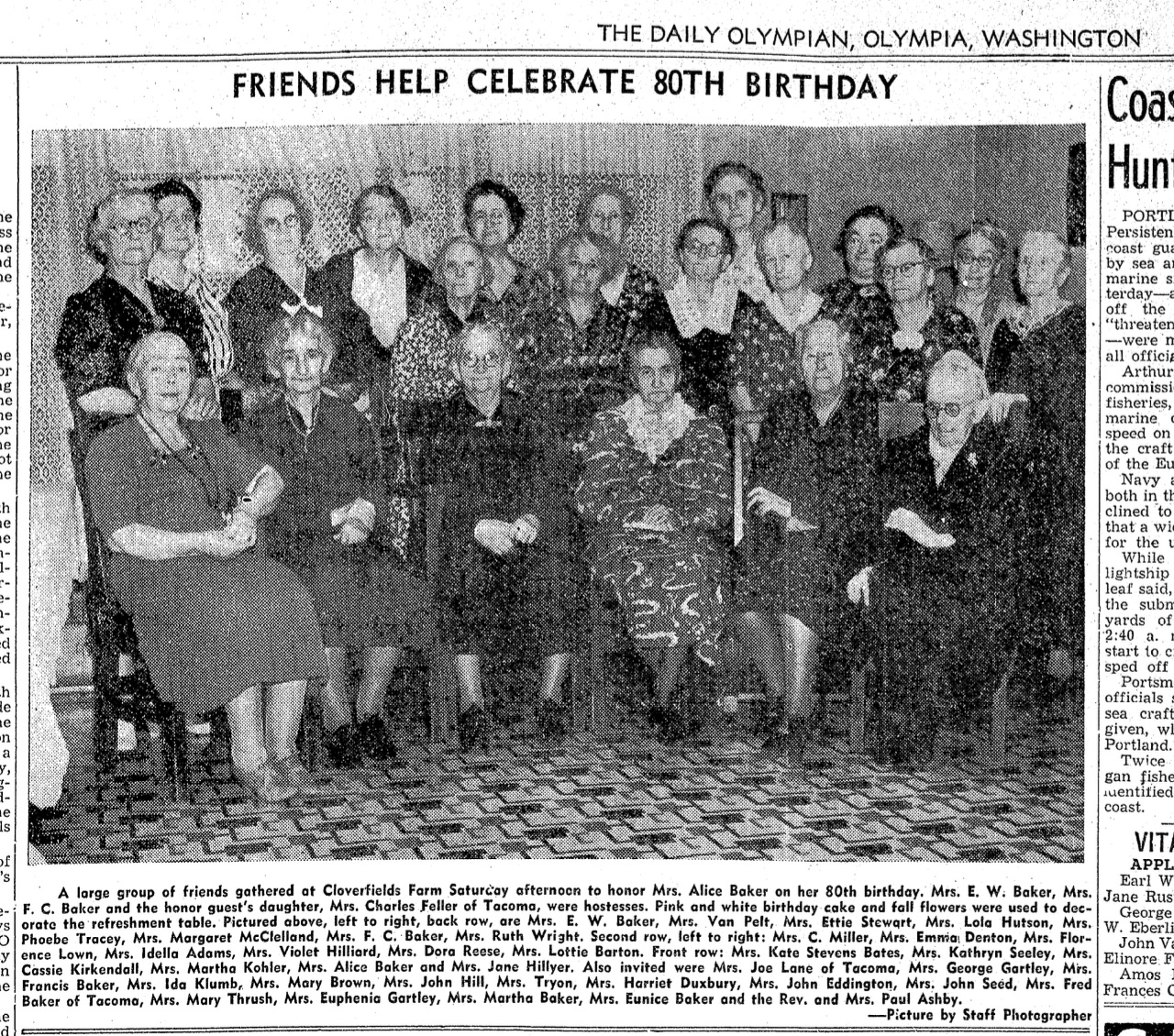
I was able to connect some of the dots when I was at the Family History Library last week–many thanks to reader Maria Tello for helping me out there. I even found the death certificate for a child who was born and died between censuses, whom I hadn’t been aware of. With the connected dots I was able to verify some (and debunk some) of the information that was on Della’s Find A Grave page. That page referred to a couple of newspaper articles in the Daily Olympian of Olympia, Washington. I have a Newspapers.com subscription and looked up those articles there, but couldn’t find them. Nor were they available on the Library of Congress’s Chronicling America site.

When I was at the Expo at RootsTech, I stopped by the Genealogy Bank booth and quizzed them about what makes them special. The representative told me that something like 95 percent of their content is exclusive, so most of the articles they have are not available elsewhere. That was enough for me to give it a try. Taking advantage of the RootsTech discount, I signed up for a year for $60.

My very first search hit pay dirt. And since then, I’ve found more than a dozen really useful articles on this family. It’s not that the family members were famous; it’s just that the newspaper reported on little things, like club meetings, birthday parties and military promotions. And, of course, deaths.

I think my two biggest a ha moments were these:

  • I saw a photo of Della…it’s so nice to see what she looked like! (That’s the photo, above.)
  • I learned that Della and my great grandmother, Hattie Adams, were in the same chapter of the Daughters of Union Veterans club together, so I’m assuming they knew one another. Hattie was married to Elmer, one of George’s sons from his first wife. Henrietta. Since Della married George after Hattie and Elmer moved from Kentucky to Washington, I didn’t know whether Della had a relationship with George’s sons who lived in Olympia. Nor do I (yet) know why Della migrated to Washington from Kentucky after she and George were divorced. But that little bit of information makes me want to learn more!

The other thing I’ve enjoyed about looking at these old newspapers is learning a bit about daily life and also realizing that things aren’t all that different now than they were then. Some of the newspaper articles could have come out of our newspapers!

I learned about a few historical things I hadn’t known about (unrelated to my family) as well. I clipped some articles and put them in an Evernote notebook called “Historical observations.” For example, apparently some counties in northern California, together with some in southern Oregon, announced they were planning to secede from their respective states and form a 49th state, called “Jefferson.” This was in 1941. That was news to me!

If you haven’t mined newspapers for information on your family, I encourage you to do so. Based on my experience so far, Genealogy Bank is a worthwhile investment, if you have the money to spend.

Filed Under: Challenges, Excitement, Genealogy tips Tagged With: Adams, learning opportunities, newspapers, social history

Introducing the Paperless Genealogy Guide

February 10, 2017 By Janine Adams 2 Comments

Paperless Genealogy GuideI’ve partnered with “Mr. Paperless,” Brooks Duncan of DocumentSnap, to create a guide to going paperless in your genealogy research. I think it will be really helpful for those who would like to go paperless but feel overwhelmed by the prospect.
Brooks and I are presenting a session at RootsTech today (Go Paperless: Streamline and Digitize Your Genealogy) and we worked on the presentation and the guide at the same time.

You can read all the details about the Paperless Genealogy Guide over at DocumentSnap and download it for $9 there.  The guide covers how to name and find your digital documents, along with different types of scanners, and strategies for protecting your precious documents. And it ends with a checklist to walk you through the actions you need to get going.

My genealogy life is much easier now that almost all of my documents are in digital form. I can carry all my research with me, find it easily, read it easily (no more magnifying glass!) and determine very easily what I have and don’t have for a particular ancestor.

If that sounds good to you, hop on over and check out the Paperless Genealogy Guide! It can be yours instantly for $9.

Filed Under: Excitement, Genealogy tips, Organizing, Technology Tagged With: Brooks Duncan, electronic files, genealogy tools, paperless, record keeping, technology

How They Do It: Denise May Levenick

February 7, 2017 By Janine Adams 15 Comments

Here is the second installment in my How They Do It series, which I inaugurated last month with a Q&A with Thomas MacEntee. In this series, I’ve reached out to genealogy luminaries whom I admire and asked them to talk about how they organize their own genealogy research. I’ll post a new installment the first Tuesday of every month.

This month, we get to learn from Denise May Levenick, The Family Curator, author of How to Archive Family Keepsakes and How to Archive Family Photos. Denise is also a frequent contributor to Family Tree Magazine, as well as a popular teacher and lecturer.

How They Do It: Denise May Levenick

How long have you been doing genealogy?

I checked out my first census record in 1976 as part of a course in Personal and Family History at the University of Idaho, and I was hooked! That course gave me the opportunity to revisit my grandmother’s family history papers and photos, but I didn’t really pursue genealogy until my sons graduated from college and I had more time. It was a long hiatus.

What’s your favorite part of doing genealogy?

Discovering the back-story of a document or an unexplained detail about an ancestor is my favorite aspect of genealogy. I loved discovering that my grandmother was an accomplished seamstress! It gives me an extra connection when I work on quilts for my family.

Do you consider your genealogy research well organized?

Is my research well-organized? My research is one thing, my research papers and files are another. I feel pretty comfortable about both, and I can usually find what I need. But, there’s always room for improvement!

What type of software do you use for organizing your genealogy research?

I’ve used or tried almost every genealogy database program – PAF,  Family Tree Maker Legacy, RootsMagic, Reunion, MacFamily Tree, and some I can’t remember. Since moving to a Mac in 2000, I use Reunion most of the time. I keep all my work in the Notes section and export GEDCOM files as needed to use features in other programs on my PC. The best advice I ever received was to invest time and effort in the Notes section of your software rather than the individual event line data. It’s served me well when I moved around as my needs changed.

Do you keep a research log? If so, what format?

Oh… research logs. Yes, I do. I had a beautiful journal log that I left somewhere, and now I use a form log online that I can access from my desktop at home or my laptop. I still use a paper journal log, but most work is duplicated on the digital log too. I’m a “form person.” I love creating tables and forms for different projects and included dozens of worksheets and forms in both my books.

Do you have a tree on Ancestry? If so, is it public or private? Why?

I have both kinds of trees on Ancestry. Public as cousin bait, and private for my works-in-progress. I don’t want my speculative work to be copied as proven, so I feel better keeping those trees private.

What’s your biggest challenge when it comes to organizing your genealogy?

My biggest challenge is keeping paper under control. I do like paper copies to read and annotate, but the pages seem to multiply like rabbits.

What’s your biggest piece of advice to beginning genealogists in terms of keeping track of their research?

I’d say, “Don’t fight the Research Log. Just do it!” We love taking shortcuts, but in genealogy, shortcuts just cost time later.

What do you think is the most important thing for people to do to stay organized when it comes to family history research?

Organization doesn’t just “happen.” For most of us, it’s part of a process or workflow. I find that when I use a consistent research process, staying organized becomes a natural part of the entire scheme. For example, creating a digital workflow was tough to develop and implement, but it’s become a habit now that I’m using the 7-Step digital asset management process I write about in my book How to Archive Family Photos. I find that I’m naturally moving from Capture to Import and through each step, and my files are organized along the way. Developing a repeatable workflow is key.

If you were starting out new as a genealogist what would you do differently?

Oh, I wish I had been a more active genealogist years ago. I have so many ancestors yet to discover! I would encourage any new family historian to take a beginning genealogy course and develop good research and record-keeping habits. You can learn about record groups as you develop in the field, but you will always use sound basic skills.

Do you keep paper or electronic files (or both)?

I keep both paper and electronic files. Papers are filed in hanging file folders until I analyze them and enter the data in Reunion; then the papers go in a binder. I keep digital files in Surname folders with meaningful filenames. I use Spotlight or other file search software to find files faster on my computer.

Are you a folder or binder person for your paper files?

I love binders because they help me keep papers in order and in place.

Do you use Evernote, One Note or any other electronic organizing system for your genealogy? If so, how do you use it?

Evernote is my go-to app for quick reference notes of webpages and articles, but I use OneNote for notes and tasks especially when traveling. I’ve used Microsoft Word for so long that it’s like a typewriter to me, and OneNote’s notebook format makes it easy to keep track of odd bits of information. When it comes to writing, however, I turn to Scrivener. I use it for all my blog posts, magazine articles, and lecture outlines, and it was great for organizing my book projects.

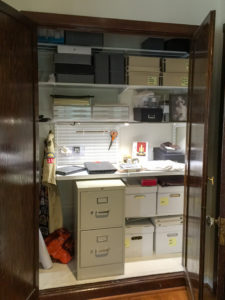
Denise’s Home Archive

Do you have a dedicated space in your home for doing genealogy research? What’s it like?

I am fortunate to have a perfect writing and research space at home. It’s a small room upstairs overlooking the front of our house, so I get a birds’ eye view of the neighborhood through a wall of glass French doors. One office wall is filled with books – English and American literature and history from my teaching days, and genealogy reference books. I have a corner cabinet that holds supplies, a vertical file cabinet, and a computer desk. We will be moving soon, and my new office will be a bit larger, so I hope I’ll have room for a table to spread out projects and items from my archive. My Home Archive is located in the closet of an extra bedroom, and I’m looking forward to having everything in one place in my new office.

Do you have anything to add?

I’ve learned that “getting organized” can become an all-consuming goal if we get stuck in the mindset of finding the “perfect” system or solution. I do better when I remind myself that progress is better than perfection; fix what isn’t working and move forward.

Such wise words! I’m particularly struck by Denise’s advice about research logs: “Don’t fight the research log. Just do it!” Amen. Thank you, Denise!

Filed Under: Challenges, Excitement, Genealogy tips, Organizing Tagged With: Denise Levenick, Family Curator, How They Do It, organizing aids

  • « Go to Previous Page
  • Page 1
  • Interim pages omitted …
  • Page 134
  • Page 135
  • Page 136
  • Page 137
  • Page 138
  • Interim pages omitted …
  • Page 219
  • Go to Next Page »

about me

I'm Janine Adams, a professional organizer and a genealogy enthusiast. I love doing family history research, but I find it's very easy for me to get overwhelmed and not know where to turn next. So I'm working hard to stay organized and feel in control as I grow my family tree.

In this blog, I share my discoveries and explorations, along with my organizing challenges (and solutions). I hope by sharing what I learn along the way I'll be able to help you stay focused and have fun while you do your research, too.

tags

30 x 30 Adams amy johnson crow anniversary Brown cemetery census Civil War conferences connections dna electronic files Evernote excitement Family Curator family photos genealogy tools getting started goals How They Do It Igleheart Jeffries keepsakes learning opportunities maps newspapers NGS organizing aids overwhelm paper files planning quick tips rasco record keeping research research log research trip resources RootsTech social history source documentation Stacy Julian technology time management vital records

join the facebook community!

join the facebook community!

My organizing business

Learn more about my organizing business, Peace of Mind Organizing®.

Subscribe by RSS

  • RSS - Posts
  • RSS - Comments

© 2026 Janine Adams


Loading Comments...