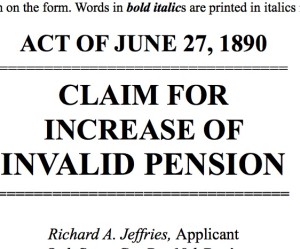
 When I took Julie Miller‘s class at the NGS conference, Anatomy of a Military Pension, I felt inspired and motivated. I went home that night and ordered the pension files from my three Union soldier ancestors. I took her advice on how to process the files. Starting with the first one that arrived (for my 3d great grandfather, Richard Anderson Jeffries, 1823-1914), I put the papers in the file in chronological order, created citations for each of the 26 documents, scanned the documents into one file and am now in the process of transcribing them.
When Julie told us to transcribe the documents, I remember thinking that sounded like way too much work. I had trouble picturing myself taking the time to do it. But Julie urged us not to skip that step. She said that when we transcribe, we learn things we would learn no other way. So I decided to take her advice. I’m now in the middle of transcribing this pension file. (I’m on document 19 of 26.) It’s what I’ve been doing daily in my 30 x 30 challenge–I find that it takes about 30 minutes to transcribe one document.
I am so glad I’m making effort! Reading and typing the documents word for word means that I’m not just skimming; I’m digesting what the documents say. I’m memorizing important dates and items that appear on every form. (He fought in Co. D, 18th Regiment, Missouri Infantry Volunteers–those words came out of my memory.)
I’ve learned things that I never would have noticed in a simple reading of the file. For example, his first (unfortunately unsuccessful) pension lawyer was a woman. In 1886! It’s also allowed me to really get to know this ancestor. He was a smallish man, 5 feet 8 inches, with dark hair and complexion and blue eyes. I’ve read and internalized in exquisite detail his physical ailments as he’s aged. Each application for an increase in pension is accompanied by a doctor’s report, some of which are quite personal in nature.
The next step, once I’ve finished transcribing, will be abstracting the data and entering it into my Reunion software. The pension file has been really helpful, revealing heretofore unknown-to-me between-census information, like the fact that he lived in the state of Washington for part of the first decade of the 20th century before moving back to Missouri. (Maybe some day I’ll find out how he traveled to and from Washington.)
I have two more ancestors’ files to process–one of them, for G.W. Adams, 1845-1938, has over 100 individual documents (as opposed to the 26 of R.A. Jeffries). It’s going to take me awhile. But, as I know already, there is gold to mine from these amazing pieces of history. And I know that going to the trouble to transcribe will help me mine it even better.
 I’m a professional organizer and I routinely give time-management advice to my clients who want it. But, as regular readers of this blog know, managing my genealogy research time is a work in progress for me. I struggle with staying focused, knowing what to work on and combating overwhelm.
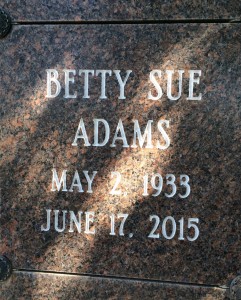 I know this isn’t news to most of you, but the fact that gravestones can contain errors was brought home to me after my mother passed away last month. As I posted at the time,
  One of my tendencies when it comes to my genealogy research is to get overwhelmed and then paralyzed. I’ve worked hard to avoid the “Where do I start?” question that used to prevent me from getting to work.