• BLOG
  • ABOUT
    • Privacy Policy

Organize Your Family History

Stay focused and happy while exploring your roots

How I processed my Civil War pension files

April 14, 2025 By Janine Adams 4 Comments

I’m fortunate to have three ancestors who fought on the Union side in the Civil War and for whom I was able to obtain pension files from the National Archives. Ten years ago, I wrote a post about how I processed those files, starting with creating a robust source citation. I got good feedback on the post, so I thought I’d resurrect it in case newer readers would find it helpful. The pension files truly are treasure troves of information and the painstaking time I spent going through them paid off. If you want to request your ancestor’s pension file, you can do so on this page of the NARA website.
Processing civil war pension filesAs I mentioned a couple of weeks ago, I received my 3d great grandfather’s Civil War pension files from the National Archives in record time. I’d been prepared to wait 45 to 120 days and it arrived the week after I submitted the request online.

I dug right in and started processing the information. I was so grateful that I had attended the class Anatomy of a Military Pension, presented by Certified Genealogist Julie Miller at the National Genealogical Society’s annual conference that month. She provided step-by-step instructions of what to do with a military pension.

So the day after I received that 65-page pension file, I did what Julie suggested. I put the documents in chronological order and I assigned a number to each. Then I figured out a citation for the overall file and a  citation for each of the numbered documents.

Coming up with a proper citation was a bit of a challenge and I emailed Julie, who was kind enough to share the citation she uses for these files. (She had given us that info in the talk, but I hadn’t written it down.)

Here’s the citation I’m using for the overall pension file for my ggggrandfather, Richard Anderson Jeffries:

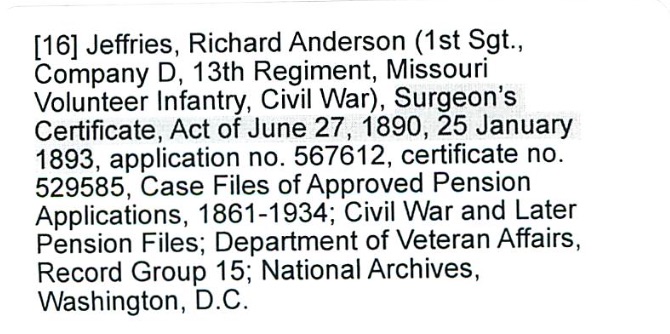
[278] Jeffries, Richard Anderson (1st Sgt., Company D, 13th Regiment, Missouri Volunteer Infantry, Civil War), application no. 567612, certificate no. 529585, Case Files of Approved Pension Applications, 1861-1934; Civil War and Later Pension Files; Department of Veteran Affairs, Record Group 15; National Archives, Washington, D.C.

278 was the next number in my source list in Reunion, my family tree software. Each of the individual documents is numbered, starting with 1, and has its own citation. My intention is that when I enter a fact into Reunion, I’ll use Source 278, but I’ll include in the detail field which of the 26 individual documents that particular fact came from.

I created citation labels for each of the documents and affixed them to the appropriate pages. (That’s the citation for document 16 above.) Then I scanned the whole document into a pdf. I elected to have one pdf, rather than 26 individual ones–time will tell whether that was a good choice. (Edited to add a year later: Yes! That was a great choice.)

The next step, according to Julie is to transcribe the documents. Yes, I’m going to type word for word exactly what is on the documents. Julie urged us not to skip that step because when we transcribe, we learn things we would not otherwise learn.

After I transcribe, I will abstract the documents, so I can tell at a glance what they are and what info is contained within each. And then I’ll enter the new-found facts into Reunion, my family-tree software.

That’s a lot of work, but I’m delighted to have learned how to be thorough with it. And I know I’ll learn so much about my ancestor.

I am so grateful to have this structure, because just a few days after receiving Richard Anderson Jeffries’s file, I received the pension file for my gggrandfather, George Washington Adams. That file is over 100 pages; I had to request and pay for the rest of the file (another 80 pages) to be copied–I’m still waiting for part two. That same week I received the third and final pension file, for another gggrandfather, Benjamin Franklin Igleheart. All three pension files, probably 250 pages, came within two weeks of my request.

If I did not have the structure Julie provided in that talk to thoroughly process the information, I know I would feel overwhelmed. I would probably skim the documents, pluck out a few easy-to-find facts, and put them away intending to get to them later. And I don’t know when later would be.

I have skimmed the most recently received pension files to get a preview what I’m going to learn. (G.W. Adams had a big dispute about the amount of his pension–an adversary in the Soldier’s Home turned him in for saying he was more disabled than he was!) But I’m not going to analyze them until I’m finished with Richard Anderson Jeffries. So that will be motivation to go through the process.

I think these pension files are going to be a great learning experience not just about my ancestors, but also about doing proper genealogical research. This feels great!
Filed Under: Challenges, Genealogy tips, Organizing Tagged With: Adams, Civil War, excitement, Jeffries, overwhelm, record keeping, research, source documentation

Getting rid of the stubborn pile on your desk

December 20, 2024 By Janine Adams 6 Comments

Banishing the stubborn pileBack in 2015, I wrote this post about finally doing something about the genealogy-related pile on my desk. As I read it in December 2024, I thought it might be a helpful reminder that we can take action on the stacks of genealogy papers that tend to become of the landscape.

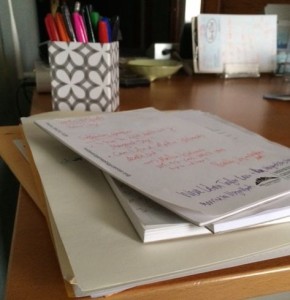
For the past few months, I’ve had this one pile on the corner of my desk that contains primarily genealogy items. When I’m hurriedly putting away the stuff cluttering my desktop, I just keep straightening that pile and leaving it there. It’s almost become a feature of the landscape of my desk. Somehow I’ve adjusted my thinking so that I have been considering my desktop clear even with that pile sitting there.

I think one of the reasons that I wasn’t dealing with it was a perception that it would take some time to really process the information in it. I was afraid that if I rushed it, I might lose valuable clues the pile might contain for my genealogy research. And I simply wasn’t taking the time to do it. (Work has been very busy lately.)

I know if I take some focused time and go through that pile, I will further my research and I won’t have an unsightly pile on my desk. But it hit me this morning that if I start but don’t finish, I’m still better off than not starting at all. So I took a photo of the pile, and wrote all the text above this line. Then I set my timer for 15 minutes and started going through the pile.

Here are some of the things I found in the pile:

  • Notes from my research trip to Kentucky and Alabama. I added tasks from those notes to my Genealogy To-Do List for the appropriate surname. Then I filed the notes in my paper files.
  • A packet of information I’d sent for from the the State of Alabama Archives pertaining to my great great grandfather, Laban Taylor Rasco. I put a sticky note saying “Analyze/process” on the packet and added that task to my Rasco To-Do List. Then I filed the packet in that couple’s file.
  • Notes from my notebook that I took on the research trip. One page had notes on Adamses on one side and notes on Rascoes on the other. I scanned the Rasco side, printed it and put in in my Rasco file for later reference. I filed the original sheet in the appropriate Adams file.
  • Notes written on several pages of two notepads I keep on my desk. I tore off the notes, logged any tasks on my To-Do list and filed or tossed the notes. Then I put the notepads where they belong.
  • A random list of how common my family surnames are. Some time ago, I found myself on a website (which I didn’t source) where you can enter a surname and see how common it is. I typed the data into Evernote so I can find it later if I ever remember it.
  • A small sticky note with a list of death certificates I’d found recently that needed to be added to my Reunion software. I checked each name to see which certificates had been entered already.  Two out of five still needed to be added and I noted that on my to-do list. I threw away the sticky note.
  • Some brainstorming notes about this blog. I filed them and made a note on my business task list to review them.

When the 15-minute timer went off I had just a few more pieces of paper to deal with. So I went ahead and finished, then did the filing.

Eliminating that pile took no more than thirty minutes. This is a pile I’d been looking at for several months. It had been mildly stressing me out, because I didn’t know its contents and it was in the way.

Now I feel in control of my research, I have clear next steps and I feel more eager to work on it. Plus I have a clear desk to enjoy. That’s the best 30 minutes I’ve spent in awhile!

What could 30 minutes of pile busting do for you?

Filed Under: Challenges, Organizing Tagged With: organizing aids, paper files

My good enough research log is good enough

October 18, 2024 By Janine Adams 6 Comments

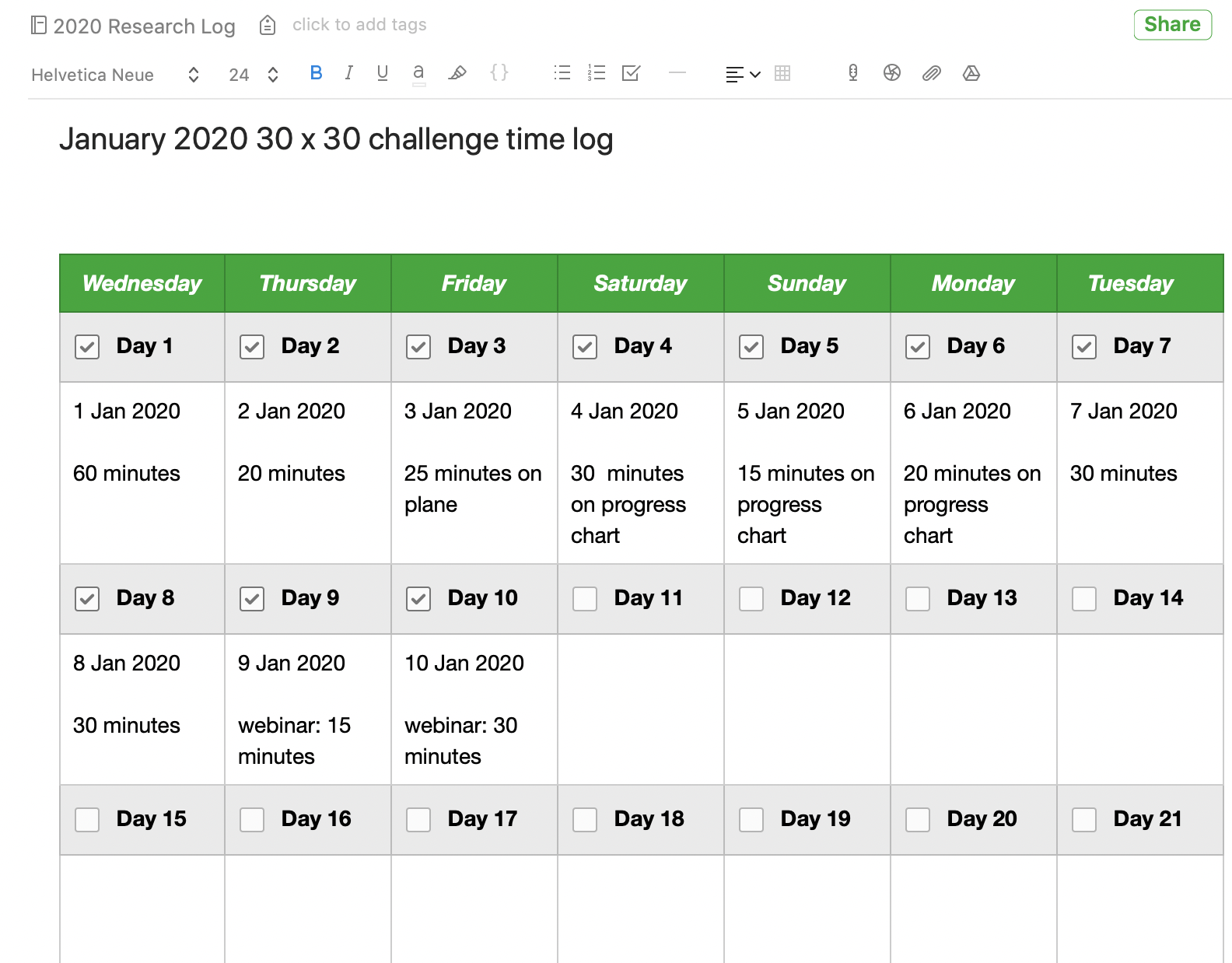
My good enough research logI wrote this post back in January of 2020. This informal logging method has stood the test of time for me. I’m still using it though I’ve moved from Evernote to Apple Notes. It’s not good enough for a professional genealogist but for my hobbyist self it keeps me on track, which is my top priority. I thought I’d repeat the post today. (The Evernote template pictured lasted exactly one month; I don’t use it any longer even during 30 x 30 challenges.)

We’re in the midst of a 30 x 30 challenge this month so I’ve been researching every day. It feels great. I have no more than 30 minutes (sometimes less) to research most days this month, so I rely on my research log to help me start each session.

I’ve blogged before about my research log and its value. This month, because I’m working on my RootsTech talk “The Imperfection Genealogist,” I’ve been reflecting on the fact that my very informal research log is far from perfect. But it’s certainly good enough.

How do I know it’s good enough? It’s because I’m in touch with why I want to keep a research log and the ways I use it. For me, it’s about knowing what I’ve researched in a given session and (perhaps more importantly) what my next steps are. It also tells me at a glance how frequently I’m researching. I keep my research log in Evernote, but I track of all my documents and family tree elsewhere, so I’m not creating source citations or storing documents in my research log. You might have a research log for different reasons. And yours may be very different from mine. And that’s great.

My good-enough research log is an Evernote notebook by year (I started the 2020 research log notebooks ten days ago), pinned as a shortcut in the sidebar. Each time I research, I open the notebook, create a new note with today’s date, and then write in free from what I worked on that day. I write down the questions that come up. I write down any discoveries. And I end the session by writing down the next steps. That way, when I start the next session, whether it’s the next day or the next month, I know where to start. That’s been a huge time saver for me. (I blogged in more detail about my research log in this post. About a year ago, I wrote a post about how my research log keeps me focused.)

This month, I’ve added an Evernote template that allows me to check off that I completed a session and I also add how many minutes I researched, because I’m hoping that I’ll get in 900 minutes in the 30 x 30 challenge, even if I don’t manage 30 minutes in some individual sessions. This is motivating to me, because when I see the checkmarks each day it makes me want to not break the chain. I also jot down in a couple of words what type of work I did. The picture at the top of this post is screenshot of the note that contains the template, which is in addition to my usual daily note but also stored in the 2020 research log notebook. (To get that template, I clicked on New Note, then on Template right in the note, then Habit Tracker in the Template Gallery. That inserted the template into the note and I edited it a bit.)

When I first started contemplating creating a research log in 2012, I could understand its value but I got wrapped up in trying to do it perfectly. Predictably, my first attempts failed. But as soon as I got in touch with what I really wanted out a research log and I made it easy to accomplish, things fell into place. Now, I’m glad to say that I’ve developed a habit of logging my session every day.

A couple of years ago, I created a Facebook group called Genealogy Research Loggers. We’re a pretty quiet group, but if you’d like some help and accountability for creating a research log habit, please join us!

For detailed information on how I organize my own genealogy research (including my research log), check out my Orderly Roots Guide, How I Do It: A Professional Organizer’s Genealogy Workflow, available for $19.99.

Filed Under: Challenges, Organizing Tagged With: Evernote, genealogy tools, research, research log

Switching from Evernote to Apple Notes

March 15, 2024 By Janine Adams 38 Comments

I was a happy Evernote user for ten years. (Click on the Evernote tag below or search for the word Evernote above to read the articles I wrote about that.) It took me a little while to embrace Evernote. I think part of my problem was that I didn’t like the way it looked. But I got used to it and created a lot of notebooks for both my genealogy and my organizing business (and my life!). I kept my genealogy research log in Evernote.

I started with a free version, then moved to a $50 Premium version that allowed me access to my Evernote notebooks even when I was offline. The price was raised to $70 and I paid that for seven years. But then, after Evernote was sold, they raised the price to $130 a year. And they made the Free version all but useless.

I found that price hike egregious, so I decided to jump ship. I did a little research and opted to use Apple Notes, which came with my Mac and iPhone and is available at no additional cost. (I’m already paying extra to Apple for 2TB of iCloud storage space.)

It turns out that the process of transferring my data to Apple Notes isn’t difficult, but it has to be done a notebook at a time. I have 200 notebooks. So I’m working on it a few notebooks at a time. The process is easy. Here’s what I do on my laptop, using the Evernote app (not the website):

  1. Select a notebook to transfer
  2. Highlight all the notes in that notebook
  3. Click File, Export
  4. Select ENEX format and click Export
  5. Create a filename that matches the notebook name and click Save.
  6. Go to Apple Notes
  7. Click File, Import to Notes
  8. Select the file you just created, then click Import
  9. Rename the notebook from the default name Imported Notes

Then go to the next notebook.

I created a little screen share video for those who prefer to see these instructions in action.

https://organizeyourfamilyhistory.com/wp-content/uploads/2024/03/video2278013066.mp4

It’s worth noting that I’m not transferring everything…there are notebooks that I really don’t need again. I’m making that evaluation as I go along. Little by little the transfer will get done. In the interim, I’m making sure to add all new notes in Apple Notes, not Evernote. Once the Evernote transition is complete, Apple Notes will be my comprehensive go-to repository of notes.

My understanding is that I can use my existing notebooks without paying. The free version limits me to one new notebook with 50 notes but I wouldn’t lose my current notes and I can export, delete and merge existing notes. However, I haven’t tested that because when I went to cancel I was repeatedly offered a lower price to stay on. So I accepted an offer of $65 (less than the $70 I was prepared to pay) for one last year. I figure it will give me some time to make this transfer without feeling any pressure or feeling like I’m shackled. The key, of course, is to keep chipping away at it and not wait until the end of the year to work on it.

It feels great not to have to budget money for what turned out to be a redundant app for me.

Filed Under: Organizing, Technology Tagged With: Apple Notes, Evernote, research log

  • « Go to Previous Page
  • Page 1
  • Page 2
  • Page 3
  • Page 4
  • Interim pages omitted …
  • Page 69
  • Go to Next Page »

about me

I'm Janine Adams, a professional organizer and a genealogy enthusiast. I love doing family history research, but I find it's very easy for me to get overwhelmed and not know where to turn next. So I'm working hard to stay organized and feel in control as I grow my family tree.

In this blog, I share my discoveries and explorations, along with my organizing challenges (and solutions). I hope by sharing what I learn along the way I'll be able to help you stay focused and have fun while you do your research, too.

tags

30 x 30 Adams amy johnson crow anniversary Brown cemetery census Civil War conferences connections dna electronic files Evernote excitement Family Curator family photos genealogy tools getting started goals How They Do It Igleheart Jeffries keepsakes learning opportunities maps newspapers NGS organizing aids overwhelm paper files planning quick tips rasco record keeping research research log research trip resources RootsTech social history source documentation Stacy Julian technology time management vital records

join the facebook community!

join the facebook community!

My organizing business

Learn more about my organizing business, Peace of Mind Organizing®.

Subscribe by RSS

  • RSS - Posts
  • RSS - Comments

© 2026 Janine Adams


Loading Comments...