
• BLOG
  • ABOUT
    • Privacy Policy

Organize Your Family History

Stay focused and happy while exploring your roots

How I’m using Evernote for genealogy

August 5, 2016 By Janine Adams 7 Comments

Evernote logoI have to admit I have been a slow adopter of Evernote. In 2013 and 2014 I posted here about how I wanted to give Evernote a(nother) try to help me organize certain aspects of my genealogy research. Well, it’s two years later and I’m happy to report that I am actually using Evernote to help organize a bunch of things in my life, including certain aspects of my genealogy research. I’ve become a big fan, though no one would describe me as a power user.

I thought it might be helpful to some people for me to describe how I’m using it for genealogy. Before I do, though, I want to emphasize that this isn’t the best way or the only way to use Evernote. It’s just the way I’m using it. And it will no doubt evolve.

So here’s a source list of ways I use Evernote in my genealogy life:

  1. Research log. I have a very simple template in Evernote in which I jot down what I’ve researched that session. Full disclosure: I don’t do it each and every session; I just do it when it feels right. Evernote makes it very easy.
  2. Genealogy task list. I have a notebook (in my Genealogy stack) called Genealogy clues/puzzles to check out. That’s where I make note of the things that come up that I don’t want to explore at the moment. I helps me stay focused on the task at hand.
  3. Source documentation project. As I described last month, I’m systematically reexamining all my sources in Reunion, verifying them, checking citations, ensuring that I’ve gleaned all the information I can out of them and adding images of each source to the citation. I keep the list in Evernote and check it off as I go.
  4. Keeping track of resources. I have a notebook called Genealogy resources where I clip interesting websites. Do I go back and look at it a lot? Not so much. But when I do there are usually some treasures in there. And clipping it means I don’t have to try to remember it, which frees up my mind.
  5. Genealogy travel. When I’m planning a research or cemetery trip, I keep notes about hotels, logistics, things to remember to pack, etc.
  6. Blog post ideas. I jot down ideas for this blog and my organizing blog when they occur to me. I consult it when I don’t know what to write. Which is quite often.

I don’t store my genealogy research in Evernote. After the 2015 National Genealogical Society meeting where I heard a detailed talk on using Evernote for genealogy, I briefly tried storing images of the genealogy documents I’d downloaded (census records, vital records, etc) in Evernote. I abandoned that as too labor intensive (though I can see the sense in it because it makes those documents exquisitely accessible). Instead, I attach those documents to the source citation in Reunion on my Mac.

In short, Evernote has become indispensable to me. It’s my go-to place to store and retrieve all manner of things (and I use it a whole lot for non-genealogy purposes as well). I pay for the premium version, so that I can access it when I’m not online. The price for the premium version just went up from $50 to $70 a year. I like it enough that I didn’t even consider not renewing because of the price hike.

Evernote is such a robust platform that I know I could be taking better advantage of it. And in a year I might be using it entirely differently. But right now it’s meeting my needs quite nicely.

How do you use Evernote for your genealogy research?
Filed Under: Challenges, General, Organizing, Reflections Tagged With: Evernote, organizing aids, research, research log, resources, technology

Preparing for my repository trip

August 2, 2016 By Janine Adams 4 Comments

Preparing for a genealogy research tripOn August 14, less than two weeks from now, I leave for my week-long research excursion to the Allen County Public Library Genealogy Center in Ft. Wayne, Indiana, a six-hour drive from my home in St. Louis. This is a National Genealogical Society research trip. I paid $750 (including hotel) and I am really excited to get my money’s worth!
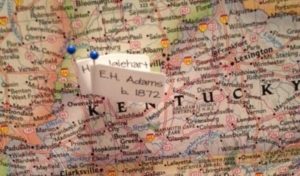
I know I need to spend some time preparing so that my time there is well spent. With all the possibilities of things to research, narrowing it down is one of my biggest challenges. I went to a talk at the Midwestern Roots Family History and Genealogy Conference earlier this month on preparing for a repository trip (see my last post), so I have a game plan. After hearing that talk, as well as a talk on the library’s holdings, I’m planning to focus my research on one locality. I have a cluster of ancestors who lived in Kentucky in the 1800s to early 1900s. I’m going to focus on McLean and Muhlenberg Counties.

I have a multi-pronged approach to this research preparation:

  • Searching the library’s holdings for information on this locality and adding to a spreadsheet of specific books and microfilm rolls I want to look at.
  • Making sure the items I’ve found aren’t readily available on the internet, so I know my time at the library is spent looking at resources I can’t readily find elsewhere.
  • Looking through my existing research for holes, mysteries, and clues I could explore at the library. I’m adding those to a separate sheet on the spreadsheet. I won’t necessarily ignore non-Kentucky mysteries, but I’ll put them lower on my priority list.
  • I also plan to go through my paper files for those ancestors to make sure there aren’t any resources there that I didn’t manage to get on my hard drive. I’m thinking that I’ll take along my computer, but not my paper files, so I’ll try to scan and file anything I’d missed.

That’s a pretty labor-intensive list for two weeks but I’m trying to do a little each day and also spend more time with it on the weekends. I know that any effort at all will be beneficial, even if I don’t get to all of it.

I love the idea of homing in on one locality. That’s helping me stay focused and not feel overwhelmed.

Do any of you experienced researchers have any advice for me that you’d like to share?

Filed Under: Challenges, Excitement, Organizing Tagged With: excitement, organizing aids, planning, research, research trip, time management

Resisting the urge to print

July 12, 2016 By Janine Adams 16 Comments

1800sidebysideI used to print all my source documentation and then analyze the printed version and add facts to my Reunion software on my computer. In fact, as recently as 2013 I blogged about how printing gave me comfort.
But that’s changed and these days I’m not even tempted to print. In November, I posted 8 reasons not to print and I stand by it. Organizing my research is much easier now that I’m not looking at a lot of printed documents. Every now and then I pull out a paper file and look at something I printed years ago, but I bet that happens fewer than ten times a year.

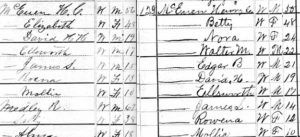
Right now I’m going through all my source documentation and in the process cleaning up my electronic files. In doing so, I found the family who had been counted twice on the 1880 census. I needed to compare the two census documents side by side. That’s when I felt the urge to print. My initial thought was that it would be easier to look at the documents on paper, rather than on my computer. One of the documents had already been printed and was in my file. I came really close to printing out the other one, when I realized that looking at the paper documents would be harder for me, not easier. The type is so small on the printed document that I might have had to get out my magnifying glass and squint. That’s the opposite of easy!

I had originally found the census documents on Ancestry and saved them to my hard drive. So I just opened the documents on my computer in Preview (that’s the Mac default pdf and jpg viewer), zoomed in on the family in question and sized each of them so that they fit side by side on my screen easily–I didn’t need to see the entire document at a glance, after all. And then I was able to easily compare them, line by line. I had Reunion open as well, so it was simple for me to enter data into my ancestors’ records and source each fact properly.

What I’m learning in my research, over time, is that going paperless is just plain easier. When I transcribe my ancestors’ Civil War pension files, I use an electronic version, which allows me to zoom in when the handwriting is a little puzzling. And I’m not shuffling a lot of long pieces of paper. (Those documents came from the National Archives in paper form. I put source information on each and then scanned the whole file into one long pdf. I detail that process here.)

The keys to successfully eschewing printing, I believe, are twofold:

  1. A good file naming protocol and folder structure, so that I can easily see what I have for each ancestor. I file by surname and individual, which is working well for me.
  2. A solid backup protocol, inĀ  case of hard drive failure. I use CrashPlan Pro to back up to the cloud and Time Machine to back my Mac onto an external hard drive that sits on my desk.

As commenter Maria Tello mentions, having a large monitor makes viewing electronic documents easier.

I was glad I resisted the urge to print that 1880 census document. It made analysis easier–and I’m sure it was easier on my eyes!

Filed Under: Challenges, Genealogy tips, Organizing, Technology Tagged With: electronic files, organizing aids, record keeping, technology

Counted twice on the census

July 5, 2016 By Janine Adams 14 Comments

Counted twice on the censusOver the holiday weekend I spent some time researching my 3d great grandparents on my father’s side, Henry Clay McEuen (1823-1894) and his wife Elizabeth Baker McEuen (1829-1917). They lived their lives in Kentucky.

Henry and Elizabeth had 14 children, the eldest of whom was my great great grandmother, Henrietta McEuen Adams (1847-1902). As part of checking my sources, I was looking at Source 22, the 1880 federal census entry for Henrietta and her husband George Washington Adams (1845-1938) in Rumsey, Kentucky.

The entry for George and Henrietta spanned two pages. When I was looking at the second page, I noticed that Henrietta’s parents were on that page. They were living with nine of their children, along with four grandchildren and Elizabeth’s mother–a four-generation household. I went to add that source to their record in Reunion and saw that I already had a (different) source for them for the 1880 census. I figured I’d duplicated the same source and was surprised to see it was a separate enumeration, on a different date, in a different town. In this second enumeration, the youngest five of their children were with them. The names and ages all matched. It was clear to me that it was the same family.

I did a little googling and discovered that being counted twice isn’t that unusual. The census is supposed to reflect the state of a household as of the census date (which in 1880 was 1 June). But clearly, in the case of this family, it reflected the household on the days the enumerator knocked on the door. I suspect that’s not unusual.

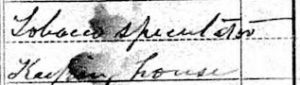
On the first enumeration, on 11 June 1880, in Rumsey, McLean, Kentucky, Henry is listed as 55 years old and a farmer. In the second enumeration, on 29 June 1880, in Sacramento, McLean Kentucky (10 miles away on today’s roads), Henry is listed as 56 years old and a “tobacco speculator” (or at least that’s what I think it says–let me know if you think otherwise when you look at the photo above). A quick look at Henry’s birth date revealed that he was in fact a year older–he celebrated a birthday on 28 June, the day before the second enumeration.

I’m speculating that some time between 11 June and 29 June, Henry and Elizabeth (or Betty, as she was known), packed up their five children under 20 and moved to Sacramento. They left behind the four older children who had lived with them, including Lucretia, a widow, and her four kids, along with Betty’s mother, Mahala Baker. Henrietta and George lived nearby.

I wonder what prompted the couple to move away from five of their kids and her mother. Perhaps Sacramento was a better place to be a tobacco speculator, or perhaps Henry had not bought land yet, so couldn’t call himself a farmer. I look forward to trying to dig into this a little more to see why the family might have moved.

It’s really fun to me how a single discovery like this–a family being counted twice on a census–can lead to further hypotheses and discoveries. If they’d moved in May or July, rather than June, I wouldn’t have had this level of detail to go on.

I love playing detective and I’m grateful to Henry and Betty for providing so many clues!


Filed Under: Excitement, My family, Organizing Tagged With: Adams, excitement, mysteries, research, social history

  • « Go to Previous Page
  • Page 1
  • Interim pages omitted …
  • Page 39
  • Page 40
  • Page 41
  • Page 42
  • Page 43
  • Interim pages omitted …
  • Page 69
  • Go to Next Page »

about me

I'm Janine Adams, a professional organizer and a genealogy enthusiast. I love doing family history research, but I find it's very easy for me to get overwhelmed and not know where to turn next. So I'm working hard to stay organized and feel in control as I grow my family tree.

In this blog, I share my discoveries and explorations, along with my organizing challenges (and solutions). I hope by sharing what I learn along the way I'll be able to help you stay focused and have fun while you do your research, too.

tags

30 x 30 Adams amy johnson crow anniversary Brown cemetery census Civil War conferences connections dna electronic files Evernote excitement Family Curator family photos genealogy tools getting started goals How They Do It Igleheart Jeffries keepsakes learning opportunities maps newspapers NGS organizing aids overwhelm paper files planning quick tips rasco record keeping research research log research trip resources RootsTech social history source documentation Stacy Julian technology time management vital records

join the facebook community!

join the facebook community!

My organizing business

Learn more about my organizing business, Peace of Mind OrganizingĀ®.

Subscribe by RSS

  • RSS - Posts
  • RSS - Comments

© 2026 Janine Adams


Loading Comments...