• BLOG
  • ABOUT
    • Privacy Policy

Organize Your Family History

Stay focused and happy while exploring your roots

Search Results for: 30 x 30 challenge

Processing Civil War pension files

June 2, 2015 By Janine Adams 23 Comments

Processing civil war pension filesAs I mentioned a couple of weeks ago, I received my 3d great grandfather’s Civil War pension files from the National Archives in record time. I’d been prepared to wait 45 to 120 days and it arrived the week after I submitted the request online.

I dug right in and started processing the information. I was so grateful that I had attended the class Anatomy of a Military Pension, presented by Certified Genealogist Julie Miller at the National Genealogical Society’s annual conference that month. She provided step-by-step instructions of what to do with a military pension.

So the day after I received that 65-page pension file, I did what Julie suggested. I put the documents in chronological order and I assigned a number to each. Then I figured out a citation for the overall file and a  citation for each of the numbered documents.

Coming up with a proper citation was a bit of a challenge and I emailed Julie, who was kind enough to share the citation she uses for these files. (She had given us that info in the talk, but I hadn’t written it down.)

Here’s the citation I’m using for the overall pension file for my ggggrandfather, Richard Anderson Jeffries:

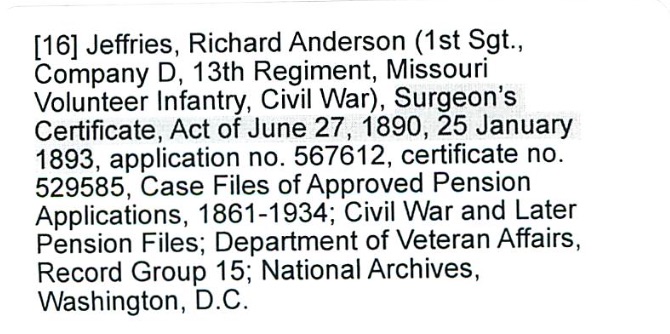
[278] Jeffries, Richard Anderson (1st Sgt., Company D, 13th Regiment, Missouri Volunteer Infantry, Civil War), application no. 567612, certificate no. 529585, Case Files of Approved Pension Applications, 1861-1934; Civil War and Later Pension Files; Department of Veteran Affairs, Record Group 15; National Archives, Washington, D.C.

278 was the next number in my source list in Reunion, my family tree software. Each of the individual documents is numbered, starting with 1, and has its own citation. My intention is that when I enter a fact into Reunion, I’ll use Source 278, but I’ll include in the detail field which of the 26 individual documents that particular fact came from.

I created citation labels for each of the documents and affixed them to the appropriate pages. (That’s the citation for document 16 above.) Then I scanned the whole document into a pdf. I elected to have one pdf, rather than 26 individual ones–time will tell whether that was a good choice. (Edited to add a year later: Yes! That was a great choice.)

The next step, according to Julie is to transcribe the documents. Yes, I’m going to type word for word exactly what is on the documents. Julie urged us not to skip that step because when we transcribe, we learn things we would not otherwise learn.

After I transcribe, I will abstract the documents, so I can tell at a glance what they are and what info is contained within each. And then I’ll enter the new-found facts into Reunion, my family-tree software.

That’s a lot of work, but I’m delighted to have learned how to be thorough with it. And I know I’ll learn so much about my ancestor.

I am so grateful to have this structure, because just a few days after receiving Richard Anderson Jeffries’s file, I received the pension file for my gggrandfather, George Washington Adams. That file is over 100 pages; I had to request and pay for the rest of the file (another 80 pages) to be copied–I’m still waiting for part two. That same week I received the third and final pension file, for another gggrandfather, Benjamin Franklin Igleheart. All three pension files, probably 250 pages, came within two weeks of my request.

If I did not have the structure Julie provided in that talk to thoroughly process the information, I know I would feel overwhelmed. I would probably skim the documents, pluck out a few easy-to-find facts, and put them away intending to get to them later. And I don’t know when later would be.

I have skimmed the most recently received pension files to get a preview what I’m going to learn. (G.W. Adams had a big dispute about the amount of his pension–an adversary in the Soldier’s Home turned him in for saying he was more disabled than he was!) But I’m not going to analyze them until I’m finished with Richard Anderson Jeffries. So that will be motivation to go through the process.

I think these pension files are going to be a great learning experience not just about my ancestors, but also about doing proper genealogical research. This feels great!

Filed Under: Challenges, Genealogy tips, Organizing Tagged With: Adams, Civil War, excitement, Igleheart, Jeffries, overwhelm, record keeping, research, source documentation

Genealogy is a marathon, not a sprint

March 10, 2015 By Janine Adams 3 Comments

Genealogy is a marathon, not a sprintLast Saturday, I squeezed some genealogy research in, because I had marked it on my calendar. I know that if it weren’t in my calendar, I wouldn’t have focused on my research that morning. I was preparing to go to a baby shower that morning and contemplating starting on my taxes in the afternoon. But because I’d made that commitment, I did a little something.
Keeping my commitment to doing research every weekend was important to me and I told myself that it didn’t matter what I did, as long as I did something. So I spent some time creating the beginnings of a new sheet for progress tracker on more in-depth information, which I’ll share as soon as I feel it’s finalized, and I added two siblings to my tree, in an effort to flesh out my collateral lines.

As I was looking for small tasks to do in the short period of time I had allotted to me, the title of this post came to mind: Genealogy is a marathon, not a sprint.

Isn’t that the truth? Genealogy research is a lifelong endeavor in which a series of short research sessions can add to an important body of work.

In my fantasy life, I’m a wealthy retired organizer and I could spend all my time researching and perhaps traveling the country and the world (à la Who Do You Think You Are) solving research challenges.

In my real life, I’m a working organizer wedging genealogy research time in between client appointments, running a business, and family and personal obligations. So I do what I can, when I can do it (which, right now, is every Saturday or Sunday morning). And I take satisfaction in knowing that all the work will add up.

There are several tools that help me keep continuity as I do my research a little at a time:

  • My quarterly focus (I focus on one grandparent’s ancestors each quarter)
  • My progress tracker
  • My genealogy to do list (I promise to create a printable of this soon!)
  • My research tracker template (which I created for Springpad and now use in Evernote)

Those things help me pick up where I left off, which has traditionally been a real challenge for me.

Whenever I get frustrated at not being able to spend more time with my genealogy research, I’m going to remind myself that this is not a sprint, and I’m in it for the long haul. Then I’ll do a little something.

Photo by Steven Pisano via Flickr. Used under Creative Commons License.

Filed Under: Challenges, Organizing, Reflections Tagged With: genealogy tools, planning, progress, research log

Digging out after a conference

March 4, 2015 By Janine Adams 2 Comments

Diggin out after a conferenceI love going to conferences. Between organizing and genealogy conferences, I attend at least three a year.
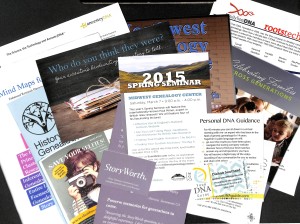
Conferences are wonderful learning and networking opportunities, but they can present an organizing challenge. When I return home from a conference, I’m usually behind in my work and it’s so easy to leave everything I learned on a back burner. The biggest challenge is probably dealing with the literature I bring home from conferences. I’m a bit ashamed to admit that, in the past, items I picked up at trade shows have stayed in the bag untouched until they’re thrown away months or even years later.

Last month, I attended RootsTech. It had a gigantic trade show and I learned about so many new resources I wanted to explore. I was bound and determined that the information I bought home with me would not languish. Here’s how I handled it this year. (Spoiler alert: I’m feeling pretty good about it!)

  • I minimized what I brought home by carefully going through all the paper before packing my bag at the hotel room in Salt Lake City.
  • Once I got home to St. Louis, I put all the literature together until I could process it.
  • I spread it out and scanned it for the photo to go with this post (something non-bloggers wouldn’t have to consider!).
  • Then I gathered it into a pile and went through it piece by piece. I looked up the websites for each of the flyers I brought home. If the product or service still interested me, I added it to a note I created in Evernote called “Interesting resources from RootsTech 2015” that I placed in my Evernote “Genealogy Resources” notebook.
  • For a couple of the resources, I created a follow up task in Things, the task management application I use.  I can assign a due date, so these tasks will pop up on my Today page next year  (helpful for reminders about conferences I might want to attend in 2016).
  • I jotted down some blog post ideas sparked by the literature and put them in my Blog Post Ideas notebook in Evernote.
  • I recycled all the paper, except two items I decided to file

The whole process took me about 30 minutes. It feels great! There were some resources I’d forgotten about already, but now they’re safe inside Evernote. I took action on a couple of items, signing up for newsletters and other services and making one inquiry about working with someone. And, perhaps best of all, I got rid of a pile of paper.

Taking 30 to 60 minutes to process this information really adds value to what I brought home from RootsTech. It’s an amazing return on the investment of time spent! I’m grateful for Evernote and Things which help me free up my memory so I can find this information when I need it.

I can’t wait to do it again after next month’s National Association of Professional Organizers conference.

Do you have a better (or different) way of digging out after a conference?

Filed Under: Challenges, Genealogy tips, Organizing, Technology Tagged With: conferences, Evernote, genealogy tools, organizing aids, resources, technology

Another great resource: free newsletters

December 12, 2014 By Janine Adams 7 Comments

weeklygenealogistI’m a big fan of the genealogy resources I pay for. Ancestry.com, Fold3.com, Family Tree magazine and Family Tree University have all been worth the money I paid for them and I’m lucky that I have the resources to budget for them.

One reason I’m glad to pay for the subscription sites is that they provide one-stop shopping, in a sense. They’re chock full of information so I can search away at one site for hours.

But there are many free resources available that a genealogy researcher could certainly keep busy without every spending a dime.

For me, anyway, sometimes the challenge lies in finding (and remembering) these resources. One great source for them, I’ve found, are genealogy society newsletters and newsletters from luminaries in the genealogy field.

When the newsletters land in my inbox, I give them a quick scan. And then I move them into a family history research email folder, waiting to come up in a search if I need them. Since I have an inbox zero policy, I do at least glance at each newsletter before filing it.

Recently that paid off when I quickly looked over The Weekly Genealogist, the newsletter for the New England Historic Genealogical Society. It had a spotlight on Washington State genealogical resources, including a link to the searchable website of the Masonic Memorial Park in Tumwater, Washington, where, it turns out, my great grandmother and great grandfather, Hattie and Elmer Adams, are buried. I love that I received Pacific Northwest resources via a New England Society!

Here are  some of the free newsletters I subscribe to.

  • The Weekly Genealogist, from the New England Historical Genealogy Society
  • Genealogy Insider, from Family Tree Magazine
  • Southern California Genealogical Society newsletter (they have great free webinars!)
  • Genealogy Gems, from Lisa Louis Cooke
  • The Practical Archivist, from Sally Jacobs
  • Hack Genealogy, from Thomas MacEntee

What valuable free newsletters am I missing? I’d love to hear about your favorites.

Filed Under: Genealogy tips Tagged With: genealogy tools, learning opportunities, newsletters, resources, technology

  • « Go to Previous Page
  • Page 1
  • Interim pages omitted …
  • Page 56
  • Page 57
  • Page 58
  • Page 59
  • Go to Next Page »

about me

I'm Janine Adams, a professional organizer and a genealogy enthusiast. I love doing family history research, but I find it's very easy for me to get overwhelmed and not know where to turn next. So I'm working hard to stay organized and feel in control as I grow my family tree.

In this blog, I share my discoveries and explorations, along with my organizing challenges (and solutions). I hope by sharing what I learn along the way I'll be able to help you stay focused and have fun while you do your research, too.

tags

30 x 30 Adams amy johnson crow anniversary Brown cemetery census Civil War conferences connections dna electronic files Evernote excitement Family Curator family photos genealogy tools getting started goals How They Do It Igleheart Jeffries keepsakes learning opportunities maps newspapers NGS organizing aids overwhelm paper files planning quick tips rasco record keeping research research log research trip resources RootsTech social history source documentation Stacy Julian technology time management vital records

join the facebook community!

join the facebook community!

My organizing business

Learn more about my organizing business, Peace of Mind Organizing®.

Subscribe by RSS

  • RSS - Posts
  • RSS - Comments

© 2026 Janine Adams


Loading Comments...