• BLOG
  • ABOUT
    • Privacy Policy

Organize Your Family History

Stay focused and happy while exploring your roots

Quick Tip #35: Have a place for your unprocessed digital files

May 3, 2022 By Janine Adams Leave a Comment

Here’s the next in my occasional series of bite-size Quick Tips. Click on the Quick Tips tag for my other Quick Tips. Because I tend to write longer posts, I wanted to provide a quick-to-read (and quick-to-write) post every couple of weeks on a small topic that pops into my head. This one helps me keep an eye on the work I need to do.

Have a place for your unprocessed digital files

If you’ve been reading this blog for awhile, you know I refer to my backlog all the time. When I talk about my backlog, I’m talking about the documents that I have downloaded and renamed, but not extracted information to add to my Reunion database. My backlog doesn’t stress me out (too much) because I know exactly how large it is and I know where all the documents are.

In my case, I download all my documents to my Surnames folder. It is only after they’re processed that they’re moved into an individual ancestor’s folder. Thus any unfiled documents (which will always float at the top above the subfolders because they start with a year) are easily visible. This is a sanity saver for me. I would hate the idea that I’d lost track of any unprocessed documents.

Photo by Sam Dan Truong on Unsplash
Filed Under: Genealogy tips Tagged With: electronic files, quick tips

Video: Creating a Digital Workflow

April 8, 2022 By Janine Adams Leave a Comment

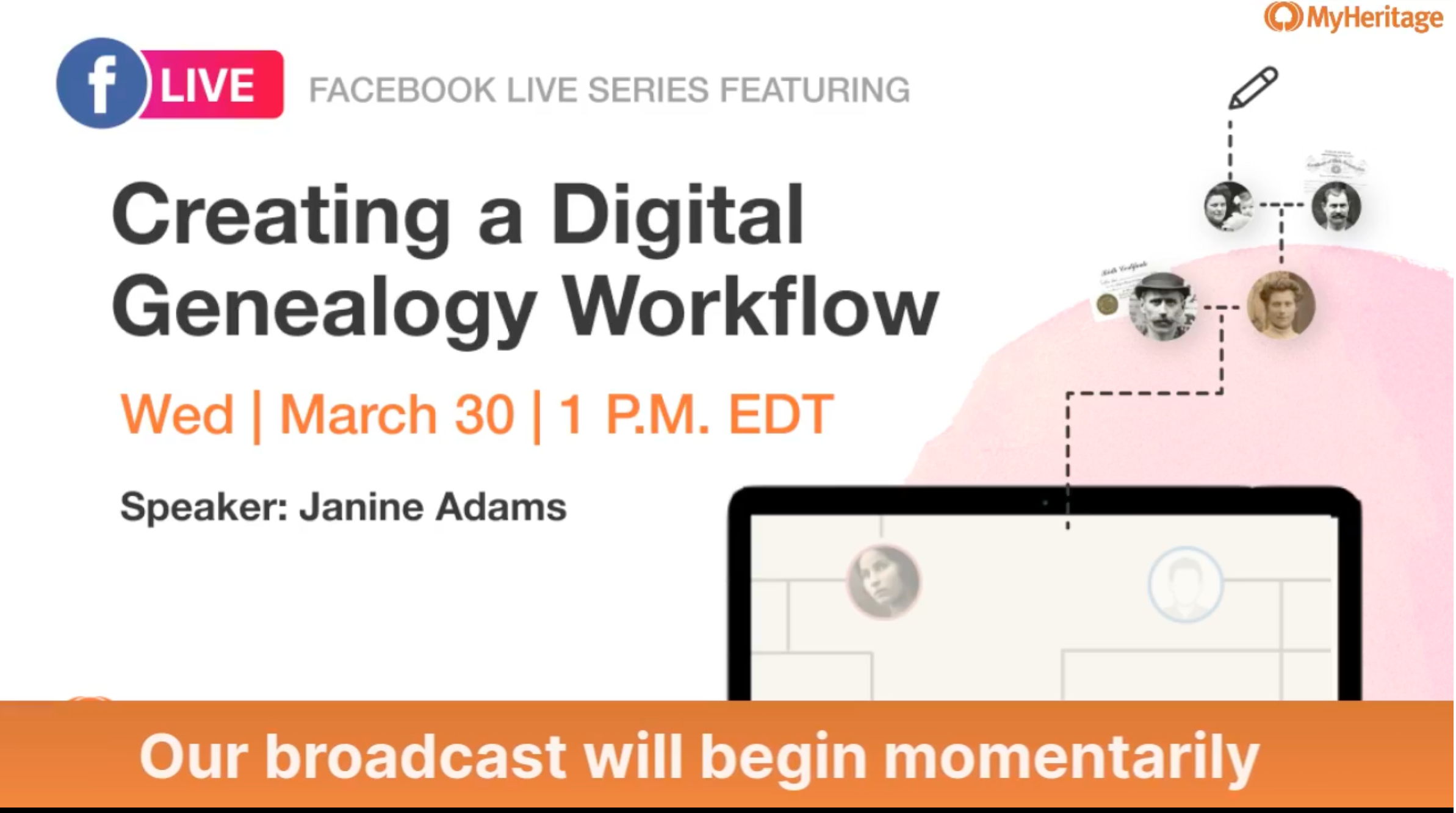
On March 30, I did a one-hour Facebook live presentation called Creating a Digital Workflow for MyHeritage. If you’re interested, the video is available on MyHeritage’s Facebook page. Here’s the link.

In the presentation, I talked about the benefits of having a digital workflow and went into some detail about my own digital workflow. As always, I repeated the caveat that this system works really well for me, but it’s not the only way to do it. But if you’re curious, please check out the Facebook Live video!

By the way, MyHeritage has published the entire 1950 census and they’re indexing like crazy, releasing states as they’re finished. As of this writing on Friday morning, April 8 (according to their Facebook page), they have completed Wyoming, Delaware, Vermont and American Samoa.

Filed Under: Excitement, Organizing Tagged With: electronic files, learning opportunities

How I handle married women in my files

March 29, 2022 By Janine Adams 8 Comments

Today I had what I thought was a great idea to write about how I handle married women in my digital files in my own research. But I searched my blog and discovered I’d written about just over a year ago! I still think it’s an interesting topic, so I’m re-running the original post, slightly edited. One thing I discovered with the comments to the original post is that the way I do it may not be the standard way! Most, if not all, of the commenters last year said that they organize the women in their family trees by their birth surname. (I object to the term “maiden name” so will stick to my preferred term, “birth name.”)

I’m by no means saying my way is the right way, but it’s worked well for me for years. I encourage you to read the comments to the original post (linked above), to see how the dozen or so commenters are handling their female ancestors and relatives.

Handling the females in your family tree

Most of the women in our family trees changed their name at some point or another. That can present an organizational conundrum in the files we keep for them. I thought I’d let you know how I handle it in my digital filing system. As always, I’m not telling you the right way to do anything. I just want to share how I do it, because it’s worked well for me.

In a nutshell, I file women under their married surname. (By contrast, in my genealogy software, Reunion, all the women are listed by their birth names and if I don’t know their birth name, I leave the surname blank.) As I describe in the post How I Process a Downloaded Document, I have surname folders on my hard drive for each of the surnames I have researched and within each folder I have folders for individual people. The folders for individuals contain the source documents pertaining to that person. (I have a separate Collateral folder within which the surname folders for collateral relatives are filed using the same folder structure.)

Here’s how I name women’s folders:

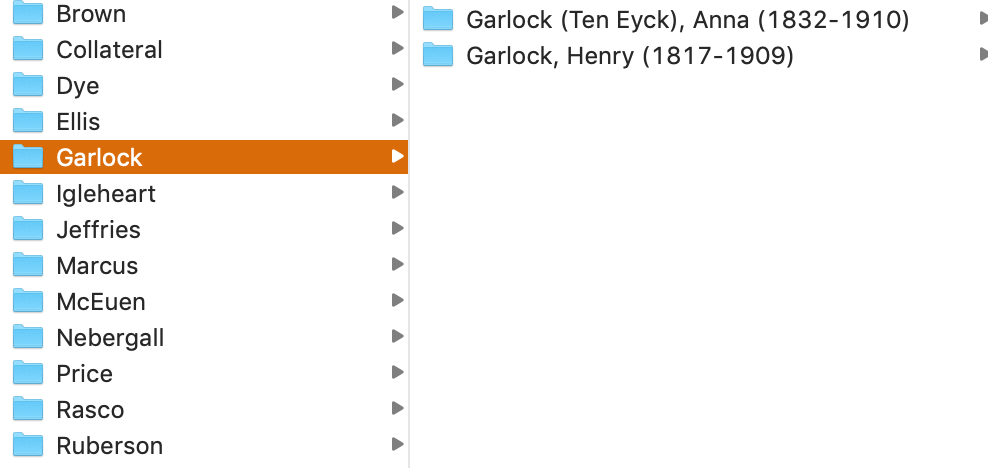
Last Name (Birth Name), First Name (YOB-YOD). So the folder for one of my second great grandmother’s folder is called Garlock (Ten Eyck), Anna (1832-1910). It resides in the Garlock Surname folder, as shown in the screenshot above.

If I find a relative before she’s married, I’ll use her birth surname for filing purposes. But once I’ve found marriage documents, I’ll rename and move her folder to her married surname.

It seems pretty straight forward, but of course, things like multiple marriages can make it more complicated. For my direct-line ancestors, it’s easy. I use the surname associated with the spouse who is my direct line. (If it’s a second or later marriage, I don’t typically use the first married name in the folder name, I just use the birth name.)

But for collateral relatives, where there isn’t necessarily a married name that is more relevant to me than the other married names, I typically just use the first married surname that I find and leave it like that.  Sometimes I make exceptions, especially for women who were married multiple times and for whom I have trouble keeping track of their various married names. For example, Leonora Adams, the daughter of my much-researched second great grandfather George Washington Adams, was married four times. I file her within the Adams Collateral folder using the folder name “Adams, Leonora (Lochry Stevens Good Ward), 1877-1962.”

Again, I’m not suggesting this is the best way to do it, but it works for me. I pretty much developed my system as I went along. And, as in almost all things, I allow myself to be imperfect about it. That means that  there may be inconsistencies in my folder structure. But I have enough of a solid infrastructure that the inconsistencies don’t bother me.

Writing this makes me want to go through my folders–particularly for the collateral relatives–and perhaps correct any inconsistencies. But I’m comfortable leaving them as is until I get around to doing that.

I’d love to hear in the comments how you handle the name changes of women in your files. And are there any situations I didn’t cover here that you’re curious about? Feel free to ask in the comments.

For more in-depth information on how I organize my own genealogy, check out How I Do It: A Professional Organizer’s Genealogy Workflow, a 37-page downloadable available for $19.99.

Filed Under: Challenges, My family, Organizing Tagged With: electronic files, organizing aids

My top five reasons to organize digitally

February 15, 2022 By Janine Adams Leave a Comment

Regular readers of this blog know that I prefer organizing my genealogy files digitally. I almost never print anything I find online and things that come to me on paper get scanned and organized on my hard drive.

Today, I wanted to simply share the top reasons for my preference for digital organizing of genealogy records:

  1. It’s more portable. I love that my research is with me wherever I go. I use Reunion genealogy software on my Mac and attach my source documents to each source record. The data is stored in Dropbox and easily accessible on my phone through the ReunionTouch app.
  2. It’s easier on my eyes. Early on, I would print census records on 8.5″ x 11″ paper and have to use a magnifying glass to read them. My eyes aren’t getting any younger and I really appreciate that I can just zoom in on documents in Preview, the app I use to read pdfs and jpgs.
  3. It takes less effort to file digitally. It is so much easier to rename a file, then drag it file to a folder on my computer than it it so open a file cabinet drawer and locate and open a folder and file (or open a binder to the right place and insert a piece of paper).
  4. It creates less clutter. I don’t have a pile of genealogy papers waiting to be filed. I don’t have unruly paper files or binders. I just have a nice neat hard drive. (True confession: I do, sometimes, I have a tidy digital backlog of files waiting to be processed into my software.)
  5. It’s less expensive. Since I’m not printing documents I find online, I save money on paper and toner. And I may save a tree or two while I’m at it.

I could go on; there are more than five reasons I love digital organization for my genealogy research! An important note: since I know that hard drives can fail, I backup my genealogy files in three places (Dropbox, an external hard drive and in the cloud via Backblaze.) A good back-up routine is critical.

If you’re interested in making the switch, check out my blog post Getting started going digital. And if you’d like a deep dive into exactly how I organize my research digitally, you can my purchase my Orderly Roots guide, How I Do It: A Professional Organizer’s Genealogy Workflow.

Filed Under: Challenges, Genealogy tips, Organizing, Technology Tagged With: electronic files, organizing aids, paper files, record keeping, technology

  • « Go to Previous Page
  • Page 1
  • Page 2
  • Page 3
  • Page 4
  • Page 5
  • Interim pages omitted …
  • Page 15
  • Go to Next Page »

about me

I'm Janine Adams, a professional organizer and a genealogy enthusiast. I love doing family history research, but I find it's very easy for me to get overwhelmed and not know where to turn next. So I'm working hard to stay organized and feel in control as I grow my family tree.

In this blog, I share my discoveries and explorations, along with my organizing challenges (and solutions). I hope by sharing what I learn along the way I'll be able to help you stay focused and have fun while you do your research, too.

tags

30 x 30 Adams amy johnson crow anniversary Brown cemetery census Civil War conferences connections dna electronic files Evernote excitement Family Curator family photos genealogy tools getting started goals How They Do It Igleheart Jeffries keepsakes learning opportunities maps newspapers NGS organizing aids overwhelm paper files planning quick tips rasco record keeping research research log research trip resources RootsTech social history source documentation Stacy Julian technology time management vital records

join the facebook community!

join the facebook community!

My organizing business

Learn more about my organizing business, Peace of Mind Organizing®.

Subscribe by RSS

  • RSS - Posts
  • RSS - Comments

© 2026 Janine Adams


Loading Comments...