• BLOG
  • ABOUT
    • Privacy Policy

Organize Your Family History

Stay focused and happy while exploring your roots

Ancestry DNA updates its ethnicity estimates

September 15, 2018 By Janine Adams 1 Comment

On September 12, Ancestry DNA debuted its “enhanced” ethnicity estimates based on a much larger reference sample (16,000 versus 3,000 reference samples) and improved algorithms. Blaine Bettinger, The Genetic Genealogist, has a great blog post explaining it.

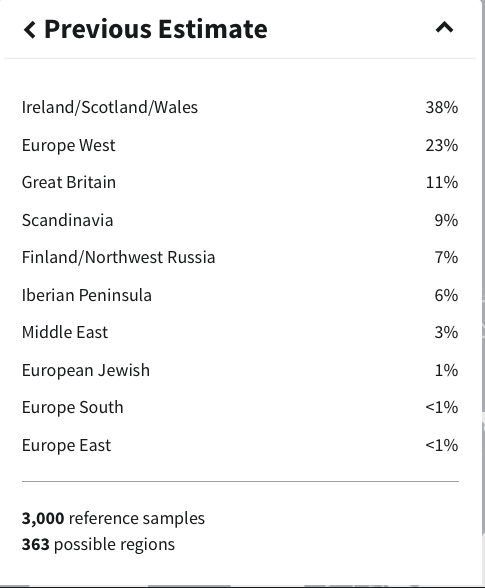
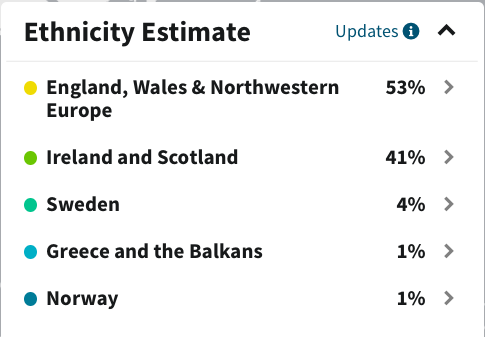
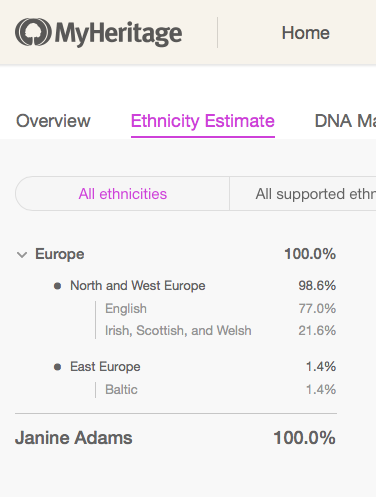
Comparing my own older and newer ethnicity estimates, fewer ethnicities are represented. My percentage Irish/Scottish has gone up and my percentage Scandinavian has gone down (and the Scandinavian countries are now mentioned specifically). If I’m reading it correctly, ethnicities that represented 20% of the estimate are now gone. Interestingly enough, the new estimate much more closely resembles the MyHeritage estimate I received when I transferred my DNA data there recently (free of charge).

Here is a summary of my old estimate, taken from Ancestry’s site today:
And here’s the new estimate:
And, just for kicks, here’s my MyHeritage ethnicity estimate:
If you’ve tested your DNA through Ancestry and haven’t checked your ethnicity estimate in the last week, I encourage you to hop over there and check it out! (And, if you haven’t already, you can transfer your raw DNA to MyHeritage here.)

By the way, I found this support page on Ancestry that explains how to make the most of your ethnicity estimate. It was news to me, so I thought I’d share.

Filed Under: Genealogy tips, Technology Tagged With: dna, genealogy tools, genetic genealogy

Understanding genetic genealogy (finally!)

August 7, 2018 By Janine Adams 8 Comments

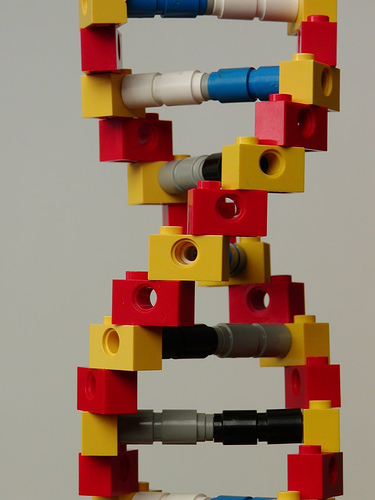
Understanding genetic genealogy (finally)I attended Diahan Southard’s series of DNA lectures on July 28 as part of the St. Louis Genealogical Society’s Summer Speaker Series. As I mentioned in a blog post last month, I’ve had a hard time using DNA in my genealogical research, mostly because I have a difficult time understanding and retaining what I try to learn about DNA.

Diahan is an expert on making this information understandable to non-scientists like me. I’ve heard her speak before but this time, a door in my brain cracked open. It may have been because at the seminar we had the privilege of listening to Diahan for four straight lectures, each of which built on the prior one. It was really a brilliant program and Diahan is an excellent speaker.

So I came home and started applying what I’ve learned and I now feel that genetic genealogy is part of my tool box. Hooray!!

Here are some of the revelations from her talks that really helped me:

  • A DNA match with a person whose tree has no familiar surnames is cause for celebration, not frustration. The DNA shows you’re related. When you figure out how you’re related, you’ll add names to your tree.
  • The Shared Centimorgan (cM) Project can help you understand how you might be related to someone, based on how much DNA you share. Here’s Diahan’s explanation of centimorgans and the Shared cM Project. It’s a great resource.
  • The solution to most DNA is quandaries is (drum roll): Do genealogy! DNA evidence can bridge gaps or open holes in brick walls. But traditional genealogy is how you build your family tree.
  • Create a list of your 32 great great great grandparents’ surnames to help you find commonalities with DNA matches. I had not compiled a list like that before and I see how it will help recognize how I might be related to those DNA matches that are fourth cousins or closer.
  • On Ancestry, even if a DNA match has not linked a tree to his/her DNA results (so you see “no family tree”), click on the “View Match” button and see if there’s a drop-down list of trees you might look at under the Pedigrees and Surnames tab. There may be a tree (or a few trees) for you to look at.

One thing I noticed when I took a look my Ancestry DNA results the day after the Diahan’s seminar is that the shared centimorgans don’t necessarily accurately reflect the relationship. For example, my mother’s first cousin, whom I know personally, shares only 183 cM with me, rather than the 439 that first cousins once removed usually share, according to the Shared cM Project. So Ancestry guessed that she was my third or fourth cousin. The Shared cM Project is a great tool, but obviously just a guideline.

Today in my research session, I explored the public tree linked to someone with whom I share 158 cM. This is a huge tree but I was able to easily focus in on a shared surname. The tree is beautifully sourced, so even though I had only a few minutes left of my 30-minute research session this morning, I was able to add a fact and supporting document to my great great grandfather’s record in my family tree software. Tomorrow I’ll go back and explore that tree more.

I finally understand how DNA can help me in my genealogy research. Better yet, I understand how to use it. This is such a revelation.

If using genetic genealogy eludes you as it did me, I heartily encourage you to check out Diahan’s website, Your DNA Guide, and to listen to Diahan speak when you have the chance. She’s speaking at the Federation of Genealogical Societies conference later this month and I know she’ll be speaking at the 2019 NGS conference in St. Charles, Missouri, next May. (I’ll plan to be in the front row!) You can also do a consultation with her where she explains your DNA results to you. She’s a terrific resource.

Unmodified photo by Michael Knowles via Flickr. Used under Creative Commons License.

Filed Under: Challenges, Excitement, Technology Tagged With: Diahan Southard, genealogy tools, genetic genealogy, research

Giving DNA another chance

July 10, 2018 By Janine Adams 6 Comments

Confession time: I have the hardest time understanding genetic genealogy. I have spent hours in seminars at various conferences. I even had a one-on-one consultation about my DNA results with genetic genealogist and consultant Diahan Southard, Your DNA Guide.

For some reason, these concepts are hard for me to grasp and retain. As a result, I do very little with my DNA results. I occasionally check matches to my autosomal test (which I did through Ancestry DNA and transferred the results to Family Tree DNA) but that’s pretty much it. Every year I hope (but don’t plan) that this is going to be the year that I harvest the power of DNA in my genealogy research.

An opportunity to learn more was just handed to me on a silver platter. Diahan Southard is coming to St. Louis for a Summer Speaker Series event put on by the St. Louis Genealogical Society on July 28. I just registered. (If you’re in St. Louis and interested in going, today July 10, is the early-bird deadline. Tomorrow the price goes up by $10.)

I know what a great speaker Diahan is and it couldn’t be more convenient for me to go. So I couldn’t turn down the opportunity to hear her speak. (Plus Diahan holds a special place in my heart because she was one of the first people to consent to being interviewed for my How They Do It series.) I’ll be attending her talks on July 28 with an open and curious mind and I’m hoping that they will help me incorporate more genetic genealogy into my research.

If you’re in St. Louis and going, please let me know so we can meet!

Unmodified photo by Alf Melvin via Flickr. Used under Creative Commons License.

Filed Under: Challenges, Reflections, Technology Tagged With: Diahan Southard, genealogy tools, genetic genealogy, research

Creating bio sketches of your ancestors

June 8, 2018 By Janine Adams 21 Comments

Reader (and professional genealogist) Maria Tello commented in my recent post on shifting my focus that she is in the process of creating biographical sketches for each of her ancestors, so that she can pass information on to her children and grandchildren, who are not genealogists.

I was intrigued by the idea and asked her to give me a little more information, along with an example.

Maria wanted to make her research more easily understood by her children and grandchildren, she is writing these short sketches of each ancestor. Her research on some of her lines goes back to the 15th century, so it’s a big task!

I’m thoroughly impressed that Maria’s goal is to write one of these each day. I think that’s a wonderful way to make an overwhelming project seem much more attainable.

Maria said that she used the Register Style Template from the New England Historic Genealogical Society as the basis for her sketches. I love that sources and footnotes are a prominent part of the template.

Here’s a sample sketch, of one of Maria’s ancestors on her father’s side. She explains, “My accreditation is in Mexico and the bulk of my research is done in Spanish language areas. I used tools that were developed for New England colonial area research, however, and that works splendidly.”

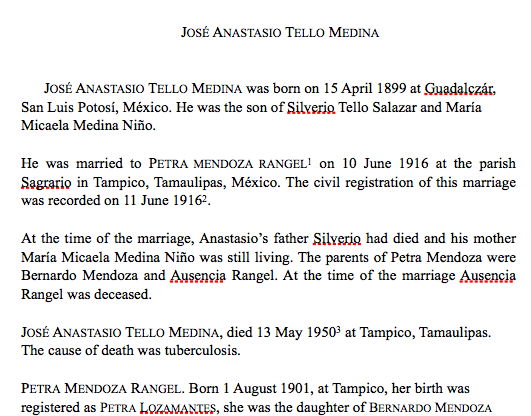
Click on this link to read Maria’s sketch of José Anastasio Tello.

Maria reports that her children not only have found the sketches easy to understand but they’re actually grateful for them!

In addition to the obvious benefit of having an easily understood way to present genealogical information to those who follow you, I can see how useful this exercise is to find holes in your research. I can also see its benefits for reacquainting yourself with your ancestors.

Reunion, the genealogy software I use, will create these reports automatically, I discovered. But Maria and I discussed the benefits to doing them by hand. There’s a big difference between creating something and reading something. (This is part of a larger post I’m contemplating on manual versus automatic in genealogy–keep an eye out.)

As I look toward shifting to a different family line in my own research, I think I’m going to take the time to write a bio sketch for the main ancestor I’ve been researching, George Washington Adams (1845-1938) before I say goodby to him for a little while. I think it should be a fun exercise.

Maria, thank you so much for sharing what you’re doing! And best of luck completing all the profiles!


Filed Under: Challenges, Genealogy tips, Preservation Tagged With: genealogy tools, Maria Tello, record keeping

  • « Go to Previous Page
  • Page 1
  • Interim pages omitted …
  • Page 9
  • Page 10
  • Page 11
  • Page 12
  • Page 13
  • Interim pages omitted …
  • Page 30
  • Go to Next Page »

about me

I'm Janine Adams, a professional organizer and a genealogy enthusiast. I love doing family history research, but I find it's very easy for me to get overwhelmed and not know where to turn next. So I'm working hard to stay organized and feel in control as I grow my family tree.

In this blog, I share my discoveries and explorations, along with my organizing challenges (and solutions). I hope by sharing what I learn along the way I'll be able to help you stay focused and have fun while you do your research, too.

tags

30 x 30 Adams amy johnson crow anniversary Brown cemetery census Civil War conferences connections dna electronic files Evernote excitement Family Curator family photos genealogy tools getting started goals How They Do It Igleheart Jeffries keepsakes learning opportunities maps newspapers NGS organizing aids overwhelm paper files planning quick tips rasco record keeping research research log research trip resources RootsTech social history source documentation Stacy Julian technology time management vital records

join the facebook community!

join the facebook community!

My organizing business

Learn more about my organizing business, Peace of Mind Organizing®.

Subscribe by RSS

  • RSS - Posts
  • RSS - Comments

© 2026 Janine Adams


Loading Comments...