
• BLOG
  • ABOUT
    • Privacy Policy

Organize Your Family History

Stay focused and happy while exploring your roots

Letting go of should

May 17, 2016 By Janine Adams 14 Comments

shouldgraphicIt’s natural to ask about questions about organizing (your genealogy or anything else) that start with the word “should.” Should I organize my documents this way or that way? Should I store things here or there? Should I focus on this or that?

When I try to answer a question that starts with should, the answer is almost always, “It depends.” Because it’s all about what will work for you.

I encourage my clients (and anyone else who will listen to me) to let go of the word should. And to also let go of asking questions that start with, “What’s the right way to…” or What’s the best way to….”

Because here’s the thing: I can’t tell you what you should do. Only you know what’s right for you. It can be much more beneficial to think in terms of what you’d like to do, or what you think will work best for you, rather than what you should do. Especially when it comes to organizing your genealogy research, the thing you should do (in my opinion) is the thing that works well for you and that you can keep up.

For example:

  • Maybe you’ve always heard that you should store your paper documents in binders, but you have trouble keeping up with that. Let go of that should and consider using file folders or scanning your documents.
  • Maybe you think you should print every document for the sake of posterity but you’re overrun with unfiled paper. You can let go of that should, particularly if your electronic documents are already organized.
  • Conversely, maybe you’ve heard you should scan every bit of paper and store files electronically, but you’re overwhelmed by the prospect. Bye bye, should. You can let your paper files be sufficient. Or just start storing new files electronically and leaving your papers unscanned.
  • Maybe you’re told you should keep a research log, but you just can’t get yourself to do it. A research log can be hugely beneficial. But don’t beat yourself up if you don’t have one just because you think you should.

In other words, set yourself up for success and do what works for you. Decide what your priorities are (accessibility for you, accessibility for others, ease of use, etc.) and focus your organizing systems on those priorities. Don’t do something just because someone told you you should if it doesn’t seem like it will work for you.

All that said, there are some genealogy shoulds that I think you should pay attention to:

  • You should cite your sources so you can find them again and know where your facts came from (but you don’t have to cite them perfectly if that’s getting in the way of citing them at all).
  • You should back up your electronic data in case of a crash. (I use an external hard drive and automated cloud storage.)

Genealogy is supposed to be fun. Don’t let the shoulds drag you down. Make your own choices and own them. And keep yourself open to new ways of doing things. (See what I did there? I told you all sorts of things I think you should do, without using that word. Take what works for you and let go of the rest.)
Filed Under: Genealogy tips, Organizing, Reflections Tagged With: goals, organizing aids, overwhelm, research log, source documentation

Doing the research vs. organizing the research

February 9, 2016 By Janine Adams 2 Comments

doing research vs organizing researchI suspect that most genealogy enthusiasts prefer doing research to organizing the results. A large part of the fun (for me, anyway) is playing detective and making discoveries. That’s thrilling. But if we don’t process our finds, what good do they do us?
I was thinking about that today as I thought about whether to do some genealogy research or spend the time working on organizing my research. I feel I’ve been so out of touch with my research (still blaming my puppy, Bix, and my long work hours) that I don’t even know where I stand with anything. That makes me feel a bit paralyzed.

I could jump right back into the research and maybe have some fun, but I think I’d be better off taking stock of where things stand organization-wise. And for me that means:

  • Looking over my genealogy to-do list
  • Looking at my progress tracker and updating it if necessary
  • Looking on my hard drive for electronic files related to the Adams family (this quarter’s family) and filing them
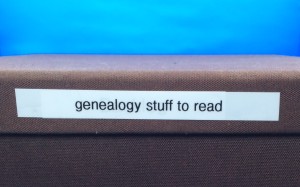
  • Pulling out my backlog box marked “genealogy stuff to read” that I didn’t even remember I had and going through the contents. I just peeked in it and it contains documents picked up at genealogy conferences in 2015. I suspect I’ll be able to pretty swiftly dispatch a lot of it. If not, I’ll add items to my genealogy task list (like I described in my blog post, Banishing the stubborn pile).
  • Updating my task list with the tasks that will inevitably result from this activity.

That’s a pretty long list, but it shouldn’t take too long. And, I remind myself, I don’t have to do all of it. Any effort here will be beneficial. Once I have a better handle on what I’m doing and what steps I need to do to improve my organization, I’ll have a clearer head. And I’ll have more direction when it comes to doing actual research. Something tells me it will be much easier to get started researching then!

Photo above taken by me using the SHOTBOX tabletop photo light studio.

Filed Under: Challenges, Organizing, Reflections Tagged With: genealogy tools, getting started, organizing aids, overwhelm, planning, time management

Taking notes at genealogy conferences

January 29, 2016 By Janine Adams 6 Comments

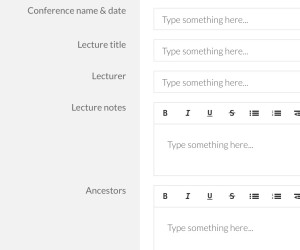
Template for taking notes at a genealogy conferenceIf you’re going to RootsTech next week (or any other genealogy conference this year) I encourage you to check out the free template I created in Transpose.
Transpose is a business platform/website that I wrote about last year. It allows you to create templates (which they now call “solutions”) to create customized forms. You can also download solutions that others have created and uploaded into the Transpose Public Library.

I’ve created a bunch of solutions for my own use and uploaded seven solutions to the Transpose Public Library. One of these is a solution called Genealogy Conference Notes. It’s designed to make it easy to take notes at a genealogy conference.

I’ve only been to one genealogy conference since I created this solution (the Genealogy Society of Southern Illinois conference last August). Using the template, I created a new record for each lecture. The template allowed me to capture general notes from the lecture and also jot down which ancestors the information might apply to, along with action ideas. It worked out really well for me–I love having a structured place to take notes. When I got home, I had a list of concrete action steps.

I chose to take notes on my laptop, because I prefer a full keyboard. Transpose has an app you can use on a tablet or smartphone, but I haven’t yet tried out taking notes with my solution on a mobile platform.

If you’re interested in trying it, you’ll need a free account at Transpose. Go to the Genealogy Conference Notes solution in the library and just copy it into your account. There it will be among any other solutions you copy or download. Just click on the solution and create a new record for each lecture you attend. All the information you capture will be saved for you in Transpose, in a searchable and filterable database.

You can also use it as a basis creating your own solution that works better for your needs. The folks at Transpose work hard to make it easy for you to use the platform. Here’s a great getting started tutorial.

I can’t wait to use it for the next genealogy conference I attend!

Unfortunately, Transpose announced on November 8, 2016 that it is shutting down on December 9, 2016.

Filed Under: Genealogy tips, Organizing, Technology Tagged With: conferences, genealogy tools, organizing aids, record keeping, research, technology

How orderly is your research desk?

November 12, 2015 By Janine Adams 2 Comments

cleandeskIf you can’t remember the last time you saw your desktop in your genealogy research space, perhaps it’s time to experience the joy of a clean desk. I know that time to do genealogy research is limited for most people and the last way  you want to spend your precious genealogy time is on cleaning up your desk. But it’s worth it. When you sit down at a clear desk, your mind is more clear and you can be more focused on your research.

But there’s good news: It doesn’t have to be hard or time consuming. Here’s a step-by-step suggestion for creating some order on your desk, swiftly.

  1. Set your timer for 25 minutes.*
  2. Clear everything off your desk (and I mean everything except, perhaps, your computer). Put like things together into rough categories as you go. (For example, put papers together in a pile on the floor near your desk; put office supplies together, etc.) It might helpful to have some bankers’ boxes or plastic totes handy to hold the categories, but the floor will do too.
  3. Put away the items that already have homes. For example, put binders and books where they belong. If something belongs in another room, put it in a box or bin that you’ve marked “Relocate to another room” so you don’t wander away from the room you’re working on. At the end of the session, you can put all that stuff away.
  4. Go through the non-paper items and put back on the desk those things that deserve to take up such prime real estate. Only those things you use every research session should be placed within arms’ reach when you’re sitting at your desk (with the possible exception of items that give you great pleasure to look at). Relocate or discard the other non-paper items that were on the desk.
  5. Take all those papers and put them in a box of some sort. Mark that box “Backlog.” (I use a box similar to this one from IKEA for that purpose and I place that box on a shelf.)
  6. Every time you’re at your desk, set a timer for ten minutes and go through the papers in the backlog, discarding, scanning and/or filing as required. Do this ten minutes a day for as long as it takes to eliminate the backlog. (You might be surprised how few of these short sessions it takes.)
  7. Don’t add to the backlog box. Instead, at the end of each research session take the time (probably less than five minutes) to clear off your desk and put everything away. That way, you’ll start each session fresh.

* When your timer goes off, stop what you’re doing and take a five-minute break. Then set it for another 25 minutes and get back to work, unless you’re done.

Filed Under: Challenges, Organizing Tagged With: organizing aids

  • « Go to Previous Page
  • Page 1
  • Interim pages omitted …
  • Page 28
  • Page 29
  • Page 30
  • Page 31
  • Page 32
  • Interim pages omitted …
  • Page 43
  • Go to Next Page »

about me

I'm Janine Adams, a professional organizer and a genealogy enthusiast. I love doing family history research, but I find it's very easy for me to get overwhelmed and not know where to turn next. So I'm working hard to stay organized and feel in control as I grow my family tree.

In this blog, I share my discoveries and explorations, along with my organizing challenges (and solutions). I hope by sharing what I learn along the way I'll be able to help you stay focused and have fun while you do your research, too.

tags

30 x 30 Adams amy johnson crow anniversary Brown cemetery census Civil War conferences connections dna electronic files Evernote excitement Family Curator family photos genealogy tools getting started goals How They Do It Igleheart Jeffries keepsakes learning opportunities maps newspapers NGS organizing aids overwhelm paper files planning quick tips rasco record keeping research research log research trip resources RootsTech social history source documentation Stacy Julian technology time management vital records

join the facebook community!

join the facebook community!

My organizing business

Learn more about my organizing business, Peace of Mind Organizing®.

Subscribe by RSS

  • RSS - Posts
  • RSS - Comments

© 2026 Janine Adams


Loading Comments...