• BLOG
  • ABOUT
    • Privacy Policy

Organize Your Family History

Stay focused and happy while exploring your roots

MyHeritage offering free photo colorization

April 22, 2020 By Janine Adams 13 Comments

When I was at RootsTech, MyHeritage had a booth where they were colorizing old black-and-white photos for people. The booth was always swamped with people. I wasn’t one of the people who stood in line for this service because the whole idea of colorizing old photos just didn’t sit right with me. I couldn’t put my finger on my objection, exactly. But I’m curious what readers of this blog think.

Today, I thought I’d blog about it, so decided to upload a couple of photos to try it out for a spin.

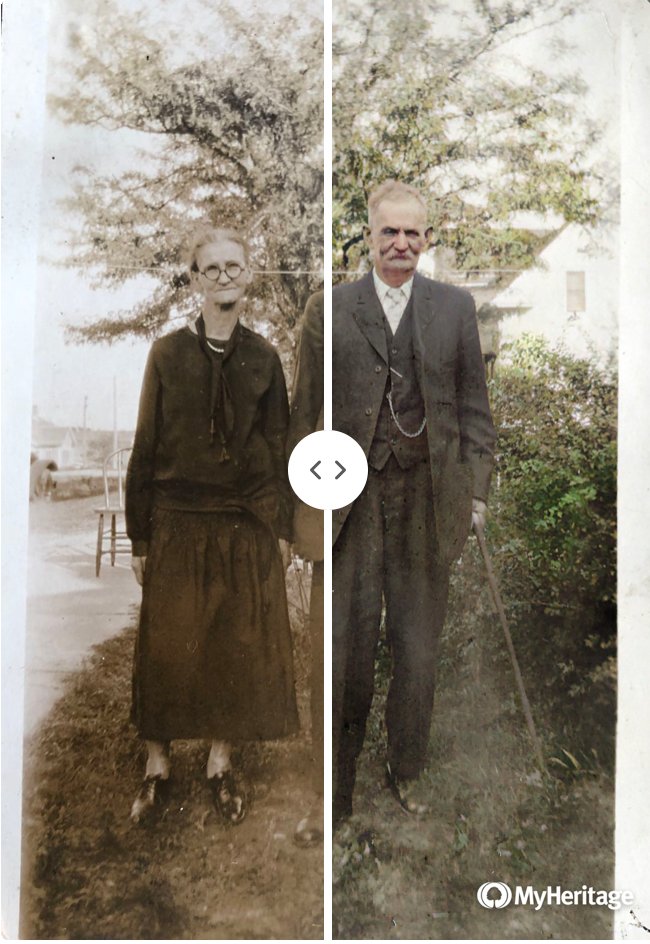
At left (at the top of this post) is a photo of my 2nd great grandparents, Samuel Vorce Wheeler (1852-1937) and Elizabeth Jane (Jennie) Nebergall Wheeler (1857-1933), taken in 1926 on the occasion of their 50th wedding anniversary. MyHeritage allows you to see your colorized and original photos side by side in one photo. You can move the dividing line back and forth and watch the photo change. That happens at the MyHeritage website–for the purposes of this post I took a screenshot. The photos you download (like those below) do not have the divider.

Here’s a photo of the Arthur Brown-Rhoda Wheeler family. (Rhoda is the daughter of Samuel and Jennie.) That’s my grandfather, Crawford Brown (1906-1996), on the far left with the dark striped shirt. I think the photo was taken around 1916. The top photo is the original that I uploaded. (I took a photo of the print with my phone, transferred it to my computer, and uploaded it.) Beneath is the colorized version.
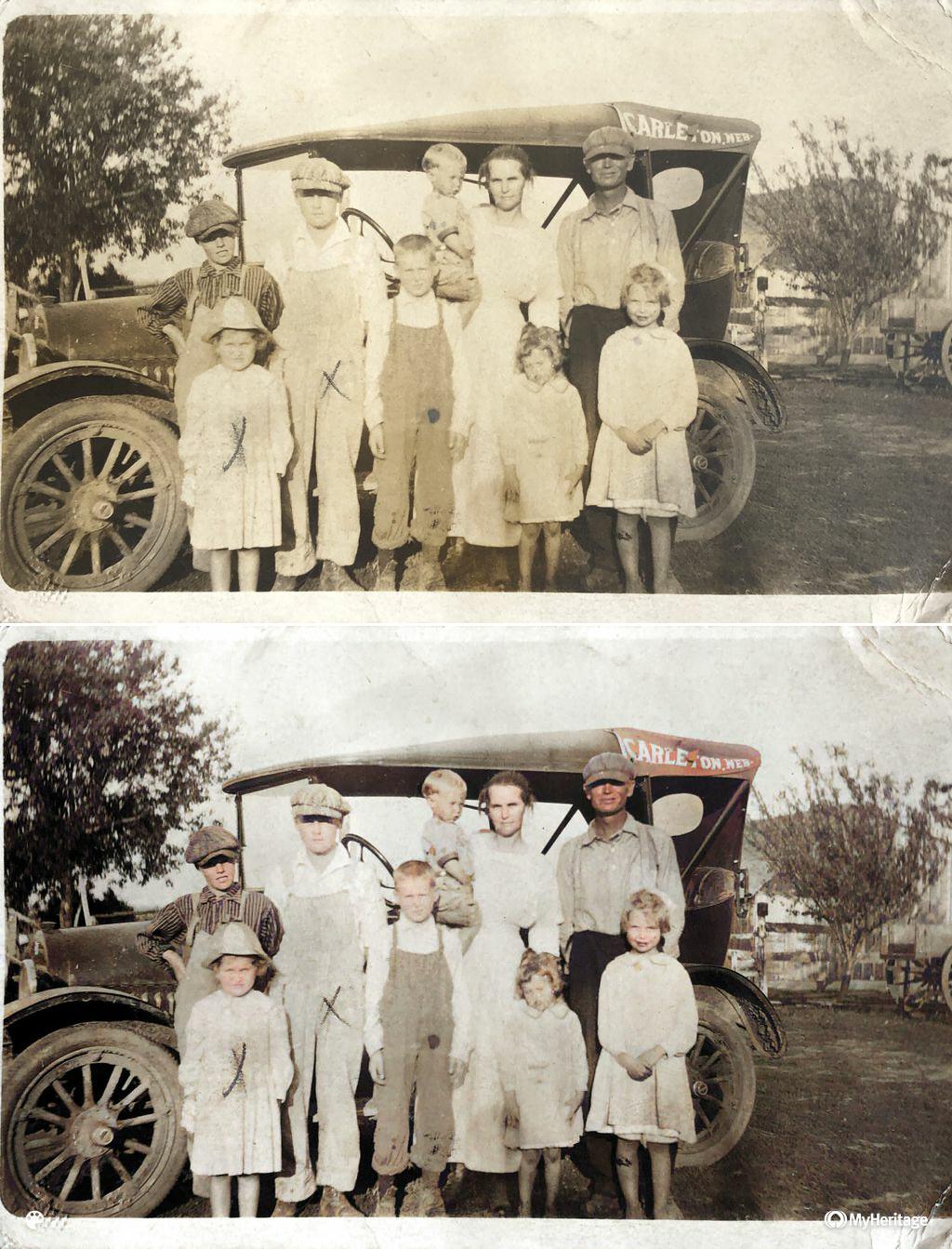
I have to admit I find the colorized version more eye-catching. But it doesn’t feel like a 1916 photo, does it?

It’s incredibly simple to upload the photo to the MyHeritage site (just drag and drop). The colorizing takes seconds. There’s no charge. With a click, you can download the colorized version and/or a comparison photo that contains both images.

It’s amazing, but I’m still not sure quite what to think about it. I do know that I’m not going to include the colorized versions among my genealogy documents–they’re purely for fun.

Have you tried it? What are your thoughts?

Filed Under: Genealogy tips, Preservation, Reflections, Technology Tagged With: Brown, family photos, genealogy tools, technology

NGS moves to virtual for its May 2020 conference

April 16, 2020 By Janine Adams 3 Comments

I feel so fortunate that the RootsTech conference was held in February, just prior to the COVID-19 crisis’s grip on the world. The National Genealogical Society wasn’t so lucky with its conference, which was to be held, like RootsTech, at the Salt Palace Convention Center in Salt Lake City. The NGS conference was scheduled for May 20 to 23, 2020.

Today, NGS announced that the 2020 conference will be virtual. The plan, as explained on their website, is for a full day of NGS Live! on May 20, from 11 am to 7 pm eastern. “In addition, streaming access to many more sessions will be available starting in July.” The conference organizers promise more updates as they become available.

To me, this seems like a smart approach and it’s better than canceling the conference. (RootsTech announced last month that its planned November 2020 conference in London is being postponed for a year. But that announcement came less than a month after the conference was announced, so the planning was in its early stages.) I’m sure it was a very difficult decision for the conference organizers and that it will be a logistical challenge.

I was to have attended the conference of the National Association of Productivity and Organizing Professionals in early April and that conference was canceled entirely. I’m happy for the NGS registrants that there will be some type of conference next month.

These are interesting times, aren’t they?

Filed Under: General, Reflections Tagged With: conferences, learning opportunities, NGS

Now’s a great time to go paperless

April 11, 2020 By Janine Adams 10 Comments

Have you been thinking about going paperless with your genealogy? I made that transition about six years ago and have never looked back. In 2015, I wrote a post called 8 reasons not to print that pretty well spells out my reasoning behind embracing digital organizing.

Making that transition is the kind of thing that you might be putting off, thinking you’ll need time to think it through and come up with and implement a plan. Most of us are not working at this time of COVID-19, so now might be a good time to start the process. And here’s a great (if I say so myself) resource to help you get started: The Paperless Genealogy Guide, a  40-plus-page downloadable pdf that I wrote in 2017 with scanning expert Brooks Duncan of DocumentSnap. We wrote the guide as we were working on the Going Digital talk we gave together at RootsTech that year.

One thing I want to make clear as you’re pondering going transitioning to digital: You don’t have to scan your existing paper files all at once. Just figure out what your digital workflow will be (here’s mine) and think about your digital file naming convention and computer folder structure. Once you know those things, you can just start with next document you find online. Rather than print it, just do this: rename it, process it and then file it digitally. You can then work on the backlog a file folder (or half hour) at a time until it’s done. But the key is not to add to the backlog. From this point forward process all incoming documents digitally.

So that it’s handy, I’ll share with you my file-naming protocol and folder structure. They’ve been working well for me for years but of course you might have or come up with something that works better for you.

My file-naming protocol:

Year Document Type-Ancestor Name-Locality of document

Example: 1938 death certificate-George Washington Adams-Indianapolis Indiana

My folder structure:

Genealogy/Surnames/[Surname]/Last Name, First Name, YOB-YOD

Example: Genealogy/Surnames/Adams/Adams, George Washington, 1845-1938

I have a folder for each individual. For married women, I file them under their married name (if there’s more than one, I use the one pertains to me) and put their birth name in parentheses.

Example of wife: Genealogy/Surnames/Adams/Adams (McEuen), Henrietta, 1847-1902

This is the kind of information that’s covered in The Paperless Genealogy, along with a lot more. The guide also includes information on selecting a scanner, keeping your data safe, and what you do (and don’t) need to get started. It also includes our Paperless Genealogy Checklist to walk you through the steps you need to take. The Paperless Genealogy is $9 and available instantly. Read more about it and purchase it at the DocumentSnap website.

Filed Under: Genealogy tips, Organizing, Technology Tagged With: electronic files, organizing aids, record keeping, technology

Putting my imperfectionism to work

April 7, 2020 By Janine Adams 7 Comments

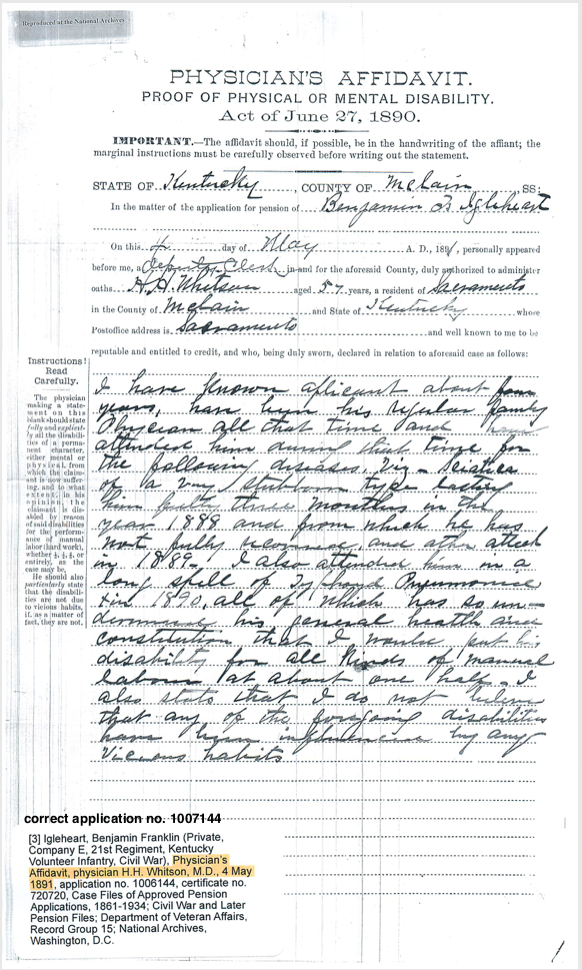
As I wrote in a post last week, I’ve been working on processing my 2nd great grandfather’s Civil War pension file. I got the tedious up-front source citation work completed, which involved creating source citations and labels for each of the 53 documents, affixing the labels to the paper documents and scanning the whole thing into a long pdf. I’m now working on transcribing the documents, one per day. (This is how I choose to process this type of document–I’m not saying it’s the only way or the best way, but it works for me.)

So today, I was working on Document Six and I realized that I have a typographical error in my source citation. The correct application number is 1007144 but I had typed 1006144 and copied it onto all my labels without realizing my error. That numbers appears 54 times (one for each document, plus an overall citation). Of course, it’s easy to fix in my software. But then I was faced with the pension document itself having the wrong application number on every document.

I considered my options:

  1. Fix all the labels, print them out again, affix the corrected label over the incorrect label on each document, and rescan the whole thing.
  2. Hand correct each label and rescan the whole thing.
  3. Add a notation to each label in the pdf itself
  4. Add a notation at the beginning of the pdf only

It felt like the “right’ thing to do would be option number 1. But what a pain in the butt that would be. I was okay with doing it once. But doing it a second time felt practically unbearable. Plus my printer is about to run out of toner.

I thought about what was important to me and realized that the most important citation was the one in my Reunion software (the one that I corrected in about 5 seconds). But I didn’t want my pension file pdf to be wrong, in case I pass it along to someone else.

So I added a notation in the pdf, 54 times, that says “correct application no. 1007144.” (That’s a picture of it above.) And you know what? That’s going to be good enough. It didn’t feel good enough to just do it at the top of the file. I want each citation label corrected in case someone is looking at only one document.

It took me less than 10 minutes to make this electronic correction (thanks to the miracle of copying and pasting), substantially less time than option number 1 would have taken. Bonus: I didn’t use up toner or risk the frustration of jammed documents in my scanner. Luckily, this is not a situation I will encounter with any kind of frequency, since I so rarely deal with paper documents.

I try to take these little lessons about “good enough” to heart and pass them along when I can. When does good enough speak to you in your genealogy research?

ETA: In the comments to this post, Kay asked for an example of a placement of the label. As I mentioned in the reply, I usually put it wherever it fits (or on the back of the page). Here’s a full-page view of the label placement.

Filed Under: Challenges, Reflections Tagged With: Civil War, electronic files, Igleheart, learning opportunities

  • « Go to Previous Page
  • Page 1
  • Interim pages omitted …
  • Page 73
  • Page 74
  • Page 75
  • Page 76
  • Page 77
  • Interim pages omitted …
  • Page 219
  • Go to Next Page »

about me

I'm Janine Adams, a professional organizer and a genealogy enthusiast. I love doing family history research, but I find it's very easy for me to get overwhelmed and not know where to turn next. So I'm working hard to stay organized and feel in control as I grow my family tree.

In this blog, I share my discoveries and explorations, along with my organizing challenges (and solutions). I hope by sharing what I learn along the way I'll be able to help you stay focused and have fun while you do your research, too.

tags

30 x 30 Adams amy johnson crow anniversary Brown cemetery census Civil War conferences connections dna electronic files Evernote excitement Family Curator family photos genealogy tools getting started goals How They Do It Igleheart Jeffries keepsakes learning opportunities maps newspapers NGS organizing aids overwhelm paper files planning quick tips rasco record keeping research research log research trip resources RootsTech social history source documentation Stacy Julian technology time management vital records

join the facebook community!

join the facebook community!

My organizing business

Learn more about my organizing business, Peace of Mind Organizing®.

Subscribe by RSS

  • RSS - Posts
  • RSS - Comments

© 2026 Janine Adams


Loading Comments...