• BLOG
  • ABOUT
    • Privacy Policy

Organize Your Family History

Stay focused and happy while exploring your roots

Even “paperless” genealogists should keep some records

May 21, 2019 By Janine Adams 5 Comments

If you’re a regular reader, you know I’ve embraced the idea of minimizing paper in my genealogical research. I never print out the documents I find online. Instead, I download them, immediately rename the file according to my file-naming protocol and, once I’ve gleaned all the information I can from the document and created a source citation, I file it within my folder structure. My blog post called How I process a downloaded document takes you step-by-step through my digital workflow. And there’s lots more information in the Paperless Genealogy Guide, the 44-page downloadable guide that Brooks Duncan of DocumentSnap and I wrote as we prepared to speak on that topic at RootsTech in 2017.

As someone who espouses letting go of paper, I’m often asked if there are papers that those who are trying to minimize should keep. I usually reply by saying that documents that are impossible or difficult to replace–even if they’re scanned–are worth hanging on to. That means, for instance, there’s no need to hang on to census records but original birth certificates are worth keeping in a file or binder.

I recently came across a post on the Abundant Genealogy blog from Melissa Barker, The Archive Lady, on this very topic. (Melissa was the subject of my How They Do It Interview in August 2017.) Her Abundant Genealogy post, called 5 Genealogical Records You Should Never Throw Away, goes into some detail about five types of records that you should hang onto. It’s definitely worth reading. (Spoiler alert: The five types of records are original records, diaries and journals, scrapbooks, old letters and photographs. Read the blog post to find out why.)

I would have a hard time throwing away hand-written letters and, in fact, though I carefully scanned it, I still have the epic 36-page letter my grandfather my wrote my grandmother right before they got married, in which he confessed the family secrets. That will be passed along to my niece or nephew or, perhaps, a cousin. But will I keep all old photographs once I’ve scanned them? I’m not so sure.

What about you? Are there are any records you would add to the list of keepers? Any that you don’t think belong there?

Filed Under: Challenges, Genealogy tips, Organizing, Preservation Tagged With: Adams, family photos, paper files

Planning my Kentucky research trip

May 17, 2019 By Janine Adams 22 Comments

One of my goals for 2019 is to take another research trip to Kentucky. My people were from western Kentucky: McLean, Hopkins and Muhlenberg counties, primarily. I’m really fortunate in that Kentucky has many wonderful repositories. I had a brief visit to the Kentucky Historical Society (or was it the State Archives?) in Frankfort when I was there on a bourbon trip with my husband in 2014. Earlier that year, I visited cemeteries and a library in McLean and Daviess counties.

On both those trips, I did do some preparation but I really floundered a bit when I got to the repositories. I don’t want to repeat that feeling of not knowing what to research. I went to a talk on Kentucky resources at the NGS conference, so I have a great list of places I could visit. And I went to a talk on organizing a research trip and have lots of great logistical ideas in terms of the travel.

Here’s what I’m struggling with today: What’s a better way to go about planning what I want to find out? It seems like I have a couple of options:

  • Come up with research questions and then figure out which respositories might have the answers
  • Research the repositories’ holdings and then figure out what I records I need from each of the repositories

My gut tells me to do the former. Figure out my burning questions and seek out the answers that I can’t find online. But I’m not sure.

These are the places I’m thinking I’ll go:

  • Kentucky State Archives (Frankfort)
  • Martin F. Schmidt Research Library at the Kentucky Historical Society (Frankfort)
  • Office of Vital Statistics (Frankfort)
  • Filson Historical Society (Louisville) [I made a connection with a curator there when I was at NGS!]
  • Kentucky Room of the Daviess County Public Library (Owensboro)
  • Western Kentucky University Manuscripts and Folklife Archives (Bowling Green)
  • McLean County Courthouse (Calhoun)
  • Various cemeteries in McLean County

That’s kind of a daunting (but exciting!) list.

I’d love to hear comments from any of you who are familiar with Kentucky research or have advice about planning my trip, which I’m hoping to take in late June. If there’s an approach you recommend for preparing or if there are places you’d suggest I go, I’m all ears!


Filed Under: Challenges, Excitement, Genealogy tips, Organizing Tagged With: excitement, planning, research, research trip

Getting started again after a hiatus

March 22, 2019 By Janine Adams 3 Comments

One of the things I love about doing daily genealogy research is that I never lose the thread of my research. I jot down next steps in my research log and then each morning I know just what to work on. No agonizing over what to research.

That’s how it’s supposed to work and how it does work when I’m in my groove. But, as I mentioned in a post earlier this week, I’ve done virtually no research for about a month. None. It makes me sad and it’s why I’m starting a 30 x 30 challenge on April 1.

Today I had a sliver of time and some motivation to get back in the saddle. But I faced a conundrum about what to work on. Most recently, I’d been working on eradicating the paper backlog I uncovered. But I’m away from home at the moment so I physically couldn’t do that.

It’s amazing to my how paralyzing the question, “What should I work on?” is. It can stop me in my tracks.

So I started thinking about the various strategies I could employ in figuring out what to work on today:

  • I could look at my research log to see where I left off.
  • I could work on processing my backlog of downloaded documents. (A small one has built up in recent months.)
  • I could open up my Source Documentation Checklist and pick up where I left off.
  • I could look at my follow-up notes, which I keep in notebooks by surname in Evernote.
  • I could choose an ancestor (any ancestor) and see what research questions I have about him/her and get started there.
  • I could look in my family-tree software (I use Reunion) and see if any of my families had a significant event today and work on them. (I wrote about that method here.)
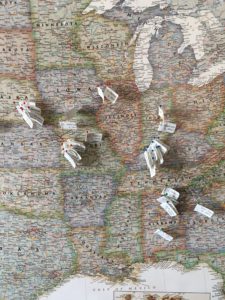
  • If I were at home, I could play pin-the-tail-on-the-donkey and close my eyes and grab a pin on my ancestor map, then do some research on that ancestor. (That’s my ancestor map in the photo.)

Here’s the thing: it doesn’t really matter what I start working on as long as I re-engage with my research. The important thing is that I get the ball rolling and work on something. (Anything, really.) As my co-host Shannon Wilkinson and I discuss on our podcast Getting to Good Enough, perfectionism can really get in the way of doing what you love!

What I ended up doing was working on my backlog of downloaded documents, which allowed me to jump right in and make progress. It felt great!

Filed Under: Challenges, Genealogy tips, Organizing Tagged With: record keeping, source documentation, time management

How They Do It: Kenyatta D. Berry

March 14, 2019 By Janine Adams 4 Comments

You may well be familiar with professional genealogist Kenyatta D. Berry, a host of PBS’ Genealogy Roadshow. She has a new book out, The Family Tree Toolkit and when I heard her talking about it on the podcast Genealogy Happy Hour, I knew I wanted to interview her about she organizes her genealogy research. So here’s this month’s How They Do It interview. Enjoy!

How They Do It: Kenyatta BerryHow They Do It: Kenyatta D. Berry

How long have you been doing genealogy?

I have been doing genealogy research and writing for over 20 years.

What’s your favorite thing about being a genealogist?

I love helping people find their people especially descendants of enslaved individuals. Their reaction when I uncover and share some remarkable information about their family history gives me chills. It is my calling to help people uncover their family history and share their ancestors story. I have seen people literally change before my eyes on Genealogy Roadshow.

What’s your biggest challenge when it comes to organizing your genealogy?

The biggest challenge is digitizing the research I have collected over the past twenty years. I have a closet full of binders and boxes of research from when I started doing genealogy and took field trips to my ancestral homelands.

What is your favorite technology tool for genealogy?

I like using Evernote to help organize research projects, stories and my family history. I also use Dropbox to share documents with clients and family members. I have created Dropbox folders for my maternal and paternal ancestors.

If you were starting out new as a genealogist what would you do differently?

I would have cited my sources, developed better research logs and started an organizational system from the beginning.

Do you keep a research log? If so, what format?

I keep a loose version of a “research log” in Evernote for projects. When I am doing enslaved genealogy research, all of my notes are handwritten. I am a visual person and I need to track the movement of enslaved and enslavers on a blank piece of paper. Once I have analyzed my notes, then I enter them into Evernote.

How do you keep track of clues or ideas for further research?

I use notebooks and small sheets of papers to keep track of clues or ideas for further research. I type the notes into Evernote and update as needed. Transferring the notes helps me work through any outstanding questions and organize my thoughts in a logical process.

How do you go about sharing your personal research with cousins or other interested parties?

I share my personal research with my family members via family stories, biographical sketches and documents on Dropbox.

What’s the most important thing you do to prepare for a research trip?

The most important thing is to know everything about the county including the resources available at the local repositories, courthouses and archives. Also, be nice to the court clerk because it goes a long way.

What’s your biggest piece of advice to genealogists in terms of organizing their research?

Create a system that works for you and don’t be afraid to try something new if something doesn’t work. We all learn differently and as your research expands you might need to alter your system for organizing research. There isn’t a right or wrong answer for organizing your research.

Do you have a dedicated space in your home for doing genealogy research? What’s it like?

I do not have a dedicated space in your home in my apartment because I live in a one-bedroom. My research is stored in closets, cabinets and a portion of my bookshelves are dedicated to genealogy books.

Do you have anything to add?

Develop your library of genealogy and historical resources based on your interests. This will help broaden your knowledge as you continue to uncover your ancestors place in history.

I can so relate to these responses, especially what Kenyatta said there being no right way to organize and that organization systems sometimes need to change. Also, as someone who keeps a very casual research log in Evernote, I was thrilled to read that Kenyatta also keep a loose version of a log there. For more information from Kenyatta, I encourage you to check out her book, The Family Tree Toolkit: A Comprehensive Guide to Uncovering Your Ancestry and Researching Genealogy.

Filed Under: Challenges, Excitement, Genealogy tips, Organizing Tagged With: How They Do It, Kenyatta Berry, organizing aids

  • « Go to Previous Page
  • Page 1
  • Interim pages omitted …
  • Page 20
  • Page 21
  • Page 22
  • Page 23
  • Page 24
  • Interim pages omitted …
  • Page 69
  • Go to Next Page »

about me

I'm Janine Adams, a professional organizer and a genealogy enthusiast. I love doing family history research, but I find it's very easy for me to get overwhelmed and not know where to turn next. So I'm working hard to stay organized and feel in control as I grow my family tree.

In this blog, I share my discoveries and explorations, along with my organizing challenges (and solutions). I hope by sharing what I learn along the way I'll be able to help you stay focused and have fun while you do your research, too.

tags

30 x 30 Adams amy johnson crow anniversary Brown cemetery census Civil War conferences connections dna electronic files Evernote excitement Family Curator family photos genealogy tools getting started goals How They Do It Igleheart Jeffries keepsakes learning opportunities maps newspapers NGS organizing aids overwhelm paper files planning quick tips rasco record keeping research research log research trip resources RootsTech social history source documentation Stacy Julian technology time management vital records

join the facebook community!

join the facebook community!

My organizing business

Learn more about my organizing business, Peace of Mind Organizing®.

Subscribe by RSS

  • RSS - Posts
  • RSS - Comments

© 2026 Janine Adams


Loading Comments...