• BLOG
  • ABOUT
    • Privacy Policy

Organize Your Family History

Stay focused and happy while exploring your roots

Revisit: Reading hard-to-read gravestones

June 24, 2025 By Janine Adams 4 Comments

This article, which I published almost exactly 11 years ago, on July 1, 2014, is easily my most-read blog post. I looked at the stats today and saw that it has had almost 61,000 views in the past 11 years. That’s a lot of views for my little blog. I thought I’d re-run it today for readers who may not have seen it before.

My family reunion was last weekend and I had a great time. Family members were so warm and welcoming to my husband and me despite the fact that my branch of the family had not been represented at that reunion in a couple of generations. I was given family pictures (some of which I’ll probably scan and share here) and well as a painting that my grandmother had painted. It was a great weekend.

On Saturday, my husband and I paid a visit to the cemetery where my grandmother’s ancestors were buried. (This was a reunion of people from my grandfather’s side of the family, so it was an adjunct activity.) I had visited that cemetery, Meyer Cemetery, last year when I traveled to western Missouri.  Three generations of Jeffries are buried in that cemetery:  my great grandfather, James Earl Jeffries;  his parents, John D. Jeffries and Susan Price Jeffries; his in-laws, John Price and Mary Puffenbarger Price; and his grandparents, Richard Anderson Jeffries and Harriet McKinley Jeffries. I wanted to capture some more photos of the gravestones, as well as find the graves of the Prices, which I hadn’t seen on my first visit.

Fortunately for me, I’d learned just the prior week about using aluminum foil to make reading hard-to-read gravestones much easier. I’d seen a link to a blog post called safe solutions for hard to read tombstones on the fabulous Organized Genealogist Facebook page. That post described how you can cover a gravestone with foil and gently rub it to make the hidden words on a gravestone almost magically appear. The post linked above suggested using a clean makeup brush. I didn’t have one so I dug around a bit more on the web and found a post on Save a Grave that suggested using a damp sponge.

So I went to the dollar store and bought some cheap aluminum foil. I grabbed a sponge from under the sink and was ready to head to the cemetery the next day. The method really felt like magic.

This is the stone of the Mary Ann Price, my great great great grandmother.
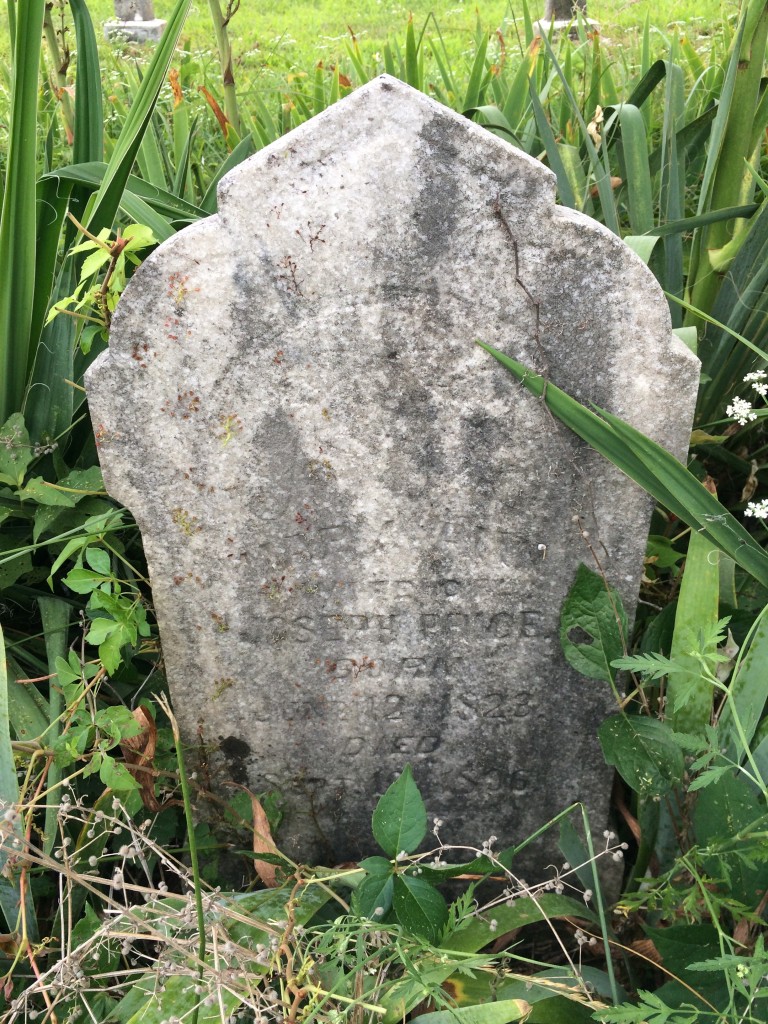
Foil can make hard-to-read gravestones legible

Cover it in foil and rub and voila, the writing emerges.
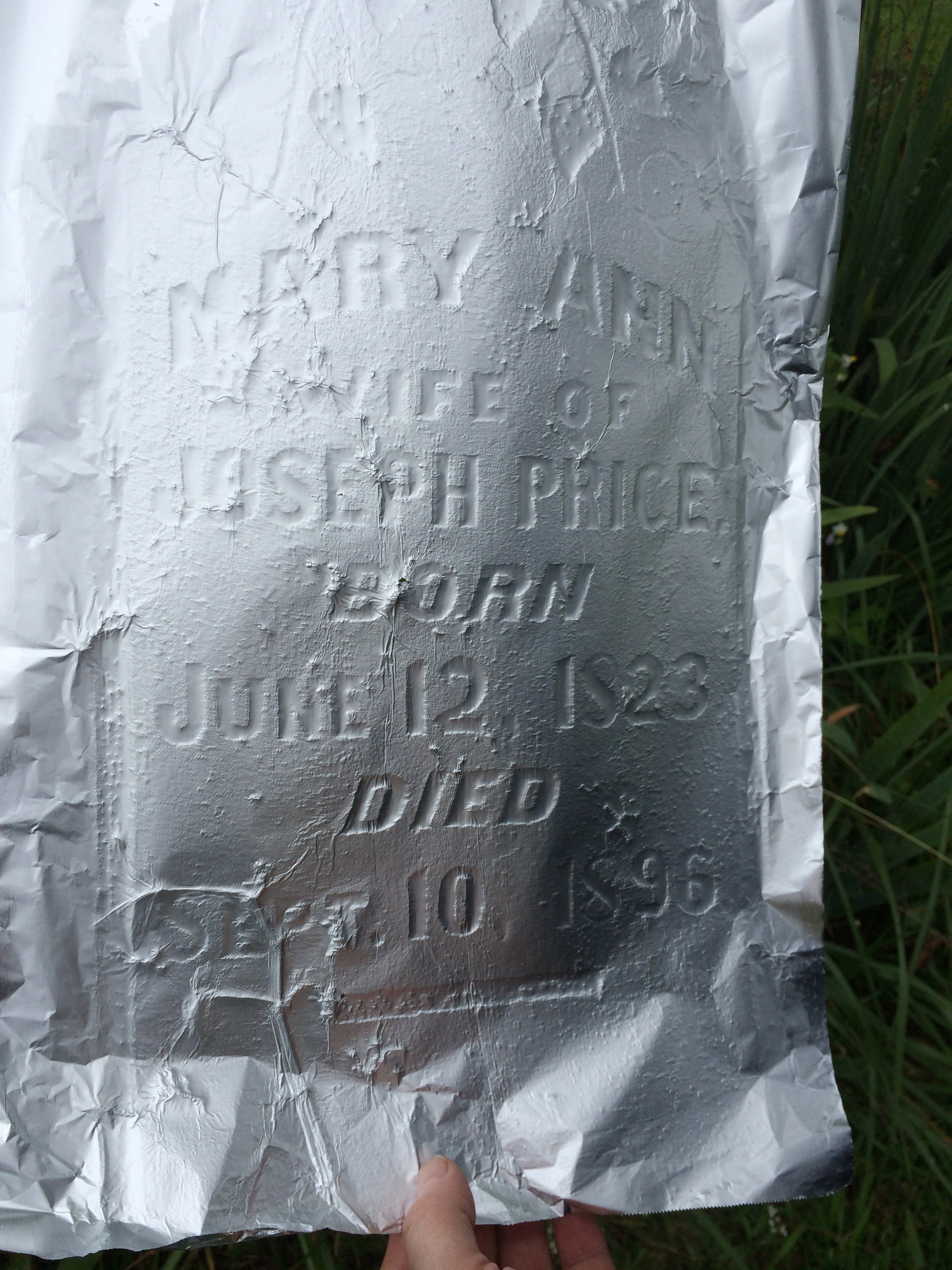
Foil can make hard-to-read gravestones legible

There’s a gravestone  right next to my great great grandfather’s grave. The top of that same stone was so worn and dirty you couldn’t really tell that there was a name on it. But when I covered it in foil and rubbed it with a damp sponge, the name “Harriett” appeared. Amazing!
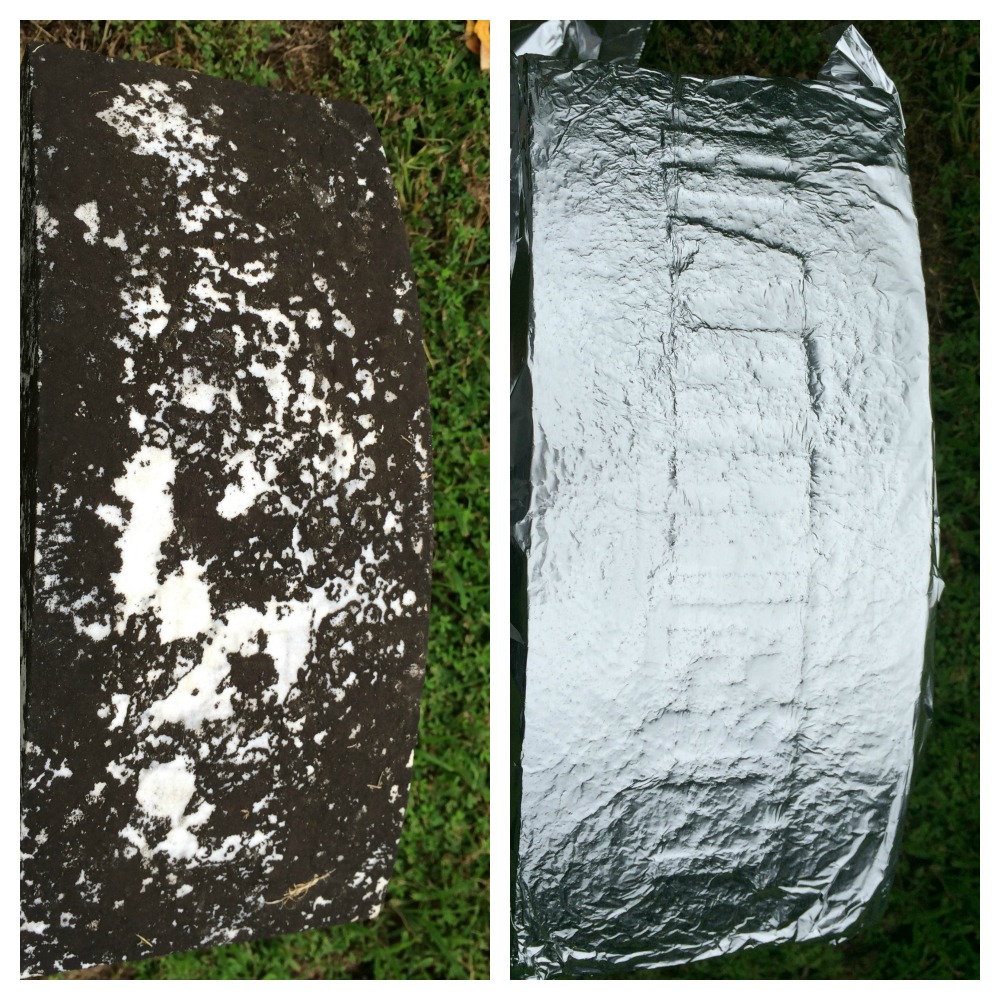
aluminum foil can make hard-to-read gravestones legible againI love this method! The downside is that, unlike gravestone rubbings–which I learned are harmful to the gravestone–it’s not easy to keep and store foil rubbings. I consider them temporary and my digital photo of the rubbed stone to be my permanent record. I can’t quite get myself to throw away the foil (it’s driving around in the back of my SUV), but soon I expect I’ll put it in the recycling bin. [ETA in 2025: I recycled it shortly thereafter!]
Filed Under: Excitement, Genealogy tips, My family, Preservation Tagged With: Brown, cemetery, excitement, genealogy tools, Jeffries, Price, resources, revisit

How I processed my Civil War pension files

April 14, 2025 By Janine Adams 4 Comments

I’m fortunate to have three ancestors who fought on the Union side in the Civil War and for whom I was able to obtain pension files from the National Archives. Ten years ago, I wrote a post about how I processed those files, starting with creating a robust source citation. I got good feedback on the post, so I thought I’d resurrect it in case newer readers would find it helpful. The pension files truly are treasure troves of information and the painstaking time I spent going through them paid off. If you want to request your ancestor’s pension file, you can do so on this page of the NARA website.

Processing civil war pension filesAs I mentioned a couple of weeks ago, I received my 3d great grandfather’s Civil War pension files from the National Archives in record time. I’d been prepared to wait 45 to 120 days and it arrived the week after I submitted the request online.

I dug right in and started processing the information. I was so grateful that I had attended the class Anatomy of a Military Pension, presented by Certified Genealogist Julie Miller at the National Genealogical Society’s annual conference that month. She provided step-by-step instructions of what to do with a military pension.

So the day after I received that 65-page pension file, I did what Julie suggested. I put the documents in chronological order and I assigned a number to each. Then I figured out a citation for the overall file and a  citation for each of the numbered documents.

Coming up with a proper citation was a bit of a challenge and I emailed Julie, who was kind enough to share the citation she uses for these files. (She had given us that info in the talk, but I hadn’t written it down.)

Here’s the citation I’m using for the overall pension file for my ggggrandfather, Richard Anderson Jeffries:

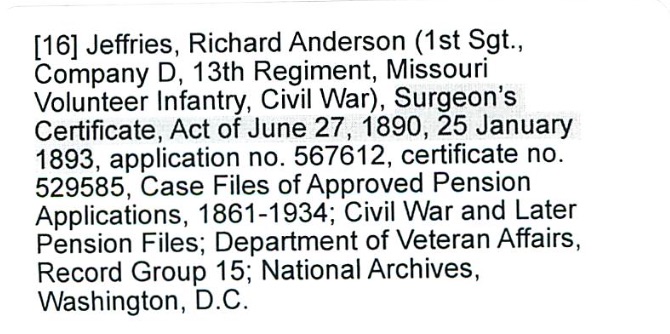
[278] Jeffries, Richard Anderson (1st Sgt., Company D, 13th Regiment, Missouri Volunteer Infantry, Civil War), application no. 567612, certificate no. 529585, Case Files of Approved Pension Applications, 1861-1934; Civil War and Later Pension Files; Department of Veteran Affairs, Record Group 15; National Archives, Washington, D.C.

278 was the next number in my source list in Reunion, my family tree software. Each of the individual documents is numbered, starting with 1, and has its own citation. My intention is that when I enter a fact into Reunion, I’ll use Source 278, but I’ll include in the detail field which of the 26 individual documents that particular fact came from.

I created citation labels for each of the documents and affixed them to the appropriate pages. (That’s the citation for document 16 above.) Then I scanned the whole document into a pdf. I elected to have one pdf, rather than 26 individual ones–time will tell whether that was a good choice. (Edited to add a year later: Yes! That was a great choice.)

The next step, according to Julie is to transcribe the documents. Yes, I’m going to type word for word exactly what is on the documents. Julie urged us not to skip that step because when we transcribe, we learn things we would not otherwise learn.

After I transcribe, I will abstract the documents, so I can tell at a glance what they are and what info is contained within each. And then I’ll enter the new-found facts into Reunion, my family-tree software.

That’s a lot of work, but I’m delighted to have learned how to be thorough with it. And I know I’ll learn so much about my ancestor.

I am so grateful to have this structure, because just a few days after receiving Richard Anderson Jeffries’s file, I received the pension file for my gggrandfather, George Washington Adams. That file is over 100 pages; I had to request and pay for the rest of the file (another 80 pages) to be copied–I’m still waiting for part two. That same week I received the third and final pension file, for another gggrandfather, Benjamin Franklin Igleheart. All three pension files, probably 250 pages, came within two weeks of my request.

If I did not have the structure Julie provided in that talk to thoroughly process the information, I know I would feel overwhelmed. I would probably skim the documents, pluck out a few easy-to-find facts, and put them away intending to get to them later. And I don’t know when later would be.

I have skimmed the most recently received pension files to get a preview what I’m going to learn. (G.W. Adams had a big dispute about the amount of his pension–an adversary in the Soldier’s Home turned him in for saying he was more disabled than he was!) But I’m not going to analyze them until I’m finished with Richard Anderson Jeffries. So that will be motivation to go through the process.

I think these pension files are going to be a great learning experience not just about my ancestors, but also about doing proper genealogical research. This feels great!

Filed Under: Challenges, Genealogy tips, Organizing Tagged With: Adams, Civil War, excitement, Jeffries, overwhelm, record keeping, research, source documentation

Going through my box of inherited items: step one

August 24, 2021 By Janine Adams 6 Comments

On November 13, 2020 I wrote these words in a blog post about Stacy Julian’s method for going through a box of family photos, documents and memorabilia.

“When I drove to Walla Walla in September, I took the opportunity to bring home a box of family stuff. It’s not so much documents as photos, but I intend to use Stacy’s framework as I go through it.”

Nine months later, I finally opened that box this past weekend. I was excited to use Stacy’s method, which I had first heard about in her terrific 2020 RootsTech presentation. I decided to go through each of Stacy’s five steps and blog about each step after I finished it.

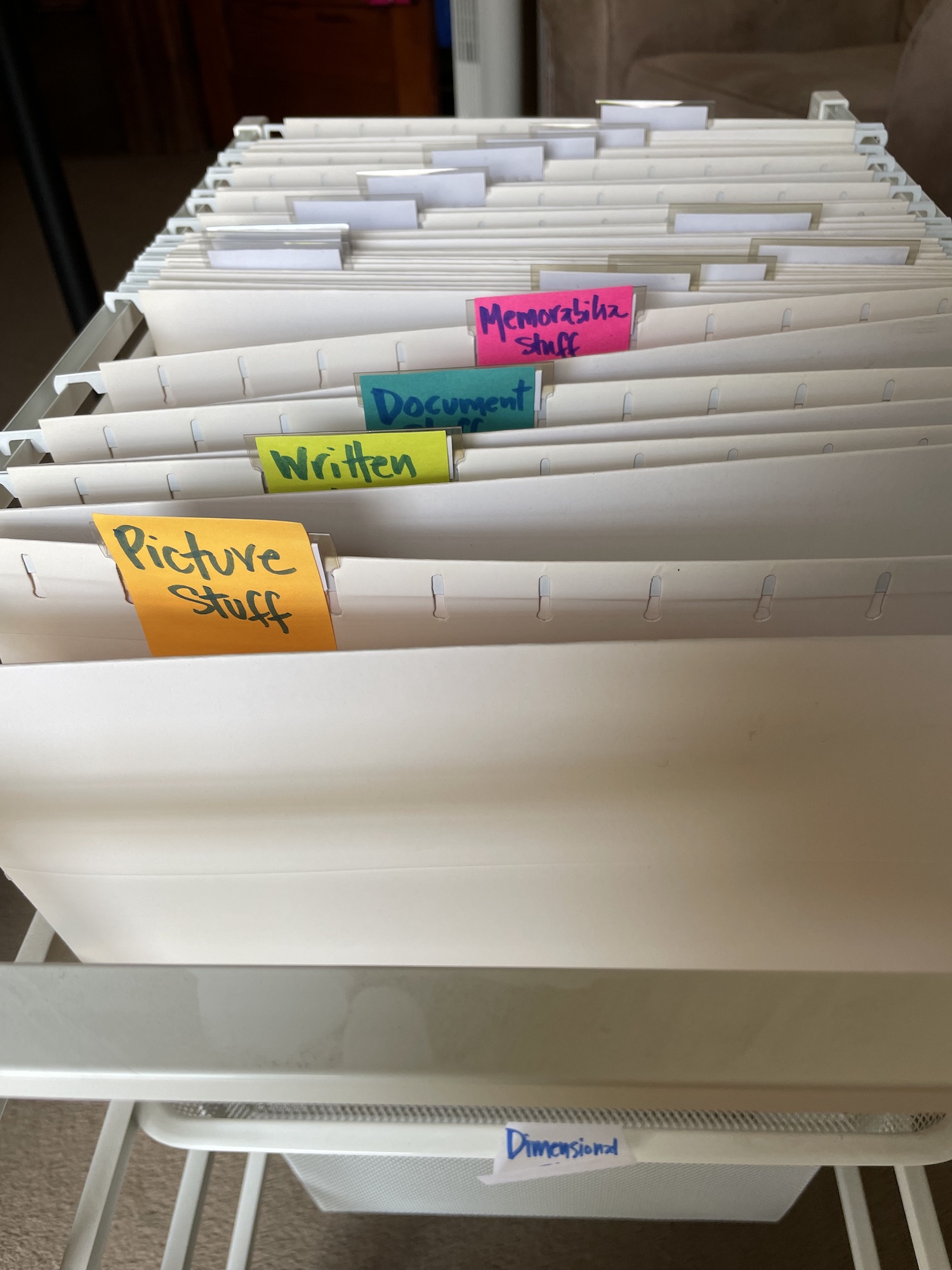
The first step is to sort the contents of the box into five categories:

  1. Picture Stuff
  2. Written Stuff
  3. Document Stuff
  4. Memorabilia Stuff
  5. Dimensional Stuff

I had an unused Elfa rolling  file cart and I rolled it to my workspace. I used sticky notes to label the folders. Here’s how it looked right before I started sorting:

It took me only 30 minutes to sort the entire contents of the box. As I had expected, the box contained primarily photos. I was able to tell by the handwriting on the back of many of them that at least some of the contents of the box had come from my grandmother, Susie Jeffries Brown, after she passed away in 1999. It was so touching to handle these items and remember my grandmother. (Today is my grandmother’s birthday! She was born 24 Aug 1908.) Some of the photos were framed in paper folders or wood or metal frames and I created a second Picture Stuff folder to contain those.

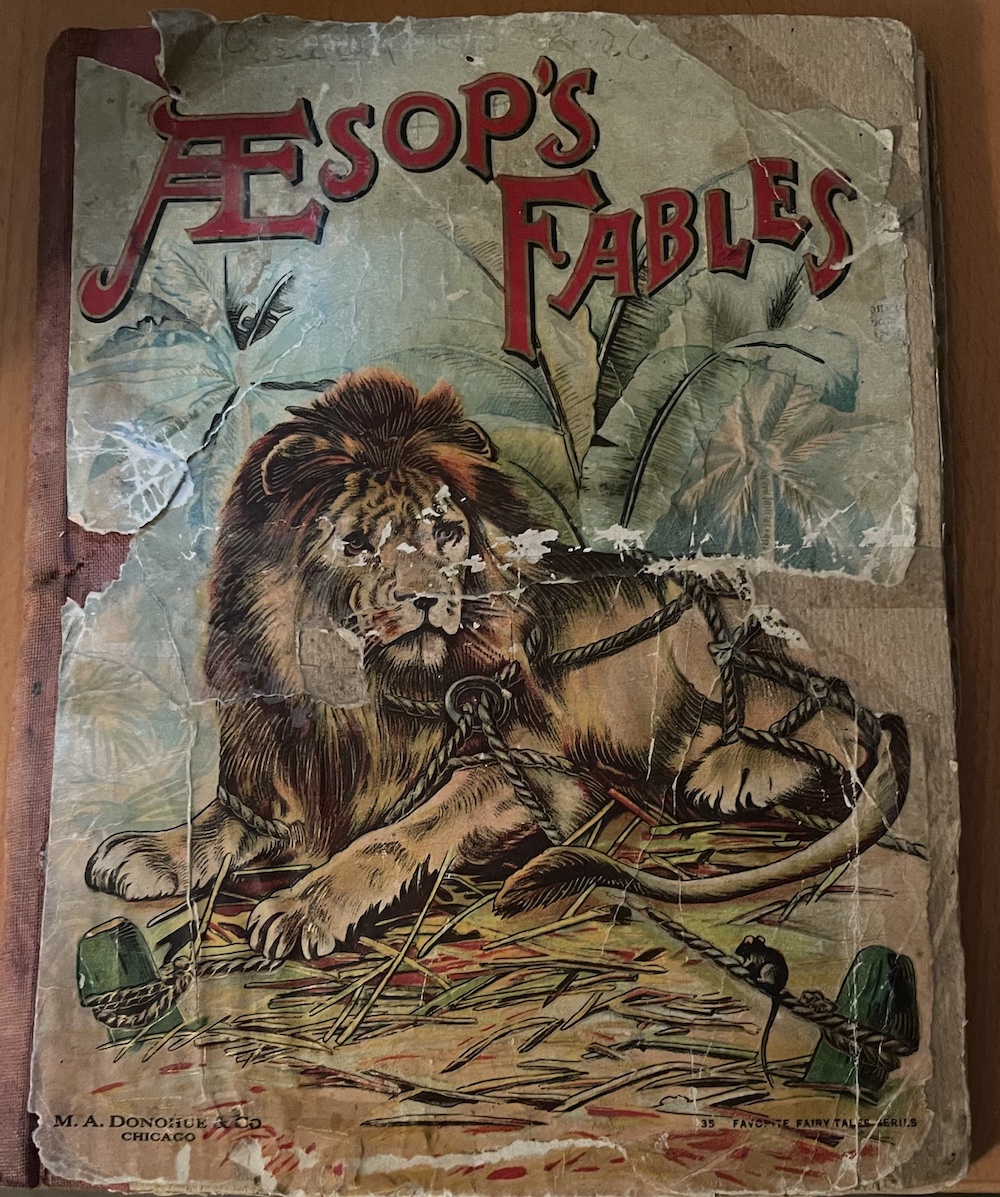
In addition to photos, there were some newspaper articles, as well as some other written items, including my parents’ wedding vows. (Those went into Written Stuff folder.) There were a few books, including an illustrated edition of Aesop’s Fables that had been given to my grandfather, Crawford Brown (1906-1996) in 1914. It was a Christmas gift from his grandmother, Antoinette Garlock Brown (1855-1922).

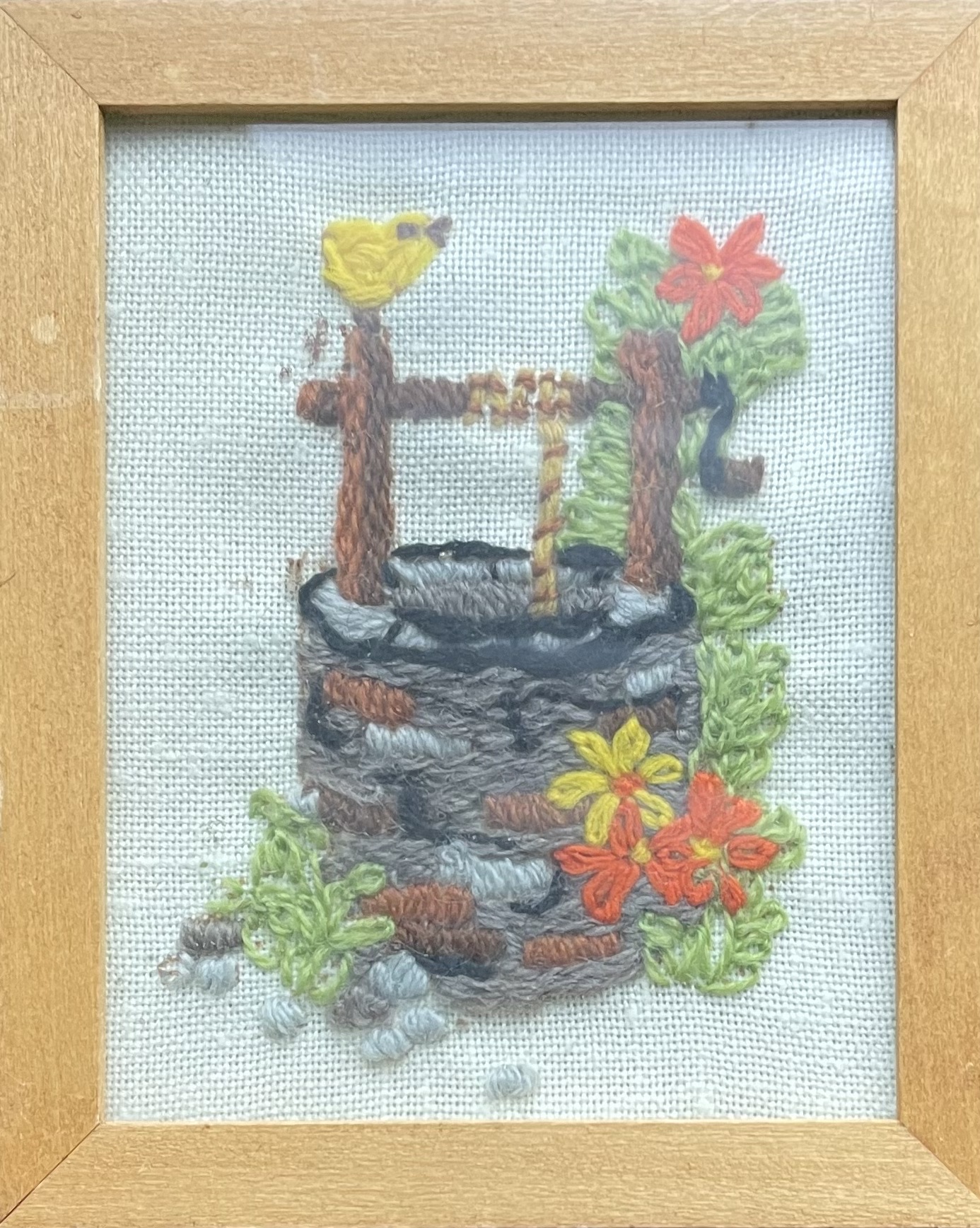
There was also a collection of the embroidery pieces I created as a kid and gave to my grandmother. She had framed them and hung them on the wall of the apartment she shared with my grandfather in their retirement home. (How sweet is that?) That’s a photo of one of them at the top of the post. The Elfa file cart has two drawers on the bottom and I ended up using both of them to hold all the dimensional stuff.

I worked hard not to spend a lot of time on individual items. The goal was to simply sort them to make them accessible. And it felt great. I can’t wait to dig in to the individual pieces.

In the next step, I will take a closer look at each document and assess value and usefulness of each item, according to Stacy’s methodology, which is detailed in her post, How to BEGIN with the BOX, on StacyJulian.com. I’ll blog about step two as soon as I finish it!

Here’s my post on step two!

Filed Under: Challenges, Excitement, My family, Organizing, Preservation Tagged With: Brown, family photos, Jeffries, organizing aids, overwhelm, paper files, resources, Stacy Julian

Is any detail too trivial to record?

August 7, 2020 By Janine Adams 12 Comments

I’ve been working on processing my backlog of newspaper articles that I downloaded during my burst of newspaper research in June and July. I don’t know about you, but when I’m doing newspaper research (or, really, any genealogy research), it can be tempting not to go to the trouble of downloading everything I find because it doesn’t seem important enough. And when I’m in the midst of a research session sometimes the downloading (or printing or copying, if I’m actually looking at paper documents) can seem so tedious that I only bother with the big stuff.

Come to think about it, that’s one advantage of short, frequent research sessions that I should add to my post The value of daily research. Since I don’t get bleary-eyed or weary during short sessions, I’m more likely to make the effort to download everything.

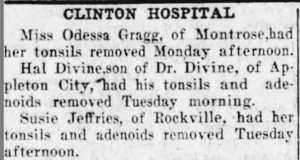
In any case, this week, as I was processing some newspaper articles, I was so happy that I had taken the effort to download even the tiniest articles. For example, there was an article in The Clinton Eye of Clinton, Henry, Missouri about my grandmother, Susie Jeffries Brown (1907-1999), having her tonsils and adenoids out on August 26, 1919. I didn’t think much of it when I downloaded it, but as I processed it, I noticed that the surgery took place 50 miles from her home in Rockville, Bates, Missouri and that it happened two days after her twelfth birthday.

I paused to think about whether 12-year-old Susie might have spent her birthday full of trepidation about the surgery and I wondered how long she stayed in the hospital. Was she served ice cream? (That always seemed to be the best part of getting your tonsils out when I was a kid.) It prompted me to do a little more research and I learned that by 1919 tonsillectomies were growing more prevalent (in fact hers was one of three mentioned in the newspaper article!), though they exploded in popularity in the 1920s. (If you’re as big a nerd as me and feel like digging into the topic, you can read The Rise and Decline of Tonsillectomies from The Journal of the History of Medicine and Allied Sciences (vol. 62, No. 4, October 2007) at JSTOR.)

I was lucky enough to have known my grandmother, who died in her 90s when I was in my 30s. But I almost always think of her as a senior citizen. Sometimes I think of her as a  mother of young children, as I recall stories my mother told me about her childhood. But I don’t know much about my grandmother’s childhood, mostly because I was lousy listener as a kid and young adult.

So this little newspaper article added to my understanding of my grandmother’s childhood and, perhaps more importantly, gave me reason to think about her as a child.

Whenever I’m tempted to skip downloading something, I’m going to remember that trivial things can often provide great clues when taken together with other clues found over time. That makes them important to capture. But even when they’re truly trivial, they can provide valuable little insights.

Filed Under: Genealogy tips, Reflections Tagged With: Jeffries, newspapers, social history

  • Page 1
  • Page 2
  • Page 3
  • Interim pages omitted …
  • Page 6
  • Go to Next Page »

about me

I'm Janine Adams, a professional organizer and a genealogy enthusiast. I love doing family history research, but I find it's very easy for me to get overwhelmed and not know where to turn next. So I'm working hard to stay organized and feel in control as I grow my family tree.

In this blog, I share my discoveries and explorations, along with my organizing challenges (and solutions). I hope by sharing what I learn along the way I'll be able to help you stay focused and have fun while you do your research, too.

tags

30 x 30 Adams amy johnson crow anniversary Brown cemetery census Civil War conferences connections dna electronic files Evernote excitement Family Curator family photos genealogy tools getting started goals How They Do It Igleheart Jeffries keepsakes learning opportunities maps newspapers NGS organizing aids overwhelm paper files planning quick tips rasco record keeping research research log research trip resources RootsTech social history source documentation Stacy Julian technology time management vital records

join the facebook community!

join the facebook community!

My organizing business

Learn more about my organizing business, Peace of Mind Organizing®.

Subscribe by RSS

  • RSS - Posts
  • RSS - Comments

© 2026 Janine Adams


Loading Comments...