• BLOG
  • ABOUT
    • Privacy Policy

Organize Your Family History

Stay focused and happy while exploring your roots

Quick Tip #15: Resist the urge to print

February 23, 2021 By Janine Adams 10 Comments

Here’s the next in my occasional series of bite-size Quick Tips. Click on the Quick Tips tag for my other Quick Tips. Because I tend to write longer posts, I wanted to provide a quick-to-read (and quick-to-write) post every couple of weeks on a small topic that pops into my head. This one changed my genealogy life.

Resist the urge to print

As a professional organizer, I know what a problem paper clutter can be. And I know how hard it can be to access unfiled paper (and so much paper is unfiled!). So I am a huge proponent of not printing genealogy documents I find online. Instead, I encourage you to download and file them.

The key to feeling confident about downloading, rather than printing, is to have a reliable file-naming protocol and folder structure so that you can find the documents. Mine is detailed in this post, but yours might be different. That’s great, as long as it works for you. When you download and file digitally, rather than print and file or put into binders, your documents are always at your fingertips when you’re at your computer, even if you’re at a library or repository. It can be a mindset shift, but I think it’s worth it.

It’s important to mention, as was brought up in the comments to this post, that it’s absolutely essential to backup your hard drive if you’re going to store your documents digitally. I wrote about this in my last quick tip.

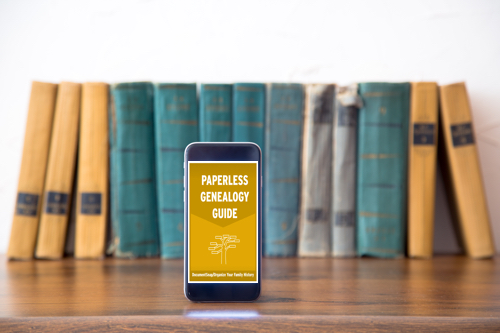
For extensive information on going paperless in your genealogy research, check out the Paperless Genealogy Guide I wrote with scanning expert Brooks Duncan, available for purchase at his website, DocumentSnap.

Photo by Sam Dan Truong on Unsplash
Filed Under: Challenges, Genealogy tips Tagged With: electronic files, quick tips, record keeping, technology

Major upgrade to Reunion released

November 3, 2020 By Janine Adams 19 Comments

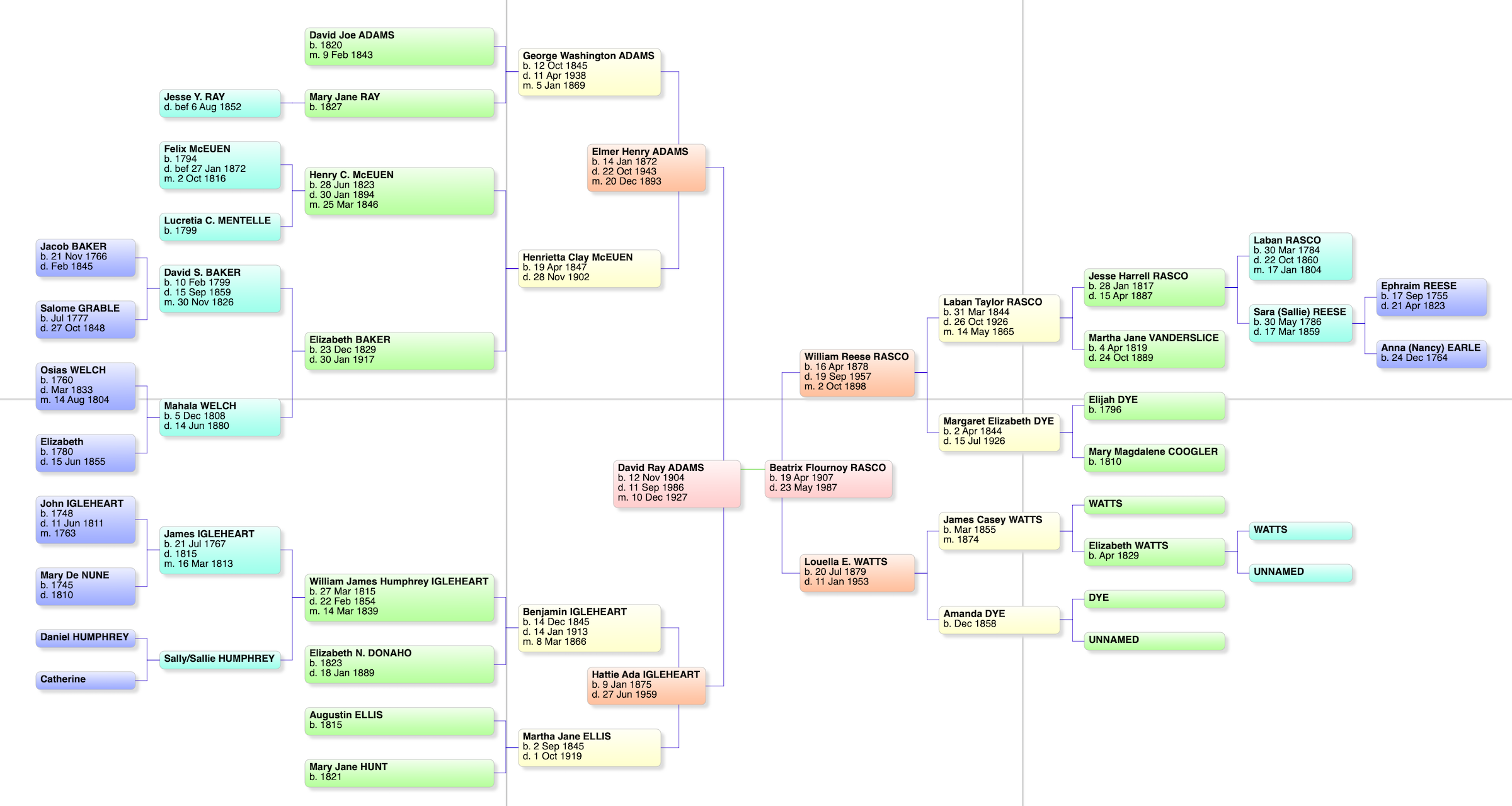
A bowtie chart for my paternal grandparents

I’ve been using Reunion, the genealogy software designed for the Mac, since I started getting serious about genealogy research, back in 2012. I love Reunion, though the truth is I’ve never used any other software so I don’t have anything to compare it with. It works well with the way I think and I’ve found it intuitive and easy to use. I’m definitely a glass-half-full kind of gal, but the only complaint I’ve ever had about Reunion is that media files do not export with a GEDCOM.

Over the years, I’ve upgraded Reunion when new versions became available every few years. (I started with Reunion 10.) Just last week when I opened the program, I saw that an upgrade to Reunion 13 was available. (It had been three years since I upgraded to Reunion 12.) I quickly checked out the new features and didn’t hesitate to spend $49.95 for the upgrade. The upgrade process was headache-free and I’m happily using and exploring the expanded capabilities.

Here’s a list of my favorite new features. I haven’t used them all but I’m glad to have them available:

  • Change Log. I can now look back and see what changes I made each research session. I used this the other day when I forgot to write in my research log. (I think the Change Log is a little hard to find, so I’ll mention that you find it by clicking on the File menu item at the top of the screen. If you don’t see Change Log, try clicking on a different screen in Reunion, if you have more than one open.)
  • Summary sidebar. Personal statistics for each member of a couple are now available in the sidebar. The summary sidebar contains information such as spouses, siblings, surnames of ancestors, surnames of descendants, number of descendants in how many generations and so forth. You can drill down on most statistics for more detail.
  • Connections allows me to add unrelated people (neighbor, godparent, witness, etc.) to my tree.
  • Find Relationship has been upgraded to instantly show a graphic relationship between to people in my tree. I can easily copy that graphic to share with someone.
  • Quickview windows pop up to provide further information about a person, couple, source record or surname without having to navigate to another record.
  • A Find feature that searches across all records and fields. You can search without having to leave the family view.
  • A new Bowtie chart that shows the ancestors of each member of a couple in one view (see photo above).

You can watch this video to see the top ten new features in action.

Eight years using Reunion and I haven’t been tempted to switch. This upgrade makes me feel more enthusiastic than ever!

Filed Under: Excitement, Genealogy tips, Technology Tagged With: genealogy tools, record keeping, technology

Now’s a great time to go paperless

April 11, 2020 By Janine Adams 10 Comments

Have you been thinking about going paperless with your genealogy? I made that transition about six years ago and have never looked back. In 2015, I wrote a post called 8 reasons not to print that pretty well spells out my reasoning behind embracing digital organizing.

Making that transition is the kind of thing that you might be putting off, thinking you’ll need time to think it through and come up with and implement a plan. Most of us are not working at this time of COVID-19, so now might be a good time to start the process. And here’s a great (if I say so myself) resource to help you get started: The Paperless Genealogy Guide, a  40-plus-page downloadable pdf that I wrote in 2017 with scanning expert Brooks Duncan of DocumentSnap. We wrote the guide as we were working on the Going Digital talk we gave together at RootsTech that year.

One thing I want to make clear as you’re pondering going transitioning to digital: You don’t have to scan your existing paper files all at once. Just figure out what your digital workflow will be (here’s mine) and think about your digital file naming convention and computer folder structure. Once you know those things, you can just start with next document you find online. Rather than print it, just do this: rename it, process it and then file it digitally. You can then work on the backlog a file folder (or half hour) at a time until it’s done. But the key is not to add to the backlog. From this point forward process all incoming documents digitally.

So that it’s handy, I’ll share with you my file-naming protocol and folder structure. They’ve been working well for me for years but of course you might have or come up with something that works better for you.

My file-naming protocol:

Year Document Type-Ancestor Name-Locality of document

Example: 1938 death certificate-George Washington Adams-Indianapolis Indiana

My folder structure:

Genealogy/Surnames/[Surname]/Last Name, First Name, YOB-YOD

Example: Genealogy/Surnames/Adams/Adams, George Washington, 1845-1938

I have a folder for each individual. For married women, I file them under their married name (if there’s more than one, I use the one pertains to me) and put their birth name in parentheses.

Example of wife: Genealogy/Surnames/Adams/Adams (McEuen), Henrietta, 1847-1902

This is the kind of information that’s covered in The Paperless Genealogy, along with a lot more. The guide also includes information on selecting a scanner, keeping your data safe, and what you do (and don’t) need to get started. It also includes our Paperless Genealogy Checklist to walk you through the steps you need to take. The Paperless Genealogy is $9 and available instantly. Read more about it and purchase it at the DocumentSnap website.

Filed Under: Genealogy tips, Organizing, Technology Tagged With: electronic files, organizing aids, record keeping, technology

Time for January 30 x 30 check in!

January 14, 2020 By Janine Adams 14 Comments

It’s almost the middle of our January 30 x 30 challenge. For those of you who signed up, how is it going? Are you managing 30 minutes of genealogy research (or organizing or scanning or whatever it is you set out to do)?

My challenge was made a little extra challenging by travel. I was in Walla Walla, Washington, visiting my dad from January 3 to 12.  I’m happy to say that I did manage to research every day, but one of those days barely counts. The day I traveled home (a 12-hour journey by car and plane) I thought I’d get research done on the plane, but when I started working I just wasn’t in the right frame of mind. So the ten minutes I put in was barely productive. I give myself credit for at least trying, but execution was not impressive.

One thing that’s helped me get back on track is that yesterday, back at my desk, I decided to pull out my 2nd great grandfather’s Civil War pension file, which I’d received way back in 2015. At the NGS conference that year, I heard Julie Miller talk about these files: what they contain and how to process them. I immediately requested the complete pension files for my three Union veteran ancestors from the National Archives. I’ve already processed the other two but had not focused on the file of Benjamin Franklin Igleheart. Since I’ve turned my attention to the Igleheart line, this is a natural thing for me to work on.

Once I pulled it out of the file (I haven’t yet scanned it), I saw that I’d started by putting the pages in chronological order and created a source citation for the whole pension file. The next step is to create a source citation for each individual document, print the citation on a label and affix the label to the paper document before scanning the whole document. After it’s scanned, I’ll start transcribing it. Yesterday I spent 45 minutes creating the citations and their labels and got through about eleven documents before having to move on to something else. For the near future, this will be the project I’ll be working every day.

I’d forgotten how great it was to have a project like this that I can break down into tiny bites. I love knowing exactly what I’m going to be working on and I love that there are lots of little milestones in this giant project so I can celebrate my progress.

Enough about me. I hope your challenge is going well and I look forward to hearing about it in the comments!

Filed Under: Challenges, My family Tagged With: 30 x 30, civil war pension, Igleheart, record keeping, time management

  • « Go to Previous Page
  • Page 1
  • Page 2
  • Page 3
  • Page 4
  • Page 5
  • Page 6
  • Interim pages omitted …
  • Page 15
  • Go to Next Page »

about me

I'm Janine Adams, a professional organizer and a genealogy enthusiast. I love doing family history research, but I find it's very easy for me to get overwhelmed and not know where to turn next. So I'm working hard to stay organized and feel in control as I grow my family tree.

In this blog, I share my discoveries and explorations, along with my organizing challenges (and solutions). I hope by sharing what I learn along the way I'll be able to help you stay focused and have fun while you do your research, too.

tags

30 x 30 Adams amy johnson crow anniversary Brown cemetery census Civil War conferences connections dna electronic files Evernote excitement Family Curator family photos genealogy tools getting started goals How They Do It Igleheart Jeffries keepsakes learning opportunities maps newspapers NGS organizing aids overwhelm paper files planning quick tips rasco record keeping research research log research trip resources RootsTech social history source documentation Stacy Julian technology time management vital records

join the facebook community!

join the facebook community!

My organizing business

Learn more about my organizing business, Peace of Mind Organizing®.

Subscribe by RSS

  • RSS - Posts
  • RSS - Comments

© 2026 Janine Adams


Loading Comments...