• BLOG
  • ABOUT
    • Privacy Policy
  • CONTACT

Organize Your Family History

Stay focused and happy while exploring your roots

NARA’s 2017 Virtual Genealogy Fair is coming up

October 13, 2017 By Janine Adams 2 Comments

Once again, the National Archives is having a Virtual Genealogy Fair, with a day’s worth of lectures available free of charge. This is the fifth year in a row they’ve offered this webcast.

You can read the lineup here. Detailed descriptions of the sessions are posted here, which is also where handouts will be posted when they’re available. (Classes are marked either Beginner” or “Experienced.”) There will be six one-hour sessions each day, including one on storing and handling family heirlooms.

Since I live in St. Louis, I’m excited that two of the sessions are about the National Archives facility in St. Louis, including one on accessing records burned in the big fire there in 1973.

The event takes place on Wednesday, October 25, starting at 10 am Eastern time and ending with closing remarks at 4 pm. I’ll be traveling that day, so I won’t be able to watch live, but I’m thrilled that the recordings will be available for a period of time after October 25.

Here’s a link to the YouTube Channel where you can watch the sessions. No registration is required!
Filed Under: Excitement, Genealogy tips Tagged With: excitement, learning opportunities

Keeping track of my progress

October 10, 2017 By Janine Adams 16 Comments

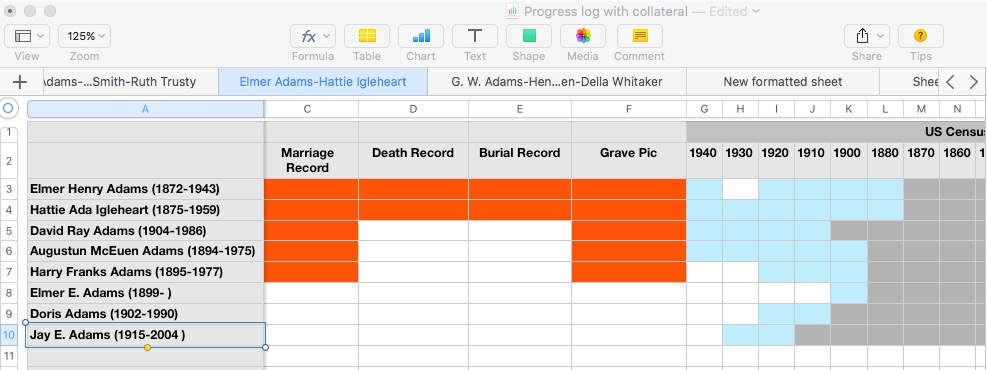
Keeping track of genealogy researchThis year, I’ve been focusing on one family line, the Adams line. I’ve been trying to gather as much information as possible not just on my direct-line ancestors (my focus in past years) but also on the siblings of my direct-line ancestors. It’s fun and fulfilling. But it’s also a bit overwhelming because there are so many people I can’t remember all of them.

I keep track of everything in my family-tree software, Reunion. But I also like having an at-a-glance summary of where I stand in my research on each person. Three years ago, I created a progress chart, which had a series of tabs on a spreadsheet in which I marked the documents I had found on each of my direct-line ancestors. That worked pretty well and gave me an at-a-glance summary I craved.

I find myself wanting a similar chart for all my research subjects, including the collateral lines, and I’m struggling with getting my arms around that. Part of my problem, I think, is that I want to be able to see everything at the same time, which is challenging when your family tree’s branches stretch wide.

Here’s what I’ve settled on. I’m creating a single spreadsheet for all the data I’m looking for for each family group (B/M/D, censuses, newspaper, military, wills, land, etc.). In my previous progress chart, I’d had all my direct-line ancestors listed on each sheet, with a separate sheet for each type of data. In this new chart, I have all my data types across the top, with a row for each member of the family group. I have a separate sheet (a tab) for each family group. I decided to start with my parents in the first sheet and work back in time by generation.

I’ve spent a little time with it and I think it’s going to be really helpful. As I started filling it out, I paid attention to how it made me feel and I had two conflicting feelings:

  • Overwhelm because there are so many people to enter into it and so many data types to research
  • Excitement as I realized how many opportunities for research there are

I think the key to making this useful and not overwhelming is putting one family group on each sheet. That narrows the focus and allows me to see what I have and what I can still research. It also helps me avoid feeling overwhelmed.

Having each family group on a separate sheet makes it easier to fill out the chart initially as well. I ordinarily enjoy filling out forms and updating progress charts. But this one was so large it felt like it might turn into a big exercise in tedium. So if I take it one family group at a time, it feels like fun, not drudgery.

I’ll keep you posted. Once I have it in shape where I think it might be useful to others, I’ll blog again and offer to send it to anyone who might want to use it.

If you have a similar chart and/or have any suggestions for mine, please share in the comments. I’m all ears!

Filed Under: Challenges, Genealogy tips, My family, Organizing Tagged With: organizing aids, overwhelm, planning, progress log, research, research log, resources

How They Do It: Randy Seaver

October 3, 2017 By Janine Adams 7 Comments

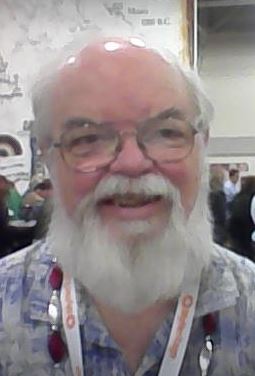
This month’s How They Do It interview is with genealogist and blogger Randy Seaver. I’m willing to bet you’re familiar with Randy Seaver and his popular GeneaMusings blog, which he has been writing more than ten years. GeneaMusings offers so much content and analysis; Randy posts multiple times per day. Randy is a prolific researcher and writer and a true luminary in the genealogy field.

When I read his interview responses I was blown away with the sheer quantity of research he does–he spends eight to ten hours every day on genealogy-related activities! I really enjoyed reading about how organizes his voluminous research.

How They Do It: Randy Seaver

How They Do It: Randy SeaverHow long have you been doing genealogy?

I finally read Roots in 1987, and watched the TV series, and figured “I can do that.” I started in early 1988 using information from my father’s Seaver siblings and my mother’s collection of papers and photographs. My paternal grandmother told her children that we were descended from Peregrine White, the baby born on board the Mayflower in 1620, so proving that became a goal. My Aunt Marion, who had been a schoolteacher, had a Seaver genealogy from a town history book, but I found errors in some of the information. I visited local libraries and the Family History Center, and quickly filled out the “easy” part of my family tree. Then it was on to research trips to New England and ordering microfilms from Salt Lake City to find more and more information about all of my ancestors.

What’s your favorite part of doing genealogy?

It’s twofold for me: THE HUNT – finding more records, and especially new ancestors, or solving a thorny research problem. THE COUSINS – finding new cousins through research and DNA testing.

Do you consider your genealogy research well organized?

I am mentally well organized. The genealogy cave has a desk, a computer, and is full of paper with 50 linear feet of bookcases, file cabinets and stacks. Half of it is genealogy magazines and conference syllabi. The balance is printed books, genealogy periodical articles, family research notebooks, local society stuff, and stacks of folders and papers. I have not spent a lot of time weeding out unnecessary papers in recent years. My descendants may have that task. I fear I’m a pack rat at heart.

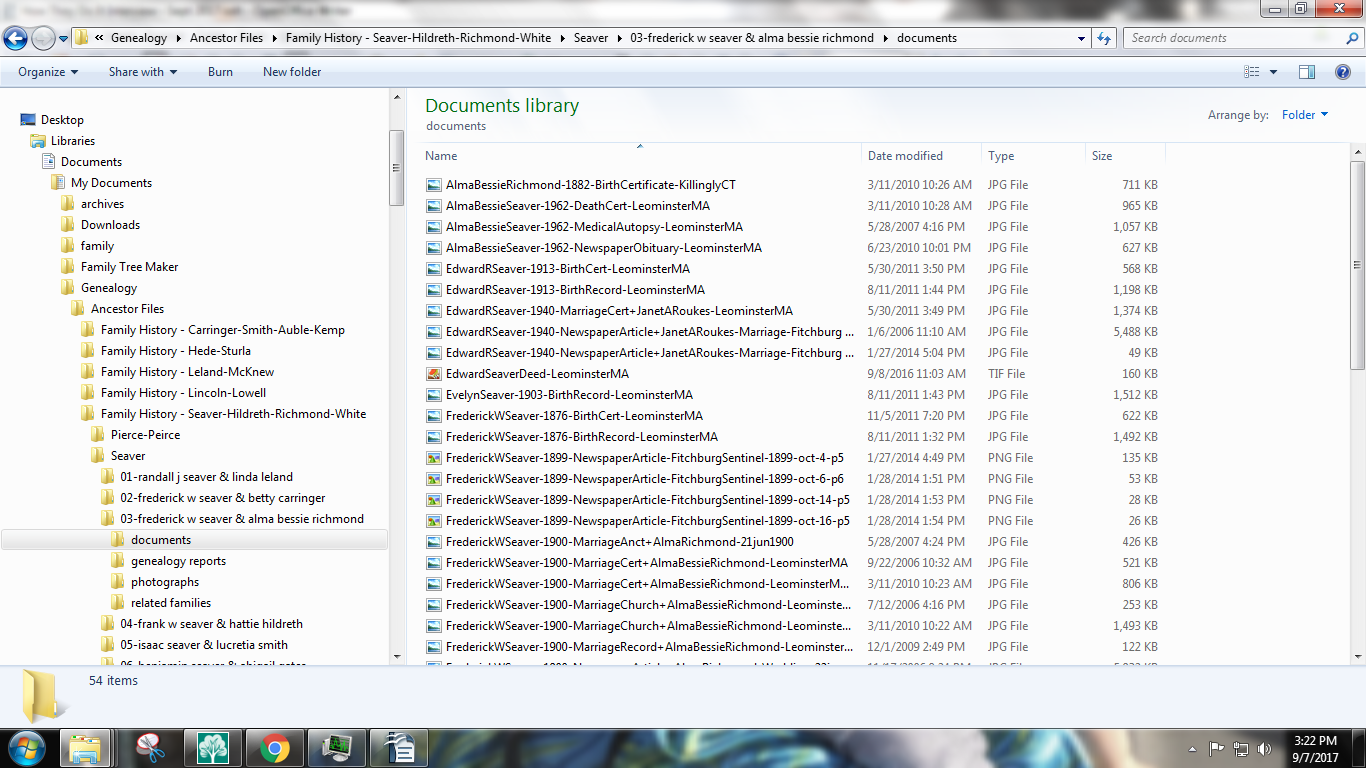
The computer digital files are well organized – I have a file naming system, a file folder filing system, and I can find a specific document, or file a new one, in seconds. See My Genealogy Digital File Folder Organization. [See a photo of his digital filing system below.]

What type of software do you use for organizing your genealogy research?

I used Personal Ancestral File from 1988 to about 1995, then Family Tree Maker until 2006, and now I use RootsMagic 7 for all of my data entry. In addition to the data entry, I use the Correspondence feature, the To-Do list feature, and the Research Log feature in RootsMagic. I also have Family Tree Maker 2017 and Legacy Family Tree 9 on my computer and use them occasionally for specific tasks, especially report-writing and charts.

I have entered all of the information about my ancestors from my collected books, periodicals, correspondence and vital record certificates into my RootsMagic family tree database. I have collected digitized books, periodical articles, genealogy and family history records, and much more and entered the text information, image and source citations into my database. I have digitized the paper certificates, family letters, and family photographs and added that information to my database.

A lot of the digitized information finds its way into a blog post – I post a transcribed document on Monday, extract data from documents on Tuesday and Thursday, post family photographs with comments on Wednesday, write an ancestor biography on Friday, and review one of my specific ancestral surnames on Saturday on my blog, www.GeneaMusings.com. All of that comes out of my RootsMagic database.

Do you keep a research log? If so, what format?

I started out keeping a Research Log on paper – one sheet for every surname. That became time consuming and overwhelming quickly. At present, I use a To-Do List and a Research Log only for a thorny research problem – of which I have many! I update them before I go to the Family History Library or another repository.

Do you have a tree on Ancestry? If so, is it public or private? Why?

I have about 15 trees on Ancestry.com. Some are Public, some are Private. My public DNA tree is limited to the ancestral families of my wife and me. Another public tree is a “cousin bait” tree that has all of my research for my ancestral families and descendants of my key surnames – Seaver, Dill, Buck, Carringer, Auble, Vaux, etc. Now that I can TreeShare my RootsMagic database with an Ancestry Member Tree, I have a public “Record Hint” tree that generates Hints for records as I add new people, and information for old people, to my database. I TreeShare every day now. I have several private trees for past client work, and for “testing” things.

What’s your biggest challenge when it comes to organizing your genealogy?

In the 21st century, genealogists are inundated with records that apply to their ancestral families – the record providers push Hints and Matches to you to work on. I have fallen behind on dealing with Ancestry Hints for my 48,000 person Ancestry Member Tree – there are over 40,000 Hints now and I will never be able to deal with all of those in my lifetime. I work on them almost every day as I receive them and try to keep up. Sourcing the Hints using EE-quality citations, takes the most time, especially census records.

The pace of discovery has increased significantly. However, those Hints and Matches do not include every record for my ancestral families – I still have to search in online and traditional repositories for records of my families.

What’s your biggest piece of advice to beginning genealogists in terms of keeping track of their research?

It is very important for beginning genealogists to understand the available record groups and repositories, the search and research process including the Genealogical Proof Standard, the art of source citations, and the use of genealogy software programs or online trees. All of this takes time, and beginners often feel overwhelmed.

Experts say that becoming competent in a subject requires 10,000 hours of work and study – that’s 5 years of effort 40 hours a week. So my advice is to set aside time to learn about different record groups, how to search record providers effectively, how to craft source citations, to join and participate in a local society, and to attend workshops, seminars and conferences, etc. It’s a lifelong learning process. Also, always remember that it is not all on the Internet, and it probably never will be.

What do you think is the most important thing for people to do to stay organized when it comes to family history research?

Stay on top of your paper and digital files – find them, obtain them, source them, enter the information into your genealogy program, and file them in your paper and/or digital file system. Try to “touch” each record once, but file it in a place that you can find it so you can review it along with other records in the future.

If you were starting out new as a genealogist what would you do differently?

I figured out in about 2006 that I should be crafting a source citation for every assertion in my genealogy software program – names, events, dates, places, relationships, etc. So I would take the time to add source citation information to my software program. I’ve been adding about 1,000 source citations each month to my genealogy program trying to “catch up” while still doing new research on my families.

Do you keep paper or electronic files (or both)?

Randy Seaver's digital filing system

Randy’s digital filing system

As noted above, I have entered almost all (?) of the data in my paper files into my genealogy software program. All new research from online resources is put into my digital file folder system. When I go to a library or other repository, I use digital photographs of records or books and enter them into my digital file system and genealogy software program. I still have almost all of my paper files, but I rarely use them.

Are you a folder or binder person for your paper files?

I have both folders and binders, and the paper files in the bookcases are in binders for a specific surname, or a locality group of surnames. I used DearMYRTLE’s system for binders for a specific family for several of my ancestral families and that worked pretty well. However, I felt that I was wasting my research time putting them together for hundreds of family lines.

Do you use Evernote, One Note or any other electronic organizing system for your genealogy? If so, how do you use it?

I have used Evernote occasionally – usually to save online documents, and to transfer workshop, seminar or conference notes from my tablet to my computer system. I never became an expert at it, and don’t use it much at this time.

How do you “advance the ball” in your research on an ongoing basis?

“Advancing the ball” in my research means:

  • Reviewing Ancestry, MyHeritage, FamilySearch and Findmypast Hints/Matches on a daily basis, and entering information from them into my software program.
  • RootsMagic TreeSharing with my Ancestry Member Tree and matching RootsMagic persons to FamilySearch Family Tree are helpful on a daily basis to keep those trees updated.
  • Reviewing what I’m “missing” in terms of records for my ancestral families and then searching for those records. For example, I have searched for and found many probate records of my ancestors in FHL microfilm and online databases, but have searched for and found relatively few land records. A To-Do list is helpful for this.
  • Writing about ancestral records, transcribing documents, composing an ancestor biography every week on my blog. I believe in the “chunk” theory – if I add something of value every day, I will have a bigger and better database by the end of the year, but it will never be “done.”

The desk in the Genea-Cave

Do you have a dedicated space in your home for doing genealogy research? What’s it like?

Ah, the Genea-Cave!! It’s a 10×12 foot back bedroom with a desk chair, desk, computer system, printer, free-standing lamp, a fan, file cabinets, bookcases, boxes, and stacks of paper. There is very little remaining floor space. It is warm in the summertime – we don’t have air conditioning. The family photo albums are in one bookcase, and there are M&Ms in a container.

Do you have anything you’d like to add?

Genealogy and family history have been a second vocation for 30 years for me. It is a tremendous intellectual challenge and a lot of genealogy fun. Traveling to ancestral locations and genealogy cruises or conferences are exciting, educational and productive. My family health situation now prevents us from traveling extensively, but I’m able to get out to teach and speak, and to contribute to and attend local and regional society programs. I spend 8 to 10 hours almost every day doing genealogy related activities. Life is good – genealogy rocks!!

Randy contributes so much to the genealogy world with GeneaMusings and I really appreciate his taking the time to share with us how he organizes his own research. I agree with so much of what he’s written, especially the advice to step away from the computer and seek sources that are not available online. And, of course, I share his transition from paper to electronic storage of files.

If you’re not reading GeneaMusings, I encourage you to explore it and learn from Randy’s musings. Thank you, Randy!

Filed Under: Challenges, Excitement, Genealogy tips, Organizing Tagged With: How They Do It, organizing aids, Randy Seaver

Preparing for your first genealogy conference

September 26, 2017 By Janine Adams 2 Comments

Today I received an email from a reader who will be attending the St. Louis Genealogy conference on October 14. I look forward to meeting her at the conference. She mentioned in her email that it will be her first genealogy conference, so she didn’t know what to expect.

That got me thinking it might be worthwhile to share a few tips about attending conference. I love going to genealogy conferences and have attended probably a dozen or so. Here are my big tips:

  • Bring your family tree or have access to it on a device. I frequently hear things at conferences that make me want to check my tree, to see whether I have ancestors in a locality, for example. Once, I was able to verify on my tree that the speaker, Joshua Taylor, and I were related! (I blogged about that exciting moment here.)
  • Bring some way to take notes, either a notebook or device. (I prefer to take notes into Evernote on my laptop.)
  • Eat a good breakfast, because you’re going to need a lot of brainpower. And bring along a bottle of water to stay hydrated. I always bring trail mix or something too.
  • Be prepared to keep a list of next steps, because the sessions you attend will surely spark ideas for things to look up or other actions.
  • Take a class that doesn’t necessarily interest you–you never know what new interests it might spark. (This tip came from reader Jan Rogge in a comment on my blog post about attending the Missouri State Genealogical Society conference last month.
  • If it’s a large conference with an app, download the app and decide what sessions you’ll be taking in advance of your arrival at the conference.
  • Make conversation with the person next to you. You may be in a position to help him/her or vice versa. Or you could even meet a cousin that way!
  • Take time after the conference to read your notes and process the conference materials you bring home.

Basically, be prepared to write stuff down because you’ll probably learn so much you’ll never remember it. Most of all, enjoy yourself!

Filed Under: Genealogy tips Tagged With: conferences

  • « Go to Previous Page
  • Page 1
  • Interim pages omitted …
  • Page 61
  • Page 62
  • Page 63
  • Page 64
  • Page 65
  • Interim pages omitted …
  • Page 106
  • Go to Next Page »

about me

I'm Janine Adams, a professional organizer and a genealogy enthusiast. I love doing family history research, but I find it's very easy for me to get overwhelmed and not know where to turn next. So I'm working hard to stay organized and feel in control as I grow my family tree.

In this blog, I share my discoveries and explorations, along with my organizing challenges (and solutions). I hope by sharing what I learn along the way I'll be able to help you stay focused and have fun while you do your research, too.

tags

30 x 30 Adams amy johnson crow anniversary Brown cemetery census Civil War conferences connections dna electronic files Evernote excitement Family Curator family photos genealogy tools getting started goals How They Do It Igleheart Jeffries keepsakes learning opportunities maps newspapers NGS organizing aids overwhelm paper files planning quick tips rasco record keeping research research log research trip resources RootsTech social history source documentation Stacy Julian technology time management vital records

join the facebook community!

join the facebook community!

My organizing business

Learn more about my organizing business, Peace of Mind Organizing®.

Subscribe by RSS

  • RSS - Posts
  • RSS - Comments

© 2026 Janine Adams


Loading Comments...