• BLOG
  • ABOUT
    • Privacy Policy

Organize Your Family History

Stay focused and happy while exploring your roots

How They Do It: Julie Goucher

February 4, 2020 By Janine Adams 5 Comments

I’m so glad to bring you another post in my How They Do It series! This month’s interview is with Julie Goucher, a UK genealogist and one-name study expert who was recommended by a reader. Julie is a well-respected writer and speaker on genealogy and is the Pharos Tutor for three One-Name Studies/Surname studies courses. She is a Trustee for the Guild of One-Name Studies and has two One-Name Studies for the surnames Orlando and Butcher, which represent her parents. Julie writes for several genealogy magazines, including Family Tree Magazine (UK) and Who Do You Think You Are? Magazine. Most recently she wrote a Surname Research Guide for the Guild of One-Name Studies, a new course for Pharos on the practicalities for One-Name Studies and is currently writing a book called Last One Standing which should publish later this year. You can keep up to date with Julie at https://anglersrest.net.
How They Do It: Julie Goucher

How long have you been doing genealogy?

Since 1988, so about 32 years. Where did that time go?

What’s your favorite thing about being a genealogist?

The thrill of the chase of information plus the journey our research takes us on. Not to mention the friendships we make along the way as we research and connect with others.

What’s your biggest challenge when it comes to organizing your genealogy?

Keeping on track with the research and filing documents and items away when I am researching. I do though consistently keep notes.

What is your favorite technology tool for genealogy?

I think this has to be the availability of the internet, which shrinks the world to the size of a matchbox and a smart phone.

If you were starting out new as a genealogist what would you do differently?

Spend more time with family members, asking questions. Even though I did that, there is still many I wish I had asked. The other thing I would do differently is to research and “deal” with that research immediately so there was no paper backlog.

Do you keep a research log? If so, what format?

Yes, I do. I am a prolific note taker, so have research logs since I began researching, though those early ones are sketchy in places. I have used a written log and an electronic log, which I kept as a spreadsheet. My favourite way is via pen and paper. I use a notebook and use it confirm what I have researched and what I have found (or not found). I build a to do list at the same time.

How do you keep track of clues or ideas for further research?

Trusty notebook and pen. On occasion I use my notes area of my iPhone, but these are migrated to my notebook as soon as I can. I use the same for blog posts, articles and presentation ideas too. I also date everything. Notebooks of choice are Leuchttrum1917 for notetaking and journaling. I use a Traveller’s notebook system for a catch all when I am on the move. I recently have moved into a A5 Filofax for organising and planning blog posts, especially useful if I am working on a series.

How do you go about sharing your personal research with cousins or other interested parties?

Blog and newsletter and website. I do have online trees, but they are not my preferred method.

What’s the most important thing you do to prepare for a research trip?

Consider the aims of the trip. What specifics I want to locate, and I always do background reading. The most important thing I can share is to note down or photograph, if you can, all the records you see. Just in case surnames that originate in one area have moved to another. Our people were more migratory that we really think. If I am not sure if it is the same family, I note it down, and assess later as opposed to discounting it during the trip. Also, date everything.

What’s your biggest piece of advice to genealogists in terms of organizing their research?

Keep it simple! Use the right tools for the job and take the time to learn how to use a piece of software. Make use of genealogical programmes for studies that do not involve just your family lines, such as a surname study or place research. Spreadsheets are good, but they are not meant for storing or creating family trees.

Do you have a dedicated space in your home for doing genealogy research? What’s it like?

Yes, I have an office at home. It has too many books, or perhaps too few bookcases! Two filing cabinets, an armchair, desk and shredder. I also have a stand with my printer (and several piles of filing) and a seat which houses a lot of genealogical data CDs. The tops of my filing cabinet house boxes of photos.

Do you have anything to add?

Genealogy gives me a great deal of pleasure, as do the friendships I have made along the way. The documentation that archives hold is so very important as that adds evidences to our family tree. Not everything is online, and the other important factor is citing the source. Even if you only cite where the material was found and not much else, it is better than nothing. The point of a citation is that you and others can follow the research pathway using the citations you provide.

I’m so grateful to Julie for taking the time to answer these questions. I found myself nodding as I read her responses, particularly the bits about processing documents as you find them and making decisions about whether something is relevant after you get home from a research trip, not during. And, of course, the advice about citing sources–even if it’s an imperfect citation–is so on point. Thank you, Julie!
Filed Under: Challenges, Excitement, Genealogy tips, Organizing Tagged With: How They Do It, Julie Goucher, organizing aids

My “good enough” research log

January 10, 2020 By Janine Adams 8 Comments

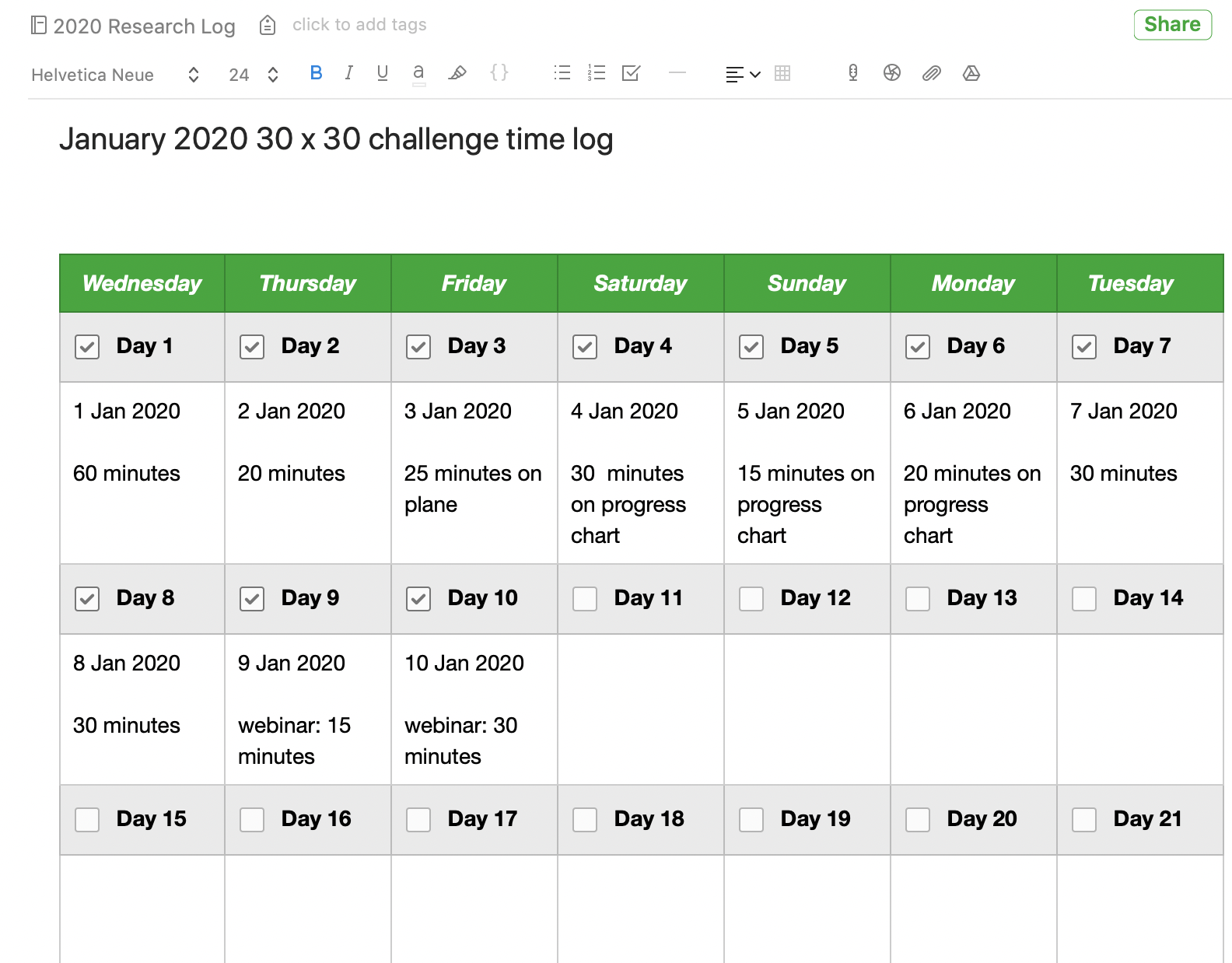
My good enough research logWe’re in the midst of a 30 x 30 challenge this month so I’ve been researching every day. It feels great. I have no more than 30 minutes (sometimes less) to research most days this month, so I rely on my research log to help me start each session.

I’ve blogged before about my research log and its value. This month, because I’m working on my RootsTech talk “The Imperfection Genealogist,” I’ve been reflecting on the fact that my very informal research log is far from perfect. But it’s certainly good enough.

How do I know it’s good enough? It’s because I’m in touch with why I want to keep a research log and the ways I use it. For me, it’s about knowing what I’ve researched in a given session and (perhaps more importantly) what my next steps are. It also tells me at a glance how frequently I’m researching. I keep my research log in Evernote, but I track of all my documents and family tree elsewhere, so I’m not creating source citations or storing documents in my research log. You might have a research log for different reasons. And yours may be very different from mine. And that’s great.

My good-enough research log is an Evernote notebook by year (I started the 2020 research log notebooks ten days ago), pinned as a shortcut in the sidebar. Each time I research, I open the notebook, create a new note with today’s date, and then write in free from what I worked on that day. I write down the questions that come up. I write down any discoveries. And I end the session by writing down the next steps. That way, when I start the next session, whether it’s the next day or the next month, I know where to start. That’s been a huge time saver for me. (I blogged in more detail about my research log in this post. About a year ago, I wrote a post about how my research log keeps me focused.)

This month, I’ve added an Evernote template that allows me to check off that I completed a session and I also add how many minutes I researched, because I’m hoping that I’ll get in 900 minutes in the 30 x 30 challenge, even if I don’t manage 30 minutes in some individual sessions. This is motivating to me, because when I see the checkmarks each day it makes me want to not break the chain. I also jot down in a couple of words what type of work I did. The picture at the top of this post is screenshot of the note that contains the template, which is in addition to my usual daily note but also stored in the 2020 research log notebook. (To get that template, I clicked on New Note, then on Template right in the note, then Habit Tracker in the Template Gallery. That inserted the template into the note and I edited it a bit.)

When I first started contemplating creating a research log in 2012, I could understand its value but I got wrapped up in trying to do it perfectly. Predictably, my first attempts failed. But as soon as I got in touch with what I really wanted out a research log and I made it easy to accomplish, things fell into place. Now, I’m glad to say that I’ve developed a habit of logging my session every day.

A couple of years ago, I created a Facebook group called Genealogy Research Loggers. We’re a pretty quiet group, but if you’d like some help and accountability for creating a research log habit, please join us!

For detailed information on how I organize my own genealogy research (including my research log), check out my Orderly Roots Guide, How I Do It: A Professional Organizer’s Genealogy Workflow, available for $19.99.

Filed Under: Challenges, Organizing Tagged With: Evernote, genealogy tools, research, research log

Talking about downsizing on Generations Cafe

October 4, 2019 By Janine Adams 6 Comments

I was so happy to be interviewed once again for Amy Johnson Crow’s  podcast, Generations Cafe. It’s a great podcast and I look forward to each new episode.

This week, Amy kicks off a series on downsizing, based on her recent experience in moving her parents from their home of many decades into a smaller space. In this week’s episode, called Downsizing and Family History, we talked at length about how it can be tricky for genealogists to decide what to let go of when they recognize the potential genealogical value of items for future generations.

The intersection of my work as an organizer and my passion as a genealogist is one of my favorite places to spend time, so I really enjoyed this opportunity to talk with Amy. (If you want to learn a little about how Amy organizes her own family history research, check out her How They Do It interview on this blog from July 2017.)

If you’re not already listening to Generations Cafe, I urge you to subscribe. If you’re new to podcasts, Generations Cafe is a great first genealogy podcast to subscribe to! The podcast showcases Amy’s clear-eyed view of genealogy and her excellent communications skills.

So glad to be a tiny part of it!

Filed Under: Excitement, Genealogy tips, Organizing Tagged With: amy johnson crow, excitement, learning opportunities, podcasts

Registration for RootsTech 2020 is open!

September 20, 2019 By Janine Adams 2 Comments

Registration has opened for RootsTech 2020, to be held in Salt Lake City February 26 to 29! As I mentioned, I will be speaking at this conference. Right now, my talk, The Imperfect Genealogist, is scheduled for Friday afternoon, February 28, but that’s subject to change. (You can see the current schedule here.) In a communication to speakers, we learned that 600 people signed up within the first few hours of registration opening on Wednesday. That bodes well for a well-attended conference as usual!

You can purchase a RootsTech pass for all four days ($169), or a one-day pass for a particular day ($99). And, if you’re feeling flush, you can also purchase an Ultimate Experience Pass (for $799) that gives you reserved seating, and behind-the-scenes opportunities, including a main stage rehearsal opportunity. You can check out this comparison chart of the various pass options.

RootsTech also offers Family Discovery Day on Saturday, February 29, for members of the LDS church. It’s free, but registration is required.

If you know you’ll attend, I urge you to register now (the early bird pricing above ends until October 11) and book a hotel room at the same time. The RootsTech block of rooms at the conference hotels are already selling out. You might consider booking a hotel room even if you’re still on the fence, since you can cancel it later if you decide not to attend. But be sure and make a note of it. Last year, I didn’t attend RootsTech, but I did book a hotel room months before–and promptly forgot. Imagine how shocked I was when I received an email suggesting I could check in for my Salt Lake City room online just a couple of days before the conference. Thankfully, I was able to cancel without penalty.

In addition to the the over 300 breakout sessions and daily general sessions with keynote speakers, RootsTech also features a giant Expo Hall where you can see the latest and greatest products and services for genealogists and talk with representatives from those companies. The conference is sponsored by Family Search, which typically has a huge booth staffed by their personnel to help you learn to take full of advantage of Family Search. Exhibitors also offer talks in the Expo Hall.

If you need more convincing, check out 10 Reasons to Attend RootsTech. And here’s an 11th reason. If you go, you can meet me! If you decide to attend, please let me know in the comments, if you haven’t already in a previous post, and we’ll arrange to meet up.

Filed Under: Challenges, Excitement, Organizing, Technology Tagged With: conferences, learning opportunities, RootsTech

  • « Go to Previous Page
  • Page 1
  • Interim pages omitted …
  • Page 16
  • Page 17
  • Page 18
  • Page 19
  • Page 20
  • Interim pages omitted …
  • Page 69
  • Go to Next Page »

about me

I'm Janine Adams, a professional organizer and a genealogy enthusiast. I love doing family history research, but I find it's very easy for me to get overwhelmed and not know where to turn next. So I'm working hard to stay organized and feel in control as I grow my family tree.

In this blog, I share my discoveries and explorations, along with my organizing challenges (and solutions). I hope by sharing what I learn along the way I'll be able to help you stay focused and have fun while you do your research, too.

tags

30 x 30 Adams amy johnson crow anniversary Brown cemetery census Civil War conferences connections dna electronic files Evernote excitement Family Curator family photos genealogy tools getting started goals How They Do It Igleheart Jeffries keepsakes learning opportunities maps newspapers NGS organizing aids overwhelm paper files planning quick tips rasco record keeping research research log research trip resources RootsTech social history source documentation Stacy Julian technology time management vital records

join the facebook community!

join the facebook community!

My organizing business

Learn more about my organizing business, Peace of Mind Organizing®.

Subscribe by RSS

  • RSS - Posts
  • RSS - Comments

© 2026 Janine Adams


Loading Comments...