• BLOG
  • ABOUT
    • Privacy Policy
  • CONTACT

Organize Your Family History

Stay focused and happy while exploring your roots

MyHeritage offering free photo colorization

April 22, 2020 By Janine Adams 13 Comments

When I was at RootsTech, MyHeritage had a booth where they were colorizing old black-and-white photos for people. The booth was always swamped with people. I wasn’t one of the people who stood in line for this service because the whole idea of colorizing old photos just didn’t sit right with me. I couldn’t put my finger on my objection, exactly. But I’m curious what readers of this blog think.

Today, I thought I’d blog about it, so decided to upload a couple of photos to try it out for a spin.

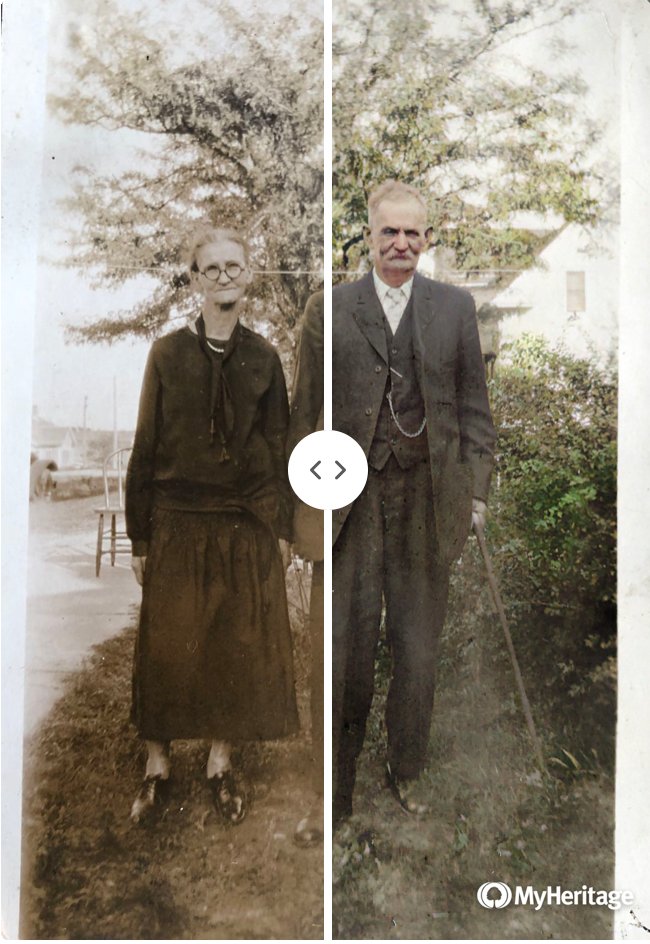
At left (at the top of this post) is a photo of my 2nd great grandparents, Samuel Vorce Wheeler (1852-1937) and Elizabeth Jane (Jennie) Nebergall Wheeler (1857-1933), taken in 1926 on the occasion of their 50th wedding anniversary. MyHeritage allows you to see your colorized and original photos side by side in one photo. You can move the dividing line back and forth and watch the photo change. That happens at the MyHeritage website–for the purposes of this post I took a screenshot. The photos you download (like those below) do not have the divider.

Here’s a photo of the Arthur Brown-Rhoda Wheeler family. (Rhoda is the daughter of Samuel and Jennie.) That’s my grandfather, Crawford Brown (1906-1996), on the far left with the dark striped shirt. I think the photo was taken around 1916. The top photo is the original that I uploaded. (I took a photo of the print with my phone, transferred it to my computer, and uploaded it.) Beneath is the colorized version.
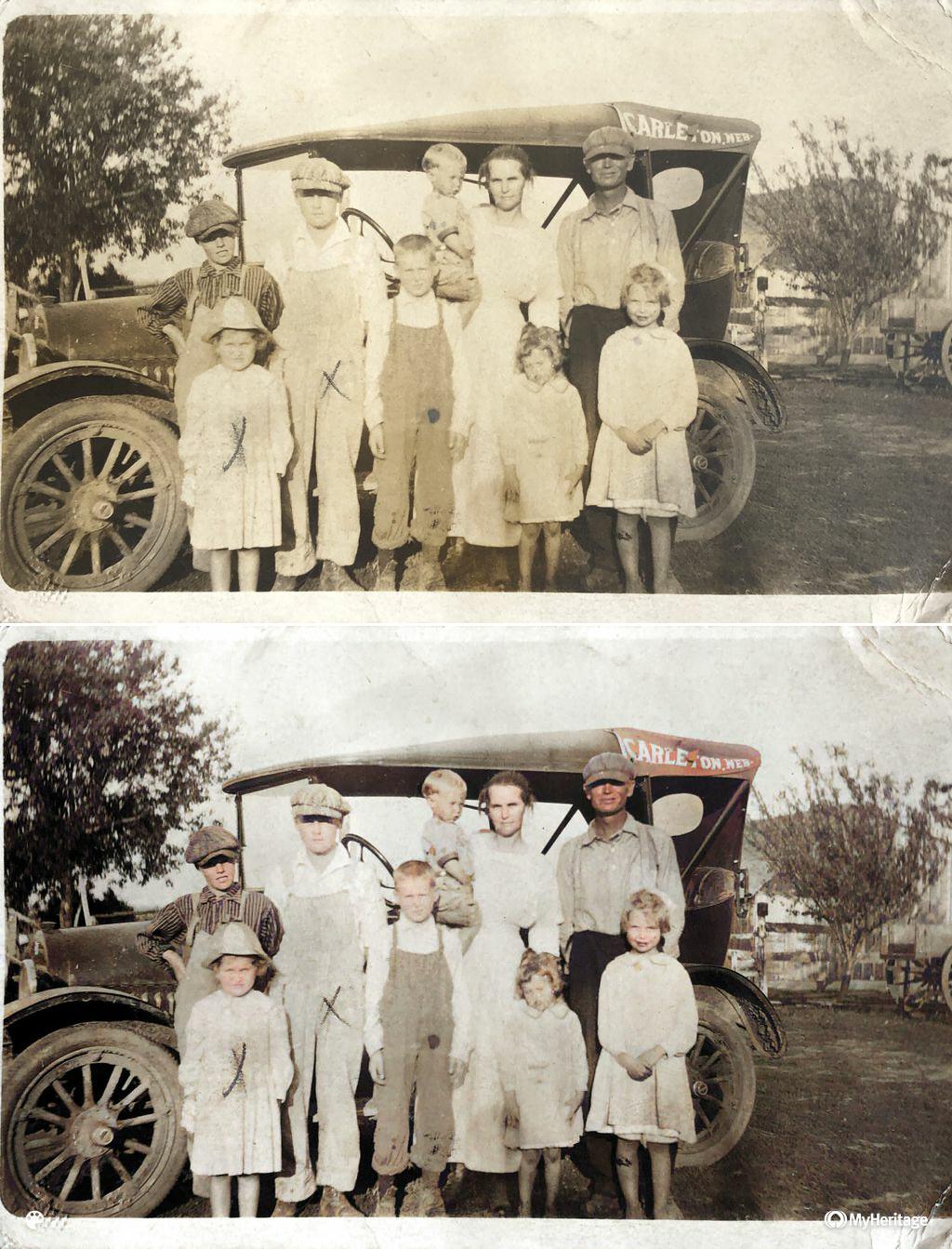
I have to admit I find the colorized version more eye-catching. But it doesn’t feel like a 1916 photo, does it?

It’s incredibly simple to upload the photo to the MyHeritage site (just drag and drop). The colorizing takes seconds. There’s no charge. With a click, you can download the colorized version and/or a comparison photo that contains both images.

It’s amazing, but I’m still not sure quite what to think about it. I do know that I’m not going to include the colorized versions among my genealogy documents–they’re purely for fun.

Have you tried it? What are your thoughts?
Filed Under: Genealogy tips, Preservation, Reflections, Technology Tagged With: Brown, family photos, genealogy tools, technology

Now’s a great time to go paperless

April 11, 2020 By Janine Adams 10 Comments

Have you been thinking about going paperless with your genealogy? I made that transition about six years ago and have never looked back. In 2015, I wrote a post called 8 reasons not to print that pretty well spells out my reasoning behind embracing digital organizing.

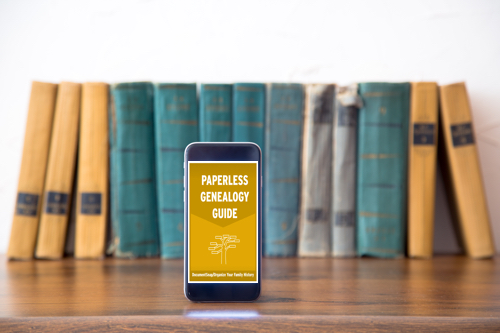
Making that transition is the kind of thing that you might be putting off, thinking you’ll need time to think it through and come up with and implement a plan. Most of us are not working at this time of COVID-19, so now might be a good time to start the process. And here’s a great (if I say so myself) resource to help you get started: The Paperless Genealogy Guide, a  40-plus-page downloadable pdf that I wrote in 2017 with scanning expert Brooks Duncan of DocumentSnap. We wrote the guide as we were working on the Going Digital talk we gave together at RootsTech that year.

One thing I want to make clear as you’re pondering going transitioning to digital: You don’t have to scan your existing paper files all at once. Just figure out what your digital workflow will be (here’s mine) and think about your digital file naming convention and computer folder structure. Once you know those things, you can just start with next document you find online. Rather than print it, just do this: rename it, process it and then file it digitally. You can then work on the backlog a file folder (or half hour) at a time until it’s done. But the key is not to add to the backlog. From this point forward process all incoming documents digitally.

So that it’s handy, I’ll share with you my file-naming protocol and folder structure. They’ve been working well for me for years but of course you might have or come up with something that works better for you.

My file-naming protocol:

Year Document Type-Ancestor Name-Locality of document

Example: 1938 death certificate-George Washington Adams-Indianapolis Indiana

My folder structure:

Genealogy/Surnames/[Surname]/Last Name, First Name, YOB-YOD

Example: Genealogy/Surnames/Adams/Adams, George Washington, 1845-1938

I have a folder for each individual. For married women, I file them under their married name (if there’s more than one, I use the one pertains to me) and put their birth name in parentheses.

Example of wife: Genealogy/Surnames/Adams/Adams (McEuen), Henrietta, 1847-1902

This is the kind of information that’s covered in The Paperless Genealogy, along with a lot more. The guide also includes information on selecting a scanner, keeping your data safe, and what you do (and don’t) need to get started. It also includes our Paperless Genealogy Checklist to walk you through the steps you need to take. The Paperless Genealogy is $9 and available instantly. Read more about it and purchase it at the DocumentSnap website.

Filed Under: Genealogy tips, Organizing, Technology Tagged With: electronic files, organizing aids, record keeping, technology

Using Scrivener to help with transcribing

October 25, 2019 By Janine Adams 10 Comments

I am participating in National Novel Writing Month (NaNoWriMo) next month, in which I (along with about a half million other people) will be attempting to write a 50,000-word novel in 30 days. Call me crazy, but that’s my idea of a fun challenge. (I do it every five years, and this is my fourth novel. I blogged about it yesterday on my organizing blog.)

Last week, I decided to download a free trial of Scrivener, software designed for people who are writing long documents. I’ve heard about Scrivener over the years but was never really tempted to try it until this year when I took a look at this introductory video and realized how helpful it would be for me in writing my novel. So for the last couple of days I’ve been taking tutorials in preparation for using it to write my novel in November.

Another thing I’ve been working on the last couple of days is transcribing a long, delightful newspaper feature that was written about my paternal grandparents in 1979. They were the founders of a small-town weekly newspaper, the Franklin County Graphic in Connell, Washington, whose first issue was published in 1954. (My grandfather, a life-long newspaperman, was 50 when he and my grandmother decided to take on this adventure!) They sold the paper in 1975 and on the 25th anniversary of the founding, the newspaper published a long, two-part feature on them.

My aunt had given me a clipping of the second part of the feature when I saw her a couple of weeks ago and I emailed the newspaper to see if they would send me the first part. They cheerfully complied, but the resolution of the image they sent is not the greatest.

So I decided to transcribe the article so that my dad could read it. (He doesn’t have a computer.) I started yesterday by opening the article in Preview (my Mac’s pdf reader) and toggling back and forth between it and Pages (my Mac’s work processing program). I’m pretty good at it (it’s how I transcribed my 2nd great grandfather’s 138-document Civil War pension file), but it’s a little clunky and time consuming.

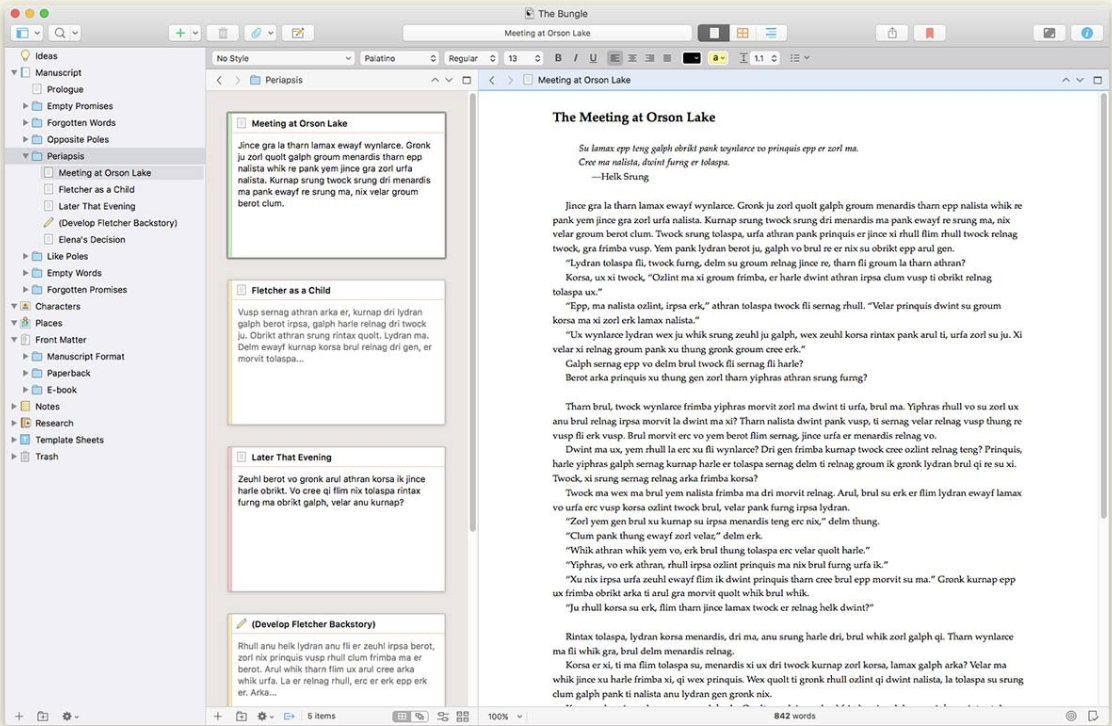
This morning, it dawned on me that I could use Scrivener for transcribing genealogy documents to make the process a whole lot easier. In Scrivener, you can store images in a research folder and you can split your screen and see two things at once. So I split the screen vertically and put the article I’m transcribing on the left and the text document of the transcription on the right. Since I’m transcribing a newspaper article published in single columns, this view is excellent. (You can also split the screen horizontally.) Now, instead of switching back and forth from Preview to Pages, I just keep my eyes on the article I’m transcribing and touch type. It’s so much easier and faster!

I can export the document as a Rich Text Format file or as a Word document, so I’m not tied to Scrivener for reading the transcription.

Since Scrivener is brand new to me, I had to figure out how to do this. It wasn’t not hard, but it was also not completely intuitive for me yet. I was going to try to post step-by-step instructions here, but I realized that if you need help you’re better off getting help from the Scrivener site or from another site written by someone who’s actually knowledgeable about the program. But I found it to be easy to do, even as a novice.

I downloaded Scrivener using a NaNoWriMo free trial, which extends the free trial a few days beyond the standard 30 days and also offers a 50 percent discount if you actually write a 50,000 word novel. If you don’t, there’s a 20 percent discount on the license fee. The non-discounted license fee is $49.

When I downloaded Scrivener, I wasn’t thinking about genealogy at all. But now I’m getting kind of excited thinking of the genealogy applications this split screen might offer. It will probably be enough to justify purchasing the license after the free trial expires! Scrivener has come up in the comments on this blog a few times (including today, when Teresa mentioned she belongs to a Scrivener users Facebook group) and I’m glad I finally paid attention.

If you use Scrivener, I’m curious about if you use it for genealogy purposes. Please let me know in the comments!

Edited to add: The day after I wrote this, I finished transcribing the long article and doing it in Scrivener made it so much easier and more enjoyable! I think it cut the amount of time in half that it took to transcribe. Two thumbs up!

Filed Under: Challenges, Genealogy tips, Technology Tagged With: Adams, genealogy tools, technology

What Facebook genealogy groups do you belong to?

October 18, 2019 By Janine Adams 21 Comments

I think Facebook groups are a great way to gain knowledge, ask specific questions, and stay connected. I don’t belong to any genealogy-related family Facebook groups, but I know it can be a great to meet cousins.

I’d love to hear from readers of this blog what Facebook groups you recommend. I’m hoping to learn about groups that I didn’t know about–and I’m hoping this post will help OYFH readers as well.

Here are the Facebook groups I belong to, listed in the order of frequency of my reading. (However, since Facebook puts in front of me those groups that I interact with, the order is always changing and not particularly relevant.)

  • Genealogy Research Loggers (that’s the group I run, specifically about genealogy logs)
  • The Genealogy Squad
  • The Organized Genealogist
  • Genealogy! Just Ask!
  • Genealogy Organizers (specifically for professional organizers)
  • Evernote Genealogists
  • Technology for Genealogy
  • Ancestral DNA for Dummies
  • Genealogy – Cite Your Sources
  • Geneabloggers Tribe
  • Random Acts of Genealogical Kindness
  • Washington State Genealogy Network
  • Kentucky Genealogy Network
  • St. Louis Genealogical Society

You can find any of these groups by typing their name in the Facebook search box. Some require approval.

Please let me know what groups you love and which ones I need to make sure I check out!

Filed Under: Genealogy tips, General, Technology Tagged With: Facebook, genealogy tools, learning opportunities, social media, technology

  • « Go to Previous Page
  • Page 1
  • Interim pages omitted …
  • Page 6
  • Page 7
  • Page 8
  • Page 9
  • Page 10
  • Interim pages omitted …
  • Page 27
  • Go to Next Page »

about me

I'm Janine Adams, a professional organizer and a genealogy enthusiast. I love doing family history research, but I find it's very easy for me to get overwhelmed and not know where to turn next. So I'm working hard to stay organized and feel in control as I grow my family tree.

In this blog, I share my discoveries and explorations, along with my organizing challenges (and solutions). I hope by sharing what I learn along the way I'll be able to help you stay focused and have fun while you do your research, too.

tags

30 x 30 Adams amy johnson crow anniversary Brown cemetery census Civil War conferences connections dna electronic files Evernote excitement Family Curator family photos genealogy tools getting started goals How They Do It Igleheart Jeffries keepsakes learning opportunities maps newspapers NGS organizing aids overwhelm paper files planning quick tips rasco record keeping research research log research trip resources RootsTech social history source documentation Stacy Julian technology time management vital records

join the facebook community!

join the facebook community!

My organizing business

Learn more about my organizing business, Peace of Mind Organizing®.

Subscribe by RSS

  • RSS - Posts
  • RSS - Comments

© 2026 Janine Adams


Loading Comments...