• BLOG
  • ABOUT
    • Privacy Policy

Organize Your Family History

Stay focused and happy while exploring your roots

Quick Tip #20: Write everything down

May 25, 2021 By Janine Adams 4 Comments

Here’s the next in my occasional series of bite-size Quick Tips. Click on the Quick Tips tag for my other Quick Tips. Because I tend to write longer posts, I wanted to provide a quick-to-read (and quick-to-write) post every couple of weeks on a small topic that pops into my head. This one saves time and frustration!

Write everything down

I learned a number of years ago that I can’t rely on my memory when it comes to genealogy. (Or a lot of things, for that matter.) I can keep a few ancestors’ names and birth and death dates in my head, but only a few. I used to think I would remember to pick up where I left off in a session or to pursue a clue (from a previous session or even the current one). But now I don’t take a chance, I write it down.

The key to success in taking these notes is having a place to put them so you know where to look. That could be a spiral bound notebook or a pad you keep by your keyboard. Or it could be a note in your genealogy software. Or it could be in follow-up notebooks in a platform like Evernote (that’s what I use). Or in your research log, in whatever form it takes

The takeaways here are twofold: (1) don’t rely on your memory and (2) have a consistent place where you put follow-up notes or lists of tasks. This small practice makes everything easier!

Filed Under: Challenges, Genealogy tips, Organizing Tagged With: best practices, quick tips, research log

Quick Tip #8: Imperfect research logs

October 13, 2020 By Janine Adams 4 Comments

Here’s the next in my occasional series of bite-size Quick Tips. Click on the Quick Tips tag for my other Quick Tips. Because I tend to write longer posts, I wanted to provide a quick-to-read (and quick-to-write) post every couple of weeks on a small topic that pops into my head. This lesson on imperfection is one I embrace on a daily basis in most aspects of my life.

An imperfect research log is better than no log at all

As I’ve written here before, I struggled for years with guilt over not having a research log. Every now and then I would try one and then I would give up because it felt like too much work. But then I embraced ease and I started a simple, extremely imperfect, Evernote research log where I simply free-write what I did during each session in a new note in my Research Log notebook. I go into it in some detail in this post.

The fact that it’s so easy to log my research means that I actually do it. One key component of my log is that I write down the next action at the end of each session so I can pick up where I left off. I find it really helpful to check my previous session’s log at the beginning of a new session.

It’s certainly possible to do a more robust research log. And you’ll surely benefit from it. But I’ve come to acknowledge that my imperfect log is perfect for me. And that’s what it’s all about.

P.S. If the topic of genealogy research logs is of interest to you, you might want to join my Genealogy Research Loggers Facebook group. It tends to be a pretty quiet group, but you can always post there looking for guidance.

Photo by Sam Dan Truong on Unsplash

Filed Under: Genealogy tips Tagged With: quick tips, research log

Reminder: You can let go of “should”

August 28, 2020 By Janine Adams 6 Comments

It’s natural to ask about questions about organizing (your genealogy or anything else) that start with the word “should.” Should I organize my documents this way or that way? Should I store things here or there? Should I focus on this or that?

When I try to answer a question that starts with should, the answer is almost always, “It depends.” Because it’s all about what will work for you.

I encourage my clients (and anyone else who will listen to me) to let go of the word should. And to also let go of asking questions that start with, “What’s the right way to…” or What’s the best way to….”

Because here’s the thing: I can’t tell you what you should do. Only you know what’s right for you. It can be much more beneficial to think in terms of what you’d like to do, or what you think will work best for you, rather than what you should do. Especially when it comes to organizing your genealogy research, the thing you should do (in my opinion) is the thing that works well for you and that you can keep up.

For example:

  • Maybe you’ve always heard that you should store your paper documents in binders, but you have trouble keeping up with that. Let go of that should and consider using file folders or scanning your documents.
  • Maybe you think you should print every document for the sake of posterity but you’re overrun with unfiled paper. You can let go of that should, particularly if your electronic documents are already organized.
  • Conversely, maybe you’ve heard you should scan every bit of paper and store files electronically, but you’re overwhelmed by the prospect. Bye bye, should. You can let your paper files be sufficient. Or just start storing new files electronically and leaving your papers unscanned.
  • Maybe you’re told you should keep a research log, but you just can’t get yourself to do it. A research log can be hugely beneficial. But don’t beat yourself up if you don’t have one just because you think you should.

In other words, set yourself up for success and do what works for you. Decide what your priorities are (accessibility for you, accessibility for others, ease of use, etc.) and focus your organizing systems on those priorities. Don’t do something just because someone told you you should if it doesn’t seem like it will work for you.

All that said, there are some genealogy shoulds that I think you should pay attention to:

  • You should cite your sources so you can find them again and know where your facts came from (but you don’t have to cite them perfectly if that’s getting in the way of citing them at all).
  • You should back up your electronic data in case of a crash. (I use an external hard drive and automated cloud storage.)

Genealogy is supposed to be fun. Don’t let the shoulds drag you down. Make your own choices and own them. And keep yourself open to new ways of doing things. (See what I did there? I told you all sorts of things I think you should do, without using that word. Take what works for you and let go of the rest.)

[If this is feels familiar, it’s because I initially published this post on May 17, 2016. Then I published it again on November 6, 2018 with a different title. It’s a message that really resonates with me right now, so I wanted to repeat it.]

Filed Under: Genealogy tips, Organizing, Reflections Tagged With: goals, organizing aids, overwhelm, research log, source documentation

My “good enough” research log

January 10, 2020 By Janine Adams 8 Comments

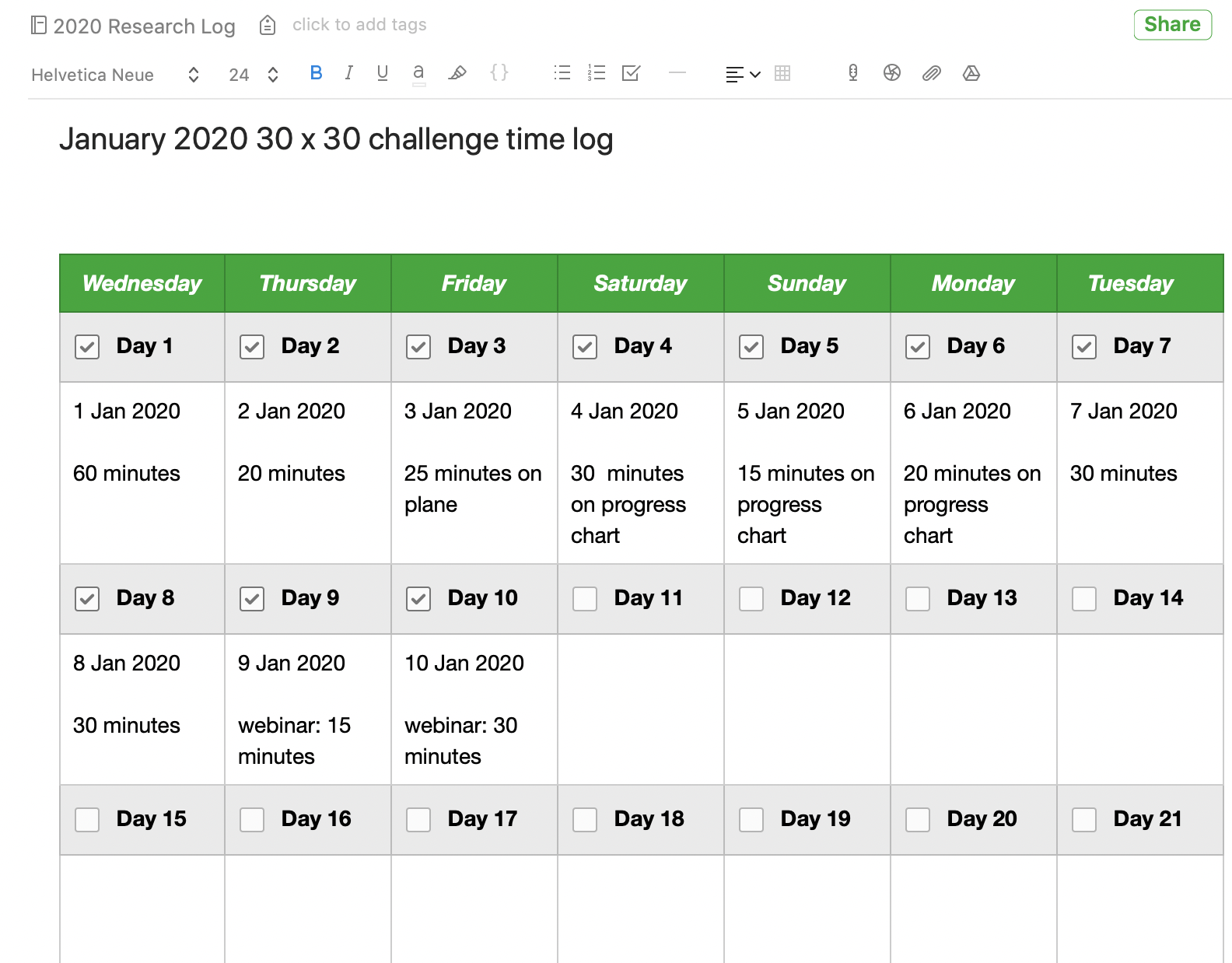
My good enough research logWe’re in the midst of a 30 x 30 challenge this month so I’ve been researching every day. It feels great. I have no more than 30 minutes (sometimes less) to research most days this month, so I rely on my research log to help me start each session.

I’ve blogged before about my research log and its value. This month, because I’m working on my RootsTech talk “The Imperfection Genealogist,” I’ve been reflecting on the fact that my very informal research log is far from perfect. But it’s certainly good enough.

How do I know it’s good enough? It’s because I’m in touch with why I want to keep a research log and the ways I use it. For me, it’s about knowing what I’ve researched in a given session and (perhaps more importantly) what my next steps are. It also tells me at a glance how frequently I’m researching. I keep my research log in Evernote, but I track of all my documents and family tree elsewhere, so I’m not creating source citations or storing documents in my research log. You might have a research log for different reasons. And yours may be very different from mine. And that’s great.

My good-enough research log is an Evernote notebook by year (I started the 2020 research log notebooks ten days ago), pinned as a shortcut in the sidebar. Each time I research, I open the notebook, create a new note with today’s date, and then write in free from what I worked on that day. I write down the questions that come up. I write down any discoveries. And I end the session by writing down the next steps. That way, when I start the next session, whether it’s the next day or the next month, I know where to start. That’s been a huge time saver for me. (I blogged in more detail about my research log in this post. About a year ago, I wrote a post about how my research log keeps me focused.)

This month, I’ve added an Evernote template that allows me to check off that I completed a session and I also add how many minutes I researched, because I’m hoping that I’ll get in 900 minutes in the 30 x 30 challenge, even if I don’t manage 30 minutes in some individual sessions. This is motivating to me, because when I see the checkmarks each day it makes me want to not break the chain. I also jot down in a couple of words what type of work I did. The picture at the top of this post is screenshot of the note that contains the template, which is in addition to my usual daily note but also stored in the 2020 research log notebook. (To get that template, I clicked on New Note, then on Template right in the note, then Habit Tracker in the Template Gallery. That inserted the template into the note and I edited it a bit.)

When I first started contemplating creating a research log in 2012, I could understand its value but I got wrapped up in trying to do it perfectly. Predictably, my first attempts failed. But as soon as I got in touch with what I really wanted out a research log and I made it easy to accomplish, things fell into place. Now, I’m glad to say that I’ve developed a habit of logging my session every day.

A couple of years ago, I created a Facebook group called Genealogy Research Loggers. We’re a pretty quiet group, but if you’d like some help and accountability for creating a research log habit, please join us!

For detailed information on how I organize my own genealogy research (including my research log), check out my Orderly Roots Guide, How I Do It: A Professional Organizer’s Genealogy Workflow, available for $19.99.

Filed Under: Challenges, Organizing Tagged With: Evernote, genealogy tools, research, research log

  • « Go to Previous Page
  • Page 1
  • Page 2
  • Page 3
  • Page 4
  • Interim pages omitted …
  • Page 9
  • Go to Next Page »

about me

I'm Janine Adams, a professional organizer and a genealogy enthusiast. I love doing family history research, but I find it's very easy for me to get overwhelmed and not know where to turn next. So I'm working hard to stay organized and feel in control as I grow my family tree.

In this blog, I share my discoveries and explorations, along with my organizing challenges (and solutions). I hope by sharing what I learn along the way I'll be able to help you stay focused and have fun while you do your research, too.

tags

30 x 30 Adams amy johnson crow anniversary Brown cemetery census Civil War conferences connections dna electronic files Evernote excitement Family Curator family photos genealogy tools getting started goals How They Do It Igleheart Jeffries keepsakes learning opportunities maps newspapers NGS organizing aids overwhelm paper files planning quick tips rasco record keeping research research log research trip resources RootsTech social history source documentation Stacy Julian technology time management vital records

join the facebook community!

join the facebook community!

My organizing business

Learn more about my organizing business, Peace of Mind Organizing®.

Subscribe by RSS

  • RSS - Posts
  • RSS - Comments

© 2026 Janine Adams


Loading Comments...
