Planning a genealogy research trip

I live in St. Louis and my maternal roots go back to western Missouri. My mother was born in Jefferson City, but moved to Spokane, Washington, in 1936 with her family. I grew up in Washington and always knew I had Missouri cousins. Though I’ve lived in Missouri for 23 years, I’ve yet to seek out those cousins, nor travel to the area (some four or five hours away) to try to track down genealogy records.

But now that I’m back into the family history research, I’m itching to go on a genealogy research trip. Looking at my calendar, I see that I have three free days next week, so the thought occurred to me that that might be just the time to take a little road trip to look into the Browns and the Jeffries.

Of course, as an organized person, I know that such a research trip will require some planning if it’s going to be productive. But I have to admit that when I think about planning it, my head starts spinning a little. So I figure what I need to do before I take such a trip is the following:

  • See how many of the four western Missouri counties in my database I can realistically fit in a quick trip
  • Choose the counties I’d like to visit
  • Figure out what family members I’d like to research, what records I already have and what I’d like to track down
  • Locate the cemeteries where I know folks were buried, based on death certificates
  • Create a list of other family members who might be buried in those cemeteries
  • Find out where I might be able to obtain the records I seek
  • Know just what I’m looking for when I go to courthouses or libraries
  • Figure out where to stay
  • Figure out driving routes
  • Ask my mother for names of cousins I might reach out to

When I write it all down like that, the spinning in my head slows down somewhat. I need to remind myself that I don’t have to get everything done in one visit. I can take plenty more road trips. But I do want to put some planning into my first one so that it’s at least somewhat productive.

This sounds like great fun. I will post the results (and some photos) here, after the research trip takes place!

Finding Civil War ancestors

If you have male ancestors born between about 1820 and 1850 and who lived in the U.S., I encourage you to look into their military records! I have been able to find large packets of information on two Civil War ancestors through Fold3.com. These are images of forms filled out by hand–Civil War Muster Roll, Pension Files and other documents. Fold3.com is a membership site. I paid only $40 for a year’s membership, though I think I got in on some kind of special. In just finding documents for two ancestors (there are probably more!), I feel I got my money’s worth.

A month or two ago, I found information on Benjamin Franklin Igleheart, my great great grandfather, on my father’s side. As I read his  Compiled Service Record, which consists of 15 pages of printed forms, filled in by hand, a story unfolded. I learned that he entered the war as a substitute. In other words, he was paid to serve for someone else (a man named Jacob Gish) who was drafted. He was only 18 and I guess had managed not get drafted himself. Thankfully, he survived that experience. I found the concept of a paid substitute an eye opener.

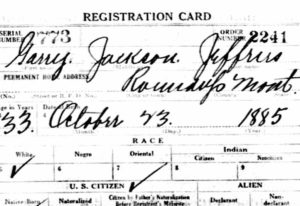
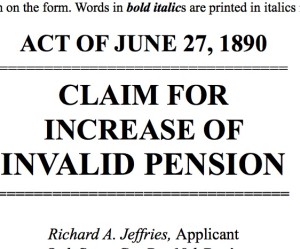
This weekend, I researched my great great great grandfather (on my mother’s side), Richard Anderson Jeffries. I was able to find his Compiled Service Record (29 pages!) and watched his story unfold as I read backward through time. I learned that on October 1, 1864, his rank was reduced from First Sergeant to Private. And on October 4, 1864, he was hospitalized in Atlanta, Georgia (with no indication why), where he appeared to reside until his discharge, due to the expiration of his term of service, on November 14, 1864. That’s mysterious. I’d love to find out why he was demoted. I also learned, that he went missing in action during the Battle of Shiloh on April 6, 1862 and was compensated upon his return for seven months as a prisoner of war. Wow. Now I want to learn more about that battle and about what conditions he might have endured as a prisoner.

To find this information, I needed to know the military unit my ancestors fought with. A good starting place to find that information is the Civil War Soldiers and Sailors Database from the National Park Service. Searching for Richard Jeffries turned up two possibilities in Missouri, where I knew my Richard lived at the time. There was one record for a Richard Jeffries in the Home Guard in Putnam County (his county) and another for serving in 18th Regiment, Missouri Infantry. I took that info to Fold3 and found his records. I was able to verify that the 18th Regiment, Missouri Infantry was him, since his death date was on the included pension form. (This was also the regiment listed in the genealogy compilation book I’d found online a couple of weeks ago, which gave me confidence.) I’m not certain if he’s also the Richard Jeffries in the Putnam County Home Guard. That will take a little more digging.

Both these ancestors fought on the Union side, so I only have experience with Union records. Your experience may be different if you’re researching ancestors who fought for the confederacy.

If you haven’t yet researched your Civil War ancestors, I think you’re in for a treat. I was amazed at how easily I found really exciting information that I was able to verify. Fold3 has been a goldmine for me, well worth the investment.

Civil War reflections

Last month I went to the Missouri History Museum to see the special exhibit, The Civil War in Missouri. I have to say, the exhibit stressed and depressed me. What a horrible war, particularly in Missouri, which was recognized by both the Union and Confederacy.

Thanks to my family history research, I believed I had people living in Missouri at that time. But I didn’t have that info at my fingertips, so I wasn’t sure who they were and where they lived. (That’s one reason I subsequently downloaded the Reunion app. I blogged about the Reunion app on my organizing business’s website.)

I learned in the exhibit about General Order No. 11, in which all residents of the better part of four western Missouri counties–no matter what their loyalty was–were ordered to vacate their homes and the counties.  I looked at the map at the exhibit and saw some counties whose names were familiar from my genealogy research. The horror of what these folks endured–being ordered, by name, to vacate their homes and told they couldn’t return to the county (or other specified counties) and then having their homes and communities destroyed by government-ordered fire–is bad enough. When I contemplated that my ancestors might have been among them, it made it even worse for me.

A week or so later, I was researching my great-great grandfather, John Jeffries, who was born in 1850. I found him on the 1860 census, living in Putnam County, Missouri. He was living in Bates County, Missouri in the 1870 census. (In both censuses, he was living with his parents.) I knew that Bates was one of the counties people were forced to leave.

I decided to try to look into the Civil War experience of people in Putnam County and started by locating it on a map. My heart was in my throat as I zoomed out to try to ascertain where within the state the county is located.

And I was flooded with relief to see that it’s in the north-central portion of the state, bordering Iowa. I think that means they would not have endured martial law. Of course, I still have plenty of social history research to do to verify that. And they probably endured another kind of misery there.

As I went through those emotions, I was really struck by how personal family-history research is and how it makes history feel very real. When you have a connection to an individual who lived through an historical event, it makes that event more vivid, more urgent.

Another interesting reflection is how having ancestors living in Missouri during the Civil War, which had both Confederate and Union sympathizers, made the war a little less cut-and-dried for me. I grew up in the state of Washington and so am a true northerner. I was taught that the Union was the side of the righteous and the Confederacy quite the opposite. The fact that my ancestors may have been terrorized by martial law imposed by the Union doesn’t make it any less horrible to me. Boy, there’s a lot of grey area there.