• BLOG
  • ABOUT
    • Privacy Policy

Organize Your Family History

Stay focused and happy while exploring your roots

30 x 30 wrap up

March 31, 2017 By Janine Adams 4 Comments

My March 30 x 30 challenge ended yesterday. I challenged myself to do 30 minutes of genealogy research every day for 30 days (in this case, March 1 to 30). Some of you said you’d join me.

For me, this was a successful challenge! As in my November 2016 30 x 30 challenge, I spent a lot of time transcribing. I will say that having a project like that makes the challenge easier because it was always there for me to turn to. But it wasn’t completely about the transcribing. Here’s what I accomplished:

  • I did at least 30 minutes of research for probably 28 days (a couple of days I forgot!).
  • I transcribed 24 documents in the Civil War pension file of my 2nd great grandfather, George Washington Adams (1845-1938).
  • I abstracted six documents in that pension file.
  • I made a few breakthroughs in researching that 2nd great grandfather’s second family.
  • I managed to stay focused on the Adams family, my goal for 2017.
  • I remembered to log each of my sessions! (Full disclosure: For the transcriptions, I counted checking off a document on my checklist logging.) I feel like I’m slowly building up the research log habit.

I can tell you in all sincerity that if it weren’t for this challenge, a fraction of those things would have been accomplished. Some days I just didn’t feel like thinking about my research, but because of the challenge, I pulled out that pension file and started transcribing. It has 138 documents and I’ve transcribed 89 if them (almost two-thirds!) and abstracted 31. I still have a ways to go, but thanks to this challenge, the light is starting to shine at the end of the tunnel.

How about you? If you participated in the challenge (or a variation of it), how did it go?
Filed Under: Challenges, Excitement Tagged With: 30 x 30, Adams, time management

My digital workflow

March 24, 2017 By Janine Adams 26 Comments

Digital workflow for genealogyWhen Brooks Duncan and I spoke at RootsTech last month about going digital with genealogy research, it became apparent to me from the questions that digital workflow is an individual thing. I’ve developed a work flow that works well for me, so I thought I’d share it here. I’m not suggesting I do things The Right Way (I don’t know if there is a right way, especially for hobbyists), but I wanted to show you what works for me. I know that I love seeing examples of how people handle their own workflow, so in the spirit of sharing, here’s mine.

When I find a digital document online–let’s say it’s a census document that I found at Ancestry–I take the following steps after ascertaining that it’s pertinent to my research:

  1. I click Save to download the document to my computer’s desktop.
  2. I rename the file immediately so that it reflects my simple file-naming protocol (year document type-ancestor name-location).
  3. I immediately file the document in my file structure (Genealogy/Surnames/[Ancestor’s surname]/[Ancestor’s name]
  4. I analyze the document and enter the first fact into my Reunion software.
  5. I create a source for that fact, using Reunion’s templates.
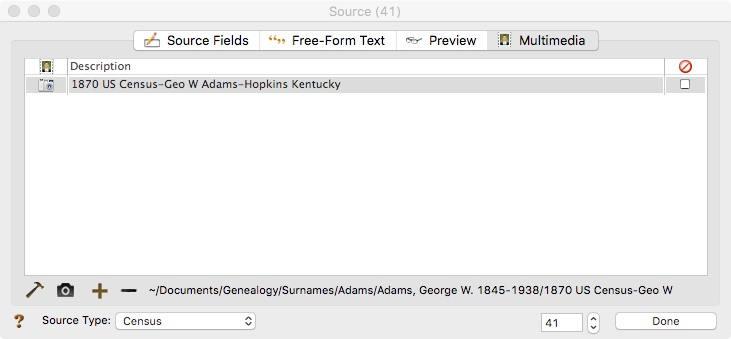
  6. I drag the image of the file into the Multimedia section of the Reunion source screen for that source. (That’s an example of the Reunion source screen at the top of this post.)
  7. I enter all other facts I find in the document into Reunion, using the same source number for each fact I find in that document.
  8. I click Preview in the Reunion source screen for that source and copy the citation and paste it into the metadata of the image file on my hard drive.

I added that last step after RootsTech, adapting a suggestion made by an audience member at our talk. I hadn’t thought about noting on the image what the source number and citation is. I think it’s a great idea and now I intend to go to back and do that for all my sources.

This eight-step work flow takes me from discovery through processing the document. It means that I don’t have stray documents on my hard drive with nonsensical file means. It also means I can easily a find a document when I want to. And it helps me see what documents are missing. Having the confidence that I can find a document I’ve saved allows me to feel good about not printing it, which cuts down on my paper clutter. (And, yes, I backup my hard drive daily, both to the cloud and to an external hard drive.) This workflow was about five years in the making, but I’m very satisfied with it!

For more in-depth information on how I organize my own genealogy, including a detailed look at my digital workflow, check out How I Do It: A Professional Organizer’s Genealogy Workflow, a 37-page downloadable available for $19.99.

Filed Under: Challenges, Organizing, Technology Tagged With: electronic files, organizing aids, record keeping, source documentation

Why keep a genealogy research log?

March 21, 2017 By Janine Adams 26 Comments

Why keep a genealogy research log?I’ve been writing about research logs quite a bit these days, particularly about my intention in 2017 to ingrain a habit of logging my research every time I do research. I created the Facebook group Genealogy Research Loggers (feel free to join us) and I really have been trying to be good about using a research log.
Recently, I received a comment on a blog post I wrote about genealogy research logs way back in 2012. Commenter Morag apparently stumbled on that post earlier this month and left this comment:

I don’t understand the value of a research log. Do you have any good posts about that, by you or someone else?

I don’t think I’ve ever written any great posts on the why of a research log. To me the value of keeping track of your research is intuitive and it’s always gone without saying. But then I realized it was a question worth addressing. So I told Morag I’d write about my reasons and then ask the smart readers of this blog to comment with their own perspectives.

For me, I think it’s valuable to write down what I’ve researched at the end of each session for the following reasons:

  • It allows me to take stock of what I’ve done
  • It prompts me to write down next steps (which helps eliminate the paralyzing question of what to work on)
  • It helps me avoid repeating searches I’ve already done
  • It keeps track of things I would otherwise inevitably forget

This thought process begs the question of what a research log actually is. I’m gathering that the term means different things to different people. For me, a research log has always been simply a record of the research I’ve done, coupled with notes about potential future exploration. I don’t store my genealogy data or source citations in a research log. Those I keep in my family-tree software, Reunion. I keep my research log in Evernote, using a very simple template I created or sometimes just a free-form note. It’s informal and not shared with anyone. I have also been experimenting with using the Log feature in Reunion for a particular research problem, but I think I’ll go back to Evernote for everything.

I’ve learned through the Genealogy Research Loggers Facebook group that different people are comfortable with different formats, and I think that’s great.  I think the best research log format is one that is simple enough that you’ll actually use it and complex enough to provide you with the information you need.

But getting back to the original question, why do you think it’s important to keep a research log? Please share!

Filed Under: Challenges, Organizing Tagged With: genealogy tools, research, research log

Kiss me, I’m Irish!

March 17, 2017 By Janine Adams 1 Comment

DNA test. Now what?Last year on St. Patrick’s Day, I wrote a post about my DNA ethnicity results. It seems appropriate to run it again today. Happy St. Patrick’s Day!

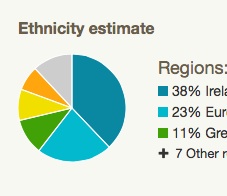
I never felt much of a connection to March 17 until I had my DNA tested through Ancestry DNA. Then I discovered in that test that I’m 38% Irish. (That’s my pie chart in the picture.) I knew that Ireland was in my family tree, but I haven’t researched much that far back to realize that it was an important part of my heritage.

Growing up, Irish roots were never mentioned. All that came up was vague mention of England, though in reality our heritage wasn’t much discussed. That’s probably because there were  no immigrants recent enough for my parents or grandparents’ to have known them. We always just felt American.

When I had my DNA tested, it was in an effort to meet cousins and further my genealogical research. (Understanding those results is an ongoing project.) The ethnicity component of didn’t even enter my mind. But today, St. Patrick’s Day, it feels nice to have a kinship with my Irish forebears, though I’m still learning about who they were.

If you’re curious about your own DNA, Ancestry DNA is having a sale–10% off kits through March 19, 2017.

If you’ve had your DNA tested were you surprised by the ethnicity results?

Filed Under: Challenges, My family, Reflections, Technology Tagged With: genealogy tools, genetic genealogy, research

  • « Go to Previous Page
  • Page 1
  • Interim pages omitted …
  • Page 70
  • Page 71
  • Page 72
  • Page 73
  • Page 74
  • Interim pages omitted …
  • Page 109
  • Go to Next Page »

about me

I'm Janine Adams, a professional organizer and a genealogy enthusiast. I love doing family history research, but I find it's very easy for me to get overwhelmed and not know where to turn next. So I'm working hard to stay organized and feel in control as I grow my family tree.

In this blog, I share my discoveries and explorations, along with my organizing challenges (and solutions). I hope by sharing what I learn along the way I'll be able to help you stay focused and have fun while you do your research, too.

tags

30 x 30 Adams amy johnson crow anniversary Brown cemetery census Civil War conferences connections dna electronic files Evernote excitement Family Curator family photos genealogy tools getting started goals How They Do It Igleheart Jeffries keepsakes learning opportunities maps newspapers NGS organizing aids overwhelm paper files planning quick tips rasco record keeping research research log research trip resources RootsTech social history source documentation Stacy Julian technology time management vital records

join the facebook community!

join the facebook community!

My organizing business

Learn more about my organizing business, Peace of Mind Organizing®.

Subscribe by RSS

  • RSS - Posts
  • RSS - Comments

© 2026 Janine Adams


Loading Comments...