
• BLOG
  • ABOUT
    • Privacy Policy

Organize Your Family History

Stay focused and happy while exploring your roots

How I’m using Evernote for genealogy

August 5, 2016 By Janine Adams 7 Comments

Evernote logoI have to admit I have been a slow adopter of Evernote. In 2013 and 2014 I posted here about how I wanted to give Evernote a(nother) try to help me organize certain aspects of my genealogy research. Well, it’s two years later and I’m happy to report that I am actually using Evernote to help organize a bunch of things in my life, including certain aspects of my genealogy research. I’ve become a big fan, though no one would describe me as a power user.

I thought it might be helpful to some people for me to describe how I’m using it for genealogy. Before I do, though, I want to emphasize that this isn’t the best way or the only way to use Evernote. It’s just the way I’m using it. And it will no doubt evolve.

So here’s a source list of ways I use Evernote in my genealogy life:

  1. Research log. I have a very simple template in Evernote in which I jot down what I’ve researched that session. Full disclosure: I don’t do it each and every session; I just do it when it feels right. Evernote makes it very easy.
  2. Genealogy task list. I have a notebook (in my Genealogy stack) called Genealogy clues/puzzles to check out. That’s where I make note of the things that come up that I don’t want to explore at the moment. I helps me stay focused on the task at hand.
  3. Source documentation project. As I described last month, I’m systematically reexamining all my sources in Reunion, verifying them, checking citations, ensuring that I’ve gleaned all the information I can out of them and adding images of each source to the citation. I keep the list in Evernote and check it off as I go.
  4. Keeping track of resources. I have a notebook called Genealogy resources where I clip interesting websites. Do I go back and look at it a lot? Not so much. But when I do there are usually some treasures in there. And clipping it means I don’t have to try to remember it, which frees up my mind.
  5. Genealogy travel. When I’m planning a research or cemetery trip, I keep notes about hotels, logistics, things to remember to pack, etc.
  6. Blog post ideas. I jot down ideas for this blog and my organizing blog when they occur to me. I consult it when I don’t know what to write. Which is quite often.

I don’t store my genealogy research in Evernote. After the 2015 National Genealogical Society meeting where I heard a detailed talk on using Evernote for genealogy, I briefly tried storing images of the genealogy documents I’d downloaded (census records, vital records, etc) in Evernote. I abandoned that as too labor intensive (though I can see the sense in it because it makes those documents exquisitely accessible). Instead, I attach those documents to the source citation in Reunion on my Mac.

In short, Evernote has become indispensable to me. It’s my go-to place to store and retrieve all manner of things (and I use it a whole lot for non-genealogy purposes as well). I pay for the premium version, so that I can access it when I’m not online. The price for the premium version just went up from $50 to $70 a year. I like it enough that I didn’t even consider not renewing because of the price hike.

Evernote is such a robust platform that I know I could be taking better advantage of it. And in a year I might be using it entirely differently. But right now it’s meeting my needs quite nicely.

How do you use Evernote for your genealogy research?
Filed Under: Challenges, General, Organizing, Reflections Tagged With: Evernote, organizing aids, research, research log, resources, technology

Letting go of should

May 17, 2016 By Janine Adams 14 Comments

shouldgraphicIt’s natural to ask about questions about organizing (your genealogy or anything else) that start with the word “should.” Should I organize my documents this way or that way? Should I store things here or there? Should I focus on this or that?

When I try to answer a question that starts with should, the answer is almost always, “It depends.” Because it’s all about what will work for you.

I encourage my clients (and anyone else who will listen to me) to let go of the word should. And to also let go of asking questions that start with, “What’s the right way to…” or What’s the best way to….”

Because here’s the thing: I can’t tell you what you should do. Only you know what’s right for you. It can be much more beneficial to think in terms of what you’d like to do, or what you think will work best for you, rather than what you should do. Especially when it comes to organizing your genealogy research, the thing you should do (in my opinion) is the thing that works well for you and that you can keep up.

For example:

  • Maybe you’ve always heard that you should store your paper documents in binders, but you have trouble keeping up with that. Let go of that should and consider using file folders or scanning your documents.
  • Maybe you think you should print every document for the sake of posterity but you’re overrun with unfiled paper. You can let go of that should, particularly if your electronic documents are already organized.
  • Conversely, maybe you’ve heard you should scan every bit of paper and store files electronically, but you’re overwhelmed by the prospect. Bye bye, should. You can let your paper files be sufficient. Or just start storing new files electronically and leaving your papers unscanned.
  • Maybe you’re told you should keep a research log, but you just can’t get yourself to do it. A research log can be hugely beneficial. But don’t beat yourself up if you don’t have one just because you think you should.

In other words, set yourself up for success and do what works for you. Decide what your priorities are (accessibility for you, accessibility for others, ease of use, etc.) and focus your organizing systems on those priorities. Don’t do something just because someone told you you should if it doesn’t seem like it will work for you.

All that said, there are some genealogy shoulds that I think you should pay attention to:

  • You should cite your sources so you can find them again and know where your facts came from (but you don’t have to cite them perfectly if that’s getting in the way of citing them at all).
  • You should back up your electronic data in case of a crash. (I use an external hard drive and automated cloud storage.)

Genealogy is supposed to be fun. Don’t let the shoulds drag you down. Make your own choices and own them. And keep yourself open to new ways of doing things. (See what I did there? I told you all sorts of things I think you should do, without using that word. Take what works for you and let go of the rest.)

Filed Under: Genealogy tips, Organizing, Reflections Tagged With: goals, organizing aids, overwhelm, research log, source documentation

Genealogy is a marathon, not a sprint

March 10, 2015 By Janine Adams 3 Comments

Genealogy is a marathon, not a sprintLast Saturday, I squeezed some genealogy research in, because I had marked it on my calendar. I know that if it weren’t in my calendar, I wouldn’t have focused on my research that morning. I was preparing to go to a baby shower that morning and contemplating starting on my taxes in the afternoon. But because I’d made that commitment, I did a little something.
Keeping my commitment to doing research every weekend was important to me and I told myself that it didn’t matter what I did, as long as I did something. So I spent some time creating the beginnings of a new sheet for progress tracker on more in-depth information, which I’ll share as soon as I feel it’s finalized, and I added two siblings to my tree, in an effort to flesh out my collateral lines.

As I was looking for small tasks to do in the short period of time I had allotted to me, the title of this post came to mind: Genealogy is a marathon, not a sprint.

Isn’t that the truth? Genealogy research is a lifelong endeavor in which a series of short research sessions can add to an important body of work.

In my fantasy life, I’m a wealthy retired organizer and I could spend all my time researching and perhaps traveling the country and the world (à la Who Do You Think You Are) solving research challenges.

In my real life, I’m a working organizer wedging genealogy research time in between client appointments, running a business, and family and personal obligations. So I do what I can, when I can do it (which, right now, is every Saturday or Sunday morning). And I take satisfaction in knowing that all the work will add up.

There are several tools that help me keep continuity as I do my research a little at a time:

  • My quarterly focus (I focus on one grandparent’s ancestors each quarter)
  • My progress tracker
  • My genealogy to do list (I promise to create a printable of this soon!)
  • My research tracker template (which I created for Springpad and now use in Evernote)

Those things help me pick up where I left off, which has traditionally been a real challenge for me.

Whenever I get frustrated at not being able to spend more time with my genealogy research, I’m going to remind myself that this is not a sprint, and I’m in it for the long haul. Then I’ll do a little something.

Photo by Steven Pisano via Flickr. Used under Creative Commons License.

Filed Under: Challenges, Organizing, Reflections Tagged With: genealogy tools, planning, progress, research log

Documenting the failures

October 21, 2014 By Janine Adams 5 Comments

Document your research failures as well as successesHave you ever been pursuing leads on a thorny research problem and found the time just slipping away, without much progress made? I just experienced that. I was trying to fill in some blanks on an ancestor and actually managed to stay pretty focused, but two hours later, those blanks are still empty. I wouldn’t mind keeping going on this challenge, but I need to stop, because I have other things I need to accomplish this morning. Plus, I’m getting kind of frustrated.

It’s easy to spend a lot of time pursuing leads in genealogy research and feel like you’ve wasted your time. But I think there’s a sure-fire way to make the time spent more valuable. And that’s by recording what you’ve done and the results–even if the results are nil.

That’s where a research log comes in. I’ve not been diligent in keeping a research log, though I know that it can be very valuable. But my frustrating time this morning has me appreciating the effort of keeping a log, because I don’t want to repeat the unsuccessful searches (or if I do, I want to do so knowing that the searches have failed in the past).

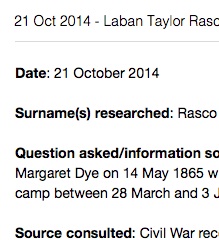
When Springpad was around, I created a research tracker template that was included in the Family History Organizer notebook on Springpad. That form works with the way I think, so I’ve been continuing to use the template, only now it’s in Evernote. (Feel free to email me if you want me to send you the template–that’s the corner of today’s entry in the photo.) It’s simple and allows me to record the pertinent data without turning it into a big chore. I need to use it more diligently, after every research session, rather than waiting until days like today when logging my research feels absolutely imperative.

My way of keeping a research log is far from perfect. There are much more complete ways to do it–Thomas MacEntee offers an amazing research log template, it just doesn’t feel right for me. (I find it a little intimidating.)

If you’ve been contemplating keeping a research log, but got bogged down in trying to select the best format or you just weren’t sure how to do it, I’d suggest you let go of making it perfect (or even great) and just get into the habit of writing something down. Any information about your research session that you document at the end of the session is better than none!

Filed Under: Challenges, Genealogy tips, Organizing, Reflections Tagged With: Evernote, genealogy tools, organizing aids, rasco, record keeping, research log, Thomas MacEntee

  • « Go to Previous Page
  • Page 1
  • Interim pages omitted …
  • Page 4
  • Page 5
  • Page 6
  • Page 7
  • Page 8
  • Page 9
  • Go to Next Page »

about me

I'm Janine Adams, a professional organizer and a genealogy enthusiast. I love doing family history research, but I find it's very easy for me to get overwhelmed and not know where to turn next. So I'm working hard to stay organized and feel in control as I grow my family tree.

In this blog, I share my discoveries and explorations, along with my organizing challenges (and solutions). I hope by sharing what I learn along the way I'll be able to help you stay focused and have fun while you do your research, too.

tags

30 x 30 Adams amy johnson crow anniversary Brown cemetery census Civil War conferences connections dna electronic files Evernote excitement Family Curator family photos genealogy tools getting started goals How They Do It Igleheart Jeffries keepsakes learning opportunities maps newspapers NGS organizing aids overwhelm paper files planning quick tips rasco record keeping research research log research trip resources RootsTech social history source documentation Stacy Julian technology time management vital records

join the facebook community!

join the facebook community!

My organizing business

Learn more about my organizing business, Peace of Mind Organizing®.

Subscribe by RSS

  • RSS - Posts
  • RSS - Comments

© 2026 Janine Adams


Loading Comments...